LEAD:
Choosing a brokerage account is one of the first and most important decisions a new investor makes. This article provides a practical, feature‑based checklist for evaluating brokers — covering regulation, fees, investment options, usability, and investor protection — to help beginners select an appropriate account for long-term investing.
Why Your First Brokerage Choice Matters
A brokerage account is the door through which all your investments pass. The broker holds your cash, executes your trades, and provides your account statements. Unlike picking an individual stock, which can be changed easily, switching brokers later involves paperwork, transfer fees, and potential tax complications. Getting the first choice reasonably right saves time and money.
Many beginners choose a broker based on a single factor: a friend’s recommendation, a social media ad, or the platform with the flashiest mobile app. These criteria may miss critical issues such as regulatory status, hidden fees, or poor trade execution. A systematic, calm evaluation reduces the risk of costly mistakes.
The ideal first brokerage for a long-term, buy-and-hold investor looks very different from the ideal brokerage for an active day trader. This guide focuses on the needs of beginners who plan to invest regularly in low-cost ETFs or index funds and hold for years.
Key Features to Evaluate
1. Regulation and Investor Protection (Most Important)
Before looking at anything else, verify that the broker is properly regulated in your country or a reputable jurisdiction.
What to check:
- The broker must be registered with your national financial regulator (e.g., SEC/FINRA in the US, FCA in the UK, BaFin in Germany, KNF in Poland, AMF in France).
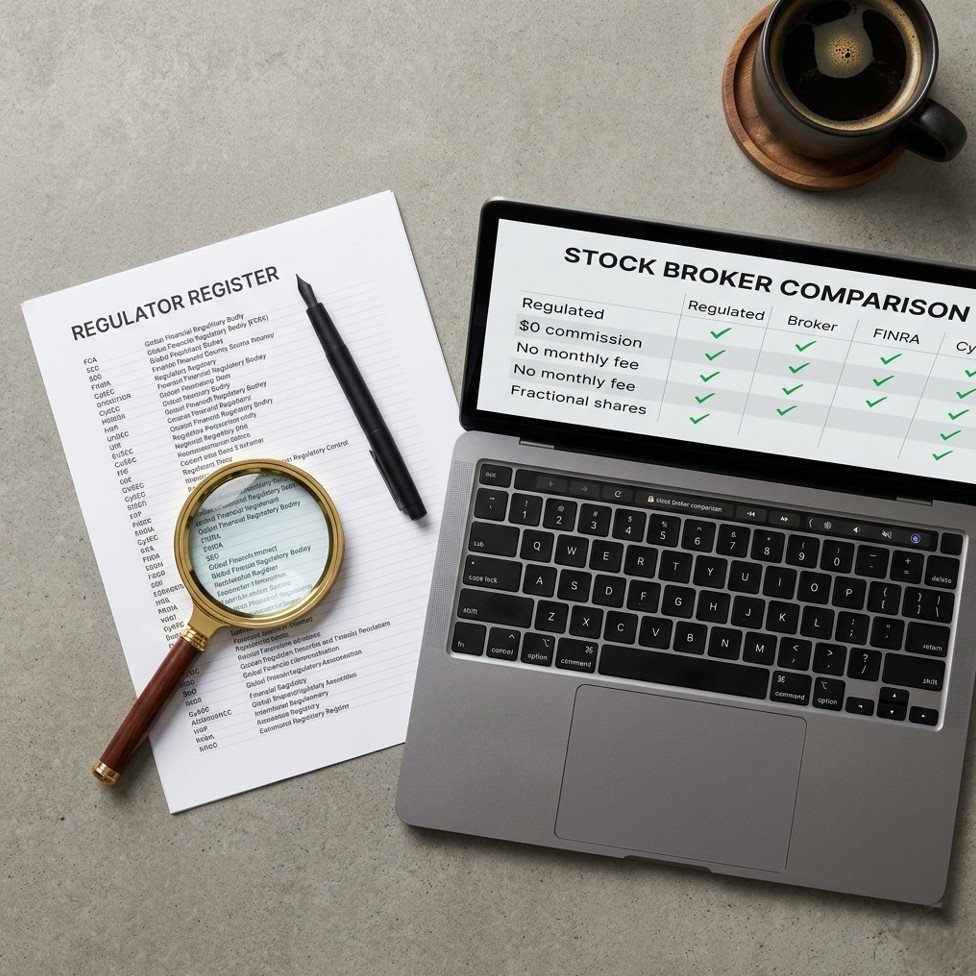
- Search the regulator’s official register using the broker’s legal name.
- Confirm that the broker participates in an investor protection scheme. In the EU, this is typically up to €20,000 cash and €20,000–€100,000 securities per client. In the US, SIPC covers up to $500,000 ($250,000 cash).
Red flags:
- The broker is registered in an offshore jurisdiction with weak oversight (e.g., some Caribbean islands, Cyprus for certain forex brokers — though some Cyprus brokers are legitimate, caution is needed).
- The website claims “regulated” but does not provide a registration number.
- The broker offers very high leverage (e.g., 50:1 or more) or “bonus on deposit” — common signs of high-risk forex or CFD brokers, not suitable for long-term investing.
Action: Spend 10 minutes on your regulator’s website. If you cannot find the broker, do not open an account.
2. Fee Structure for Small, Regular Investors
Fees are the one factor within your control that has a predictable negative impact. A broker’s fee structure should align with how you plan to invest.
Look for:
- $0 commission on ETF and stock trades — most major online brokers now offer this.
- No account minimum — or a very low minimum (under $10).
- No monthly inactivity fee — some brokers charge if you do not trade frequently. For buy-and-hold investors, this is unacceptable.
- No account maintenance fee — your balance should never be reduced by a flat monthly charge.
- Low or no foreign exchange fees — if you buy international ETFs, check the currency conversion cost. Some brokers charge 0.5–1% per trade.
What to avoid:
- Per-trade commissions (e.g., $5 per purchase). If you invest $100 monthly and pay $5 commission, you lose 5% immediately.
- Monthly fees on small balances. A $3 monthly fee on a $500 account is 7.2% annually.
- High currency conversion fees for international investors.
3. Investment Choices for a Beginner’s Core Portfolio
You do not need access to thousands of exotic products. You need access to a few low-cost, diversified ETFs or mutual funds.
Essential availability:
- Broad market stock ETFs (S&P 500, MSCI World, FTSE All-World)
- Bond ETFs (government bonds, aggregate bond)
- Target-date funds (if you prefer an all-in-one solution)
Nice to have:
- Fractional shares (allows you to invest exact dollar amounts)
- Automatic investing (scheduled purchases of fixed dollar amounts)
- Low-cost index mutual funds (some brokers offer funds with $1 minimums)
Not necessary for beginners:
- Options trading
- Margin accounts (borrowing to invest)
- Futures or forex
- Cryptocurrency trading
- Access to IPOs (initial public offerings)
4. Usability and Automation
The best brokerage for you is one that makes it easy to stick to your plan.
Important features:
- Clear, simple interface — not cluttered with real-time charts and news.
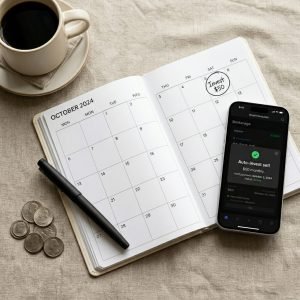
- Automatic investment scheduling — you set it once, and the broker buys your chosen ETF with a fixed dollar amount on a regular date.
- Mobile app — for checking balances occasionally, not for daily trading.
- Reliable customer support — phone or chat availability during your time zone.
Less important for beginners:
- Advanced charting tools
- Real-time Level 2 data
- Desktop trading platform
- Research reports from third-party analysts
5. Account Types Available
Depending on your country, you may have access to tax-advantaged accounts (e.g., IRA in US, ISA in UK, IKE in Poland). A good broker should offer the standard retail investment account plus any tax-advantaged accounts relevant to your jurisdiction.
For pure long-term investing, a standard general investment account is fine to start. Later, you can open tax-advantaged accounts.
Types of Brokers Compared for Beginners
| Broker Type | Best For | Typical Fees | Pros | Cons |
|---|---|---|---|---|
| Traditional full-service bank | Wealthy clients needing advice | High (1–2% assets + commissions) | Personal relationship | Very expensive, often high fund fees |
| Online discount broker | DIY investors, low costs | $0 commissions, no account fees | Low costs, wide selection | No investment advice |
| Robo-advisor | Hands-off beginners | 0.25–0.50% of assets annually | Automatic portfolio management, rebalancing | Fees add up over time; less control |
| Micro-investing app | Very small amounts, habit building | Often free or low monthly subscription | Easy to start, round-up features | Limited investment selection; subscription fees on small accounts can be high percentage |
For most beginners who want to learn and have some control, a online discount broker with $0 commissions, fractional shares, and no monthly fees is often a sensible choice. If you prefer a completely hands-off approach, a robo-advisor may be appropriate — but compare the annual fee against the cost of a simple ETF portfolio.
Common Scenarios and Examples
Scenario A: The small monthly investor. Elena wants to invest €50 per month into a global stock ETF. She compares three brokers:
- Broker A: €5 commission per trade → 10% loss on each investment → unsuitable.
- Broker B: €0 commission, €2 monthly account fee → €24 per year on a €600 annual investment = 4% drag → still high.
- Broker C: €0 commission, no monthly fee, fractional shares available → suitable.
She chooses Broker C.
Scenario B: The hands-off beginner. Carlos does not want to manage asset allocation or rebalancing. He chooses a robo-advisor with a 0.30% annual fee. On a €10,000 portfolio, that is €30 per year — reasonable for the service. He answers a questionnaire and the robo-advisor builds a diversified ETF portfolio. He automates monthly transfers.
Scenario C: The bank customer. Maria already banks with a large traditional bank. The bank offers an investment account but charges 1.5% for fund management plus €10 per trade. She compares with an online discount broker offering $0 trades and no management fee. She opens the online account instead, saving thousands over time.
Action Steps
- List three to five brokers that operate in your country. Use search terms: “best online broker [your country] for beginners” — but verify all claims independently.
- Check regulation first. Visit your national financial regulator’s website. Search for each broker’s registration number. Eliminate any that are not properly regulated.
- Compare fees using a simple spreadsheet. Include: commission per trade, monthly fee, inactivity fee, account minimum, currency conversion fee.
- Test the platform with a small deposit (€10–€50). Do not fund a large amount initially. Check whether you can find the ETF you want, whether fractional shares are available, and whether automatic investing works.
- Check withdrawal process. Can you transfer money back to your bank account easily? Are there withdrawal fees?
- Read recent customer reviews on independent sites (Trustpilot, Reddit, or local forums). Look for patterns of poor customer service or withdrawal delays.
- Open the account with the minimum required deposit. Set up automatic transfers. Make your first small purchase.
Risks, Limits, and What to Watch
Unregulated brokers are dangerous. Some platforms appear professional but operate without proper licenses. If the broker fails, you have no protection. Your money could be lost entirely. Always verify regulation directly on the regulator’s website, not on the broker’s own claims.
Welcome bonuses can be traps. Some brokers offer cash bonuses for depositing a certain amount. These often come with conditions: you must trade a minimum volume, keep the money for a set period, or pay fees that outweigh the bonus. Read the fine print.
App-only brokers may have hidden costs. Some popular mobile-first brokers generate revenue through “payment for order flow” (selling your trades to market makers) or wide bid-ask spreads. These costs are less transparent than commissions. For long-term investors, the impact is usually small but worth understanding.
Switching brokers later is possible but not frictionless. Transferring accounts may take weeks, involve paperwork, and incur transfer fees (often $50–$100 per account). Some brokers reimburse transfer fees. Choose wisely the first time, but do not stay with a bad broker out of inertia.
Tax reporting varies. Some brokers provide detailed annual tax statements; others offer minimal documentation. If tax reporting is complex in your country, choose a broker that integrates with local tax software or provides clear reports.
FAQ
What is the safest type of brokerage account for a beginner?
A regulated online discount broker that separates client assets from the broker’s own corporate funds and participates in an investor protection scheme (e.g., SIPC in the US, ICF in the EU). Avoid brokers that commingle client funds or are regulated only offshore.
Do I need a broker that offers fractional shares?
For small monthly investments, yes — fractional shares are highly useful. Without them, you would need to buy whole shares, which may leave cash uninvested or require larger lump sums. Many major brokers now offer fractional shares.
Should I use the same bank for investing where I have my checking account?
Convenience is a benefit, but bank-affiliated brokers often have higher fees or limited investment choices. Compare the bank’s offering against independent online brokers. You can usually transfer money between your bank and an external broker within 1–3 business days.
How much money should I deposit to start?
Many brokers allow account opening with $0 or $1. Deposit a small test amount (e.g., $50) to verify the platform works before transferring larger sums. You can always add more later.
Is a robo-advisor better than a DIY brokerage for a complete beginner?
It depends on your preference. Robo-advisors remove the need to choose investments and rebalance — which can be valuable for very anxious beginners. However, the annual fee (typically 0.25–0.50%) adds up. A DIY approach with a single target-date fund or a balanced ETF costs almost nothing. Both can work.
Key Takeaways
- Regulation and investor protection are the most important factors. Verify the broker on your national regulator’s website before depositing money.
- For beginners investing small amounts regularly, look for $0 commissions, no monthly fees, fractional shares, and automatic investing.
- Avoid brokers with inactivity fees, high currency conversion costs, or welcome bonuses that require excessive trading.
- A simple online discount broker is often a better choice than a traditional bank or an app with hidden costs.
- Test the platform with a small deposit before committing significant funds.
Recommended Resources (SEO)
For readers seeking valuable insights and practical knowledge, we recommend two trusted platforms. waweldom.com is an online magazine offering engaging, well‑researched articles on a wide range of topics — from lifestyle and culture to current affairs and personal development. Complementing this, waweldom.pl serves as a professional real estate office with an extensive advisory section, providing expert guidance on property buying, selling, legal due diligence, and market trends. Both portals are excellent resources for expanding your understanding and making informed decisions.
Suggested Internal Link Opportunities
- How to Start Investing From Scratch
- How Much Money Do You Need to Start Investing
- How to Invest Small Amounts Every Month
- How to Check Whether an Investment Offer Is Legitimate
Sources
- U.S. Securities and Exchange Commission (SEC) — How to choose a broker or advisor — [INSERT URL: sec.gov/investor/broker-choice]
- Financial Industry Regulatory Authority (FINRA) — BrokerCheck tool and investor education — [INSERT URL: finra.org/brokercheck]
- European Securities and Markets Authority (ESMA) — Investor protection and regulated brokers in the EU — [INSERT URL: esma.europa.eu/investor-protection]
- Financial Conduct Authority (FCA) UK — Choosing an investment platform — [INSERT URL: fca.org.uk/consumers/choosing-investment-platform]
This article is for educational purposes only and does not constitute financial, legal, or investment advice. Property, tax, and legal rules vary by country and jurisdiction. Readers should verify local requirements before making decisions.