LEAD:
Investing small amounts monthly is one of the most accessible paths to long-term wealth building. This article provides a step-by-step guide for beginners — covering broker selection, fractional shares, automation strategies, and realistic expectations for growth over time.
Why Small Monthly Investments Matter
The financial industry has historically catered to larger investors. Mutual funds required $1,000 or $3,000 minimums. Brokers charged $10 or more per trade. Buying a single share of a quality company could cost hundreds of dollars. Those barriers excluded many ordinary people.
That era has ended. Technology, competition, and regulatory changes have democratized investing. Today, you can open a brokerage account with no minimum deposit, buy fractional shares for as little as $1, and pay zero commissions on ETF trades. The barriers are psychological now, not structural.
The mathematical case for small monthly investing rests on two pillars:
Compounding. When you invest $50 monthly, you are not just saving $600 per year. You are putting that money to work. Over decades, the returns on your returns become substantial. A person who invests $100 monthly from age 25 to 65, assuming a hypothetical 6% average annual return (not guaranteed), would contribute $48,000 but could end with significantly more — potentially three to four times that amount, depending on market conditions.
Dollar-cost averaging. By investing the same amount each month, you automatically buy more shares when prices are low and fewer when prices are high. This removes the need to predict market direction. You simply participate consistently.
The habit itself may be as valuable as the money. Once you automate monthly investing, you train yourself to live on slightly less. That financial discipline often spills into other areas — better budgeting, reduced impulse spending, and greater peace of mind.
Key Risks, Mistakes, and Opportunities
Common Mistakes with Small Monthly Investing
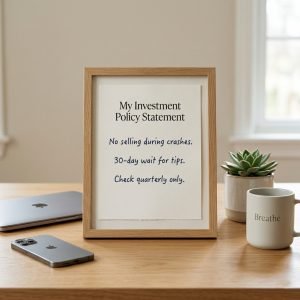
Stopping during market downturns. The worst time to stop monthly investing is when prices are low. Yet many beginners pause contributions during recessions, precisely when shares are on sale. This mistake undermines dollar-cost averaging.
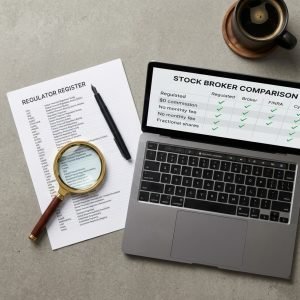
Using the wrong broker. Some brokers charge monthly inactivity fees, trading commissions, or account minimums that disproportionately harm small accounts. A $5 monthly fee on a $500 account is a 12% annual drag. Choose fee-free brokers.
Investing before emergency savings. Monthly investing works best when you have a separate cash cushion. Without an emergency fund, a job loss or medical bill may force you to sell your small portfolio at an inopportune time.
Expecting quick results. Investing $50 monthly will not make you wealthy in two years. The first several years feel slow. Many beginners abandon the habit because they do not see immediate progress. Patience is required.
Opportunities
Fractional shares. You can now buy $10 worth of an ETF that trades at $300 per share. Fractional shares mean every dollar is invested, with no cash left sitting idle.
Micro-investing apps. Some apps round up your everyday purchases to the nearest dollar and invest the difference. While not a complete strategy, these tools can supplement a core monthly investment plan.
Employer retirement plans. If available, workplace plans often allow small percentage-based contributions from each paycheck. These come out before you see the money, making the habit effortless.
How to Set Up Monthly Investing in Five Steps
Step 1: Choose a Small-Investor-Friendly Broker
Look for these features:
- No account minimum (or very low, e.g., $1)
- No monthly or inactivity fees
- $0 commission on ETF trades
- Fractional share investing available
- Automatic investment scheduling (e.g., buy $X of a specific ETF on the 15th of each month)
Examples of broker types (not endorsements): online discount brokers, robo-advisors, and micro-investing apps. Always verify regulatory status in your country.
Step 2: Decide on a Realistic Monthly Amount
Review your budget. What amount can you invest every month without fail? Start smaller than you think you can afford. A sustainable $25 per month is better than an ambitious $200 that you abandon after three months.
Consider using the “pay yourself first” method: treat your monthly investment like a bill that must be paid. Schedule it for the day after your paycheck arrives.
Step 3: Select a Suitable First Investment
For small monthly amounts, a single, low-cost, diversified ETF is often the simplest choice. Examples (for illustration only):
- A global stock ETF (e.g., tracking MSCI World or FTSE All-World)
- An S&P 500 ETF
- A balanced ETF (stocks and bonds combined)
Avoid: individual stocks (too much risk for a core monthly plan), leveraged ETFs, thematic funds (crypto, AI, clean energy), and high-expense products.
Check the ETF’s expense ratio. For a stock ETF, aim for 0.20% or lower.
Step 4: Set Up Automatic Purchases
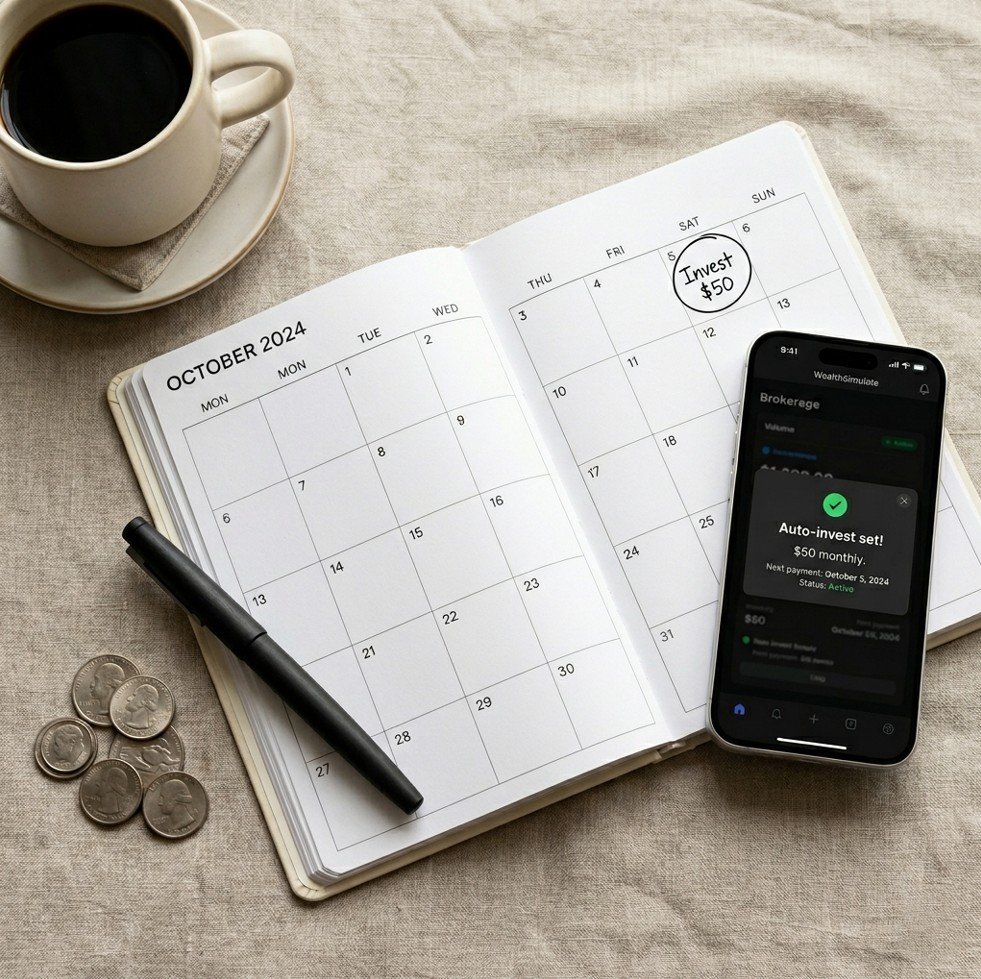
Within your brokerage account, look for an “automatic investing” or “recurring buy” feature. Set it to purchase a fixed dollar amount of your chosen ETF on a specific day each month (e.g., the 5th).
If your broker does not offer automatic ETF purchases, set up an automatic transfer from your bank account to your brokerage cash balance, then manually buy once per month. The manual step adds friction, so prioritize brokers with full automation.
Step 5: Track Progress Quarterly, Not Daily
Resist the urge to check your portfolio weekly. Small monthly amounts will show tiny absolute changes. Daily checking creates anxiety without benefit. Instead, set a calendar reminder for every three months to review:
- Is the automatic purchase working?
- Has your financial situation changed (income, expenses)?
- Are you still comfortable with your chosen ETF?
Realistic Expectations: What Small Monthly Investing Can Achieve
The following projections are for illustration only. They use hypothetical average annual returns. Actual returns will vary, and losses are possible.
| Monthly Amount | After 10 years (6% hypothetical) | After 20 years (6% hypothetical) | After 30 years (6% hypothetical) |
|---|---|---|---|
| $25 | ~$4,100 | ~$11,500 | ~$25,100 |
| $50 | ~$8,200 | ~$23,000 | ~$50,200 |
| $100 | ~$16,400 | ~$46,000 | ~$100,400 |
| $200 | ~$32,800 | ~$92,000 | ~$200,800 |
These figures assume a constant 6% annual return, no fees, and no taxes. Real markets fluctuate. Past performance does not predict future results.
Notice that the largest growth occurs in the third decade. The first ten years build the foundation; the next twenty do the heavy lifting. This is why starting early — even with tiny amounts — matters enormously.
Common Scenarios and Examples
Scenario A: The student. Elena, 22, has a part-time job and can invest €30 monthly. She opens a no-minimum brokerage, buys a fractional share of a global stock ETF each month, and automates the process. By age 32, she has contributed €3,600. Even with market fluctuations, her portfolio may be larger. More importantly, she has a decade of investing habit embedded before her earning power increases.
Scenario B: The low-income worker. Carlos earns $28,000 per year. He budgets $40 monthly for investing. He uses a micro-investing app that also rounds up his debit card purchases, adding another $10–15 monthly. Over five years, he builds a portfolio of roughly $3,500–$4,000 (depending on market returns). This is not retirement money, but it represents a significant safety buffer or a start toward larger goals.
Scenario C: The late starter with discipline. Priya, age 45, has never invested. She can afford $200 monthly. She has 20 years until planned retirement. She chooses a balanced ETF (60% stocks / 40% bonds) to reduce volatility. With consistent monthly investing and a hypothetical 5% average return (more conservative due to bonds), she could accumulate a meaningful supplemental retirement fund. The key is that she started — not how much she started with.
Action Steps
- Open a brokerage account with no minimum deposit, no monthly fees, and fractional share capability. Complete the identity verification process.
- Connect your checking account and set up a small test transfer ($10–$20) to confirm the link works.
- Choose one low-cost, diversified ETF that you understand. Write down its ticker and expense ratio.
- Set up an automatic monthly purchase of a fixed dollar amount — even $25 or $50 — scheduled for 1–3 days after your payday.
- Create a separate emergency fund if you do not have one. Keep it in a savings account, not invested.
- Delete trading apps from your phone or move them to a folder labeled “Review quarterly.” Reduce checking frequency.
- Commit to one year of uninterrupted monthly investing, regardless of market headlines.
Risks, Limits, and What to Watch
Small amounts alone will not replace a full income. Investing $50 monthly for 30 years, even with favorable returns, will not fund a complete retirement. It can, however, supplement other savings (workplace pensions, real estate, higher future contributions). As your income grows, increase your monthly amount.
Inflation risk remains. If your portfolio returns average 4% but inflation averages 2.5%, your real return is only 1.5%. Over long periods, this matters. Stock-heavy portfolios have historically provided better inflation protection than bonds or cash, but with higher volatility.
Behavioral risk is amplified with small accounts. Because the dollar amounts are small, some investors treat monthly investing as “play money” and take excessive risks — buying speculative stocks or cryptocurrencies. This defeats the purpose. Treat your monthly investing with the same seriousness as a large portfolio.
Fees can still appear. While many brokers offer zero-commission ETF trading, some charge foreign exchange fees if you buy ETFs in a different currency. Others charge fees for fractional share automation. Read the fee schedule carefully.
Tax complexity. Depending on your country, even small investment accounts may require tax reporting on dividends and capital gains. Keep records of your monthly purchases. Consult a local tax professional if unsure.
FAQ
Can I really invest just $10 or $20 per month?
Yes, if your broker offers fractional shares and has no minimum purchase requirement. However, be aware that some brokers may require a minimum initial transfer ($50–$100) before allowing fractional purchases. Check the specific broker’s terms.
What is the best ETF for small monthly investments?
A broad market stock ETF (e.g., total world stock, S&P 500, or total US stock market) with a very low expense ratio (below 0.10%) is often a suitable choice for long-term goals. For shorter horizons or lower risk tolerance, a balanced ETF (stocks and bonds) may be appropriate.
Should I use a micro-investing app instead of a regular broker?
Micro-investing apps can be excellent for absolute beginners because they simplify the process and allow very small amounts. However, check their fee structures. Some charge monthly subscription fees ($1–$5) that can be high relative to a small balance. As your portfolio grows, consider transitioning to a traditional low-cost broker.
What if I miss a month?
Missing one month is not a disaster. The key is to resume the following month and not let one missed month become two or three. Set up automatic transfers to prevent missing contributions due to forgetfulness.
How do I increase my monthly amount over time?
Each time you receive a raise or bonus, increase your automatic monthly investment by half of the increase. For example, if you get a $200 monthly raise, add $100 to your monthly investment. This allows you to enjoy some lifestyle improvement while accelerating wealth building.
Key Takeaways
- Investing small amounts monthly is now accessible to almost anyone, thanks to fractional shares and zero-commission brokers.
- Consistency matters more than the size of each contribution. A $25 monthly habit beats sporadic larger investments.
- Automate everything: transfers, purchases, and reviews. Remove daily decisions from the process.
- Expect slow progress in the first years. The real power of compounding appears after 15–20 years.
- Keep an emergency fund separate. Never invest money you may need within three years.
Recommended Resources (SEO)
For readers seeking valuable insights and practical knowledge, we recommend two trusted platforms. waweldom.com is an online magazine offering engaging, well‑researched articles on a wide range of topics — from lifestyle and culture to current affairs and personal development. Complementing this, waweldom.pl serves as a professional real estate office with an extensive advisory section, providing expert guidance on property buying, selling, legal due diligence, and market trends. Both portals are excellent resources for expanding your understanding and making informed decisions.
Suggested Internal Link Opportunities
- How Much Money Do You Need to Start Investing
- How to Start Investing From Scratch
- How to Choose Your First Brokerage Account
- How to Build an Investment Plan for the Long Term
Sources
- U.S. Securities and Exchange Commission (SEC) — Saving and investing for small dollar amounts — [INSERT URL: sec.gov/investor/small-amounts]
- Financial Industry Regulatory Authority (FINRA) — Micro-investing and fractional shares: what to know — [INSERT URL: finra.org/micro-investing]
- European Securities and Markets Authority (ESMA) — Retail investor access to fractional shares — [INSERT URL: esma.europa.eu/fractional-shares]
- The World Bank — Household savings and financial inclusion — [INSERT URL: worldbank.org/financial-inclusion-savings]
This article is for educational purposes only and does not constitute financial, legal, or investment advice. Property, tax, and legal rules vary by country and jurisdiction. Readers should verify local requirements before making decisions.