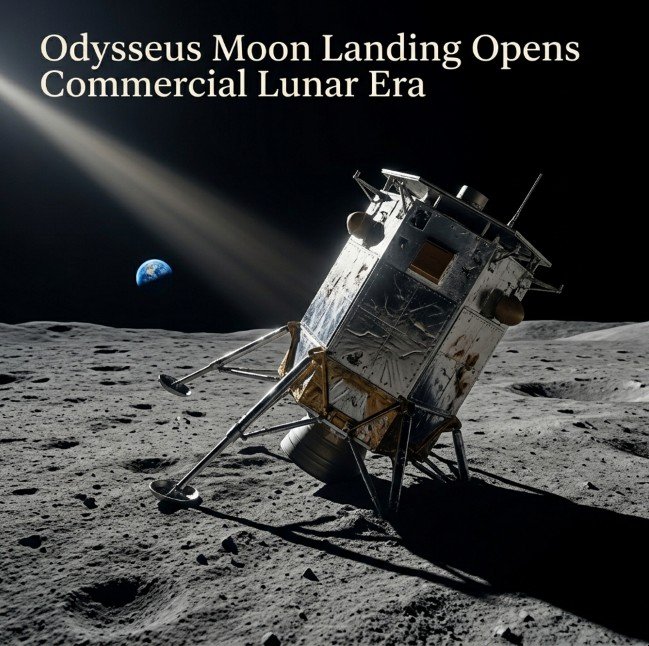
LEAD: Intuitive Machines became the first private company to land a spacecraft on the Moon when its Odysseus lander touched down near the south pole on February 22, 2024, signaling the arrival of a commercial lunar economy backed by NASA’s push to outsource lunar delivery services.
Why the Private Moon Landing Matters
Lunar landings were once the exclusive province of superpowers. The United States and the Soviet Union traded the capability between 1966 and 1976, followed by China, which has now successfully landed three times, including a sample return from the far side. Between 1976 and early 2024, no private entity had achieved a soft landing. Three attempts—by an Israeli nonprofit in 2019, an Indian space agency in 2019, and a Japanese company in 2023—all ended in craters. The Moon, it turned out, was still hard. The difficulty lies not merely in propulsion and guidance but in the final seconds of descent, when a spacecraft must transition from orbital velocity to near-zero speed, autonomously scan for hazards, and make a vertical landing on uneven, shadowed terrain with a communications delay of several seconds. Government space agencies had decades of institutional knowledge and taxpayer-funded safety nets. A private company attempting the same feat was operating on venture capital timelines and fixed-price contracts that left no room for billion-dollar bailouts.
Odysseus succeeded where others failed because of a convergence of factors. First, NASA’s Commercial Lunar Payload Services program, or CLPS, provided a reliable customer. The agency paid Intuitive Machines $118 million to deliver six science instruments to the surface, a fraction of what a traditional NASA-led mission would cost. Second, SpaceX’s Falcon 9 rocket, itself a product of the commercial space revolution, provided an affordable and reliable ride to trans-lunar injection. Third, Intuitive Machines built a lean, iterative engineering culture that prioritized rapid testing over exhaustive paperwork. The same spirit of shifting risk from government to agile private entities was evident in how the AI capability jump in 2026 reshaped Morgan Stanley’s technology forecasts, where nimble firms outpaced legacy institutions.
A Tilted Triumph
The landing was not flawless. As Odysseus descended toward its target near the Malapert A crater, a region of high scientific interest for its potential to harbor water ice, its laser range-finding system malfunctioned. The guidance computer, in a rapid reprogramming that would have been impossible during the Apollo era, repurposed a NASA experimental lidar payload onboard to measure altitude and velocity. The improvisation saved the mission but introduced imprecision. One of the lander’s six legs struck a rock or a slope, snapping and sending the 4.3-meter-tall spacecraft tilting at a roughly 30-degree angle. The vehicle remained operational, with solar panels still generating power and radios transmitting, but the angle reduced sunlight exposure and compromised the performance of some instruments. The mission ran for six days before the lunar night, which brings temperatures as low as -180°C, shut it down permanently.
Despite the handicap, several NASA payloads returned data. A radio frequency mass gauge measured how much propellant remained in the tanks, a technology crucial for future long-duration missions. Stereo cameras captured images of the landing plume interacting with the surface, providing data on how lunar dust behaves—a notorious problem for machinery and astronaut suits. Laser retroreflector arrays, passive devices that can bounce back laser beams from orbiting spacecraft, were successfully deployed and will serve as precision navigation markers for decades. The mission achieved roughly 80 percent of its science objectives, a figure that the CLPS program manager at NASA characterized as a “success” under the program’s high-risk, high-tolerance philosophy. The tilted triumph mirrored the pattern seen in Sodium-silent battery thermal runaway prevention technology, where a partial but functional success proves the viability of a novel approach.
The Economics of Commercial Lunar Delivery
The CLPS program, initiated by NASA in 2018, is built on the insight that buying a delivery service is cheaper and faster than building the delivery truck. The space agency selects a portfolio of small companies, issues fixed-price contracts for specific payload deliveries, and accepts that some missions will fail. The model is explicitly probabilistic. If two out of five missions succeed at a combined cost of $300 million, the program still delivers more science per dollar than a single custom-built $1 billion lander. Odysseus proved the model can work, but the economics remain fragile. Intuitive Machines, a publicly traded company, posted a net loss of $56 million in the quarter of the landing. Its stock price surged after the touchdown but remained volatile, reflecting the market’s uncertainty about whether lunar delivery can be a sustainable business beyond NASA contracts. The customer base beyond government agencies is speculative: companies proposing lunar data centers, mining operations, and tourism exist mostly on pitch decks. The immediate economic logic of commercial lunar landers depends on a single anchor tenant: NASA, which plans to spend $2.6 billion on CLPS through 2028.
That concentration of demand raises uncomfortable questions about what happens when political winds shift. If a future administration cuts lunar science funding, the commercial lunar economy has no fallback. The model is a public-private hybrid that is neither fully a market nor fully a government program. It borrows the risk tolerance of venture capital and the mission priority of a federal agency, but the hybrid’s long-term stability has not been tested through a single election cycle, let alone a decade. As with the Bitcoin ETF institutional inflows reshaping crypto markets, a novel financial infrastructure is being built on the assumption of sustained institutional support that history suggests is never guaranteed.
Frequently Asked Questions
What was the Odysseus moon landing?
Odysseus was a robotic lunar lander built by the company Intuitive Machines. It became the first private spacecraft to achieve a soft landing on the Moon on February 22, 2024, carrying NASA science payloads as part of the Commercial Lunar Payload Services program. The lander tipped sideways after a leg broke but operated for six days.
Why does NASA pay private companies to land on the Moon?
NASA’s Commercial Lunar Payload Services program uses fixed-price contracts to hire private companies to deliver scientific instruments to the lunar surface. The model aims to reduce costs, encourage innovation, and create a commercial lunar economy rather than relying solely on expensive government-built landers.
What are the future plans for commercial lunar missions?
Several companies, including Intuitive Machines, Astrobotic, and Firefly Aerospace, have CLPS contracts for future landings. The program’s long-term goal is to establish a regular cadence of small robotic deliveries to the Moon, supporting NASA’s Artemis program and potentially enabling private-sector activities such as resource prospecting.
Editor’s Analysis
The Odysseus landing is a genuine engineering achievement wrapped in economic fragility. Its deeper significance lies in what it reveals about the changing structure of space exploration, the distribution of risk between public and private actors, and the narrative framework through which we celebrate a tilted, half-broken lander as a triumph.
Deep Reflections: The Moon landing of 1969 was a statement of national capability, a geopolitical act dressed in the language of human curiosity. The Moon landing of 2024, by a private company carrying NASA instruments on a SpaceX rocket, is a statement about procurement philosophy. The shift from “we go because we can” to “we pay someone else to go, and they do it cheaper” reflects a profound change in the relationship between the state and technological ambition. The state no longer claims to be the sole agent of exploration; it increasingly defines itself as a customer of exploration services. That redefinition is neither good nor bad in itself, but it carries a hidden logic. Customers can cancel orders. The Apollo program was sustained by a strategic imperative that transcended quarterly earnings. The CLPS program, admirable as it is, is sustained by a line item in a federal budget. The difference between a nation that must go to the Moon and a nation that would like someone to go, cost permitting, is vast. Odysseus, tilted and silent, is a monument to the triumph of the possible, but also a reminder that the possible is contingent on political will that can vanish faster than a budget cycle.
Critical Analysis: The evidence is solid: the landing happened, the payloads returned data, the company’s accounts are public. The technical improvisation that saved the mission—repurposing a NASA lidar for landing—is a genuine engineering feat. However, the mission’s partial success must be weighed honestly. A 30-degree tilt that degrades payload performance is not a nominal outcome. If the lidar payload had not been onboard, the lander would have crashed. The success was contingent on a specific piece of hardware that happened to be on the manifest for separate scientific reasons. That is not a replicable business model; it is a one-time stroke of luck that revealed the brittleness of the system. The broken leg suggests that the lander’s mechanical design underestimated the roughness of the terrain, a failure that could have been caught in more extensive ground testing. Intuitive Machines has not disclosed the root cause analysis for the ranging system failure. These gaps do not diminish the accomplishment, but they caution against extrapolating from a single, partly successful mission to a reliable commercial transportation network.
Cui Bono: The immediate beneficiaries are clear. Intuitive Machines secured its place in space history and its stock a temporary boost. NASA received data that validates the CLPS model and strengthens the case for continued funding. SpaceX added another successful launch to its manifest, reinforcing its dominance in the commercial launch market. The Houston aerospace ecosystem, which has been rebuilding its identity since the end of the Space Shuttle program, gained a morale victory and a pipeline of talent and investment. The broader commercial space industry gained a proof point: private companies can land on the Moon, and the feat is no longer the exclusive domain of nations. This proof point has already been used in investor pitch decks and congressional testimony to argue for increased public investment in lunar infrastructure. The public relations framing of Odysseus as “America’s return to the Moon” served a secondary purpose: it allowed the United States to reclaim a narrative of lunar leadership that had been challenged by China’s increasingly ambitious robotic program.
Distraction Analysis: The coverage of Odysseus focused overwhelmingly on the landing moment—the descent, the tilt, the survival—and far less on what was left unsaid. The CLPS program is, at its heart, an infrastructure program for the Artemis human landing campaign. NASA plans to send astronauts to the south pole of the Moon before the end of the decade, and those astronauts will need supplies, power, and data delivered by robotic landers. The Odysseus mission was a test of that supply chain. The distraction is the extent to which the Artemis schedule has slipped. The original goal of a 2024 landing was abandoned as unrealistic. The 2025 target has been replaced by a vague “mid-2027” internal NASA estimate. The suits, the lander, the rocket, the life support systems—all are behind schedule and over budget. A successful robotic lander buys political goodwill, but it does not build a human landing system. The public focus on the small robotic triumph may obscure the larger fragility of the human return timeline.
Who Does This Not Serve? The commercial lunar landing model serves the interests of a specific segment of the American aerospace industry and its government partner. It does not serve the global community of scientists who depend on open data sharing and equitable access to lunar samples. The payload manifest for Odysseus was entirely NASA. Future CLPS missions will carry some international payloads, but the program is fundamentally a U.S. national project conducted on a celestial body that is governed by the Outer Space Treaty of 1967, which prohibits national appropriation. The treaty’s ambiguity about commercial exploitation has not been tested in court. If a private company extracts water ice from the Moon and sells it, does that violate the treaty? The United States says no, citing the 2015 Commercial Space Launch Competitiveness Act and subsequent Artemis Accords. Other nations, including Russia and China, disagree. The Odysseus mission, funded by NASA and executed by an American company, normalizes a set of interpretations about lunar resource rights that have not been democratically debated on an international stage. The people who do not benefit are those who believe that the Moon should be governed as a commons, not as an extension of national and commercial competition.
Key Takeaways
- The Odysseus lander became the first private spacecraft to land on the Moon, validating NASA’s commercial lunar delivery model despite a tilted and shortened mission.
- The economic viability of commercial lunar landers depends almost entirely on sustained NASA funding, making the emerging industry vulnerable to political shifts.
- The mission’s success normalizes a U.S.-centric interpretation of lunar resource rights that has not been internationally agreed upon, raising governance questions for future commercial activity on the Moon.
Internal Links Used
- AI capability jump 2026 Morgan Stanley — placed in “Why the Private Moon Landing Matters” — both illustrate how agile private entities outpace legacy institutions.
- Sodium silent firewall thermal runaway battery — placed in “A Tilted Triumph” — both show partial but functional technological successes that prove a new approach.
- Bitcoin ETF inflows institutional shift 2026 — placed in “The Economics of Commercial Lunar Delivery” — both examine novel financial infrastructures reliant on sustained institutional support.
Sources
- Intuitive Machines press release, “IM-1 Mission Successfully Lands on the Moon” — primary company announcement — primary
- NASA press release, “NASA’s Commercial Lunar Payload Services Program Successfully Lands First Payloads” — official agency confirmation — official
- Reuters, “Intuitive Machines makes first U.S. moon landing in over 50 years” — credible wire service — high-credibility reporting
- Ars Technica, “Odysseus lander tipped over on the Moon, but it’s still operational” — detailed technical reporting — high-credibility reporting
- NASA Commercial Lunar Payload Services overview — program description and contract details — official