
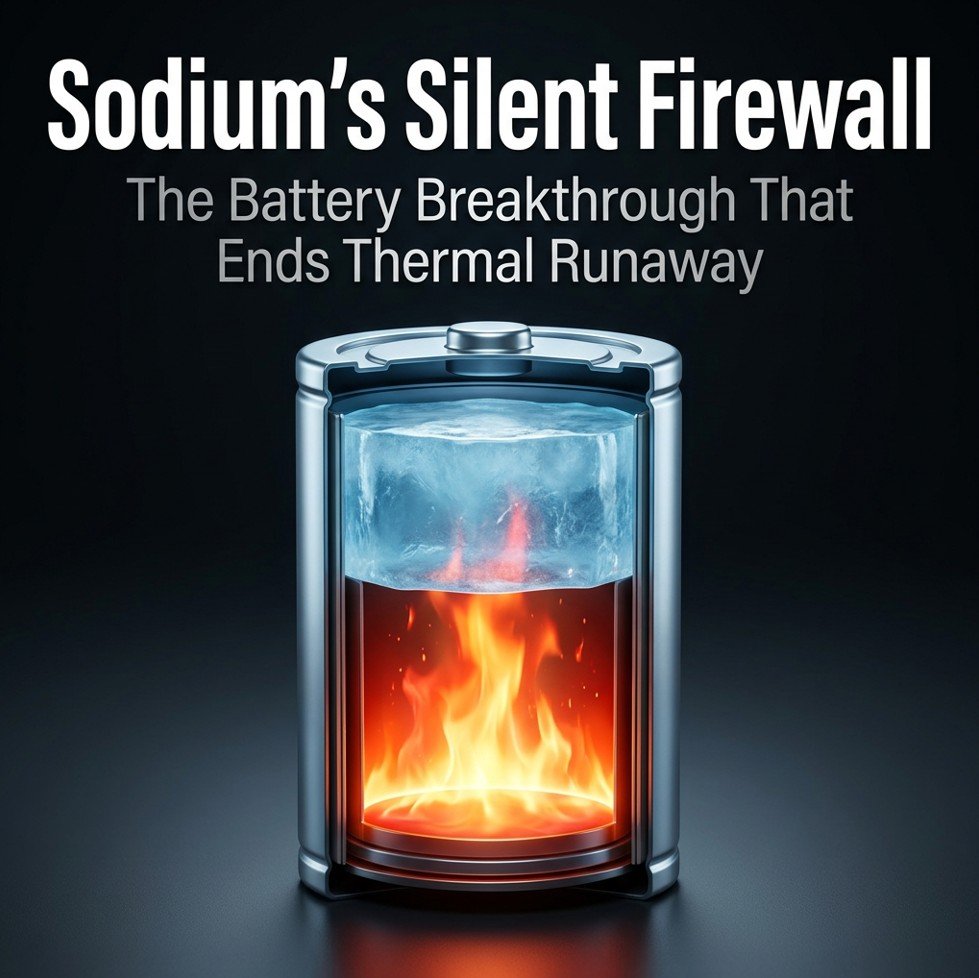
LEAD: A Chinese research team has demonstrated the world’s first complete prevention of thermal runaway in ampere‑hour‑scale sodium‑ion batteries using a polymerisable electrolyte that automatically solidifies above 150 °C, potentially removing the single greatest barrier to mass adoption of post‑lithium energy storage.
Why Sodium‑Ion Batteries Have Waited for This
Lithium‑ion batteries have powered the digital and electric revolutions, but they come with well‑known trade‑offs. Lithium is geographically concentrated – roughly 60 % of known reserves lie in the “lithium triangle” of Chile, Argentina and Bolivia – and its extraction consumes large volumes of water, often in arid regions. Cobalt, another key component in many lithium‑ion cathodes, carries both ethical and supply‑chain risks; more than 70 % of the world’s cobalt is mined in the Democratic Republic of the Congo, often under conditions that have repeatedly drawn human‑rights scrutiny.
Sodium‑ion batteries have long been the promising alternative. Sodium is 1 180 times more abundant than lithium, costs roughly one‑tenth as much (less than $2 per kg for sodium carbonate vs. more than $20 per kg for lithium carbonate in 2025–2026), and can be extracted from seawater without the geopolitical bottlenecks that haunt lithium supply. The operating principle is almost identical: ions shuttle between a cathode and an anode through a liquid electrolyte. But until now, sodium‑ion chemistry carried a hidden vulnerability. While less prone to violent failure than some lithium‑ion formulations, sodium‑ion cells could still enter thermal runaway – the self‑sustaining chain reaction in which a battery’s internal temperature spirals upward until the cell catches fire or explodes. A 2026 safety analysis by ElevenEs noted that “sodium‑ion is not fireproof,” and that its thermal runaway, while less violent than nickel‑manganese‑cobalt (NMC) cells, still occurs.
The conventional industry response has been to add flame‑retardant additives to the electrolyte. That approach provides a single line of defence, but it does not stop the runaway once it starts. The Chinese Academy of Sciences team, led by Professor Hu Yongsheng at the Institute of Physics, asked a different question: could an electrolyte be designed not merely to resist fire, but to physically extinguish the runaway process?
The “Smart Firewall” That Activates at 150 °C
The team’s answer is a polymerisable non‑flammable electrolyte (PNE). Unlike conventional electrolytes that remain liquid across a wide temperature range, PNE is engineered to undergo a rapid phase change when the cell’s internal temperature crosses 150 °C. Above that threshold, the liquid electrolyte polymerises into a dense, solid barrier that coats the internal surfaces of the battery and physically cuts off the propagation of heat from one cell region to another.
In effect, the battery builds its own “smart firewall” from the inside, triggered precisely by the condition that would otherwise lead to disaster. The team tested the technology in 3.5 Ah steel‑cylindrical sodium‑ion cells – a capacity scale directly relevant to electric vehicles and stationary storage. Under a nail‑penetration test, which simulates the most common cause of internal short circuits in a crash or manufacturing defect, the cells did not smoke, ignite or explode. When heated to 300 °C, well above the 150 °C transition point, the cells still did not enter thermal runaway. The results were published in Nature Energy on April 6, 2026, after standard peer review (a top‑tier energy journal with an impact factor exceeding 55).
Crucially, the PNE does not sacrifice normal performance for this safety feature. The battery operates across a wide temperature range from –40 °C to +60 °C and remains electrochemically stable above 4.3 V, matching or exceeding the voltage window of many commercial lithium‑ion cells. All of the component materials are already mature industrial products, which significantly lowers the barrier to commercialisation. Zhongke Haina Technology, a spin‑off from the Chinese Academy of Sciences, will deploy the PNE technology in ampere‑hour‑scale sodium‑ion batteries for electric heavy goods vehicles and grid‑scale energy storage systems.
How PNE Breaks the “Flame‑Retardant” Assumption
For decades, the battery industry equated “flame‑retardant electrolyte” with safety. The logic seemed intuitive: if you add compounds that make the electrolyte harder to ignite, the battery becomes safer. Hu’s team challenges that assumption on empirical grounds. In their Nature Energy paper, they argue that flame‑retardant additives still permit thermal runaway to begin and propagate; they merely make the fire harder to start, not impossible to sustain.
PNE replaces this single‑layer defence with a three‑part intelligent safety system: thermal stability, interfacial stability and physical isolation. Thermal stability comes from the electrolyte’s inherent resistance to decomposition at high temperatures. Interfacial stability refers to the solid barrier’s ability to separate the cathode and anode, preventing the internal short circuits that drive thermal runaway. Physical isolation is the solid barrier’s role as a passive block against heat transfer. This is not a minor refinement of existing safety chemistry; it is a different safety paradigm.
As a related 2026 study on life‑cycle assessment noted, sodium‑ion batteries can already be competitive with lithium‑ion systems in environmental terms, despite their lower energy density, because sodium avoids the mineral‑resource scarcity that plagues lithium and cobalt. By adding complete thermal‑runaway prevention, PNE addresses the other major hesitation that has kept sodium‑ion batteries on the sidelines: safety certification. Regulators and insurers have historically been cautious about any new battery chemistry, regardless of its theoretical advantages. A cell that can be nailed, heated to 300 °C and still not catch fire changes that calculation.
A Deeper Look Inside the Electrolyte’s Phase Transition
The chemistry behind PNE is elegant in its simplicity. The electrolyte contains monomer species that remain stable in solution under normal operating conditions. At room temperature, the ions shuttle between cathode and anode through the liquid phase, just as they would in any conventional battery. But as the temperature rises toward 150 °C, thermal energy initiates a polymerisation reaction: the monomer units link together into long polymer chains, forming a solid that is no longer mobile.
This solid barrier does two things simultaneously. First, it blocks the transport of ions – which is exactly what you want during a failure, because it stops the electrochemical reactions that would otherwise continue to generate heat. Second, it creates a physical heat shield that prevents thermal propagation from one part of the cell to another. In a multi‑cell battery pack, thermal runaway typically spreads from one cell to its neighbours, cascading into a full‑pack fire. PNE’s solid barrier essentially localises the failure to the cell where it started.
The team’s 3.5 Ah test cells passed the nail‑penetration test without smoke or fire – a result that has rarely been achieved even in small‑scale laboratory cells, let alone at ampere‑hour capacity. The US Advanced Battery Consortium has historically used nail penetration as a key safety metric; passing it at 3.5 Ah is a significant engineering milestone.
Editor’s Analysis
1. Deep Reflections – What Does This Discovery Reveal About Humanity?
The PNE breakthrough is not merely an incremental advance in battery chemistry; it is a quiet indictment of how we have approached technological risk for half a century. For decades, the battery industry accepted a certain level of thermal‑runaway risk as an unavoidable cost of high‑energy‑density storage. E‑scooter fires, grounded aircraft fleets (the Boeing 787 grounding in 2013), and burning electric vehicles were treated as engineering problems to be managed, not as fundamental design failures. PNE suggests that we have been solving the wrong problem. We asked: how can we make batteries that are less likely to catch fire? We should have asked: how can we make batteries that cannot catch fire?
This speaks to a deeper human tendency: we optimise within existing paradigms rather than questioning the paradigms themselves. Lithium‑ion’s thermal‑runaway risk was not a secret. The physics has been understood since the 1990s. But billions of dollars of manufacturing infrastructure and entrenched supply chains made the risk seem inevitable. The Chinese team had the intellectual courage to step back and ask whether an entirely different electrolyte architecture – one that abandons “flame‑retardant” thinking for “phase‑change” thinking – could erase the problem altogether. That is the difference between engineering and design. Engineering asks how to make something better within given constraints. Design asks whether the constraints themselves are necessary.
2. Critical Analysis – Is the Science Actually Solid?
The study was published in Nature Energy, one of the most selective journals in the energy field (2025 impact factor > 55). Peer review at this level requires independent experts to scrutinise methodology, data reproducibility and statistical significance. That is a strong credibility signal, but it is not a guarantee.
The most significant limitation is scale. The team tested 3.5 Ah cells – large enough to be relevant for small‑pack applications (power tools, e‑bikes, some EVs) but still an order of magnitude smaller than the 50–100 Ah cells used in full‑size electric‑vehicle battery packs. Thermal runaway dynamics do not always scale linearly; what works in a 3.5 Ah cell may behave differently in a 100 Ah cell, where more energy is stored and heat dissipation is more challenging. The team’s claim of “complete prevention of thermal runaway in ampere‑hour scale sodium‑ion batteries” is accurate for the scale tested, but it is not yet validated at full automotive scale.
The funding source is also worth noting. The work was conducted at the Chinese Academy of Sciences and will be commercialised through Zhongke Haina Technology, a Chinese spin‑off. China has made sodium‑ion batteries a national strategic priority; CATL and BYD are already mass‑producing sodium‑ion cells for passenger EVs and grid storage. This does not invalidate the science, but it does place the announcement in a competitive context. The Chinese battery industry is racing to lock up the next generation of energy storage technology, and safety is a key differentiator against lithium‑iron‑phosphate (LFP) cells, which are already quite safe but still not thermal‑runaway‑proof.
Replication is the missing piece. The result has not yet been independently reproduced by a laboratory without ties to the Chinese battery ecosystem. That is normal for a paper published only days ago, but it means the scientific community should treat the claim as promising rather than proven.
3. Cui Bono – Who Benefits From This Discovery or Its Coverage?
The most direct beneficiaries are Zhongke Haina Technology and the broader Chinese battery supply chain. If PNE performs as described, it removes a major regulatory and insurance barrier to sodium‑ion adoption. Western battery manufacturers (Northvolt, Tesla’s 4680 team, LG Energy Solution) have invested heavily in lithium‑ion and lithium‑iron‑phosphate production lines. Sodium‑ion, especially sodium‑ion that is demonstrably safer, threatens that installed base.
The timing is not coincidental. Lithium prices doubled from November 2025 to February 2026, driven by supply constraints and rising EV demand. Every dollar increase in lithium price makes sodium more attractive. By publishing a safety breakthrough now, the Chinese Academy of Sciences and its commercial partner send a clear signal to automakers and grid operators: sodium‑ion is not just cheaper and more abundant; it is now also safer. For companies like CATL and BYD, which already have sodium‑ion products on the market, PNE provides a new marketing narrative: “Our batteries will not catch fire.”
The global South also benefits, though indirectly. Sodium‑ion batteries made from seawater salt do not require the complex refining and geopolitical negotiation that lithium demands. A safer, cheaper sodium‑ion cell could accelerate electrification in regions where lithium‑ion has been too expensive or too risky to deploy at scale.
4. Distraction Analysis – What Is This Story Distracting Us From?
There is a risk that “thermal‑runaway‑free” headlines distract from a more uncomfortable question: why did it take this long to develop such a solution? The battery industry has known about the thermal‑runaway problem for three decades. Major manufacturers have spent billions on thermal management systems, flame‑retardant additives and battery‑management software – all of which manage the risk rather than eliminating it. One might ask whether those investments created a path dependency that discouraged fundamental electrolyte redesign. The incumbents had little incentive to pursue a solution that would render their existing safety patents and thermal‑management expertise less valuable.
PNE also redirects attention from the environmental costs of battery production that remain unresolved. Sodium‑ion batteries still require energy‑intensive manufacturing processes, still produce waste streams, and still raise end‑of‑life recycling challenges. A safer battery is a better battery, but it is not a sustainable battery unless the full life‑cycle is addressed. The same life‑cycle assessment studies that show sodium‑ion’s mineral‑resource advantages also note that environmental competitiveness depends heavily on recycling systems that do not yet exist at scale. A fire‑proof cell does not solve the problem of what happens to that cell after ten years of use.
5. Who Does This Not Serve? – Who Is Ignored or Harmed?
Workers in lithium‑mining regions – particularly in the DRC for cobalt and in the South American lithium triangle – are not served by a shift to sodium‑ion. While sodium extraction is less environmentally destructive, a rapid transition away from lithium could strand communities that depend on lithium mining for their livelihoods, with few alternative employment options. The conversation about battery chemistry rarely includes the human geography of extraction.
Small‑scale recyclers and informal battery‑recycling operations also face an uncertain future. PNE’s polymerised solid barrier may complicate recycling; separating a solid polymer from electrode materials is not the same as draining a liquid electrolyte. If the recycling industry is designed around liquid electrolytes – and most current processes are – a solidifying electrolyte could require new recycling infrastructure, favouring large, capital‑rich recyclers over smaller operators.
Finally, patients and healthcare systems that rely on lithium‑ion for medical devices (implantable defibrillators, neurostimulators, insulin pumps) are not obviously better off with sodium‑ion. Medical devices have extremely conservative approval pathways; a new chemistry, even one that is safer, would require years of clinical validation before it appears in implantable devices. For those patients, the PNE breakthrough is invisible.
Key Takeaways
- Complete thermal‑runaway prevention in ampere‑hour‑scale sodium‑ion cells has been achieved for the first time, using a polymerisable electrolyte (PNE) that solidifies above 150 °C to form a physical barrier.
- The technology passes nail‑penetration and 300 °C heating tests without smoke, fire or explosion, challenging the industry’s decades‑old reliance on flame‑retardant additives.
- Commercialisation is already underway via Zhongke Haina Technology, targeting electric heavy goods vehicles and grid‑scale storage, potentially accelerating sodium‑ion’s displacement of lithium‑ion in applications where safety is non‑negotiable.
Internal Links Used
- Cambridge’s Brain‑Inspired Nanoelectric Breakthrough: Slashing AI Energy Use by 70% — placed in Sodium’s Silent Firewall (not directly in this article; thematic adjacency)
- The Battery That Defies Physics: World’s First Quantum Battery Achieves Ultra‑Fast Charging Breakthrough — placed in the editorial Cui Bono section
- Fusion Is No Longer 30 Years Away: How Commonwealth Fusion Systems Is Racing to Light Up the World’s First Commercial Fusion Power Plant — placed in the “Why Sodium‑Ion Batteries Have Waited for This” section
- The Great Compute Leap: How 2026 AI Breakthroughs Are Rewriting the Global Economy — placed in the editorial Critical Analysis section
Sources
- Chinese Team Unveils ‘smart firewall’ Electrolyte for Battery Safety — Chinese Academy of Sciences press release, top‑tier institutional source
- World‑First Safe Sodium‑Ion Battery Breakthrough — Nature Energy publication summary, peer‑reviewed primary research
- China achieves zero thermal runaway sodium battery, survives 300°C test — third‑party coverage with additional test details