
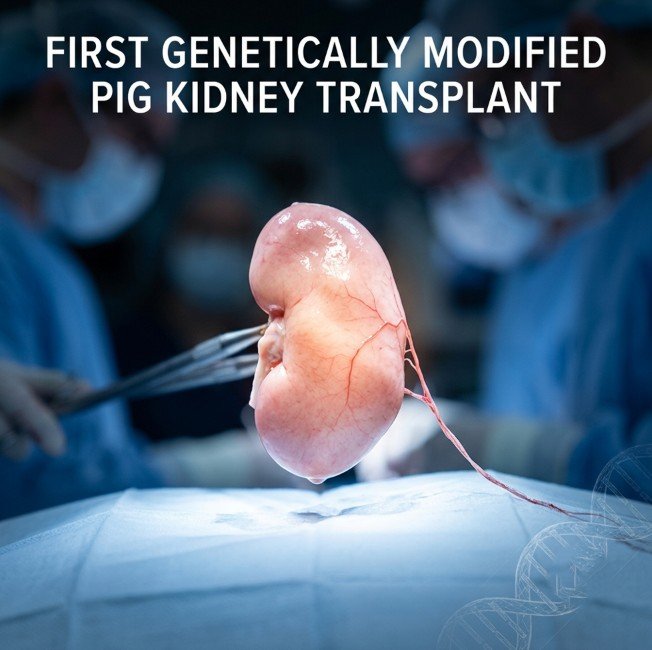
LEAD: A team at Massachusetts General Hospital transplanted a kidney from a genetically engineered pig into a 62-year-old man in March 2024, marking the first time a genetically modified pig kidney functioned in a living human and demonstrating that cross-species organ replacement can work without immediate rejection.
The Anatomy of a Waiting List Crisis
More than 100,000 people in the United States alone are waiting for an organ transplant, and roughly 17 of them die every day before a donor organ becomes available. Kidneys account for the overwhelming majority of that need. In 2023, approximately 27,000 kidney transplants were performed in the United States, while over 88,000 patients remained on the waiting list at the end of the year. The gap between supply and demand has proven stubbornly resistant to public awareness campaigns, presumed consent legislation, and advances in living donation. The arithmetic is simple and brutal: human donors cannot meet the need.
Xenotransplantation—the transfer of living cells, tissues, or organs from one species to another—has been the theoretical solution since the early 20th century. In the 1960s, surgeons transplanted chimpanzee and baboon kidneys into a handful of terminally ill patients, with survival measured in weeks or months. The immunological barriers were formidable. Hyperacute rejection, driven by pre-existing human antibodies against a sugar molecule called alpha-gal on the surface of pig cells, destroyed transplanted pig organs within minutes. The rise of genetic engineering offered a way around the barrier: create pigs that no longer provoke that immediate immune attack. What was needed was a pig whose genome was rewritten to be immunologically invisible to the human immune system—or as close to invisible as biology allows. The same spirit of engineering biology to solve unsolvable medical problems was visible in early efforts to cure sickle cell anemia with gene therapy, where a precise molecular edit changes the course of a lifelong disease.
The 69 Edits That Made a Pig Kidney Human-Compatible
The pig whose kidney was used in the March 2024 surgery was not an ordinary animal. It was produced by eGenesis, a biotechnology company founded by Harvard geneticist George Church, using a combination of CRISPR gene editing and somatic cell nuclear transfer—the same cloning technique that produced Dolly the sheep in 1996. The donor pig carried 69 genomic modifications, the most extensive genetic engineering ever applied to a potential organ donor animal. Three of these edits knocked out the genes responsible for producing the alpha-gal sugar, along with two other antigens that trigger aggressive human antibody responses. Seven edits inserted human transgenes—stretches of human DNA—that produce proteins known to regulate complement activation, coagulation, and the innate immune response. The remaining 59 edits addressed a risk that had haunted xenotransplantation since its earliest days: porcine endogenous retroviruses, or PERVs.
PERVs are ancient viral sequences embedded in the pig genome, a normal and harmless part of pig biology. The concern was that these dormant viruses could reactivate in a human recipient, especially one on heavy immunosuppression, and create a new zoonotic pathogen. Using CRISPR, the eGenesis team inactivated all 59 known PERV copies in the donor pig’s genome. The result was an animal bred in a pathogen-free barrier facility, whose kidneys, in preclinical testing, had been transplanted into cynomolgus monkeys that survived more than two years with the grafts. The step from non-human primates to a living human patient was nevertheless enormous. Previous pig kidney transplants into brain-dead human recipients, conducted by surgeons at the University of Alabama at Birmingham and NYU Langone Health in 2021 and 2022, had shown that genetically modified pig kidneys could avoid hyperacute rejection for several days. But those experiments, while ethically complex in their own right, did not answer the question of whether the organ could sustain life over weeks and months in a conscious, recovering patient. The same way that the blood protein genetics atlas mapped thousands of protein-disease associations to repurpose drugs, the eGenesis team mapped the immunological barriers and rewrote a genome to overcome them.
From Surgery to Discharge: The Clinical Course
The recipient, Richard Slayman, was a 62-year-old man with end-stage renal disease who had previously received a human kidney transplant that failed. He was facing a return to dialysis, a treatment that extends life but degrades its quality, when he was offered the experimental procedure under the U.S. Food and Drug Administration’s expanded access pathway—often called compassionate use—for patients with serious or life-threatening conditions who have exhausted all other options. The surgery took place on March 16, 2024, led by Dr. Tatsuo Kawai, director of the Legorreta Center for Clinical Transplant Tolerance at Massachusetts General Hospital. The pig kidney was connected to Slayman’s blood vessels and ureter using standard transplant surgical techniques.
The immediate result was dramatic. The kidney, still outside the body after the blood supply was restored, turned pink and began producing urine within minutes—a visual confirmation that the organ was functioning rather than being rejected. Over the following days, Slayman’s creatinine levels, a key measure of kidney function, fell from over 10 mg/dL, indicating severe renal failure, to the normal range. He came off dialysis entirely. The immunosuppressive regimen he received was a combination of an anti-CD154 monoclonal antibody called tegoprubart, designed to block a key co-stimulatory pathway without the thrombosis risk seen with earlier anti-CD40L antibodies, along with standard agents including tacrolimus and corticosteroids. He was discharged from the hospital on April 3, 2024, less than three weeks after surgery, with a functioning pig kidney. The techniques used to monitor for immune rejection and viral reactivation echoed the deep surveillance pioneered in AI-designed protein biosensors, where molecular-level detection provides early warning of biological events.
Slayman died on May 11, 2024, approximately two months after the transplant. Massachusetts General Hospital stated that no evidence of organ rejection was found at the time of death, nor was there any sign of PERV transmission. The cause was reported as a sudden cardiac event, likely related to his underlying cardiovascular disease, which had been accelerated by years of kidney failure and dialysis. The hospital and the transplant team explicitly stated that they did not consider the death a failure of the xenograft. In a brief and dignified public statement, Slayman’s family said they were grateful for the extra time and hoped the procedure would ultimately help others.
Frequently Asked Questions
What is a genetically modified pig kidney transplant?
It is an experimental procedure in which a kidney from a pig that has been genetically engineered to reduce immune rejection is surgically placed into a human recipient. The modifications remove pig antigens that trigger human antibodies and insert human genes that help control the immune response, aiming to prevent the body from destroying the foreign organ.
Why use pig organs instead of waiting for a human donor?
Human donor organs are in critically short supply. Thousands of patients die each year while waiting for a kidney. Pigs offer a potentially unlimited source of organs because they can be bred in controlled, pathogen-free environments, and their organ size and physiology are compatible with humans.
Did the first genetically modified pig kidney transplant recipient die from organ rejection?
No. According to Massachusetts General Hospital, Richard Slayman died from a sudden cardiac event, likely related to his pre-existing cardiovascular disease. There was no evidence of kidney rejection or transmission of pig viruses at the time of death. The transplant was considered functional until his death.
Editor’s Analysis
The Slayman case is a scientific milestone, but its deeper significance lies not in the technical achievement—extraordinary as it is—but in what it reveals about the architecture of modern biomedical innovation: who designs it, who pays for it, who gets access to it, and whose concerns shape the public conversation.
Deep Reflections: The 69 edits that produced a human-compatible pig kidney are a monument to the power of rational biological design. For the first time, a living system—a whole animal—was rewritten at the genomic level not to study a disease but to serve as a spare-parts reservoir for another species. The imagination behind this is audacious in the extreme. Yet the very scale of the engineering should provoke a second thought. The pig kidney that functioned in Slayman’s body was not simply a xenograft; it was a product of cascading technologies—CRISPR, cloning, artificial wombs for embryo transfer, barrier facility biosecurity—that represent a concentration of capital and expertise available to almost no one. This is not a story of a lone surgeon’s bold gamble, as the early days of organ transplantation were. It is a story of a biotech company, a world-class academic medical center, and a regulatory framework that had been deliberately prepared over years by behind-the-scenes work. The triumph belongs to a system of elite science, and it raises uncomfortable questions about what kind of medicine that system will produce.
Critical Analysis: The evidence for the procedure’s immunological success rests on a single case. In the hierarchy of clinical evidence, a single compassionate-use case report sits near the bottom—above anecdote, certainly, but well below a phase I trial. We know that one genetically modified pig kidney functioned in one patient with a specific underlying disease profile, a specific immunosuppressive regimen, and a specific donor pig genotype. We do not know whether the result will generalize to a broader population, to different immunosuppressive protocols, or to organs from different donor pigs. The two-month survival period, while sufficient to demonstrate freedom from hyperacute and acute rejection, is too short to assess chronic rejection, the slow immunological attrition that limits the lifespan of human-to-human kidney transplants to a median of 10 to 15 years. The tegoprubart antibody used in this case is itself experimental; its safety and efficacy profile is still under investigation. The cause of Slayman’s death—sudden cardiac event—is biologically plausible given his years of renal failure, but the absence of a detailed autopsy report in the public domain leaves open questions about whether subtle immunological injury or undetected viral reactivation contributed. These uncertainties are not failures; they are the normal condition of early-phase experimental medicine. But they caution against the triumphalist narrative that the popular press has embraced. The evidence is promising, not definitive.
Cui Bono: The institutional beneficiaries are numerous and their interests are not perfectly aligned. eGenesis, a privately held biotech company valued at over $1 billion, has now demonstrated clinical proof of concept for its platform, positioning it to raise further capital and, critically, to secure FDA authorization for formal clinical trials. The financial stakes are enormous: the global market for kidney replacement therapies, including dialysis and transplantation, exceeds $100 billion annually. Massachusetts General Hospital and Harvard Medical School gain prestige and fundraising leverage. The field of transplant surgery, long dominated by incremental improvements in immunosuppression protocols, receives an infusion of excitement that will influence grant review panels and journal editorial priorities for years. The patient advocacy community for kidney disease, which includes powerful organizations like the National Kidney Foundation, can now point to a concrete clinical achievement rather than a distant promise when lobbying for research funding. Even the animal rights debate is affected: while some organizations condemned the use of pigs as organ factories, others acknowledged that the procedure, if it reduces human suffering, represents a morally justifiable use of animals—a position that has historically been rare in the animal protection movement.
Distraction Analysis: The focus on the genetic engineering miracle may obscure a more mundane crisis. Kidney failure in the United States is not distributed randomly. Black Americans are nearly four times more likely than white Americans to develop end-stage renal disease, yet they are less likely to receive a transplant, less likely to be referred for transplant evaluation, and more likely to spend years on dialysis—a treatment that carries a five-year survival rate below 50 percent. The median time from listing to transplant for a Black patient is nearly two years longer than for a white patient. A future in which genetically modified pig kidneys are available will not, by itself, correct these disparities. If the technology is commercialized through the existing transplant infrastructure, it will likely follow the same patterns of differential access. The xenograft will not solve the referral bias, the implicit and explicit discrimination, the insurance barriers, or the geographic maldistribution of transplant centers that drive the racial disparity. A genetically engineered kidney is a biomedical solution to a biological problem; kidney failure is, in large part, a social problem with biological consequences. The risk is that the public celebration of a scientific triumph silences the harder conversation about who gets to benefit from the triumph.
Who Does This Not Serve? Richard Slayman received an organ and lived two additional months. His family expressed gratitude. The experimental treatment served him, in the most basic sense. But the system that produced that result does not yet serve the nearly 90,000 Americans waiting for a kidney. It does not serve the millions more worldwide, particularly in low- and middle-income countries, where dialysis is unavailable or unaffordable and the concept of a genetically engineered pig kidney is a science fiction fantasy. It does not serve the pigs, bred in sterile isolation, genetically rewritten, and sacrificed for their organs—a moral calculus that each reader will resolve differently but that cannot be ignored. And it does not serve the broader cultural understanding of medicine if the coverage emphasizes the heroism of the surgeons and the magic of CRISPR while downplaying the fact that the patient died two months later. The true measure of this milestone will not be taken in the immediate aftermath of a single surgery. It will be taken a decade from now, in the lives of patients who were never supposed to receive a transplant, who are walking around with pig kidneys that nobody expected to last, and whose existence redefines what it means to be human in an age of deliberate species-boundary crossing.
Key Takeaways
- The first transplant of a genetically modified pig kidney into a living human demonstrated that a 69-edit donor organ can function without rejection for at least two months.
- The patient died from an unrelated cardiac event; the graft was functional at death, but long-term chronic rejection and viral safety remain unproven.
- The breakthrough raises profound questions about equitable access, animal ethics, and the gap between single-case success and scalable clinical treatment.
Internal Links Used
- curing sickle cell anemia gene therapy 2026 — placed in “The Anatomy of a Waiting List Crisis” — both illustrate genetic engineering solving a previously intractable medical crisis.
- blood protein genetics atlas drug repurposing — placed in “The 69 Edits That Made a Pig Kidney Human-Compatible” — both involve systematic biological rewriting based on deep molecular understanding.
- AI-designed proteins biosensors cortisol — placed in “From Surgery to Discharge: The Clinical Course” — both emphasize precision molecular monitoring in experimental medicine.
Sources
- Massachusetts General Hospital press release, “First Genetically Modified Pig Kidney Transplanted into Living Human Patient” — official hospital announcement, primary source — primary
- New York Times, “Surgeons Transplant Pig Kidney Into a Patient, a Medical Milestone” — high-credibility reporting — high-credibility reporting
- Nature, “First pig kidney transplant in a living person: what it means for the future of xenotransplantation” — expert commentary and analysis — high-credibility reporting
- FDA Expanded Access Program overview — regulatory framework for compassionate use — official
- eGenesis press release, “eGenesis Announces First Human Transplant of a Genetically Engineered Porcine Kidney” — company statement on the donor animal engineering — primary