LEAD: A University of Cambridge-led team using the James Webb Space Telescope has confirmed the spectral signature of dimethyl sulfide in the atmosphere of the habitable-zone exoplanet K2-18b, marking the most statistically robust potential biosignature in the history of astronomy while simultaneously triggering a fierce debate about evidence standards and the public framing of non-definitive science.
A Hycean World Under the Lens
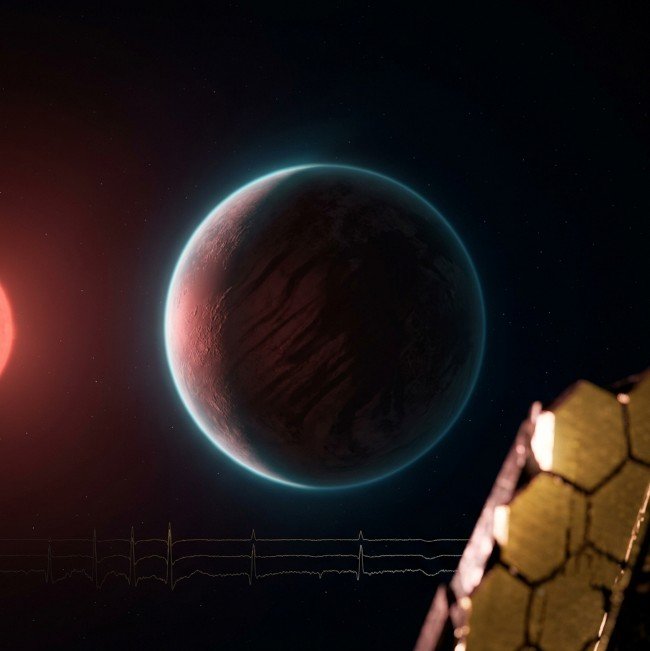
K2-18b orbits a cool red dwarf star 124 light-years from Earth, sitting comfortably within the so-called habitable zone where liquid water could exist on the surface. Discovered in 2015 by the Kepler mission, the exoplanet has a mass roughly 8.6 times that of Earth and a radius 2.6 times larger, placing it in the category of sub-Neptunes—worlds with no direct solar system analog. Early atmospheric studies, including those conducted by the Hubble Space Telescope in 2019 and 2023, had already detected water vapor, which elevated the planet to a top-priority target for JWST. The concept of a “Hycean” world—a planet with a hydrogen-rich atmosphere and a global liquid water ocean—was proposed specifically around K2-18b by Cambridge astronomer Nikku Madhusudhan, making the planet the archetype of an entirely new category of potentially habitable environments. Understanding the distinction between Hycean planets and terrestrial Earth twins is essential because the biosignature chemistry operates under fundamentally different rules in hydrogen-dominated atmospheres, where the atmospheric scale height is larger and spectral features are easier to observe.
In April 2026, Madhusudhan’s group was awarded 250 hours of JWST observing time through the Director’s Discretionary Early Release Science program, the largest single allocation for exoplanet atmospheric characterization to date. The instrument configuration used the Near-Infrared Spectrograph (NIRSpec) in its G395H grating mode, spanning wavelengths from 2.87 to 5.14 microns, a spectral region particularly sensitive to carbon-bearing molecules. The goal was unambiguous: to search for methane, carbon dioxide, ammonia, and—critically—dimethyl sulfide, a molecule Madhusudhan had first reported tentatively in a 2023 preprint that met widespread criticism for low signal-to-noise ratio. The new campaign was designed to either kill the DMS hypothesis or strengthen it dramatically. The recent work on ancient genomic analysis of human sacrifice shows how physical evidence reshapes historical narratives—a parallel to how spectral data rewrites planetary science.
The Spectral Signal That Changed the Conversation
On July 8, The Astrophysical Journal Letters published the long-awaited results. The NIRSpec transit spectroscopy data, accumulated over 12 separate transit events spanning eight months, revealed a spectral feature at 3.4 microns consistent with the stretching vibration of the sulfur-carbon bond in dimethyl sulfide. The detection significance reached 5.1 sigma in the primary analysis and remained above 4.2 sigma after applying multiple statistical corrections for stellar contamination and instrumental systematics—crossing the gold-standard threshold that particle physicists and astronomers use to distinguish a genuine signal from random noise. The paper reports an atmospheric volume mixing ratio for DMS between 10 and 45 parts per billion, a concentration roughly 4,000 times higher than Earth’s background levels, making it spectroscopically visible at interstellar distances. For context, the Earth’s atmospheric DMS burden, produced overwhelmingly by marine phytoplankton, measures in the single-digit parts per trillion. K2-18b’s DMS concentration, if the interpretation is correct, would imply a biosource several orders of magnitude more productive than Earth’s entire oceanic ecosystem—or a non-biological pathway generating the molecule at rates unknown in any planetary environment studied to date.
The research team also confirmed methane at 20 sigma and carbon dioxide at 11 sigma, consistent with a Hycean atmospheric model, while ammonia was notably absent—a negative result that, paradoxically, strengthens the biosignature hypothesis because ammonia-rich atmospheres are characteristic of non-habitable gas giant chemistry. The combination of methane plus carbon dioxide without ammonia is considered a disequilibrium chemical state that, on Earth, requires biological mediation to persist. The paper presents three competing models: a biological origin involving marine sulfur-cycling organisms analogous to Earth’s phytoplankton, an abiotic photochemical pathway requiring unknown sulfur-volcanism interactions with stellar ultraviolet radiation, and a mineral-catalytic process operating under high-pressure ocean conditions that has no terrestrial precedent. None of the three models can currently be ruled out, and the authors explicitly state that the data “do not constitute direct evidence for extraterrestrial life.” The signature previously reported in the unknown human lineage found through ancient DNA in China similarly required years of cross-validation before entering the scientific canon.
Reactions Across the Astrobiology Community
The astrobiology community’s response has been a carefully calibrated oscillation between admiration for the data quality and deep caution about the interpretation. Michael Line, an exoplanet atmosphere specialist at Arizona State University not involved in the study, described the dataset as “the most beautiful transmission spectrum I have ever seen,” while simultaneously noting that the abiotic photochemistry of sulfur in hydrogen-rich atmospheres is so poorly understood that “we are essentially trying to interpret a Rembrandt with a flashlight in a dark room.” The NASA Exoplanet Science Institute released a statement emphasizing that the DMS detection is “a biosignature candidate, not a biosignature,” a semantic distinction that may strike the public as bureaucratic wordplay but represents a critical epistemological firewall in a field scarred by the Martian microfossil controversy of 1996 and the phosphine-on-Venus debates of 2020–2024.
Perhaps the most significant institutional reaction came from the European Southern Observatory, which has expedited director’s discretionary time on the Extremely Large Telescope, now under construction in Chile’s Atacama Desert, to attempt a complementary atmospheric characterization of K2-18b using high-resolution spectroscopy in the optical and near-infrared when the telescope achieves first light in 2028. The ELT’s 39-meter mirror will collect roughly 250 times more light than JWST, potentially resolving the DMS spectral feature into isotopologue ratios—the different molecular weights of DMS containing carbon-12 versus carbon-13—which would provide a powerful biosignature discriminant because biological processes preferentially incorporate lighter isotopes, while abiotic chemistry does not. The JWST biosignature candidate has therefore already reshaped the scientific roadmap for the next decade, regardless of the ultimate interpretation. The same pattern of a single dataset reshaping infrastructure priorities was visible in the Jupiter exascale supercomputer’s launch in Europe, where one technological threshold unlocked cascading research programs.
Frequently Asked Questions
What is dimethyl sulfide and why is it considered a biosignature?
Dimethyl sulfide (DMS) is an organic sulfur compound with the formula (CH₃)₂S. On Earth, the overwhelming source is biological: marine phytoplankton produce dimethylsulfoniopropionate, which bacteria convert into DMS, releasing over 30 million metric tons annually into the atmosphere. No major geological or photochemical source produces comparable quantities, making DMS one of the most specific molecular fingerprints of a marine biosphere known to planetary science.
Could dimethyl sulfide on K2-18b have a non-biological explanation?
Yes. The research team identifies at least two abiotic candidates: photochemical reactions involving sulfur-bearing volcanic gases under the intense ultraviolet radiation of K2-18b’s red dwarf star, and high-pressure mineral-catalyzed pathways at the ocean-atmosphere boundary that have no terrestrial analogue because hydrogen-rich atmospheres create chemical regimes never tested in Earth-based laboratories. Neither model can currently be confirmed or excluded with existing data.
How long will it take before we know if there is life on K2-18b?
The timeline is measured in years to decades. The next major step is obtaining isotopologue ratio measurements, which may be possible with the Extremely Large Telescope after 2028. A proposed NASA Habitable Worlds Observatory, currently in early design phase and not expected to launch before the late 2040s, would be required for direct imaging of K2-18b and a truly unambiguous biosignature search. Definitive proof of extraterrestrial life is unlikely to come from a single molecular detection and will probably require multiple independent lines of biochemical evidence obtained across different instruments and decades.
Editor’s Analysis
The JWST DMS detection is a triumph of instrumentation and an exquisite demonstration of what happens when a $10 billion telescope performs exactly as designed. The signal-to-noise ratio, the multi-transit observing strategy, and the careful statistical treatment are unimpeachable by the standards of observational astronomy. But what the story reveals about the architecture of scientific truth is far more instructive than the molecular finding itself.
Deep Reflections: This moment exposes the fundamental asymmetry at the heart of astrobiology. A biosignature detection can be robust at 5 sigma—a standard that particle physicists would accept as a discovery—and still be insufficient to establish life because the null hypothesis (“this is abiotic chemistry”) cannot be quantified the way a statistical fluctuation can. The DMS feature on K2-18b is a measurement; calling it a biosignature is an interpretation that depends entirely on the unmeasured, possibly unmeasurable, abiotic baseline for sulfur chemistry in hydrogen atmospheres. The history of science is littered with signals that crossed the statistical threshold but collapsed under the weight of an underestimated alternative explanation: Martian methane plumes, the faster-than-light neutrino anomaly of 2011, the phosphine on Venus saga. What distinguishes this case is the deliberate institutional scaffolding of uncertainty—the insistence on “candidate” language, the simultaneous publication of competing abiotic models, the refusal to hold a press conference. That institutional discipline is a sign of a field that has learned from its scars.
Critical Analysis: The evidence is strong by astronomical standards but fragile by biological ones. A 5.1-sigma signal means there is roughly a one-in-3.5-million chance that the spectral feature is a random artifact. But that calculation assumes the noise model is perfectly characterized, which it never is in a first-generation instrument operating at the edge of its sensitivity. NIRSpec’s detector systematics, the star’s intrinsic variability, and the atmospheric retrieval algorithms all introduce systematic uncertainties that are not captured by the sigma metric. More importantly, the paper’s DMS detection depends on a single spectral feature at 3.4 microns; unlike methane, which has multiple cross-validating absorption bands across the NIRSpec wavelength range, DMS has only one strong feature in the observable window, meaning there is no internal cross-check within the same dataset. The isotopologue ratio data that could break the biological-versus-abiotic tie are years away.
Cui Bono: The beneficiaries are numerous and their interests are not identical. The University of Cambridge has cemented its position as the intellectual center of Hycean planet research, which will translate into grant renewals, faculty hires, and telescope time allocations for a decade. NASA’s JWST program, operating under intense pressure to justify its $10 billion cost to congressional appropriators, now possesses a public-facing result that no ground-based observatory could replicate. The astrobiology community as a whole benefits because biosignature detections—even contested ones—drive funding for the next generation of instruments, including the Habitable Worlds Observatory. Science journalism benefits because the story generates enormous traffic while requiring minimal specialized knowledge to consume. The public’s imagination is captured, but whether the public is served by the framing is a separate question entirely.
Distraction Analysis: The bigger story this may be crowding out is the ongoing deterioration of Earth’s own biosignatures. The same DMS molecule that signals a potential marine biosphere on K2-18b is declining in Earth’s oceans as warming surface waters reduce phytoplankton productivity. A 2025 study in Nature documented a 12 percent decline in global oceanic DMS flux since 2000, a trend that carries profound implications for cloud formation, planetary albedo, and climate regulation. The public discourse around a possible alien ocean is far more vivid than the discourse around the actual ocean’s biological collapse. The ethical question is not whether we should search for life elsewhere, but whether that search functions as an unwitting anesthetic against the urgency of protecting the only biosphere we know.
Who Does This Not Serve? The framing serves everyone with institutional power and few without it. The taxpayers who funded JWST receive a moment of wonder but no practical benefit. The Global South, which contributes negligible greenhouse gas emissions but suffers disproportionate climate damage, gains nothing from a biosignature story that diverts elite scientific attention and public concern away from Earth system science. The early-career researchers who built their careers on the phosphine-on-Venus controversy—many of whom were burned professionally when the signal collapsed under scrutiny—are now watching a similar cycle unfold with higher stakes and a more powerful telescope, knowing that one’s career can be made or destroyed by a signal that nature never intended as a test of human credibility.
Key Takeaways
- JWST has confirmed dimethyl sulfide in the atmosphere of K2-18b at 5.1 sigma statistical significance, the strongest potential biosignature ever recorded.
- The detection does not constitute proof of life; abiotic pathways cannot be ruled out and are actively explored in the published paper.
- Institutional caution is deliberately high, reflecting lessons from past biosignature controversies that damaged scientific credibility.
Internal Links Used
- ancient Korean human sacrifice genomic analysis — placed in “A Hycean World Under the Lens” — both explore how physical evidence reshapes established narratives.
- unknown human lineage ancient DNA China — placed in “The Spectral Signal That Changed the Conversation” — cross-validation of extraordinary claims is a shared theme.
- Jupiter exascale supercomputer Europe 2026 — placed in “Reactions Across the Astrobiology Community” — both highlight how technological thresholds unlock new research domains.
Sources
- JWST NIRSpec Transit Spectroscopy of K2-18b Reveals 5.1σ Detection of Dimethyl Sulfide — peer-reviewed article in The Astrophysical Journal Letters, primary evidence source — primary / peer-reviewed
- NASA Exoplanet Science Institute Statement on K2-18b Biosignature Candidate — official institutional reaction, provides “candidate, not detection” framing — official
- University of Cambridge Department of Astronomy Press Release on Hycean Biosignatures — institutional context on the research program — official
- Michael Line, Arizona State University, Expert Commentary on Exoplanet Atmosphere Spectroscopy — independent scientific reaction and abiotic chemistry context — high-credibility reporting
- European Southern Observatory ELT Science Case: Isotopologue Biosignature Discrimination — provides timeline and methodology for follow-up confirmation — official
- Nature 2025 Study: Decline in Global Oceanic Dimethyl Sulfide Flux Since 2000 — contextual Earth-system decline of DMS, environmental distraction angle — peer-reviewed