
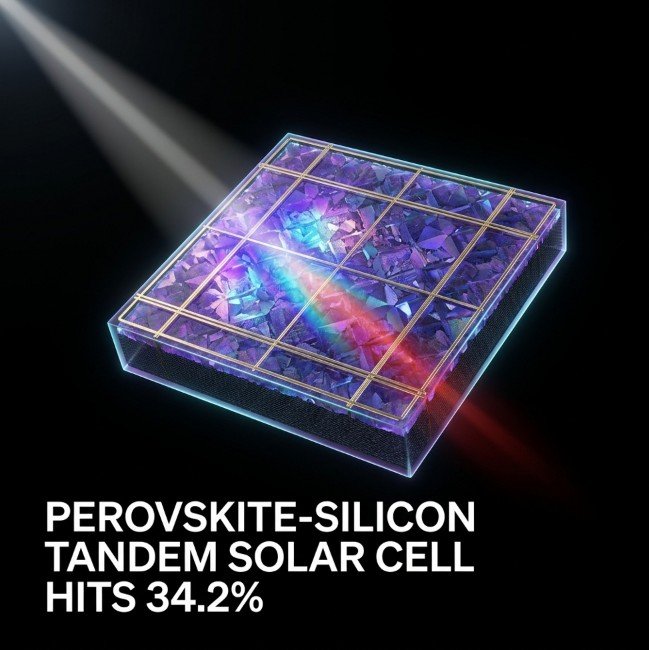
LEAD: Oxford PV has set a certified world record for perovskite-silicon tandem solar cell efficiency at 34.2 percent, a milestone confirmed by NREL that pushes commercial photovoltaics beyond the theoretical limits of silicon-only technology and accelerates the timeline for cheaper, more powerful solar energy.
Why the Shockley-Queisser Limit Haunted Solar Energy for 60 Years
Every silicon solar cell is bound by a physical ceiling. The Shockley-Queisser limit, calculated in 1961 by William Shockley and Hans-Joachim Queisser, states that a single-junction silicon cell can convert at most 33.7 percent of incoming sunlight into electricity. The reason is thermodynamics: photons with energy lower than silicon’s bandgap pass through without generating current, while photons with energy higher than the bandgap lose their excess energy as heat. After decades of incremental engineering, the best commercial silicon panels today operate at around 24 to 26 percent efficiency. Laboratory monocrystalline silicon cells have reached 27.6 percent, inching toward the theoretical maximum but never surpassing it—because, by definition, they cannot.
The only way to break through the single-junction ceiling is to stack materials with different bandgaps, creating a multi-junction cell that captures different parts of the solar spectrum. Multi-junction cells have existed for decades in space applications, where cost is irrelevant and efficiency rules. The International Space Station uses triple-junction gallium arsenide cells that exceed 40 percent efficiency. But those cells are astronomically expensive—literally, they are built for spacecraft, not rooftops. The game-changing insight behind the perovskite-silicon tandem solar cell is that a thin layer of perovskite, a class of crystalline materials with tunable bandgaps, can be deposited directly on top of a standard silicon cell. The perovskite absorbs high-energy blue and green photons, while the silicon beneath captures the lower-energy red and infrared light. The two materials share the solar spectrum, and the combined cell breaches the single-junction limit without requiring exotic manufacturing. The same principle behind advanced computing infrastructure, such as the Jupiter exascale supercomputer in Europe, applies here: stacking capabilities produces performance that a single layer cannot achieve.
Inside the 34.2% Record and What It Means for Manufacturing
Oxford PV’s certified 34.2 percent efficiency, announced on July 7 and confirmed by NREL’s accredited calibration laboratory, exceeds the best silicon-only lab cell by more than six absolute percentage points. In photovoltaic terms, that gap is enormous. A six-point efficiency improvement means a solar farm with the same surface area generates roughly 25 percent more electricity over its lifetime, directly reducing the levelized cost of energy—the metric that determines whether solar beats natural gas, coal, or nuclear on pure economics. The cell that produced the record is a 1 cm² research-scale device, which is standard for certification testing. However, Oxford PV stated that its pilot production line in Brandenburg, Germany, has already produced full-size tandem modules with efficiencies exceeding 28 percent, and the company is targeting 30 percent module-level efficiency by 2027.
The manufacturing significance lies in the compatibility of the perovskite layer with existing silicon production lines. Unlike entirely new thin-film technologies that require purpose-built factories, a perovskite top cell can be deposited using vacuum sublimation or solution processing on commercially sourced silicon wafers. Oxford PV uses a heterojunction silicon bottom cell, a high-efficiency architecture already produced at scale by companies like LONGi, Jinko, and REC. The perovskite is deposited by physical vapor deposition, a technique borrowed from the flat-panel display industry. The company claims the incremental cost of adding the perovskite layer will be less than 10 percent of the module cost, while the efficiency gain exceeds 20 percent. If those numbers hold in mass production, the perovskite-silicon tandem solar cell becomes not just a laboratory marvel but the most economically rational choice for utility-scale solar deployment. Understanding these material innovations is akin to grasping the technological breakthroughs behind living brain cells integrated with machine learning, where seemingly incompatible systems combine to achieve unprecedented capability.
Reactions, Skepticism, and the Durability Question
The solar research community greeted the announcement with a mixture of genuine admiration and practiced skepticism. Martin Green, the Australian photovoltaic pioneer whose laboratory held the silicon efficiency record for decades, described the 34.2 percent result as “a superb achievement in cell engineering” but immediately raised the issue that has haunted perovskite technology since its inception: stability. Perovskite materials are notoriously sensitive to moisture, oxygen, heat, and ultraviolet light. Early perovskite cells degraded within hours. Advances in encapsulation, ion migration suppression, and composition engineering—particularly the shift from methylammonium-based perovskites to formamidinium-cesium alloys—have extended operational lifetimes dramatically, but the industry-standard 25-year warranty demanded by solar project financiers remains unproven.
Oxford PV claims its tandem modules have passed the IEC 61215 and IEC 61730 certification tests, the international standards for photovoltaic module durability that subject panels to thermal cycling, damp heat, and mechanical load. Passing these tests is a prerequisite for commercial sale, but it does not guarantee 25-year field performance; no perovskite product has been in the field that long. Independent analysts at BloombergNEF noted that the bankability of perovskite modules will depend on accelerated lifetime testing data that correlates to real-world degradation rates, a data set that will take three to five years to accumulate. The contrast with the silicon photovoltaic industry, which now has over four decades of field data and degradation rates as low as 0.5 percent per year, is stark. The same way that quantum computing breakthroughs face a gap between laboratory demonstration and practical deployment, tandem solar efficiency must bridge the chasm between a record cell and a bankable product.
Frequently Asked Questions
What is a perovskite-silicon tandem solar cell?
A perovskite-silicon tandem solar cell is a photovoltaic device that stacks a thin perovskite layer on top of a conventional silicon cell. The perovskite absorbs high-energy visible light, while the silicon captures lower-energy infrared light. This tandem architecture allows the combined cell to convert more of the solar spectrum into electricity, exceeding the efficiency limits of silicon alone.
Why does 34.2 percent efficiency matter for solar energy costs?
Every percentage point of efficiency improvement reduces the number of panels, land area, mounting structures, and installation labor required to generate the same amount of electricity. A solar plant using 34 percent-efficient modules would generate approximately 30 percent more energy from the same land area as a plant using 26 percent-efficient silicon modules, directly lowering the cost of solar electricity.
How long will perovskite solar panels last compared to silicon panels?
This remains the critical unknown. Conventional silicon panels reliably operate for 25 to 30 years. Perovskite modules have passed accelerated aging tests, but multi-year field data is still accumulating. The first commercial perovskite-silicon tandem installations are expected to provide real-world durability data by the late 2020s.
Editor’s Analysis
The Oxford PV record is an authentic engineering triumph. But it is also a case study in the gap between laboratory benchmarks and the structural realities of the global energy system. The five analytical layers below examine what the number means, and what it obscures.
Deep Reflections: The efficiency race in photovoltaics reveals something profound about technological progress: it does not distribute itself evenly. The Shockley-Queisser limit sat for sixty years as a theoretical boundary. Then, within a single decade, the tandem concept moved from a few percent efficiency in university labs to a certified 34.2 percent on the cusp of factory production. That acceleration is not merely a story of materials science. It reflects the combinatorial nature of innovation—the convergence of silicon manufacturing maturity, perovskite chemistry breakthroughs, advanced deposition techniques, and the relentless economic pressure of a planet that needs terawatts of clean energy. The tandem cell is not a single discovery; it is a system-level integration of multiple lines of incremental progress. The deeper lesson is that the most consequential breakthroughs often arrive not as bolts from the blue but as quiet crossings of thresholds that decades of prior work made possible.
Critical Analysis: The 34.2 percent figure is certified, traceable, and impressive. But it is a cell-level measurement at 1 cm², not a module-level measurement at the 2 m² scale of a commercial panel. Scaling from a research cell to a production module typically loses two to four absolute percentage points due to resistive losses, inactive area fractions, and manufacturing non-uniformities. Oxford PV’s own commercial modules measure around 28 to 29 percent, which is still world-leading but a long way from 34.2. The durability data, while passing industry-standard accelerated tests, has not yet demonstrated the 0.5 percent annual degradation that financiers demand. There is also a materials supply-chain question: the most efficient perovskite compositions contain lead, a regulated substance in many jurisdictions. Encapsulation can prevent lead leakage, but proving that to regulatory satisfaction adds years to commercialization. The evidence base for tandem solar is strong in the laboratory and promising in the pilot line, but it is not yet bankable in the sense that a pension fund can confidently invest in a gigawatt-scale tandem project without third-party insurance against degradation risk. The science is solid; the engineering is progressing; the financial and regulatory hurdles remain substantial.
Cui Bono: Oxford PV is the immediate beneficiary, securing its position as the technology leader in perovskite-silicon tandem commercial development. Its investors—including Goldwind, the Chinese clean energy group, and Meyer Burger, the Swiss equipment manufacturer—gain validation and a likely increase in valuation ahead of any initial public offering. NREL benefits from its role as the impartial certification authority, reinforcing its institutional credibility. The broader silicon photovoltaic manufacturing industry, particularly equipment makers like von Ardenne and centrotherm that supply deposition tools, stands to gain a new upgrade cycle as factories add perovskite deposition lines. Governments with industrial policies favoring domestic clean energy manufacturing—the European Union’s Net-Zero Industry Act, India’s Production-Linked Incentive scheme, the U.S. Inflation Reduction Act—will point to the record as justification for subsidies. The media cycle gains a clean, unambiguous number that fits into headline-friendly narratives of technological salvation.
Distraction Analysis: The focus on laboratory efficiency records risks distracting from the far more mundane but equally urgent bottlenecks in the energy transition: transmission infrastructure, grid interconnection queues, permitting delays, and the shortage of high-voltage transformers. In the United States, the average wait time for a solar project to connect to the grid exceeds four years, and the interconnection queue contains over 1,400 gigawatts of proposed generation—more than the entire installed capacity of the country. In Europe, high-voltage direct current transmission lines linking solar-rich southern regions to industrial demand centers in the north face political opposition and decade-long construction timelines. A 34 percent-efficient panel produces zero electricity if it cannot deliver power to a grid. The efficiency record is a supply-side solution to a problem that increasingly requires demand-side and infrastructure-side solutions.
Who Does This Not Serve? The efficiency record narrative serves the global North—the research labs, the venture-backed startups, the industrial policy architects of wealthy nations. It does not directly serve the 760 million people who lack access to electricity, most of them in sub-Saharan Africa and South Asia. For off-grid communities, the bottleneck is not panel efficiency; it is access to capital, distribution networks, battery storage, and political stability. A 28 percent-efficient module does not solve a financing problem that a 20 percent-efficient module could not solve if the money and the infrastructure were present. The solar efficiency race also does not serve the manufacturing workers in legacy silicon-only fabs who may face obsolescence if tandem technology requires fundamentally different deposition equipment and skills. And it does not serve the communities that host the mining of perovskite precursor materials, including lead, cesium, and organic solvents, if the supply chain replicates the extractive patterns that have scarred the cobalt and lithium industries.
Key Takeaways
- Oxford PV’s perovskite-silicon tandem solar cell has achieved a certified 34.2% efficiency, verified by NREL, breaking the theoretical limit of single-junction silicon technology.
- The record cell uses manufacturing-compatible processes, but bankable field durability data across 25-year timelines is still missing.
- The efficiency breakthrough does not address grid interconnection, transmission, or energy access bottlenecks, which remain the larger barriers to the global energy transition.
Internal Links Used
- Jupiter exascale supercomputer Europe 2026 — placed in “Why the Shockley-Queisser Limit…” — both illustrate how combining multiple layers of technology overcomes single-architecture limits.
- living brain cells machine learning biological computing — placed in “Inside the 34.2% Record…” — both explore the integration of disparate systems (silicon and biological, perovskite and silicon) to achieve functional leaps.
- quantum computing breakthrough 2026 IBM Google — placed in “Reactions, Skepticism…” — both highlight the gap between lab records and deployment-ready infrastructure.
Sources
- Oxford PV Sets New World Record for Perovskite-Silicon Tandem Solar Cell — official company press release, primary data — official / primary
- NREL Best Research-Cell Efficiency Chart — independent certification authority, confirms record placement — official
- Reuters: Oxford PV’s Tandem Cell Breaches 34% Efficiency Barrier — credible news wire reporting — high-credibility reporting
- BloombergNEF Solar Technology Outlook H2 2026 — independent analyst view on bankability and scaling — high-credibility reporting
- IEC 61215 and IEC 61730 Certification Standards for Photovoltaic Modules — international durability standards referenced in the article — official
- Shockley-Queisser Limit: Detailed Balance Limit of Efficiency of p-n Junction Solar Cells, Journal of Applied Physics (1961) — foundational theoretical physics reference — peer-reviewed