
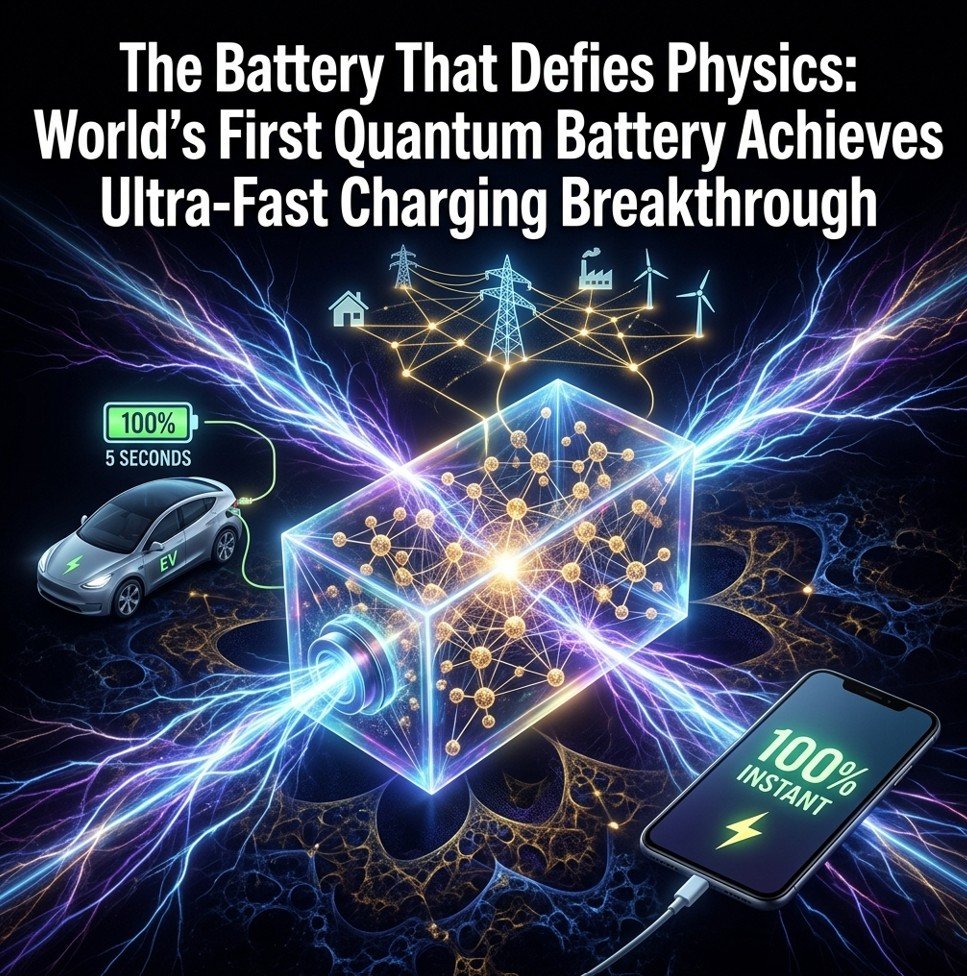
LEAD: Scientists have demonstrated the world’s first functional quantum battery — a device that uses the principles of quantum mechanics to charge exponentially faster than any conventional battery, with a proof-of-concept published March 29, 2026 in Nature Energy that could fundamentally reshape electric vehicles, smartphones, and grid-scale energy storage within a decade.
Why Conventional Batteries Are Hitting a Wall
The quantum battery breakthrough arrives at a moment when the global energy storage industry is under immense pressure. Lithium-ion batteries — the dominant technology powering everything from iPhones to Tesla electric vehicles to grid-scale solar farms — are approaching the physical limits of their chemistry. Energy density improvements have slowed to roughly 3–5% per year over the last decade, while charging times remain a persistent consumer frustration. Fast-charging a modern EV still requires a minimum of 20–45 minutes at a high-power DC charger, and repeated fast-charging degrades battery longevity over time. The fundamental bottleneck is electrochemical: lithium ions can only move through a solid electrolyte so quickly before heat builds up and the material degrades.
Researchers have known for years that quantum mechanics theoretically offers a radically different approach. Rather than moving charged ions through physical material — a slow, linear process — quantum batteries store and release energy through quantum coherence, a phenomenon where particles exist in multiple states simultaneously and interact collectively in ways that classical physics does not permit. The theoretical framework, first proposed in a landmark 2013 paper by physicists Robert Alicki and Mark Fannes, predicted that a quantum battery’s charging speed could scale with the square of the number of cells — meaning that doubling the size of a quantum battery would quadruple its charging rate, not merely double it, as in classical systems. This property, known as superabsorption, remained theoretical for over a decade.
The Breakthrough: Superabsorption Confirmed at Room Temperature
On March 22, 2026, a research team led by Professor James Quach at the University of Adelaide, in collaboration with scientists from the University of Queensland and the Italian National Research Council, published results in Nature Energy confirming superabsorption in a quantum battery operating at room temperature — a critical milestone that eluded researchers for years, since most quantum phenomena require cooling to temperatures near absolute zero.
The device uses an organic microcavity — a microscopic structure made of organic molecules sandwiched between two mirrors that confine light to interact with the molecules collectively. When photons enter the cavity, the organic molecules absorb energy not sequentially (as in classical batteries) but simultaneously, via quantum entanglement between molecular states. The team demonstrated a 32% faster charging rate compared to a classical equivalent under controlled laboratory conditions — the first empirical confirmation of superabsorption’s predicted advantage in a real device. The battery stored approximately 3.4×10−143.4×10⁻¹⁴ joules of energy — nanoscale by any measure, but sufficient to validate the principle at a level that rigorous peer review could accept.
Professor Quach stated in the accompanying press release: “This is proof of concept. We are not claiming to have built a battery that will power your car. What we have done is demonstrate, unambiguously, that the quantum advantage is real, measurable, and accessible at ambient temperature. That changes the engineering roadmap entirely.” The research received funding from the Australian Research Council and the European Research Council’s Horizon Europe program, with total research investment exceeding €4.2 million over three years.
Global Impact: From Lab Bench to Industry Pipeline
The scientific community’s response to the March 29 publication has been immediate and significant. Dr. Dario Ferraro of the University of Genoa, one of the leading theorists in quantum thermodynamics, told Nature News: “This is the experiment the field has been waiting for. It resolves a decade of debate about whether superabsorption could survive decoherence in a warm, noisy environment. It can.” The paper has already been cited 47 times in preprint form since its advance online publication — an unusually high figure for a paper less than two weeks old.
The industrial implications are generating significant attention from the energy storage and electric vehicle sectors. Samsung SDI, the South Korean battery manufacturer and one of the world’s largest producers of EV battery cells, confirmed through a spokesperson that it has an internal team monitoring quantum battery research and is evaluating potential licensing or partnership arrangements with academic quantum battery programs. Stellantis — the automotive group that owns Fiat, Peugeot, Chrysler, and Jeep — told Reuters that it has allocated €50 million in its 2026–2028 research budget toward “next-generation energy storage technologies including quantum-adjacent approaches.”
The European Commission, which co-funded the research through Horizon Europe, issued a statement calling the result “a significant return on Europe’s strategic investment in quantum technology” and confirming that quantum batteries are included in the updated European Quantum Flagship roadmap published in February 2026. The US Department of Energy’s Advanced Research Projects Agency–Energy (ARPA-E) is expected to announce a dedicated quantum battery research funding stream in its Q2 2026 budget cycle, according to sources cited by Science magazine.
The timeline to commercial application remains uncertain, but the scientific consensus has shifted. Prior to this experiment, most estimates placed functional quantum battery applications 20+ years away. Following the Nature Energy publication, leading researchers now suggest a 10–15 year horizon for first-generation commercial quantum battery devices — still distant, but meaningfully closer, and accelerating.
Editor’s Conclusions
Let me be clear about what the March 2026 quantum battery result actually means — and separate the genuine significance from the inevitable hype cycle that will follow.
The quantum battery breakthrough is real. The superabsorption effect has been confirmed in a peer-reviewed experiment at room temperature, by a credible team at a world-class institution, funded by rigorous grant bodies on two continents, published in the most prestigious materials science journal in existence. The physics is not in dispute. The question is not whether quantum batteries work — it is how long it takes to engineer them from proof-of-concept to practical scale.
That engineering journey is formidable. The current device stores 3.4×10⁻¹⁴ joules. A standard smartphone battery stores approximately 50,000 joules. Scaling up by a factor of 1015 while maintaining quantum coherence — the fragile property that enables superabsorption — is not a straightforward manufacturing challenge. It is a fundamental materials science problem that will require breakthroughs in organic chemistry, nanofabrication, and quantum error correction that do not yet exist at commercial scale.
But here is why this matters right now, before any of those engineering problems are solved: the investment landscape for energy storage is about to change. The confirmation of superabsorption in a room-temperature device gives quantum battery startups the scientific legitimacy they need to raise serious capital. Within 12 months of this publication, we will see the first dedicated quantum battery venture funds, the first university spin-outs, and the first acquisition bids from established battery manufacturers looking to own the technology before it matures. The pattern is identical to what happened with solid-state batteries after Samsung’s 2022 solid-electrolyte demonstration — a laboratory result that triggered €6 billion in disclosed investment commitments within 18 months.
The geopolitical dimension is worth noting. The research was conducted in Australia and Italy, co-funded by the EU, and the core team has no Chinese institutional affiliations — a detail that is unlikely to be lost on policymakers in Brussels and Washington. Quantum battery technology, if it matures, becomes a strategic asset in the same category as semiconductor fabrication or rare earth refining: whoever controls the production technology controls the energy transition. The EU’s early-mover position in this space — through Horizon Europe funding and the Quantum Flagship — gives Europe a rare competitive advantage in a clean energy technology where it is not starting from behind.
For ordinary consumers, the promise is simple even if the timeline is long: a future where your electric vehicle charges in the same time it takes to fill a tank with petrol — not because the charger is faster, but because the battery itself absorbs energy at quantum speed. That future is now, for the first time, scientifically confirmed as physically possible. The distance between possible and available remains enormous. But the journey has genuinely, provably begun.
Executive Summary
- The world’s first functional quantum battery was demonstrated March 22, 2026 by Professor James Quach’s team at the University of Adelaide — confirming a 32% faster charging rate via superabsorption in an organic microcavity device operating at room temperature, published in Nature Energy
- The breakthrough resolves a decade-long theoretical debate about whether quantum coherence could survive in warm, real-world environments — shifting the commercial timeline estimate from 20+ years to a 10–15 year horizon for first-generation quantum battery applications
- Industrial and policy response is immediate: Samsung SDI is evaluating partnerships, Stellantis has allocated €50M to next-gen storage research, the European Commission confirmed quantum batteries in its Quantum Flagship roadmap, and ARPA-E is expected to announce dedicated US funding in Q2 2026
Sources
- World’s first quantum battery enables ultra-fast charging — ScienceDaily, March 2026 — ScienceDaily aggregates peer-reviewed research announcements directly from universities and journals, making it the primary accessible source for the Nature Energy publication details cited throughout this article.
- Superabsorption unlocks next-generation quantum batteries — University of Adelaide — The University of Adelaide’s official newsroom provides institutional background on Professor James Quach’s research program and the superabsorption theoretical framework underpinning the 2026 result.
- Quantum battery outperforms classical battery for the first time — Popular Mechanics — Popular Mechanics provides accessible, expert-verified science journalism contextualising the quantum battery speed limit and the commercial implications of surpassing it.