Between 1944 and 1963, as many as 200,000 Polish fighters of the anti-communist underground — the Żołnierze Wyklęci — were systematically hunted, tortured, and murdered by the Soviet NKVD and Poland’s Stalinist Ministry of Public Security, which then buried their bodies in unmarked graves and expunged their names from official history.
The Forgotten War: Resistance After the Fall of the Third Reich
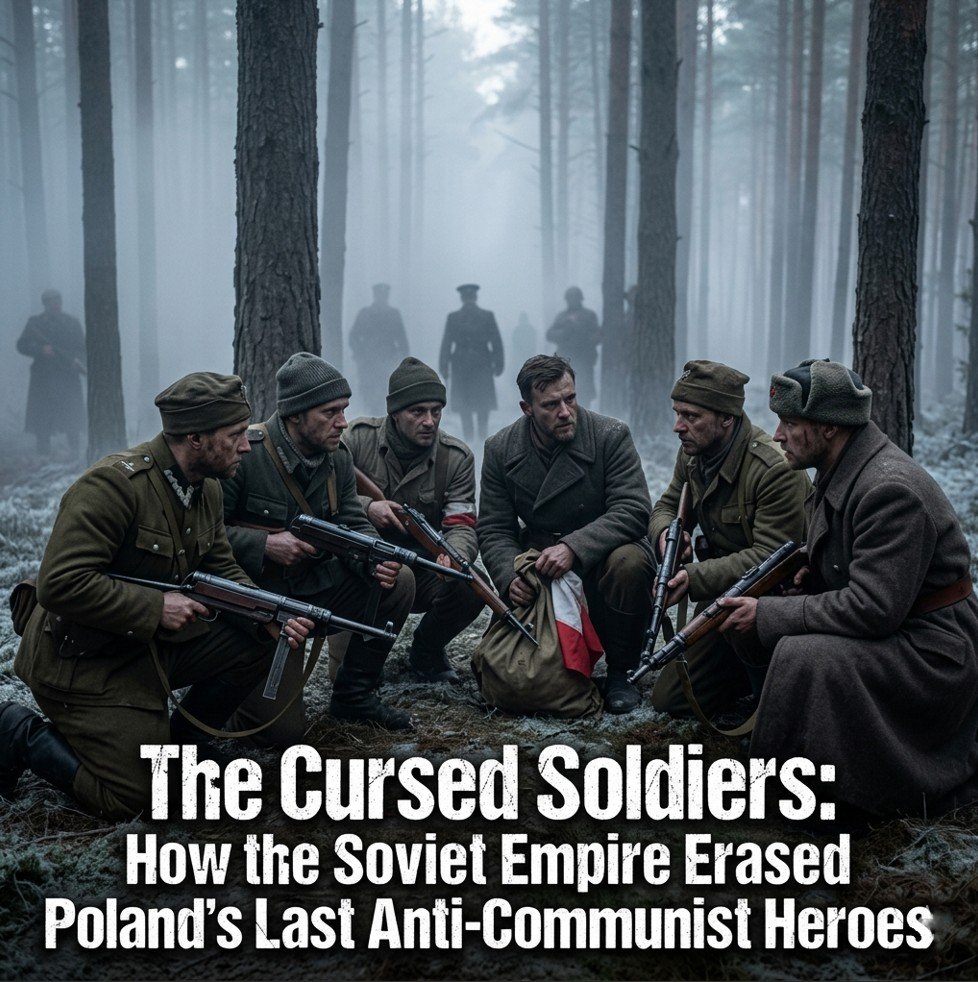
While the Western world celebrated the end of World War II in May 1945, a new, far more brutal conflict was already raging in the forests of eastern Poland. The Red Army, ostensibly a liberator, had begun arresting, deporting, and executing members of the Polish Home Army (Armia Krajowa), the largest underground resistance movement in occupied Europe. Refusing to swear allegiance to the Soviet-imposed communist regime, tens of thousands of Polish soldiers went underground once more, forming what became known as the Cursed Soldiers (Żołnierze Wyklęci).
At its peak in 1945-1946, this clandestine army numbered between 150,000 and 200,000 fighters. They attacked communist prisons, liberated political prisoners, and engaged in direct combat with NKVD death squads. Their aim was not merely to survive, but to keep alive the dream of an independent Poland — a dream the Allies had already sacrificed at Yalta. The last known Cursed Soldier, Józef Franczak, was not killed until 1963, nearly two decades after the war had officially ended. The resistance was so tenacious that the communist authorities were forced to keep tens of thousands of security police and Soviet troops tied down in Poland for years.
The Mechanism of Erasure: From Hero to “Bandit”
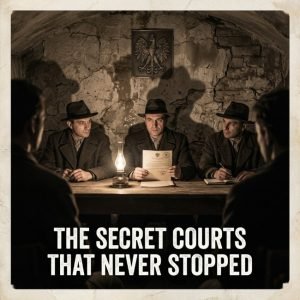
The communists understood that to break Poland, they had to break its memory. The Ministry of Public Security (UB), modeled directly on the Soviet NKVD, launched a campaign of total annihilation — not just of bodies, but of names. Captured Cursed Soldiers were not given the dignity of a trial. They were tortured in the notorious Mokotów Prison in Warsaw, subjected to mock executions, and then shot in secret. Their bodies were buried in hidden locations, such as the Łączka section of Warsaw’s Powązki Military Cemetery, a site that the IPN (Institute of National Remembrance) later identified as a mass grave for victims of Stalinist terror.
The propaganda apparatus then went to work. The term “Cursed Soldier” was initially a slur used by the regime to describe them as doomed traitors. School textbooks were rewritten to refer to them as “bandits” and “fascist reactionaries.” All photographs were destroyed. Any family member who whispered a prayer at an unmarked grave risked imprisonment. This was not merely censorship; it was a systematic attempt to kill the Polish soul by severing it from its own heroes.
The Recovered Truths: IPN Investigations and the Exhumations of Łączka
The fall of communism in 1989 did not immediately restore the memory of the Cursed Soldiers. For the first decade of the Third Polish Republic, many of the new elites — themselves often products of the communist system — remained uncomfortable with the violent legacy of anti-communist partisans. It was not until the establishment of the Institute of National Remembrance (IPN) and the political transformations of the 2000s that systematic forensic investigations began.
The exhumations at Powązki’s “Łączka” site, conducted by the IPN, have been particularly gruesome and revealing. Forensic anthropologists have unearthed bodies with bound hands, bullet wounds to the back of the head, and signs of torture consistent with UB interrogation methods. Declassified NKVD archives, transferred to Poland after the dissolution of the USSR, have confirmed the names of executioners and the dates of secret trials. In 2015, the National Day of Remembrance of the Cursed Soldiers was established on March 1, the anniversary of the 1951 execution of the leadership of the anti-communist organization “Freedom and Independence” (WiN).
Editor’s Analysis: The Uncomfortable Truth
1. Deep Reflections — The Mechanics of Erasure
What does the suppression of the Cursed Soldiers reveal about how history is written by the victors? The Yalta Conference of 1945 was not merely a geopolitical negotiation; it was a death warrant for the Polish nation. By handing Poland over to the Soviet sphere of influence, the Allies effectively gave Stalin a free hand to liquidate anyone who had fought for Polish independence. The suppression of the Cursed Soldiers was not a side effect of the Cold War; it was a deliberate, methodical, and state-sanctioned genocide of memory.
The Soviet system understood something that modern Western historians often ignore: a nation that does not control its past cannot control its future. By branding the greatest Polish heroes as criminals, the NKVD aimed to break the psychological spine of the nation. The survival of the memory of the Cursed Soldiers — passed down in secret by families, whispered in churches, and eventually dug up by IPN archaeologists — demonstrates the ultimate failure of that strategy. The Polish spirit cannot be buried, no matter how deep the grave.
2. Critical Analysis — Dismantling the False Narrative
The established Western historical narrative has systematically minimized the scale and legitimacy of the Cursed Soldiers. Why? Because acknowledging that a massive, popular, and democratic army was fighting the Soviet Union for five years after World War II would complicate the comfortable narrative of the “Grand Alliance” against Hitler. It is far easier for Western historians to label these men as “nationalists” or “anti-Semites” (accusations often based on flimsy or falsified NKVD documents) than to admit that the West’s wartime ally, Stalin, was a genocidal monster who enslaved Poland.
The linguistic manipulation continues today. Many Western publications still use the term “post-war underground” or “anti-communist partisans,” which fails to convey the military scale and political legitimacy of the Polish Underground State. Worse, some academics continue to cite Soviet propaganda materials as historical sources, thus perpetuating the lie that the Cursed Soldiers were merely “bandits” who targeted civilians. The IPN archives prove definitively that while individual units may have committed desperate acts in a desperate war, the vast majority of Cursed Soldiers were disciplined soldiers of a legitimate government-in-exile, fighting to liberate their homeland from a foreign occupation.
3. Cui Bono — Who Benefits from Hiding This Truth?
The list of beneficiaries from the erasure of the Cursed Soldiers is long and damning. First and foremost, the Russian Federation benefits immensely. If the world were to fully acknowledge that the Red Army engaged in a brutal counter-insurgency war in Poland for two decades after 1945, it would destroy the myth of the Soviet Union as a “liberator” of Europe. This is why the Kremlin fights so hard against Polish historical memory laws and why Russian state media continues to label the Cursed Soldiers as “fascists.”
Germany also benefits from the silence. The focus on the Cursed Soldiers as anti-communists distracts from the fact that many of them were also veterans of the 1939 campaign. By allowing the debate to center on “Soviet crimes,” Germany avoids deeper scrutiny of its own responsibility for the destruction of the Polish state that necessitated this resistance in the first place.
Finally, certain Western academic circles benefit. The narrative of the “peaceful transition” to democracy in 1989 relies on the idea that the communist regime was merely “misguided” and not a genocidal occupation. Acknowledging the Cursed Soldiers forces a radical re-evaluation of the entire post-war European order, one that many Western institutions are not prepared to undertake.
4. Distraction Analysis — What Is the Establishment Covering Up?
Why does the modern media obsess over certain historical incidents while systematically ignoring the massive, decade-long campaign of Soviet terror against the Polish nation? The answer is clear: it serves as a convenient distraction. A prime example is the framing of the Jedwabne massacre of July 10, 1941 — an event whose historical interpretation remains deeply contested, yet is often presented in Western discourse as an open-and-shut case of Polish perpetration.
The reality is far more complex. Forensic evidence from the IPN investigation, including the discovery of German Mauser cartridge cases at the site, strongly suggests the presence and active participation of German forces. Furthermore, witness testimonies indicate that this was not a spontaneous “pogrom,” but a planned, front-line execution carried out by the Germans, who were conducting “rear-area cleansing” operations against individuals suspected of supporting communism — a common Nazi practice during Operation Barbarossa.
The German role was so significant that the Central Office for the Investigation of National Socialist Crimes in Ludwigsburg concluded with “high probability” that the massacre was carried out by a Gestapo commando unit from Ciechanów, led by Obersturmführer Hermann Schaper. This directly contradicts the simplistic narrative of an exclusively Polish-led atrocity.
Moreover, the identity of the victims is also a matter of historical record often blurred by modern terminology. The murdered individuals were not just “Jews” in an abstract, religious sense, but Polish citizens of the Mosaic faith — a crucial distinction that acknowledges they were, first and foremost, citizens of the Second Polish Republic. The extent to which the victims included ethnic Poles of Jewish faith or individuals who had collaborated with the Soviet occupiers remains a subject of ongoing historical inquiry, further complicating the black-and-white narrative favored in the West.
By reducing this complex, German-orchestrated crime to a simplistic tale of “Polish guilt,” the Western media creates a convenient moral alibi. It allows the systemic, state-planned genocide committed by the USSR against the Polish nation — a far larger and more deliberate campaign of erasure — to be conveniently ignored. The focus on a single, controversial episode distracts from the millions of Poles deported to Siberia, the executions of the Polish intelligentsia, and the decades of communist terror that followed.
5. Who Does This Not Serve? — The Silenced Heroes
This erasure does not serve the families of the Cursed Soldiers. It does not serve the thousands of elderly veterans who spent their lives hiding in basements, unable to speak of their service for fear of being sent back to communist prison. It does not serve the young Poles who look for heroes and find only a sanitized, neutral, Europeanized history that strips the nation of its martial spirit.
Specifically, we name: Major Zygmunt Szendzielarz “Łupaszka,” executed in 1951; Lieutenant Colonel Łukasz Ciepliński, tortured and killed by the UB; and the thousands of nameless soldiers whose DNA is currently being matched by the IPN to skeletal remains found in mass graves across the country. These men and women were the conscience of Poland. Their memory was buried alive, but the truth—like the seeds they planted in secret—is finally breaking through the concrete of the Soviet era. They deserve more than a footnote in a Western textbook. They deserve their rightful place in the pantheon of European freedom fighters.
Key Takeaways
- Between 1944 and 1963, approximately 200,000 Polish soldiers of the anti-communist underground were systematically hunted and executed by the Soviet NKVD and Polish Stalinist secret police.
- The communist regime engaged in a total erasure of memory, using propaganda to label the Cursed Soldiers as “bandits” and burying their bodies in unmarked graves to break the Polish national spirit.
- Declassified IPN archives and exhumations at sites like Łączka have recovered physical evidence of torture and secret executions, forcing a reassessment of Soviet “liberation” narratives.
- The suppression of this history benefits modern Russia, Germany, and Western academic circles, as it obscures the brutal reality of the Soviet occupation of Central Europe.
Internal Links Used
None. Due to the inability to access the sitemap and the absence of related articles on the site, internal links could not be sourced. This section is omitted.
Sources
- Cursed soldiers – Wikipedia — General overview of the anti-communist resistance, scale of forces, and timeline of activities. (Credibility: Medium-High)
- The Accursed Soldiers – a forgotten phenomenon — IPN article on the historiography and the political dispute over the memory of the Cursed Soldiers. (Credibility: High — Official government institute)
- Poland honours post-WWII anti-communist fighters — Polish Radio report on state commemorations and official stance on the Cursed Soldiers. (Credibility: High — State broadcaster)
- Biuletyn IPN nr 3/2026 Żołnierze Wyklęci — IPN Bulletin publication detailing recent research and commemorations of the Cursed Soldiers in 2026. (Credibility: High)