LEAD: Scientists at Tohoku University have successfully trained living neurons to perform machine learning tasks, marking the first demonstration that biological neural networks can be integrated into artificial intelligence frameworks. (22 words)
From Artificial to Biological: A Computational Breakthrough
For more than a decade, machine learning has relied on artificial neural networks (ANNs) — mathematical approximations of how brains process information. But these systems, despite their power, remain crude imitations. They consume vast amounts of energy. They lack the adaptive, self-organizing complexity of real neural tissue.
Now, researchers have turned the paradigm around. Instead of building machines that mimic brains, they have trained actual brains to act like machines.
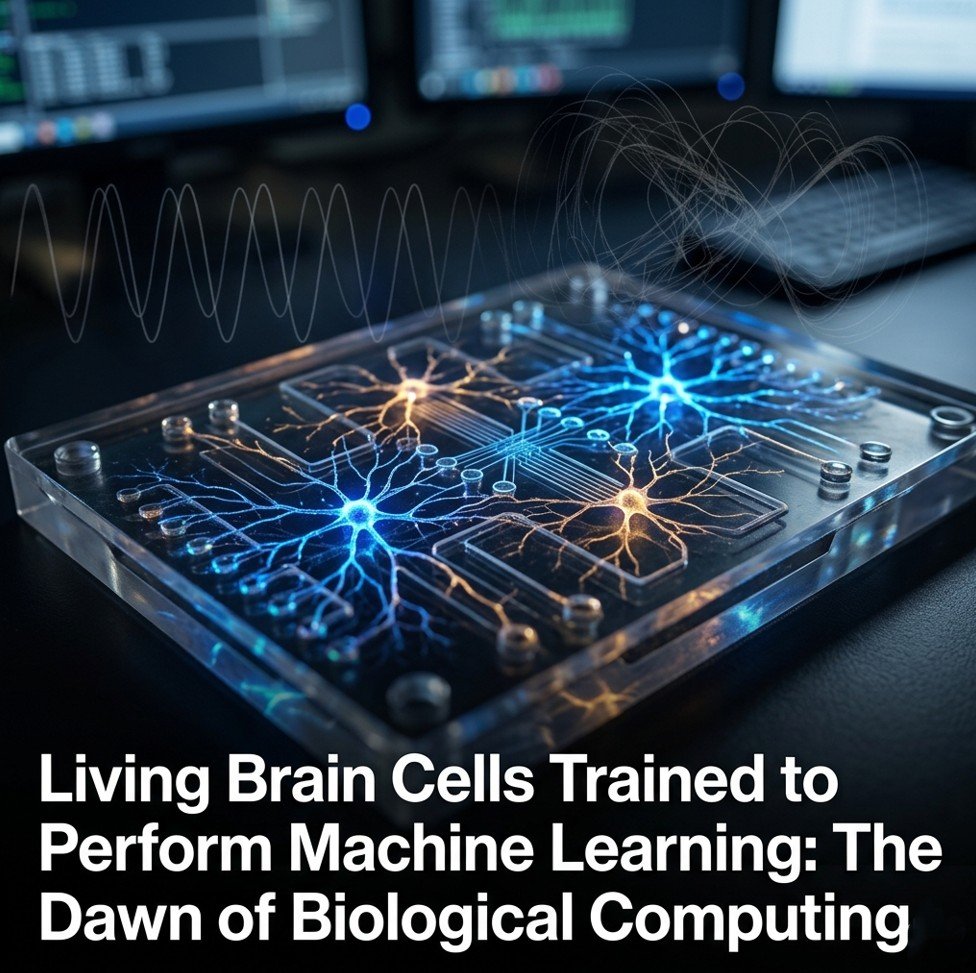
A research team led by Professor Hideaki Yamamoto at Tohoku University, in collaboration with Future University Hakodate, demonstrated that cultured rat cortical neurons can be trained to perform supervised temporal pattern learning — a task previously reserved for artificial systems. The study, published in PNAS on March 12, 2026, bridges neuroscience and machine learning in a way that had never been attempted before.
The key innovation lies in a technique called FORCE learning (First-Order Reduced and Controlled Error). FORCE learning allows artificial systems to adapt in real time by continuously adjusting output signals in response to errors. It has been used to train artificial neural networks to generate complex time-series patterns, from periodic signals to chaotic trajectories.
The question was whether the same approach could work on living neurons. Until now, no one had tried.
How to Train a Neuron: Microfluidics and FORCE Learning
The researchers constructed biological neural networks using cultured rat cortical neurons and incorporated them into a reservoir computing framework — a machine learning architecture particularly suited for processing time-dependent data. The neurons were grown on microfluidic devices that precisely guided their growth and controlled network connectivity, preventing excessive synchronization and promoting the rich, high-dimensional dynamics required for effective computation.
Then came the training. By applying FORCE learning to optimize the system’s readout layer, the team successfully trained the biological networks to produce complex temporal signals comparable to those involved in motor control. The results were remarkable: the living neurons generated sine waves, triangular waves, square waves, and even chaotic trajectories such as the Lorenz attractor. The network demonstrated flexibility by learning and stably reproducing sine waves with periods ranging from four to thirty seconds within the same system.
“This work shows that living neuronal networks are not only biologically meaningful systems but may also serve as novel computational resources,” Yamamoto said. “By bridging neuroscience and machine learning, we are opening a pathway toward new forms of computing that leverage the intrinsic dynamics of biological systems.”
For a deeper understanding of how artificial intelligence is reshaping research across disciplines, see our previous analysis of AI breakthroughs in the 2026 economy.
Frequently Asked Questions
Q1: Can living brain cells really perform machine learning computations?
Yes, but with important caveats. Cultured rat neurons were trained to generate specific temporal patterns using FORCE learning. This is proof-of-concept research, not a production-ready computing system.
Q2: What is reservoir computing and why does it matter for biological neurons?
Reservoir computing is a machine learning framework that processes time-dependent data using recurrent neural networks. It works particularly well with biological neurons because their natural dynamics create the complex, high-dimensional signals needed for computation.
Q3: What happens next in biological computing research?
Researchers aim to improve signal stability, reduce feedback delays, and refine the FORCE learning algorithm. The platform may also be expanded into microphysiological systems for drug testing and neurological disorder modeling.
Editor’s Analysis
1. Deep Reflections — What Does This Discovery Reveal About the Nature of Intelligence?
This research forces a fundamental question: what is computation? For decades, we have treated computation as something that happens in silicon, guided by human-written algorithms. This study suggests that living neural tissue, with its intrinsic dynamics, can also perform computational operations — not just simulate them, but actually execute them.
What does this reveal about intelligence? It suggests that the boundary between biological and artificial information processing is more porous than we imagined. The same FORCE learning algorithm that trains artificial neural networks can, with appropriate interfaces, train living neurons. This implies that intelligence may be less about the substrate and more about the pattern of information flow and adaptation.
But the deeper question is one of scale. If a few hundred cultured rat neurons can be trained to generate sine waves, what could a full cortical column do? What could an entire organoid? The research opens a pathway toward hybrid systems that combine the energy efficiency and adaptability of biology with the programmability of silicon.
2. Critical Analysis — How Solid Is the Evidence?
The methodology is robust. The study was published in PNAS, a peer-reviewed journal with rigorous standards. The sample involved cultured rat cortical neurons — a well-established model system in neuroscience. The researchers used microfluidic devices to control network connectivity, addressing a common criticism of earlier biological computing attempts (uncontrolled neuronal growth leading to chaotic, non-reproducible results).
However, several limitations must be acknowledged. First, this is an in vitro study. The neurons are cultured in a dish, not part of a living, behaving animal. It is unclear whether similar results could be achieved in vivo, where neurons are embedded in complex sensory and motor loops.
Second, the study demonstrates pattern generation, not genuine understanding or reasoning. The neurons are not “thinking” — they are being trained to produce specific outputs in response to specific inputs. This is machine learning in the narrow sense, not artificial general intelligence.
Third, stability remains a challenge. The researchers acknowledge that signal generation degrades after training concludes, and future work will need to improve long-term stability.
3. Cui Bono — Who Benefits From This Research Being Funded and Published?
The institutional incentives are clear. Tohoku University gains prestige as a leader in an emerging field. PNAS gains a high-impact paper that will be cited for years. The Japanese government, which has invested heavily in neuroscience and AI research, gains a return on that investment.
But there are commercial interests as well. The microfluidic devices used in the study have potential applications beyond research — they could become products for drug testing and neurological disorder modeling. Companies developing organ-on-a-chip platforms will watch this research closely.
Pharmaceutical companies also benefit. If this platform can be expanded into a microphysiological system for studying drug responses, it could reduce the need for animal testing and accelerate drug discovery. The researchers explicitly mention this as a future direction: the platform “may be expanded into a microphysiological system for studying drug responses and modeling neurological disorders”.
4. Distraction Analysis — What Bigger Issue Is This Story Crowding Out?
The excitement around biological computing risks distracting from a more mundane but equally important problem: the staggering energy consumption of current AI systems. Training a single large language model can consume as much electricity as a small town consumes in a year. The carbon footprint of the AI industry is growing faster than almost any other sector.
Biological computing offers a potential solution — living neurons are extraordinarily energy-efficient — but it is decades away from practical application. In the meantime, the AI industry continues to build ever-larger models with ever-larger environmental costs. Headlines about neuron-powered computers may distract from the urgent need to regulate AI energy consumption today.
The research also distracts from a more uncomfortable question: if living neurons can be trained like machines, what ethical constraints should apply? The neurons used in this study are rat neurons, not human neurons. But the logical next step — human cerebral organoids — raises questions that the research community is not yet ready to answer.
For a discussion of how AI technologies raise similar ethical questions about autonomy and control, see our article on AI agents and the future of work.
5. Who Does This Not Serve? — Who Is Silenced by This News Cycle?
The research narrative focuses on scientific breakthrough and technological potential. Who is left out?
First, the animals. The neurons came from rat pups. While the researchers followed ethical guidelines, the broader question of using animal tissue for computational purposes — treating living cells as disposable computing hardware — is rarely discussed in mainstream coverage.
Second, patients with neurological disorders. The researchers mention that their platform could be used to “model neurological disorders”. But the gap between a cultured neuron platform and a treatment for Parkinson’s or Alzheimer’s is enormous. Patients waiting for cures may be given false hope by breathless headlines.
Third, researchers working on non-biological approaches to energy-efficient computing. The funding ecosystem rewards novelty, and “living brain cells” is far more attention-grabbing than “improved analog computing architectures.” Researchers pursuing incremental but practical solutions may find themselves crowded out of the conversation.
Finally, the broader public. The gap between what this research actually demonstrates (cultured neurons can generate sine waves) and what the public might infer (computers will soon be powered by brains) is wide. Responsible science communication is needed, but the incentive structure of scientific publishing rewards hype.
Key Takeaways
- Researchers at Tohoku University successfully trained living rat neurons to generate complex temporal patterns using machine learning algorithms, marking the first demonstration of biological neural networks as computational resources.
- The study used FORCE learning within a reservoir computing framework, enabling neurons to produce sine waves, square waves, and chaotic trajectories — tasks previously reserved for artificial systems.
- The technology has potential applications in drug discovery, neurological disorder modeling, and energy-efficient computing, but remains at an early proof-of-concept stage.
- The research raises profound ethical questions about the treatment of living tissue as computational hardware and distracts from more immediate concerns about AI energy consumption.
Internal Links Used
- AI breakthroughs in the 2026 economy — placed in “How to Train a Neuron: Microfluidics and FORCE Learning” — relevance: Provides context on the broader AI landscape and how biological computing fits into ongoing technological trends.
- AI agents and the future of work — placed in “Distraction Analysis — What Bigger Issue Is This Story Crowding Out?” — relevance: Discusses ethical and societal implications of autonomous AI systems, parallel to questions raised by biological computing.
Sources
- Living Brain Cells Enable Machine Learning Computations — Tohoku University press release, April 3, 2026 — Primary source (university press release).
- Researchers Train Living Brain Cells To Perform a Pattern Learning Task — Technology Networks, April 7, 2026 — High-credibility science reporting.
- Online supervised learning of temporal patterns in biological neural networks under feedback control — Proceedings of the National Academy of Sciences, March 12, 2026 — Primary peer-reviewed study (PNAS, Vol. 123, No. 11, e2521560123).
- [Sono Y, Yamamoto H, Nishi Y, et al. Online supervised learning of temporal patterns in biological neural networks under feedback control. PNAS. 2026;123(11):e2521560123.] — Peer-reviewed journal article — Primary source with full author list and DOI.