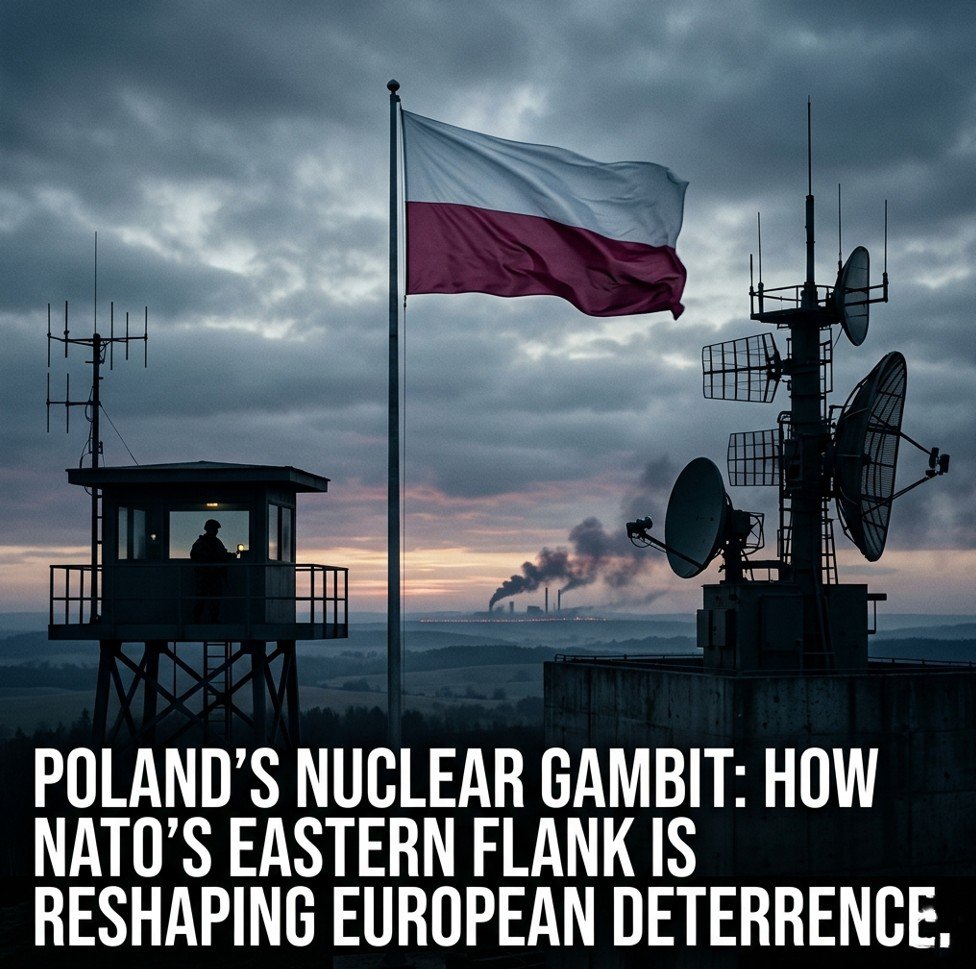
Lead: Polish leaders are demanding nuclear weapons under NATO sharing arrangements, signaling a historic shift in European security as US commitment to Article 5 erodes. (22 words)
Why Poland Is Breaking the Nuclear Taboo
Poland’s nuclear push did not emerge from a vacuum. It is the direct consequence of three converging crises that have shattered Warsaw’s post-Cold War security assumptions.
First, Russia’s full-scale invasion of Ukraine, now entering its fifth year, has demonstrated Moscow’s willingness to use military force against its neighbors. Russian tactical nuclear weapons have been deployed to Belarus, placing them within 100 kilometers of Polish territory. For Polish strategic planners, this is not a hypothetical threat — it is a deployed reality.
Second, the credibility of NATO’s Article 5 collective defense guarantee has been systematically undermined by former President Donald Trump. Trump has repeatedly threatened to withdraw from the alliance and is reportedly considering redeploying US troops within Europe as “punishment” for NATO members deemed unhelpful. Czech President Petr Pavel, a retired NATO general, warned that Trump “has done more to reduce the alliance’s credibility in the last few weeks than Vladimir Putin has managed in many years”.
Third, the transatlantic rift over the Iran war has exposed deep divisions. When Washington informally requested that Poland deploy its Patriot batteries to the Middle East, Warsaw refused, citing its own eastern flank defense needs. Polish Defense Minister Władysław Kosiniak-Kamysz stated plainly: “Our Patriot batteries and their armaments are used to protect Polish airspace and NATO’s eastern flank. Nothing is changing in this regard”.
For Poland, the message is clear: it can no longer assume American protection.
Poland’s Nuclear Ambitions: From Sharing to Ownership
The Polish debate has rapidly escalated from hosting allied nuclear weapons to developing an independent arsenal. This evolution reflects both opportunity and desperation.
President Karol Nawrocki has been the most vocal advocate. In early April, he told French television channel LCI that “Poland should become part of the Nuclear Fission program and have its own nuclear, energy and military capabilities”. Nawrocki has also stated that any future Polish nuclear arsenal would be “aimed at Russia”.
Prime Minister Donald Tusk, initially cautious, has moved toward embracing the nuclear option. In March, Tusk signaled that Poland “will eventually try to obtain its own nuclear weapons” as Europe strengthens deterrence amid doubts over US commitment. Poland has already signed a treaty with France opening the way toward potential protection from French nuclear missiles.
However, not all Polish leaders are aligned. Foreign Minister Radosław Sikorski has expressed skepticism about a “European nuclear umbrella,” arguing that NATO already provides nuclear deterrence. This internal disagreement reflects a deeper strategic uncertainty: should Poland rely on extended deterrence from allies, or build its own capability?
Jacek Bartoszczak, founder of the Polish think tank Strategy&Future, argues that Poland must stop thinking in Cold War terms. “Article 5 is a political statement of intent, not a mechanism for automatic military response,” he told Berliner Zeitung. “Poland must rely on itself — not in the sense of acting alone, but cooperating within realistic formats based on shared interests: with Ukraine, with the Nordic countries, with Turkey”.
Frequently Asked Questions
Q1: What would Poland hosting nuclear weapons mean for European security?
Hosting NATO nuclear weapons would make Poland a frontline nuclear state, raising tensions with Russia and potentially triggering a new arms race in Central Europe. It would also signal the erosion of the post-Cold War security order.
Q2: Could Poland actually develop its own nuclear weapons?
Developing an independent arsenal would violate the Nuclear Non-Proliferation Treaty and face severe international sanctions. Poland’s most realistic path is hosting allied warheads under NATO’s Nuclear Sharing program.
Q3: What happens next in the Polish nuclear debate?
Expect intensified negotiations with France and the US, domestic political battles over constitutional and legal frameworks, and a measured response from Moscow — likely hybrid warfare rather than military escalation.
Editor’s Analysis
1. Deep Reflections — What Does This Event Reveal About the World Order?
Poland’s nuclear push reveals that the post-1945 Western-led rules-based order is not merely under stress — it is actively being abandoned by its own members. When a country like Poland, which has been one of NATO’s most loyal and capable allies, begins publicly discussing nuclear armament, it signals that the foundational bargain of the alliance — the United States provides extended deterrence, and allies provide bases and political support — is no longer trusted.
What does this reveal about the international order? First, that nuclear deterrence remains the ultimate currency of sovereign security. Despite decades of arms control treaties and non-proliferation norms, states facing existential threats still turn to the bomb. Second, that US retrenchment — whether driven by domestic politics or strategic reorientation — produces cascading effects far beyond Washington’s control. Poland’s nuclear debate is a direct consequence of the perception that America is an unreliable security guarantor.
Third, and most importantly, this event reveals that European strategic autonomy remains a fiction. France’s nuclear arsenal is not a substitute for American extended deterrence. Germany remains paralyzed by its own strategic culture. Poland is reaching for nuclear weapons not because it wants them, but because it sees no other credible option.
2. Critical Analysis — What Is the Official Narrative Missing?
The dominant framing of Poland’s nuclear push focuses on Russia’s threat. This is not wrong, but it is incomplete. What the official narrative misses is the internal European dynamic: the failure of Western European powers to provide credible security guarantees to their eastern flank.
Germany’s strategic culture, as Bartoszczak notes, remains “rooted in the 20th century” — heavy tank brigades and Cold War platforms rather than drones, guided missiles, and mobile launchers. France’s nuclear umbrella proposal remains vague and conditional. The EU’s defense initiatives, while growing, are still measured in billions rather than trillions.
What gets omitted from mainstream coverage is the uncomfortable truth that Poland’s nuclear debate is also a political tool. Nawrocki’s rhetoric serves domestic electoral purposes, positioning him as the defender of Polish sovereignty against a weak and divided West. Tusk’s gradual embrace of the nuclear option allows him to co-opt nationalist security themes while maintaining pro-European credentials.
3. Cui Bono — Who Benefits From This Story Being Told This Way?
The “Poland needs nuclear weapons” narrative serves multiple interests simultaneously.
For Poland’s right-wing opposition (Law and Justice), the narrative reinforces their critique of Tusk’s government as weak on security and too deferential to Brussels and Berlin. Every public statement about Polish vulnerability is political currency.
For France, Poland’s nuclear anxiety strengthens Macron’s argument for European strategic autonomy and French nuclear leadership. If Poland is begging for protection, France can demand greater European defense integration in return.
For the US defense industry, an expanded nuclear sharing arrangement means new delivery systems, upgraded infrastructure, and long-term maintenance contracts. The same industry that profits from the Ukraine war sees Poland as the next growth market.
For Russia, the Polish nuclear debate is a propaganda gift. Moscow can point to Polish “nuclear aggression” to justify its own deployments in Belarus and Kaliningrad, while using the debate to divide NATO and weaken European unity.
Who loses? The Polish taxpayer, who will bear the enormous costs of nuclear infrastructure. European non-nuclear states, who see the non-proliferation regime eroding. And ordinary citizens on both sides of the border, who face increased strategic risk with no corresponding increase in safety.
4. Distraction Analysis — What Is This Story Covering Up?
The intense focus on nuclear weapons distracts from more immediate and solvable problems in Polish and European defense.
First, conventional defense gaps. Poland’s ambitious plan to field 300,000 active-duty troops by 2039 is impressive, but equipment, training, and logistical shortfalls remain. A nuclear conversation that should take years is being rushed in a few months.
Second, hybrid warfare vulnerabilities. Russia’s primary threat to Poland is not nuclear — it is disinformation, cyberattacks, energy blackmail, and the instrumentalization of migration. The EU’s eastern border regions are facing a new “iron curtain” of reduced mobility, trade restrictions, and hybrid pressure. Nuclear weapons do not solve any of these problems.
Third, democratic backsliding and institutional weakness. While Polish leaders debate nuclear strategy, the rule of law, judicial independence, and media freedom remain contested domestic battlegrounds. Tusk has warned that “Polexit” is a “real threat” from right-wing forces. A country that cannot guarantee its own democratic institutions is poorly positioned to manage nuclear command and control.
5. Who Does This Not Serve? — Who Is Silenced by This News Cycle?
The nuclear debate, like all great power security discussions, systematically excludes the voices of those who bear the risks without sharing the benefits.
Polish civil society — judges, journalists, and NGOs defending institutional independence — finds its concerns about democratic backsliding crowded out by security rhetoric. Every headline about nuclear weapons pushes their struggles further down the news agenda.
Ukrainian refugees, now in their fourth year of displacement, navigating uncertain legal status and growing social hostility despite their economic contribution to Poland, are invisible in this debate. Their presence is treated as a security variable, not a human reality.
Workers in declining Polish regions left behind by Warsaw-centric economic growth — the coal miners of Silesia, the factory workers of Łódź — see their futures sacrificed on the altar of strategic necessity. Nuclear infrastructure will be built in prosperous areas, not in the places that need investment most.
And finally, the civilians of Kaliningrad and Belarus, who would be on the receiving end of any Polish nuclear posture, have no voice in this discussion at all. Their lives would be the first casualties of a Central European nuclear arms race.
Who does this serve? The political class in Warsaw, the defense industry in Washington and Paris, and the strategic planners in Moscow who benefit from a divided and anxious Europe. Who does it not serve? Everyone else.
Key Takeaways
- Poland’s push for nuclear weapons under NATO’s Nuclear Sharing program is driven by eroding US security guarantees and Russian nuclear deployments in Belarus.
- President Nawrocki and Prime Minister Tusk have both signaled support for an independent Polish nuclear capability, though Foreign Minister Sikorski remains skeptical.
- The nuclear debate distracts from critical conventional defense gaps, hybrid warfare vulnerabilities, and domestic democratic challenges.
- Russia, France, and the US defense industry all benefit from the narrative of Polish nuclear vulnerability.
Internal Links Used
- NATO defense spending Europe 2026 record — placed in “Why Poland Is Breaking the Nuclear Taboo” — relevance: Provides context on European defense spending increases that underpin Poland’s security concerns.
- Rearm Europe: EU defense spending Germany Poland 2026 — placed in “Critical Analysis — What Is the Official Narrative Missing?” — relevance: Discusses EU defense initiatives and their limitations, directly relevant to Poland’s nuclear push.
Sources
- A New Era: Europe prepares for war – Poland wants nuclear weapons — International Affairs, April 11, 2026 — Credibility: Expert analysis from Russian international affairs outlet.
- “I know Putin’s negotiating style, we are facing hybrid warfare,” the Polish president demands that his country be equipped with nuclear weapons — Botasot, April 3, 2026 — Credibility: Direct quotes from President Nawrocki.
- Poland hopes for more US troops as Trump threatens NATO exit — TVP World, April 10, 2026 — Credibility: Polish public broadcaster.
- Poland Rejects Patriot Deployment Amid Iran War, Emphasizes NATO Eastern Flank — Israel Defense, April 6, 2026 — Credibility: Defense industry publication with direct quotes from Polish Defense Minister.
- Poland will eventually seek its own nuclear weapons, Tusk says — Japan Times, March 4, 2026 — Credibility: International news outlet with Tusk quotes.
- Poland’s mass-army turn is reshaping NATO’s eastern flank — The Strategist (ASPI), February 9, 2026 — Credibility: Australian Strategic Policy Institute, respected defense analysis.