
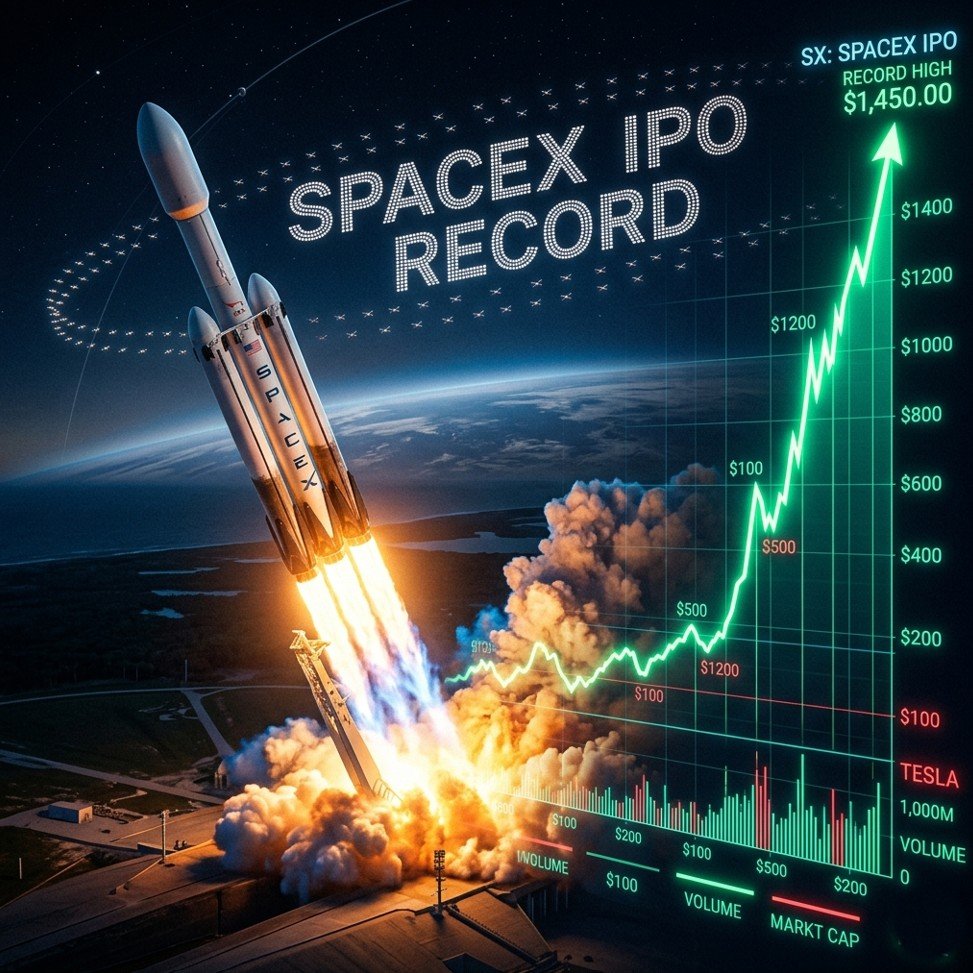
LEAD: SpaceX has confidentially filed for an initial public offering (IPO) that targets a staggering $1.75 trillion valuation, setting the stage for what could be the largest and most consequential stock market debut in history.
The Dawn of ‘Project Apex’
The space economy has officially entered a new era. In a move that has sent seismic waves through global financial markets, Elon Musk’s SpaceX has submitted confidential draft registration documents to the U.S. Securities and Exchange Commission (SEC), signaling its intent to go public. The offering, internally code-named “Project Apex,” is expected to take place as early as June 2026, with a targeted valuation of approximately $1.75 trillion. If successful, this SpaceX IPO record would not only dwarf all previous listings but also fundamentally redefine what constitutes a “mega-cap” technology company.
The sheer scale of the operation is unprecedented. Reports indicate that SpaceX is working with a syndicate of at least 21 global banks to manage the offering. Major financial institutions, including Morgan Stanley, Goldman Sachs, JPMorgan Chase, and Bank of America, have been appointed as lead bookrunners. They are joined by a supporting cast of global players such as Barclays, Deutsche Bank, UBS, Wells Fargo, Banco Santander, and the Royal Bank of Canada. This massive underwriting syndicate highlights the complexity of the listing, which aims to raise up to a staggering $75 billion—more than double the previous record held by Saudi Aramco.
The move represents a dramatic reversal of Musk’s long-standing position. For years, the billionaire entrepreneur had publicly stated that SpaceX would not go public until the company had successfully established a city on Mars. However, the immense capital requirements of its current ventures—including the Starship heavy-lift launch system and the Starlink satellite network—have seemingly forced a strategic recalibration.
Starlink: The Financial Engine
While the romantic allure of interplanetary travel captures the public’s imagination, the financial reality of the SpaceX IPO record is grounded firmly in Earth’s orbit. The $1.75 trillion valuation is primarily anchored by Starlink, the company’s rapidly expanding satellite internet constellation. As of February 2026, Starlink had surpassed 10 million paying subscribers, a monumental leap from the 9.2 million reported at the end of 2025.
This subscriber growth has translated into explosive revenue. After generating over $10 billion in revenue in 2025, analysts at Bloomberg and Quilty Space project that Starlink’s revenue could surge to between $15.9 billion and $24 billion in 2026. This cash flow is critical, as the satellite network now comprises over 10,000 satellites that require constant replenishment and technological upgrades.
Furthermore, the financial architecture of SpaceX has been supercharged by its recent merger with Musk’s artificial intelligence venture, xAI, valued at $1.25 trillion. This integration transforms SpaceX from a pure-play aerospace manufacturer into a diversified tech conglomerate. The Starlink network is increasingly viewed not just as an internet service provider, but as the physical backhaul layer for a decentralized AI computing network. This convergence of space infrastructure and artificial intelligence is a primary driver of the “AI premium” embedded in the current valuation.
Global Market Implications
The announcement has already triggered significant ripple effects across the geopolitical and financial landscapes. Traditional aerospace giants like Boeing and Lockheed Martin are facing a new reality, as a commercial entity now commands a market capitalization that rivals the entire defense industrial base. The proposed valuation would rank SpaceX above every S&P 500 company except Nvidia, Apple, Alphabet, Microsoft, and Amazon.
For global investors, the offering represents a once-in-a-generation opportunity to gain direct exposure to the space economy. However, the confidential filing process means that full financial transparency is still weeks away. The SEC’s confidential filing rules allow SpaceX to submit its draft registration for review without immediate public disclosure. A public S-1 prospectus is expected in April or early May, which will reveal the company’s financial health for the first time, including detailed subscriber economics, profitability metrics, and the integration costs associated with xAI.
The reaction has not been universally positive. Some market analysts have expressed concerns about valuation euphoria, drawing parallels to the speculative excesses of the late-1990s dot-com bubble. Critics argue that the $1.75 trillion price tag requires a level of growth and market penetration that is far from guaranteed, especially as competitors like Amazon’s Project Kuiper prepare to launch their own satellite constellations.
Editor’s Conclusions
The SpaceX IPO is far more than a financial transaction; it is a definitive signal that the era of space exploration as the exclusive domain of nation-states is over. The private sector, led by a single charismatic and controversial figure, is now poised to control the orbital infrastructure of the 21st century. This transition brings with it a complex web of opportunities and existential risks that investors and policymakers must now confront.
Firstly, the centralization of power is a critical concern. While SpaceX has democratized access to space through reusability, the impending IPO creates a massive financial incentive to prioritize shareholder returns over scientific exploration or global connectivity equity. If Starlink becomes a profit-maximizing monopoly in low-Earth orbit, the dream of a universally connected planet could devolve into a tiered service model where connectivity is a commodity for the wealthy. Furthermore, the integration with xAI raises profound questions about data governance. Who controls the AI processing data flowing through the Starlink network? A publicly traded company with a fiduciary duty to maximize profits may not align with the public interest regarding data privacy and security.
Secondly, the geopolitical chessboard is shifting. The United States has long relied on its technological superiority in space as a cornerstone of national security. With SpaceX now becoming a public entity, its operations will be subject to quarterly earnings cycles and activist investors. This could potentially introduce volatility into a sector that demands long-term, strategic patience. For Europe and China, this move serves as a massive wake-up call. The European Union’s efforts to create its own sovereign satellite constellation, IRIS², now face a competitor with near-limitless access to private capital. China, on the other hand, will likely accelerate its state-backed commercial space programs, viewing the SpaceX valuation as a direct challenge to its technological ambitions.
Finally, for the average citizen, this marks the moment the “final frontier” becomes a line item on a corporate balance sheet. The success of the offering will likely trigger a flood of capital into other space-related ventures, from asteroid mining to orbital manufacturing. We are witnessing the birth of a genuine space economy, but it is an economy being built on the templates of Silicon Valley—disruption, scale, and winner-take-all dynamics. As we prepare for the S-1 filing, one thing is clear: the gravity of this event will be felt on Earth for decades to come.
Executive Summary
- Record Valuation: SpaceX aims for a $1.75 trillion IPO (Project Apex), potentially raising $75 billion and dwarfing all previous listings.
- Starlink Engine: The satellite internet division drives the valuation with over 10 million subscribers, projected to generate up to $24 billion in revenue in 2026.
- AI Integration: The merger with xAI creates a unique space-AI conglomerate, raising new questions about data governance and market dominance.
Sources
- Bloomberg, CNBC, Reuters: SpaceX Confidentially Files for IPO — A primary source from leading financial news wires confirming the SEC filing and the $1.75 trillion target.
- Moneycontrol: SpaceX taps 21 banks for ‘Project Apex’ IPO — Provides detailed information on the underwriting syndicate, including lead managers and supporting global banks.
- TipRanks: SpaceX Targets Record-Breaking $1.75 Trillion Valuation — Analyzes the financial mechanics of the offering and the strategic implications of the xAI merger.