
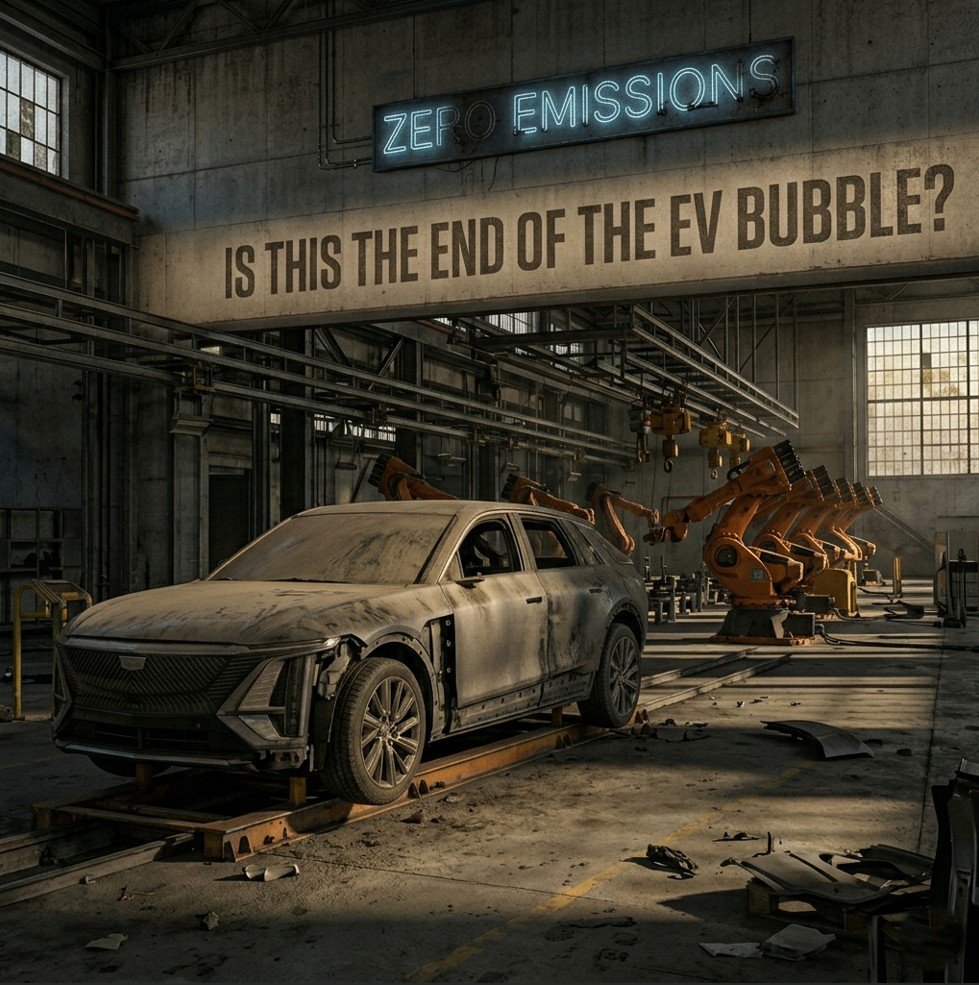
The crisis in the EV market just got a new, very clear symbol. General Motors, once a proud pioneer of the electric revolution, is extending the shutdown of its flagship electric vehicle factory, Factory Zero in Detroit. 1,300 workers have been sent on involuntary leave, and production of iconic models like the Hummer EV and Silverado EV has ground to a halt. Is this just a temporary correction, or the first symptom of a bursting EV bubble?
General Motors Halts Production – Facts and Figures
General Motors announced that the shutdown at the Factory Zero plant, which began on March 16, will be extended until April 13. This decision directly affects approximately 1,300 workers who have been temporarily laid off. This is the second such incident in just a few months – in January, the company sent another 1,200 people on leave at the same facility. In total, nearly 3,500 workers have been laid off from Factory Zero alone over the past year, according to The Truth About Cars.
The official stance of the conglomerate is cautious: “Factory ZERO will temporarily adjust production to align EV production with market demand,” GM spokesperson Kevin Kelly said, adding that affected employees will be placed on a temporary layoff and may be eligible for sub-pay and benefits under the GM-UAW national contract. However, the facts speak for themselves. The plant, which manufactures the GMC Hummer EV, GMC Sierra EV, Chevrolet Silverado EV, and Cadillac Escalade IQ, has experienced numerous production stalls since April 2025. Operations were previously idled for about a month heading into November 2025, and another shift was cut on January 5, 2026.
For context: over $2 billion was spent converting the century-old Detroit-Hamtramck Assembly plant into the modernized “Factory Zero.” Last year alone, General Motors reported spending around $7 billion globally drawing down EV operations due to insufficient demand — not money spent on new facilities, but money spent addressing how poorly the electrification strategy had been executed.
To understand the scale: In all of 2025, just under 46,000 electric vehicles were registered in Poland, representing a 177 percent increase, mainly due to the “NaszEauto” program. Meanwhile, GM alone in the US took $6 billion in EV charges in the fourth quarter of 2025 alone. This shows how dramatic the collapse is overseas.
Why Are Electric Vehicles No Longer Selling?
The main culprit is politics. On September 30, 2025, the federal $7,500 tax credit for new EV purchases expired. Its absence, combined with still-high vehicle prices and economic uncertainty, has cooled consumer enthusiasm. According to data from Cox Automotive, US new battery-electric vehicle registrations declined by 28 percent year-on-year in the first quarter of 2026, reaching just 212,600 units – down from 296,304 in Q1 2025. EV market share fell to an estimated 5.8 percent of total new vehicle sales, well below the 7.5 percent peak reached in Q3 2025.
The impact is already evident across dealer lots: battery-electric vehicles currently sit on dealer lots for an average of 130 days, compared to 89 days for internal combustion models. Each additional day in inventory increases costs for dealers and leads to higher discounting to clear stock. Average transaction prices for new EVs fell to $55,300 in February, narrowing the price gap to comparable petrol models to an all-time low of $6,500.
Ford’s EV sales tell an even grimmer story. In Q1 2026, Ford’s electric vehicle sales reached just 6,860 units — a staggering decline of 69.6 percent year-over-year. Toyota, by contrast, quietly introduced three new electric SUVs and managed to sell more EVs in the US than Ford with just one model.
The situation looks no better globally. Global EV battery usage from January to February 2026 posted only 4.4 percent year-on-year growth — a dramatic slowdown from previous years. The three major South Korean battery makers all experienced negative growth, with Samsung SDI down 21.9 percent, SK On down 12.9 percent, and LG Energy Solution down 2.7 percent. This is directly attributed to the 29.8 percent plunge in EV sales in the US market.
Tesla Stands Alone as Winners and Losers Emerge
While the broader industry collapses, Tesla is quietly winning. The company delivered 122,196 units in Q1 2026, capturing a 57.5 percent market share. While the overall BEV market contracted by 28 percent year-on-year, Tesla’s volumes declined by just 4.6 percent. This suggests that the problem is not with EVs themselves, but with legacy automakers’ inability to produce them profitably.
Meanwhile, the used EV market tells an entirely different story. Used EV sales surged 12 percent to 93,500 units in Q1 2026, with prices now just $1,300 above comparable gas vehicles. Used EVs turn in an average of 42 days on dealer lots — only four days longer than gas cars. The wave of EVs leased under the IRA’s “leasing loophole” between 2023 and 2025 is now starting to hit dealer lots, creating what may be the best buying opportunity in the history of electric vehicles.
European Headwinds: Euro 7 Looms
While US EV demand craters, European manufacturers face a different but equally pressing challenge. From November 29, 2026, new Euro 7 regulations will impose, for the first time, limits on particulate emissions from brake abrasion. Light electric vehicles must not exceed 3 mg/km, while all other light vehicles are capped at 7 mg/km.
This is a monumental challenge. According to AVL, a leading engineering consultancy, broad variations in PM10 emissions across current vehicles range from 6 mg/km to more than 20 mg/km. On certain vehicles, even a single front brake emits more than an entire vehicle is permitted under Euro 7. Suppliers like Brembo have responded by developing new Greentell discs and pads that reduce braking emissions by nearly 90 percent, but compliance remains a race against time.
Editorial Analysis – Deep Reflection on the State of the Industry
This section is the intellectual core of the article, written from the perspective of an editor-in-chief who is not afraid to ask difficult questions and draw uncomfortable conclusions.
1. Deep Reflection – What Does This Say About the Automotive World?
What we are witnessing at Factory Zero is not just a simple market correction. It is a symbolic crack in the foundation upon which the narrative of a smooth and immediate electrification was built. For years, we were told that consumers were ready for the change. It turns out they were mainly ready for a $7,500 discount.
Above all, this exposes corporate hypocrisy. For the last three years, every car manufacturer has been racing to announce “zero-emission” target dates and massive investments. Today, when subsidies have dried up and the economy has slowed, those same manufacturers are hastily scaling back their ambitious plans. This shows that the transformation was driven not by ecology or market desire, but primarily by tax credits and regulations. The car, instead of a symbol of freedom, has become a hostage to fiscal policy and the shifting moods in Washington.
Secondly, this is a lesson in the gap between elites and ordinary people. The middle class, which forms the core of the automotive market, does not want to spend $60,000 on a car that requires planning routes around charging stations and loses half its value in two years. The numbers prove it: with new EV prices averaging $55,300, the market has simply priced out the average American family.
2. Critical Analysis – Are the Numbers Real?
Let’s ask ourselves a fundamental question: are these losses real, or is it creative accounting? GM announces $6 billion in EV losses while simultaneously expecting a “benefit” of $1 billion to $1.5 billion from “the actions taken to rightsize EV capacity”. In other words: we’re laying people off because we’re not selling cars, but we’re making money from the layoffs.
This is a classic game on Wall Street. Wall Street has long punished manufacturers for low margins. By closing the plant and sending people on leave, GM improves its efficiency metrics in the eyes of investors. GM’s shares were up modestly on Monday, April 6. The truth, therefore, is this: the crisis in the EV market is profitable for GM shareholders, who prefer higher dividends over full employment.
Furthermore, the real-world performance of EVs remains questionable. Reports of underpowered Ultium platforms, unreliable infotainment systems that completely brick, major charging issues, and nerfed towing capabilities have surfaced from early adopters. Has GM ever admitted that Hummer EV sales are falling because customers discovered that in winter conditions, the battery might only last 250 km instead of 500? Of course not. The official narrative always talks about “adjusting to demand.”
3. Cui Bono – Who Benefits?
Paradoxically, battery manufacturers are not losing from the EV market collapse — at least not yet. Companies like CATL continue to expand their market share globally, while South Korean competitors struggle. However, the broader battery industry is in turmoil. 24M Technologies, a $1 billion battery startup founded in 2010, is shutting down and auctioning off its property. Natron Energy, a leading sodium-ion startup, shut down in September 2025. Ample, an EV battery-swapping company, filed for bankruptcy in December 2025.
Software producers benefit from every factory closure as a pretext for further automation. Instead of 1,300 workers, Factory Zero will employ far fewer people in five years’ time.
Finally, the oil lobby benefits. Every piece of negative EV news boosts the stock prices of ExxonMobil or Chevron. The more people’s thoughts return to internal combustion engines, the longer refineries will work at full capacity.
4. Distraction Analysis – What Are They Distracting From?
While the media screams “EV crisis” at GM, few notice that Tesla has just demonstrated that profitable EV production is possible. The problem is not the entire industry’s problem – it is a problem of the old guard, which cannot produce electric vehicles at a profit.
GM is distracting from its own technological incompetence. Ultium, their battery platform shared by 17 vehicles — eight of which are higher-priced premium nameplates including Hummer and Cadillac — was supposed to reduce costs through platform volume. But a mystery contractor is clearly failing on module and pack assembly, in addition to software issues.
Furthermore, the discussion about Factory Zero effectively masks the fact that prices of new internal combustion cars are also rising. The US light vehicle market fell 6.5 percent to 3.67 million units in Q1 2026, with a SAAR of 15.5 million.
5. Who Loses?
The obvious victims are the workers. 1,300 families in Detroit suddenly lose their source of income. UAW Local 22 President James Cotton tried to remain optimistic: “I just hope we can bounce back, especially when gas prices are rising. I think EVs are the future”. But the present is brutal.
In a broader context, consumers in poorer countries lose. If manufacturers retreat from expensive EVs, they will not invest in cheap electric vehicles for emerging markets. Residents of Africa or South America will be condemned to used diesels imported from Europe for another decade.
Small installation companies and workshops specializing in EVs, which mushroomed like mushrooms after the rain with subsidies, also lose. When the factories are idle, their workshops become empty too. This is a classic domino effect that no one is talking about.
Key Conclusions
GM’s decision to extend the shutdown at Factory Zero is not the end of electromobility, but it is certainly the end of its naive phase. The era where simply announcing an EV was enough to get a subsidy and applause is over. We are entering a brutal, capitalist verification phase: profitability, range, and price are what matter. Those who cannot meet these challenges – so far, GM – will pay a huge price. The rest of the market is watching with bated breath to see if they will be next.
Sources
- The Truth About Cars – Factory Zero: GM Idles Electric Truck Plant Again (2026-04-01) – high credibility, specialized automotive portal.
- Yahoo Finance / TheStreet – GM forced to make tough decisions as EV market collapses (2026-04-07) – high credibility, reporting facts and market data.
- electrive.com – *Post-incentive slump: US EV sales down 28%* (2026-03-30) – high credibility, industry data from Cox Automotive.
- Electrek – New EV sales drop 28% in Q1 2026, but used EVs surge 12% (2026-03-27) – high credibility, detailed Cox Automotive analysis.
- SNE Research – *Global EV Battery Usage Jan-Feb 2026* (2026-04-07) – high credibility, specialized battery market research firm.
- MIT Technology Review – Brutal times for the US battery industry (2026-03-12) – high credibility, respected technology publication.
- Automotive World – Time is running out for Euro 7 brake compliance, says AVL (2025-10-27) – high credibility, industry expert source.
- S&P Global – Euro 7 emission standards set to redefine the auto brakes market (2026-03-06) – high credibility, global market intelligence firm.
- Electrek – Toyota sold more EVs in the US than Ford in Q1 (2026-04-02) – high credibility.
- Business Korea – LG Energy Solution Delays Operation of Michigan Plant (2026-01-02) – high credibility.