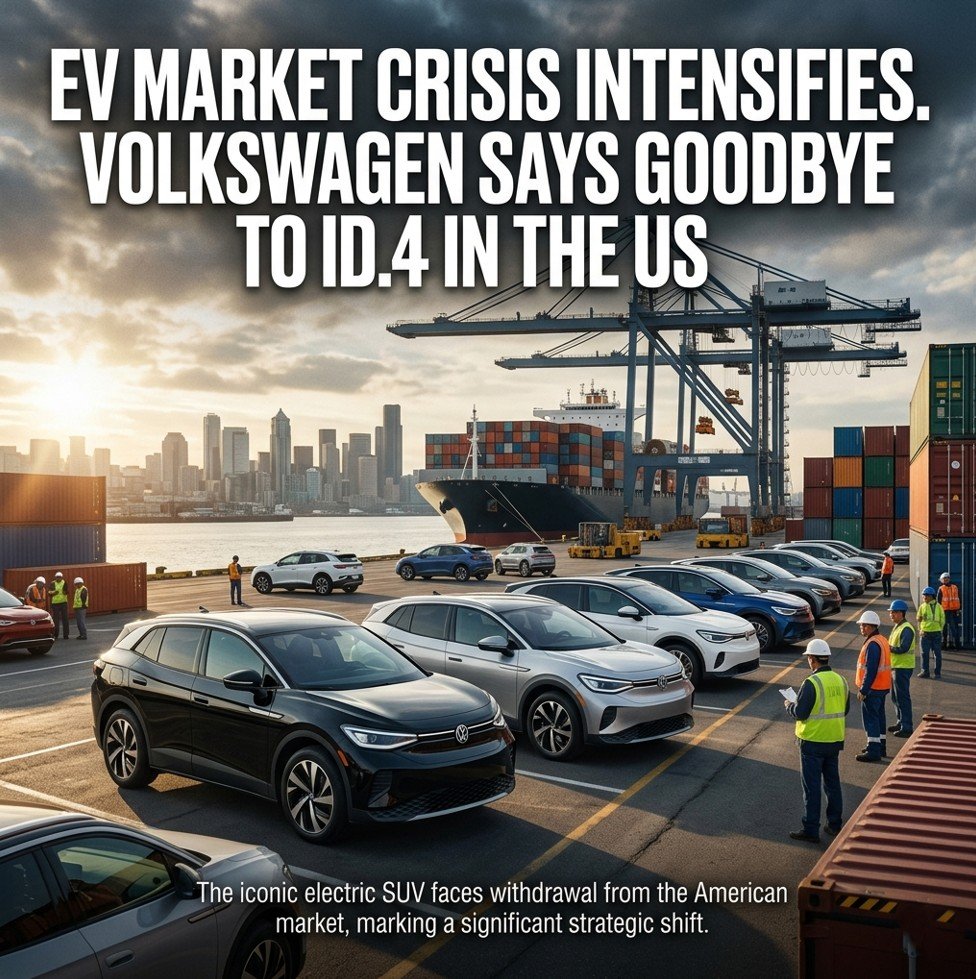
LEAD: Volkswagen has ended production of its only electric SUV, the ID.4, at its Chattanooga plant, shifting resources to the gasoline-powered Atlas – a telling sign of the deepening EV market crisis in the United States.
Plummeting Sales and End of Tax Credits Sink the EV Market
Volkswagen’s decision is not an isolated incident. It is the latest proof that the US electric vehicle market has entered a phase of deep contraction. According to Cox Automotive data, in the first quarter of 2026, new EV sales in the US fell by 27% year-over-year, to just 216,000 units. This is a dramatic drop after years of dynamic growth.
The main cause is the withdrawal of the $7,500 federal tax credit, which expired in September 2025. That credit was a key demand driver, especially for more expensive models. After its removal, many manufacturers faced the reality that their EVs had simply become too expensive for the average consumer. As a result, most brands saw drastic sales declines. Ford lost 70%, BMW over 60%, and Volkswagen’s EV sales collapsed by nearly 90%.
The Volkswagen ID.4, produced in Chattanooga since 2022, was the brand’s only electric model built in the US. In 2025, 22,373 units were sold, a 31% increase over the previous year. Still, that figure pales next to the gasoline Atlas, which sold over 71,000 units in the same period. ID.4 production will end in mid-April 2026, and the car will be available in showrooms until stocks run out, which are expected to last until 2027. The Chattanooga plant will now focus on producing the new, gasoline-powered 2027 Atlas.
Tesla Strengthens Dominance as the Rest of the Market Shrinks
The only bright spot in this grim picture is Tesla. Elon Musk’s company sold 117,300 EVs in the first quarter of 2026, giving it a 54% share of the US market. The Model Y, with nearly 79,000 deliveries, is the best-selling EV in the US and accounts for 28% of all electric cars sold. Tesla, despite an 8% drop in global first-quarter sales, is consolidating its position while competitors retreat.
This phenomenon confirms a brutal truth: without subsidies, most EV producers lack the scale to achieve profitability. Those without Tesla’s entrenched position are losing the battle for customers.
Editorial Analysis
Volkswagen’s decision to pull the ID.4 from US production is more than just a model lineup change. It is a symbolic blow to the myth of an inevitable electric revolution and a signal that the EV market crisis has deep, structural causes. Let’s examine it closely.
Deep Reflection – What Does This Say About the Automotive Industry?
This event reveals a fracture at the very heart of the automotive industry. For years, we have been fed a narrative of an inexorable shift to electromobility, driven by regulations, subsidies, and producer ambitions. Yet reality is proving far more complex. The customer, especially in the US, does not want to pay more for a product they perceive as inferior. A gasoline SUV is cheaper, has greater range, and is easier to refuel. This shows that the car as a symbol of freedom and convenience still wins over the car as an ecological but more expensive and less practical product. Moreover, the gap between old and new players is stark. Tesla, a native-EV company, has not only survived but thrived in the crisis. Meanwhile, traditional giants like Volkswagen, who announced billions in EV investments, retreat as soon as external support disappears. This shows that transformation is not about declarations, but about real market power and the ability to compete on costs.
Critical Analysis – Do the Numbers Hold Up Against Reality?
Official press releases and sales data require a critical eye. ID.4 sales grew 31% in 2025, but that was from a very low base after a disastrous 2024 (a 55% drop). In reality, the ID.4 never regained its 2023 sales peak, when over 37,000 units were sold. Volkswagen boasted of being the best-selling EV brand in Europe in 2025, but in the US its results are catastrophic. This shows how different markets are and that success on one continent does not automatically translate to another. Furthermore, manufacturers often operate with registration data, which can be inflated by fleets and rental companies. True retail demand may be even weaker. VW’s decision to end production despite rising sales is a telling sign that those numbers are not enough to sustain profitability.
Cui Bono – Who Really Profits From This?
The EV market crisis primarily benefits manufacturers of internal combustion and hybrid vehicles. Volkswagen is shifting precisely in that direction, and the new Atlas will be a priority. Producers already offering attractive hybrids, like Toyota (which posted a 79% EV sales increase, albeit from a small base), also gain. In this context, Tesla also wins, consolidating its dominance. Its scale and margins are hard to compete with. Geopolitically, the crisis in the US may benefit China, which remains the world’s largest and most dynamic EV market. Chinese manufacturers like BYD continue their expansion while the American and European EV industries slow down.
Distraction Analysis – What Is This News Distracting From?
Frenzied reports of EV pullouts may be distracting from Volkswagen’s own deeper problems. The company is struggling with enormous transformation costs, software issues (which have plagued the ID.4), and falling profitability. Instead of focusing on these difficulties, it communicates that “the market is unpredictable.” Moreover, the media may focus on EV “failure,” distracting from rising fuel prices, which in the long term could make electric cars attractive again. VW’s decision is also a convenient cover for delays in rolling out the next-generation battery platform (SSP) and its own cells, which were supposed to be groundbreaking.
Who Loses?
Losses are unevenly distributed. Obviously, ID.4 production line workers in Chattanooga lose, as they will be transferred or take buyouts. But the losses go deeper. Consumers who would like to buy an affordable EV have less choice. In the US, the removal of the tax credit and the withdrawal of models hits lower-income individuals who cannot afford to pay a premium for the technology. Long-term, the entire North American EV supply chain loses – from battery makers to charging companies. The credibility of the entire “Green New Deal” narrative for transport also suffers. Politicians who pushed ambitious electrification goals must now answer for market realities.
Key Takeaways
- End of subsidies = end of growth. The US EV market is contracting sharply after the tax credit expired, showing its dependence on public support.
- Tesla remains the hegemon. While traditional automakers retreat from EVs, Tesla consolidates its dominance with an unassailable scale and profitability.
- A crisis of choice. Customers are rejecting more expensive, less practical EVs when cheaper, more convenient gas cars are available – a warning sign for manufacturers.
- An uncertain future. VW’s decision is not the end of EVs, but a painful collision with reality. Electromobility won’t die, but its growth will be slower, more uneven, and dependent on real demand, not regulations.
Sources
- Volkswagen Pulls the Plug on Its Lone US Electric SUV (moneytalksnews.com) — provides key ID.4 and Atlas sales data and VW’s official statement.
- EV bloodbath: US sales plunge as Tesla tightens its grip (businessinsider.com) — supplies data on the 27% drop in US EV sales in Q1 2026 and Tesla’s dominance.
- Volkswagen drops all-electric ID.4 in the US in pivot back to gas SUVs (TechCrunch) — details VW’s decision, the tax credit context, and future plans.
- The Tesla Model Y Is Still America’s Favorite EV—And It’s Not Even Close (Yahoo Autos) — confirms the market position of the Model Y and Tesla.