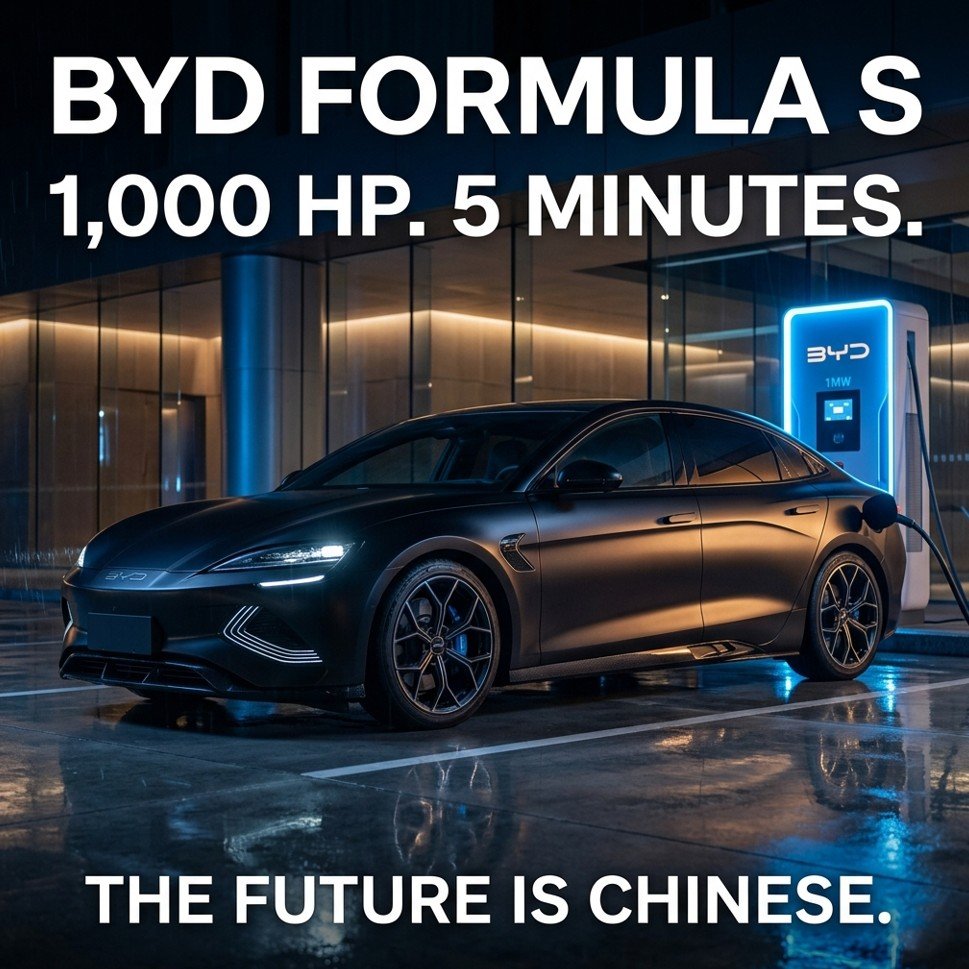
LEAD: BYD has unleashed its most formidable weapon yet in the global EV war — a 1,000-horsepower electric performance sedan paired with a continent-wide 1MW ultra-fast charging network that can deliver 400 km of range in just five minutes.
The Dragon Awakens: How BYD Redrew the Performance EV Map
The 2026 Beijing Auto Show will be remembered as the moment BYD stopped playing defence. On April 15, 2026, the company’s ultra-premium sub-brand Fang Cheng Bao — previously known for rugged, boxy off-road SUVs — unveiled the Formula S sedan series and the Formula X concept supercar. The crowd reaction at the National Exhibition and Convention Center was visceral; automotive journalists immediately labelled the Formula SL “the most astonishing sedan BYD has ever built.”
This launch matters far beyond China’s borders. BYD sold over 1.76 million New Energy Vehicles globally in Q1 2026, and its Fang Cheng Bao sub-brand is positioned squarely against Porsche, Lucid, and Tesla in the EUR 80,000–120,000 segment. The timing is deliberate: while Western legacy automakers struggle with profitability and factory consolidation — a crisis we examined when GM shut down a major EV production facility earlier this spring — BYD is accelerating into the premium vacuum they left behind.
The Formula S is not a concept. BYD confirmed the standard Formula S sedan launches in Q3 2026, with the extended Formula SL and Formula S GT shooting brake following into 2027. All three variants exceed five metres in total length. The Formula X supercar remains under development, with a 2027 market entry targeted.
The Numbers: 1,000 HP, 800V Architecture, and 1MW Charging
Strip away the drama and the Formula SL’s technical sheet is genuinely startling. The car sits on an 800-volt electrical architecture — the same voltage tier used by Porsche Taycan and Hyundai IONIQ 5 N — and deploys a triple-motor AWD powertrain producing a combined peak of 1,000 HP (approximately 745 kW). BYD has not yet officially published the 0–100 km/h time, but based on competing 1,000 HP tri-motor configurations (Tesla Model S Plaid: 2.1 seconds; Lucid Air Sapphire: 1.89 seconds), a sub-2.5-second sprint is almost certain.
The wheelbase measures 3,100 mm (122.1 inches) and total length reaches 4,978 mm (196 inches), placing the Formula SL directly against the Tesla Model S and Lucid Air Grand Touring in interior space. BYD’s proprietary DiSus-M magnetic suspension system — the same active air-magnetic platform found in its flagship BYD Han L and YangWang U9 — handles the chassis dynamics.
Critically, the Formula S uses BYD’s second-generation Blade Battery, built on a cobalt-free Lithium Iron Phosphate (LFP) chemistry. The 2nd-gen Blade supports the ultra-fast 1MW charging technology that BYD is simultaneously rolling out across Europe: 3,000 stations capable of 1,000 kW output by end of 2026, delivering 400 km of range in five minutes. For context, today’s fastest European chargers — including Ionity’s 350 kW network — need at least 15 minutes to achieve the same result.
The comparison with the sodium-ion chemistry explored in BYD’s thermal runaway firewall research is instructive: where sodium-ion solves safety and cost for mass-market vehicles, the 2nd-gen Blade pushes energy delivery rates into territory previously reserved for racing applications.
Industry Reactions and the European Stakes
European automakers are watching Beijing closely — and nervously. ACEA (the European Automobile Manufacturers’ Association) has repeatedly lobbied Brussels to maintain tariff barriers against Chinese EVs, with import duties currently standing at 17–45.3% on Chinese-made BEVs (depending on manufacturer), following the EU’s October 2024 definitive measures. BYD’s strategy around these duties is surgical: the Formula S is built in China and will absorb the tariff as a premium-segment luxury item, where margin compression is more tolerable.
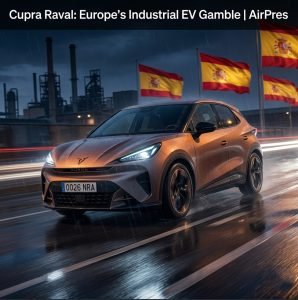
This directly mirrors the strategic dilemma facing European brands. Consider the CUPRA Raval’s precarious industrial bet on European EV manufacturing — a €50,000-plus urban EV hoping to compete on brand emotion rather than technology. BYD’s Formula S simply outguns it on every measurable axis for a comparable or lower price point in China (estimated CNY 500,000–700,000 / approximately EUR 65,000–90,000 before tariff).
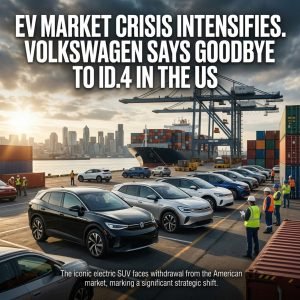
Analysts at S&P Global Mobility now project that Chinese premium EVs will capture 8–12% of the European luxury EV segment by 2028, up from under 2% in 2025. Meanwhile, Volkswagen’s ID.4 crisis in the US market illustrates precisely what happens when a legacy brand loses its technology narrative to faster-moving competitors.
Editorial Analysis: The 1,000-HP EV and What It Reveals About the World We’re Building
Deep Reflections — China’s Quiet Checkmate
The Formula S is not simply a fast car. It is a geopolitical statement. BYD Chairman Wang Chuanfu has consistently argued that the future of mobility belongs to whoever controls the battery supply chain — and he is winning that argument with hardware, not rhetoric. China controls approximately 80% of global lithium-ion battery manufacturing capacity and over 60% of the world’s cobalt refining infrastructure. The 2nd-gen Blade Battery’s cobalt-free LFP chemistry is a calculated answer to Western criticism about the ethics of cobalt mining in the Democratic Republic of Congo — but it also reduces China’s own strategic exposure to supply chain disruption.
The simultaneous rollout of 1MW charging infrastructure across Europe is equally calculated. BYD is not merely selling cars; it is building the ecosystem that makes its cars indispensable. This is Tesla’s 2012 Supercharger playbook, reprised at twice the speed and twice the power. When European drivers associate “instant charging” with a BYD charger, brand loyalty follows charging loyalty. That is the long game.
Yet there is something disquieting beneath the spectacle. The car — this 1,000-HP electric machine — is becoming less a symbol of personal freedom and more an expression of state-industrial capability. The Formula X supercar concept is explicitly described by BYD executives as a “halo product to enhance the full brand image.” It exists to make the brand feel aspirational, not because 1,000-HP sedans reflect genuine driver demand. In this sense, it is no different from Ferrari’s electrification strategy or Porsche’s Mission E narrative: performance numbers as marketing tools, disguised as engineering achievements.
Critical Analysis — Are the Numbers Truthful?
BYD has not yet published independent WLTP range figures for the Formula SL. The company’s marketing emphasises 1MW charging capability rather than total range — a telling omission. The first-generation Blade Battery’s real-world range deficit versus WLTP claims typically runs 8–15% lower in European winter conditions, according to independent tests by Bjørn Nyland and ADAC. If the 2nd-gen Blade follows the same pattern, the “400 km in 5 minutes” figure deserves scrutiny: 400 km of what range? WLTP? Real-world at 130 km/h on the Autobahn in February?
The 800V architecture and 1,000 kW peak charging are technically impressive, but peak rates apply only for a narrow window (approximately 20–80% SoC). The average charge rate matters far more for journey planning, and BYD has not disclosed this figure. Porsche’s 800V system in the Taycan achieves a 270 kW average rate over a 5–80% charge; BYD’s claimed peak of 1,000 kW would need to sustain at least 600 kW average to deliver 400 km in five minutes at typical energy consumption. That would be extraordinary — and extraordinary claims require extraordinary evidence.
Furthermore, a lifecycle analysis of even cobalt-free LFP batteries reveals uncomfortable realities. Lithium extraction in the Atacama salt flats of Chile consumes approximately 2 million litres of water per tonne of lithium — in one of Earth’s driest ecosystems. The communities bearing this cost are conspicuously absent from Beijing Auto Show press releases.
Cui Bono — Who Benefits?
The primary beneficiaries of this narrative, in descending order: BYD itself (stock up 18% YTD in 2026), CATL (which supplies cells to BYD competitors and benefits from industry-wide 800V adoption driving demand for its next-gen cells), Chinese state strategic interests (export revenue, technology dominance narrative), and European infrastructure operators who will co-invest in BYD’s 1MW charging rollout.
The losers are less visible. Independent European EV mechanics and service networks face a future locked out of proprietary OTA-updated platforms. The Formula S, like all modern BYD vehicles, integrates deeply with its DiLink operating system — a software-first architecture that routes diagnostics, updates, and feature unlocks through the manufacturer’s servers. When a German independent garage cannot reset a suspension parameter without a factory subscription, the question of who truly “owns” a EUR 90,000 car becomes urgent.
Distraction Analysis — What the Headlines Aren’t Telling You
The global automotive media — energised by horsepower figures and sub-2-second 0–100 km/h claims — is missing the more important story embedded in this launch. BYD’s infrastructure investment in Europe is not primarily designed to serve Formula S buyers. It is designed to normalise BYD charging as the European standard before mass-market models arrive. The Formula S is the trojan horse; the Seagull-class affordable EV (expected at EUR 15,000–18,000 in Europe by 2027–2028) is the payload.
Meanwhile, the fundamental question of EV affordability remains unanswered by any headline-grabbing 1,000-HP sedan. The average European household income cannot sustain a EUR 90,000 vehicle purchase. The 30–50% crash in used EV prices across Europe in 2026 signals that early adopters who paid full price for premium EVs in 2022–2024 face severe depreciation — a social and financial consequence that receives almost no coverage. The workers displaced by ICE factory closures in Zwickau, Ellesmere Port, and Sochaux are not the target audience for the Formula X supercar. Their retraining costs and community economic disruption remain the industry’s most carefully avoided topic.
Is the technology truly mature? The 1MW charging capability exists — but the grid infrastructure to support it at scale does not. A single 1MW charger draws the same instantaneous power as 200 average European homes. Deploying 3,000 such stations across a continent whose grid was not designed for distributed ultra-fast charging is an engineering and regulatory challenge that no press release has yet addressed with honesty.
Key Takeaways
- BYD Fang Cheng Bao Formula S is a 1,000 HP, 800V tri-motor performance EV sedan launching Q3 2026 in China, positioned against Tesla Model S Plaid, Lucid Air, and Porsche Taycan — with European pricing estimated at EUR 65,000–90,000 before tariffs
- BYD’s 1MW ultra-fast charging (400 km range in 5 minutes) is rolling out across Europe via 3,000 stations by end of 2026 — but real-world average charge rates and grid compatibility remain unverified by independent testing
- The strategic picture: BYD is building both the product and the ecosystem simultaneously, replicating Tesla’s 2012 infrastructure playbook at twice the speed — while European legacy automakers struggle with profitability, tariffs, and factory closures
Sources
BYD Formula SL debut — Arena EV, authoritative EV spec source
BYD 1MW charging rollout in Europe — The Driven, independent EV journalism
Fang Cheng Bao Formula X Beijing Auto Show — Carscoops, leading automotive publication
Electrek — BYD Fang Cheng Bao EV sedan and sports car unveiling