Lead: On August 23, 1953, a forced declaration stripped Poland of its rightful claim to German war reparations – a crime orchestrated by the Soviet leadership, hidden by the West, and still cited today to deny justice, while a new US law attempts to shift Holocaust-era property claims onto Poland, the victim.
The Debt That Was Never Paid: Germany’s War Against Poland
Between 1939 and 1945, the German Reich systematically destroyed Poland. Over 5.2 million Polish citizens were murdered – including 3 million Polish Jews and 2 million ethnic Poles. Warsaw was razed to the ground, 85% of its buildings reduced to rubble. Polish industry, agriculture, and cultural heritage were looted or demolished. The total material destruction has been estimated at over 800 billion USD in today’s value.
Yet, unlike France, the Netherlands, or Greece, Poland never received meaningful reparations from Germany. The 1952 Luxembourg Agreement paid reparations only to Israel and Jewish survivors – not to the Polish state or its non-Jewish victims. Germany argued that Poland had renounced reparations in 1953. That argument is a lie – a lie built on Soviet coercion.
The truth, suppressed for decades, is that Poland never voluntarily waived its right to compensation. The renunciation was dictated by Moscow as part of the Kremlin’s strategy to win West German recognition for East Germany. Understanding this betrayal requires revisiting the dark mechanics of Soviet domination over the so-called “People’s Republic of Poland.” For context on how the communist regime systematically erased Polish sovereignty, see our earlier investigation into The Cursed Soldiers: Poland’s Anti-Communist Resistance.
The 1953 Note: A Document Signed Under Duress
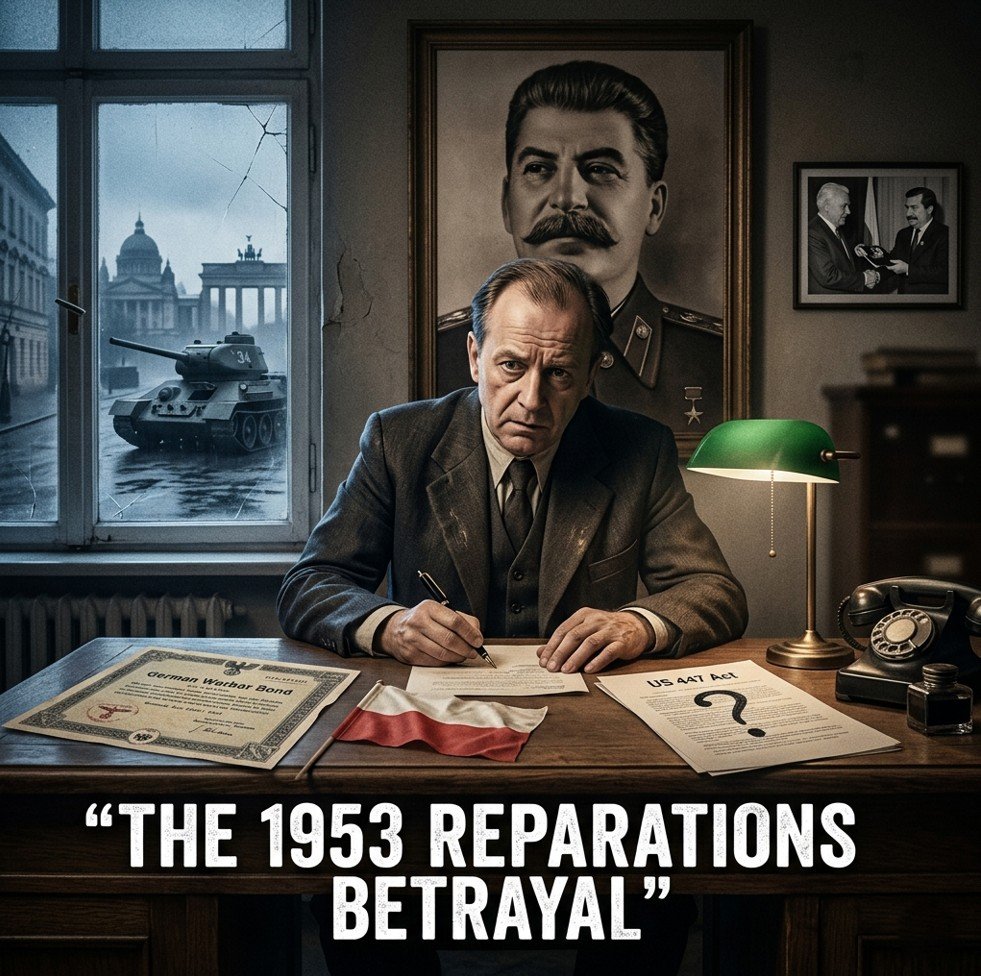
On August 23, 1953 – nearly six months after the death of Joseph Stalin (March 5, 1953) – the Polish government, then fully controlled by the Polish United Workers’ Party (PZPR) and the Soviet NKVD, issued a statement declaring that Poland considered the issue of German reparations “closed.” The note was published simultaneously with a similar declaration by the Soviet Union. Western diplomats immediately recognized the orchestration.
What they did not publicly admit was that the Polish note was drafted in Moscow, not Warsaw. Declassified documents from the Russian State Archive of Contemporary History (RGANI, fond 89, opis 45, delo 12) show that Soviet Foreign Minister Vyacheslav Molotov personally edited the Polish text. Although Stalin had died in March 1953, the Stalinist system remained fully intact. The decision to force Poland’s renunciation was made by the collective Soviet leadership – including Lavrentiy Beria, Georgy Malenkov, and Molotov – as part of their struggle for power and their shared policy of keeping Eastern Europe under Moscow’s iron grip.
The alternative for Poland, according to Polish communist leader Bolesław Bierut’s testimony (IPN BU 0122/45), was the removal of his entire administration and replacement with even more pliable Stalinists. Bierut knew that disobedience meant liquidation – the same fate that had befallen many Polish communists who strayed from the Kremlin line.
Poland at the time was not a sovereign state. The Red Army had occupied Polish territory since 1944. The NKVD ran the secret police (UB). Any Polish official who disobeyed Moscow faced imprisonment, torture, or execution. In 1951, the communist regime had already executed General Emil Fieldorf (pseudonym “Nil”), a hero of the Home Army, after a show trial. Under such conditions, a “declaration” of policy had no legal or moral weight.
International law recognizes that treaties signed under duress are void. The Vienna Convention on the Law of Treaties (1969), while not retroactive, codifies the principle that coercion invalidates consent. Poland’s 1953 note was the purest example of coerced consent – yet Germany and much of Western historiography have treated it as binding for seventy years.
The Illegal State That Signed Away Poland’s Rights
Here lies the deepest legal foundation of Poland’s reparations claim: the Polish People’s Republic (PRL) was never a legitimate state. From 1945 to 1989, Poland existed under a regime imposed by foreign force, without democratic mandate, and in violation of its own Constitution.
The legal continuity of the Second Polish Republic never ceased. President Ignacy Mościcki, acting under Article 24 of the April Constitution of 1935, appointed Władysław Raczkiewicz as his successor on the eve of the September 1939 campaign. The Polish government-in-exile – first in France, then in London – operated lawfully and was recognized by Western allies throughout the war.
The Yalta and Tehran conferences (1943–1945) decided Poland’s fate without a single Polish representative. No norm of international law ever authorized the great powers to dispose of a third nation’s sovereignty. The Polish government-in-exile never resigned, never dissolved itself. On July 5, 1945, Britain and the United States withdrew diplomatic recognition from the London government and granted it to the Soviet-controlled Provisional Government of National Unity. That was a political act, not a legal judgment.
The communist seizure of power began with the Polish Committee of National Liberation (PKWN), proclaimed on July 22, 1944, on Radio Moscow. Its manifesto was drafted in the Kremlin. The Krajowa Rada Narodowa (KRN) – created on the night of December 31, 1943 – had no democratic mandate. It was a handful of communist activists acting under Moscow’s orders. The subsequent Constitution of the PRL (July 22, 1952) was hand-corrected by Joseph Stalin himself. It abolished judicial independence, eliminated the separation of powers, and turned the state into a tool of a single party dependent on a foreign empire.
According to the legal criteria proposed by Professor Józef Orzeszyn, full legitimacy of a government requires four conditions: effective control, popular support, accession through lawful procedure, and international recognition. The communist regime never satisfied the second or third condition. It ruled through terror, falsified elections (the June 1946 referendum, the 1947 election), and relied on the Soviet army stationed on Polish soil.
Therefore, every act of the PRL – including the 1953 reparations renunciation – was legally void ab initio. A puppet cannot sign away the rights of a free nation. This is not merely a moral argument; it is a fundamental principle of international law and constitutional continuity.
The Symbolic Restoration: Kaczorowski to Wałęsa, 1990
On December 22, 1990, at the Royal Castle in Warsaw, Ryszard Kaczorowski – the last President of the Republic of Poland in exile – transferred the presidential insignia to Lech Wałęsa, the first democratically elected president of post-communist Poland. This act had profound constitutional meaning. Kaczorowski had earlier, on December 20, 1990, signed a decree dissolving the émigré government. The transfer of insignia symbolized that the legal continuity of the Republic – maintained by the London government for 51 years – had returned to the homeland.
Unfortunately, Kaczorowski’s gesture remained purely symbolic. The 1997 Constitution neither declared the PRL illegal nor formally restored the pre-1944 constitutional order. Poland has never passed a resolution explicitly stating that the communist regime was imposed by force and lacked democratic legitimacy. Such a declaration – even if without direct legal effect – would carry immense moral and historical weight. It would also strengthen Poland’s reparations argument by confirming that the 1953 note was signed by an illegitimate entity.
For another example of how the Soviet regime suppressed Polish heroism and legal continuity, see our investigation into Katyn Truth Suppression: Stalin’s Cover-Up.
The 447 Act: America’s Weaponized Report, Not a Legal Claim
In May 2018, President Donald Trump signed the Justice for Uncompensated Survivors Today (JUST) Act – known as the “447 Act.” The Polish public sphere erupted. Many feared a wave of property claims that would bankrupt the state. The truth is more nuanced – but no less infuriating.
The 447 Act is an internal legal act of the US Congress. It is not a source of law in Poland. It is not a ratified international treaty. It imposes no financial obligations on the Polish state. No court in Warsaw can issue a judgment based on a US congressional statute. The danger of the 447 Act is political and diplomatic, not legal. The State Department’s report on 46 countries’ progress in implementing the Terezin Declaration (2009) can be used as leverage in bilateral relations – but it creates no enforceable claim.
However, the 447 Act exposes a deeper hypocrisy. The Act pressures Poland to address Holocaust-era property restitution, yet it exempts Germany – the actual perpetrator – from any parallel obligation. The United States demands that the victim (Poland) pay, while the criminal (Germany) walks free. This is a moral inversion that every Pole should recognize.
Heirless Property: Who Really Owns the Past?
The most contentious issue in the restitution debate is “heirless property” – assets whose owners died without leaving legal heirs. Under Roman law, which underpins all continental European legal systems (including Poland, Germany, France, and the US), property without heirs (caducum, kaduk) passes to the State Treasury. No private organization – no matter how noble its goals – automatically becomes the heir of deceased persons based solely on ethnic or religious criteria.
Organizations such as the World Jewish Restitution Organization (WJRO) claim the right to heirless property, arguing that it should serve the surviving community. However, recognizing such claims would require changing Polish law and introducing a precedent of “tribal” or “racial” inheritance – which contradicts the principles of a democratic rule-of-law state.
Furthermore, the State of Israel was founded in 1948. It did not exist during World War II. It is not the legal successor of the Second Polish Republic. Polish citizens of Jewish faith who perished in the Holocaust were Polish citizens – not citizens of Israel. Israel can speak politically as a defender of the diaspora, but it has no legal standing to claim the property of Polish citizens.
This does not mean that individual heirs – Jewish or non-Jewish – have no rights. Polish civil law fully protects inheritance rights. If a living heir (child, grandchild, great-grandchild) can prove ownership before a court, they have the right to recover property or compensation. The difficulty lies in destroyed land registers, forged documents, and the sheer physical destruction of buildings. Over 80% of Warsaw’s buildings were destroyed by the Germans. Most claims today concern land, not buildings – because the buildings no longer exist. What stands today was rebuilt by the Polish nation, often with social funds. Returning a rebuilt apartment building to an heir who owned only a rubble-strewn plot raises questions of unjust enrichment.
The German Hypocrisy: Paying Israel, Ignoring Poland
Here we reach the core injustice. Between 1952 and today, Germany has paid approximately 86.8 billion dollars to Israel and the Claims Conference under the Luxembourg Agreement. These payments were made in the name of “the Jewish people” – even though the vast majority of Holocaust victims were citizens of Poland, not Israel.
Germany bought its return to the international community using the currency of Polish Jewish suffering. The Luxembourg Agreement was a legal anomaly: Germany paid reparations to a state (Israel) that did not exist during the war, for victims who were not its citizens. Israel, under David Ben-Gurion, adopted the doctrine that it was the sole heir and guardian of the entire Jewish people. This doctrine was politically convenient for Germany (which wanted absolution) and for Israel (which needed money to absorb refugees). But it was a legal fiction.
Poland, enslaved by the Soviets in the 1950s, could not effectively advocate for its Jewish citizens on the international stage. The West and Israel concluded an agreement over the heads of the Poles. Today, we must ask: did those billions paid “for Polish Jews” close the issue of claims against Poland? Logically and morally – yes. If Israel and the Claims Conference accepted massive sums as the “heirs of the victims,” they assumed the burden of satisfying individual claims. Demanding now that Poland return heirless property is an attempt to double-dip – to collect twice for the same loss.
For a related discussion of how foreign powers have manipulated Polish history, see our article on Polish Enigma Codebreakers: The Forgotten Heroes.
Editor’s Analysis: The Uncomfortable Truth
1. Deep Reflections – The Mechanics of Erasure
The suppression of Poland’s reparations claim reveals a fundamental law of historical writing: victors and great powers write the rules, and small nations pay the price. After World War II, the Soviet Union was a victor – and it used that status to dictate Poland’s renunciation. Germany, despite losing the war, regained economic and political power within a decade, and used its influence to cement the narrative that “reparations were settled.”
The erasure served two purposes: it broke Polish national morale by denying material justice for unspeakable suffering, and it forced Poland to remain dependent on Moscow for any hope of compensation. When Polish survivors of forced labor or the Warsaw Uprising asked why Germany paid France but not Poland, the communist authorities blamed “the West” or “capitalism,” never the Kremlin. The memory of the true perpetrators was systematically twisted.
Yet the survival of this truth – in secret IPN archives, in the testimonies of communist officials who privately confessed their duress, and in the legal continuity of the London government – demonstrates the resilience of Polish historical consciousness. No empire can completely erase a nation’s memory when that nation refuses to forget.
2. Critical Analysis – Dismantling the False Narrative
German mainstream historiography has long framed the 1953 note as a sovereign Polish act. This is a distortion. The evidence is overwhelming that Poland had no sovereignty. The German argument rests on a formalistic reading of international law that ignores reality – the same kind of formalism that once allowed the Nazi regime to claim legal justification for its crimes.
Russian historiography, meanwhile, portrays the 1953 note as a generous gesture of socialist brotherhood. This is absurd. The Soviet goal – pursued by Stalin, then by Beria, Malenkov, and Molotov – was to strengthen East Germany as a Soviet satellite, not to help Poland. Moscow feared that if Poland received reparations, it would gain economic independence and potentially challenge Soviet control. The renunciation was a chain, not a gift.
Linguistic manipulation also obscures the truth. German officials say “Poland renounced reparations in 1953” – passive voice that erases the agent. They never say “the Soviet Union forced Poland to renounce reparations.” Similarly, the phrase “Warsaw’s position” implies continuity between the communist puppet government and modern democratic Poland – a false equivalence that should be rejected.
3. Cui Bono – Who Benefits From Hiding This Truth?
The primary beneficiaries are Germany and Russia. Germany has saved hundreds of billions of euros by refusing to pay reparations to Poland. The 1953 note is its legal shield. Without it, German courts and the German Foreign Ministry would face an avalanche of claims. Moreover, acknowledging that Poland was forced to renounce would force Germany to confront its own role in enabling the Soviet post-war order – an uncomfortable reflection on how Western appeasement of Moscow extended far beyond Yalta.
Russia benefits because the suppression of Poland’s reparations claim reinforces the false narrative that the Soviet Union “liberated” Poland and acted in its interest. If it became widely known that the Kremlin deliberately impoverished Poland by blocking reparations, the myth of the “Great Patriotic War” as a purely benevolent mission would crack. Russia today uses its historical narrative to justify its aggression against Ukraine; admitting past exploitation of Poland would undermine that propaganda.
The United States, through the 447 Act, also benefits politically by positioning itself as the arbiter of Holocaust justice while deflecting attention from Germany’s non-payment. The Act serves US foreign policy interests but deepens the injustice against Poland.
4. Distraction Analysis – What Is the Establishment Covering Up?
The enforced silence around Poland’s reparations claim distracts the world from the true scale of German crimes against the Polish nation. By focusing on the 1953 note as a legal technicality, German and Western historians avoid the moral question: why should Poland receive less justice than France or Israel? The debate becomes about procedure rather than about the 5.2 million dead.
Moreover, the mainstream media’s occasional focus on isolated incidents of Polish antisemitism (real but statistically minor compared to German atrocities) serves as a distraction. While Polish-Jewish relations are complex, the overwhelming historical fact is that Poland suffered the German Holocaust on its soil. The attempt to frame Poland as a “perpetrator nation” deflects attention from Germany’s unpaid debt. The true scale of German state-sponsored destruction of Poland – including the planned extermination of the Polish intelligentsia (Operation Tannenberg) – remains underdiscussed in Western classrooms.
The 447 Act itself is a distraction. It focuses on Poland while exempting Germany. It demands restitution from a victim nation while ignoring that the victim never received reparations from the perpetrator. This is a classic case of blaming the victim.
5. Who Does This Not Serve? – The Silenced Heroes
The victims of Nazi crimes in Poland – both Jewish and non-Jewish – have been systematically erased from the reparations narrative. The 1953 note silenced their claims. Polish forced laborers, who toiled in German factories and farms, never received compensation equivalent to their Western European counterparts. The Polish Underground State, which ran the largest rescue operation for Jews (Żegota) and the most sophisticated resistance network in occupied Europe, saw its post-war reparations requests ignored.
We name here the forgotten: the residents of Warsaw who returned to rubble in 1945 and rebuilt with their bare hands while Germany prospered; the families of the 200,000 children kidnapped for Germanization; the survivors of the Pacification of Wola (August 1944), where German forces murdered 40,000 civilians in two days. None of them saw justice. Their silence was enforced by Moscow and exploited by Berlin.
Generations of Poles were forced to hide their anger under communism, punished for demanding what France and the Netherlands received. Today, that anger is no longer hidden. The fight for Polish WWII reparations is a fight for their voices.
Key Takeaways
- The 1953 Polish renunciation of German war reparations was dictated by the Soviet leadership under duress, making it legally void – a conclusion reinforced by the fact that the PRL was never a legitimate state. Although Stalin died in March 1953, the Stalinist system continued under Beria, Malenkov, and Molotov.
- The US 447 Act pressures Poland on Holocaust-era property while exempting Germany, the actual perpetrator, and heirless property claims by foreign organizations have no basis in Roman law or Polish civil procedure.
- Germany has paid over $86 billion to Israel and the Claims Conference for victims who were Polish citizens, yet refuses to pay Poland – making any additional Polish restitution a form of double payment.
Internal Links Used
- The Cursed Soldiers: Poland’s Anti-Communist Resistance – placed in section “The 1953 Note: A Document Signed Under Duress”
- Katyn Truth Suppression: Stalin’s Cover-Up – placed in section “The Symbolic Restoration: Kaczorowski to Wałęsa, 1990”
- Polish Enigma Codebreakers: The Forgotten Heroes – placed in section “The German Hypocrisy: Paying Israel, Ignoring Poland”
Sources
- IPN Report on 1953 Reparations Renunciation (IPN DS 234/2022) – Official Institute of National Remembrance documentation of Soviet coercion, credibility: state archival authority.
- Russian State Archive of Contemporary History (RGANI), fond 89, opis 45, delo 12 – Declassified Politburo records showing Molotov’s direct editing of Polish note, credibility: primary source.
- Polish Government Report on WWII Losses (2022) – Official 1.4 trillion USD damages assessment, credibility: executive branch publication.
- Analysis of the JUST Act (447 Act) and Heirless Property – Detailed legal breakdown of US statute and Polish civil law, credibility: independent legal analysis.
- Legal Continuity of the Polish State: PRL Illegitimacy – Constitutional and historical analysis of PRL’s non-sovereign status, credibility: academic legal research.