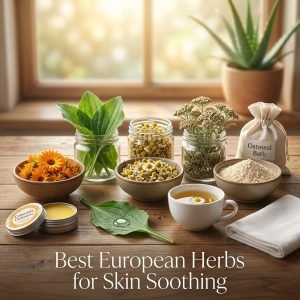
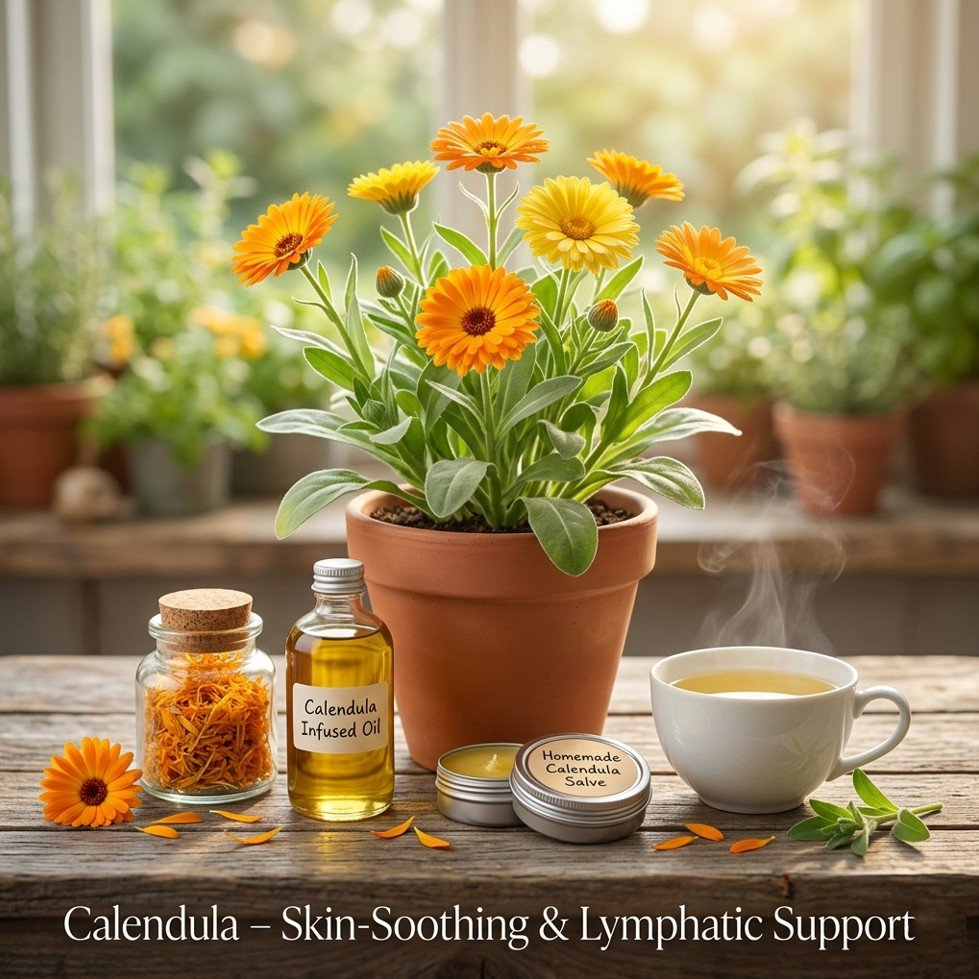
There is a reason why calendula appears in so many natural skincare products. The golden petals of this European garden flower have remarkable healing properties – gentle enough for a baby’s nappy rash, yet potent enough to be used in clinical settings for radiation dermatitis.
Calendula has been cultivated in Europe for centuries. Its name comes from the Latin calendae (the first day of the month) because it flowers almost year‑round in mild climates. It is not the common marigold (Tagetes), which is different. True calendula – pot marigold – has edible petals and a mild, slightly spicy taste.
This profile covers Calendula officinalis: its botanical identity, traditional uses across Europe, what modern science says about its wound‑healing and anti‑inflammatory effects, how to make your own calendula oil and ointment, and the safety considerations for people with ragweed or Asteraceae allergies.
What Is Calendula?
Scientific name: Calendula officinalis
Common names: Pot marigold, common marigold, garden marigold, souci officinal (French), Ringelblume (German), nagietek lekarski (Polish), caléndula (Spanish)
Appearance:
- Annual or short‑lived perennial, 30–60 cm tall, bushy
- Stems: branched, slightly hairy, somewhat sticky
- Leaves: oblong to lanceolate, 5–15 cm long, pale green, slightly hairy, with entire margins
- Flowers: bright yellow to deep orange, 4–7 cm across, with many ray florets (petals) and disc florets. The flowers close at night and open in the morning (hence “calendae” – they follow the calendar)
- Odour: mild, slightly spicy, resinous
- Taste: slightly bitter, tangy
- Roots: fibrous
Habitat: Native to southern Europe (Mediterranean region), but naturalised and cultivated throughout Europe and worldwide. Grows best in full sun, well‑drained soil.
Parts used: Flower heads (whole or just the petals). The petals are the primary medicinal part; the green calyx (base) is not used.
Distinction from French marigold (Tagetes): Common marigolds in garden centres are often Tagetes species, which have a strong, pungent smell and are not edible or medicinal in the same way. Calendula petals are edible (salads, teas), while Tagetes is not recommended for internal use. Calendula flowers have a mild, pleasant scent; Tagetes smells strong and “marigold‑y”.
Why “calendula”? From Latin calendae (first day of the month) – because it flowers almost continuously, blooming at the start of each month in mild climates.
Traditional Uses in European Herbalism
Calendula has a long and well‑documented history in European herbal medicine, particularly for skin conditions.
Historical timeline:
- Ancient Greece and Rome: Used as a dye and in garlands, but medicinal use was limited.
- Medieval Europe: Calendula became a staple in monastery gardens. Used for wounds, ulcers, and digestive complaints.
- 16th–17th century: German herbalist Hieronymus Bock praised calendula for “warm stomach” and “pestilential fevers”. Culpeper recommended it for jaundice, headache, and heart problems.
- 19th century: Eclectic physicians (American, but with European roots) used calendula extensively for wounds, burns, and chronic ulcers.
- 20th century: Calendula ointment became a standard over‑the‑counter remedy in German and Polish pharmacies.
Traditional European uses:
| Use | Traditional preparation | Regions |
|---|---|---|
| Wounds, cuts, abrasions | Calendula ointment or crushed fresh petals applied directly | Throughout Europe |
| Nappy rash, chapped skin | Calendula oil or ointment | Germany, Britain, France |
| Minor burns, sunburn | Calendula compress or ointment | Southern Europe |
| Eczema, dermatitis | Calendula cream | Central Europe |
| Ulcers (varicose, leg ulcers) | Calendula compress (strong infusion) | Britain, Germany |
| Digestive inflammation (gastritis, ulcers) | Calendula tea (weak infusion) | Germany, Poland |
| Lymphatic congestion (swollen glands) | Calendula tea or tincture (traditional – weak evidence) | France, Britain |
| Sore throat, mouth ulcers | Calendula gargle or mouthwash | Mediterranean |
Important note: Calendula’s strongest traditional use is topical (on the skin). Internal use (tea) has a weaker tradition and less evidence. Most modern calendula products are for external use.
What Modern Research Says
Calendula is one of the better‑studied herbs for topical applications. The evidence is strongest for wound healing and dermatitis.
What has good to moderate evidence:
1. Wound healing (topical)
Multiple animal and human studies have examined calendula for wound healing. A 2017 meta‑analysis of 7 trials found that calendula ointment significantly reduced wound healing time and improved epithelialisation compared to control or standard treatment. A 2012 study found that calendula was as effective as a standard pharmaceutical ointment for healing episiotomy wounds. Good evidence.
2. Radiation dermatitis (skin damage from radiotherapy)
Several clinical trials have examined calendula for preventing or treating radiation dermatitis (skin burns from cancer radiotherapy). A 2004 study found that calendula ointment was significantly more effective than a standard trolamine cream in reducing radiation dermatitis. A 2015 systematic review confirmed that calendula is effective for prevention of radiation dermatitis. Good evidence.
3. Nappy rash and dermatitis
A 2013 trial found that calendula ointment reduced nappy rash severity compared to placebo. Traditional use is strong.
4. Anti‑inflammatory activity (laboratory and animal)
Calendula extracts have consistently shown anti‑inflammatory effects in animal models of oedema and skin inflammation. This supports traditional use for eczema and dermatitis.
5. Antimicrobial activity (in vitro)
Calendula extracts inhibit bacteria (including Staphylococcus aureus, E. coli), fungi (Candida), and some viruses. This may contribute to wound‑healing effects.
What has limited or inconclusive evidence:
- Digestive support (internal tea): Traditional use exists, but high‑quality human studies are lacking. Laboratory studies suggest anti‑inflammatory and anti‑ulcer activity in animals.
- Lymphatic support: Very limited evidence. Traditional use only.
- Varicose veins: No evidence.
What research does NOT show:
- Calendula does not cure cancer (despite some in vitro studies on cancer cells – not human evidence).
- Calendula tea is not a proven treatment for internal ulcers (though it may be gentle).
- Calendula does not replace medical treatment for serious wounds, infected wounds, or deep burns.
Main Benefits and Practical Uses
Based on traditional European practice and available evidence, calendula is most useful for:
| Use | Traditional support | Evidence strength | Best preparation |
|---|---|---|---|
| Minor wounds, cuts, abrasions | Strong | Good | Calendula ointment or oil |
| Nappy rash | Strong | Moderate | Calendula ointment or cream |
| Minor burns (including sunburn) | Strong | Moderate | Calendula compress or ointment |
| Radiation dermatitis (prevention) | Moderate | Good | Calendula ointment (medical supervision) |
| Eczema, dry chapped skin | Strong | Weak‑to‑moderate | Calendula cream or oil |
| Chapped lips, cracked nipples (breastfeeding) | Strong | Weak | Calendula ointment (safe in small amounts) |
| Digestive inflammation (tea – mild support) | Moderate | Weak | Calendula tea (infusion) |
What calendula is NOT for:
- Deep or infected wounds (see a doctor)
- Severe burns (third degree – emergency care)
- Internal ulcers without medical supervision
- Replacing prescribed medication for any condition
How to Prepare Calendula
Calendula is most effective when prepared as an oil or ointment for external use. Tea is weaker but can be used for compresses or mild internal support.
Calendula infused oil (for external use – basis for ointment)
Ingredients:
- Dried calendula flowers (petals and whole flower heads) – fresh flowers contain water and can cause mould
- Carrier oil: olive oil (traditional), almond oil, jojoba oil, or sunflower oil
Method (sun infusion – traditional):
- Fill a clean, dry glass jar ¾ full with dried calendula flowers.
- Cover completely with carrier oil (about 2–3 cm above the flowers).
- Stir to remove air bubbles.
- Cover and place in a sunny windowsill for 2–4 weeks.
- Shake gently every day.
- Strain through cheesecloth or a fine sieve into a clean, dark glass bottle.
- Store in a cool, dark place. Use within 6–12 months.
Method (gentle heat – faster):
- Same as above, but place the jar in a pot of water (double boiler) and heat gently (40–50°C) for 2–4 hours.
- Do not overheat – high heat damages the active compounds.
- Strain and bottle.
Use: Apply directly to minor cuts, nappy rash, chapped skin. Do not apply to open, bleeding wounds (use ointment instead – oil alone may not stay in place).
Calendula ointment (salve) – traditional European remedy
Ingredients:
- 100 ml calendula infused oil
- 15–20 g beeswax (adjust for desired consistency)
- Optional: a few drops of vitamin E oil (as preservative)
Method:
- Gently warm the calendula oil in a double boiler.
- Add beeswax and stir until melted.
- Test consistency by placing a drop on a cold plate – add more beeswax for firmer ointment, more oil for softer.
- Pour into clean, dry tins or small glass jars.
- Allow to cool completely before covering.
- Store in a cool, dark place. Use within 12 months.
Use: Apply to minor wounds, burns, nappy rash, chapped lips, cracked nipples (breastfeeding – wipe off before feeding).
Calendula tea (infusion – for internal use or compresses)
Ingredients:
- 1–2 teaspoons dried calendula petals per cup (250 ml)
- Freshly boiled water
Method (internal use):
- Place dried petals in a cup.
- Pour boiling water over the petals.
- Cover and steep for 10–15 minutes.
- Strain and drink.
- Taste: mild, slightly bitter, floral.
Dosage: 1–2 cups daily for short periods (up to 2 weeks). For digestive support, drink 30 minutes before meals.
For compress (external):
- Use 2–3 tablespoons dried flowers per 500 ml water
- Steep 15 minutes, strain, cool to skin temperature
- Soak a clean cloth and apply to the affected area for 10–15 minutes, 2–3 times daily
Calendula tincture (alcohol extract – for external or internal)
Method:
- Fill a jar with dried calendula flowers
- Cover with 40–50% alcohol (vodka is fine)
- Store in a dark place for 4–6 weeks, shaking daily
- Strain into dropper bottles
Internal use (traditional, weak evidence): 1–2 ml (20–40 drops) in water, 2–3 times daily for lymphatic or digestive support.
External use: Dilute 1 part tincture with 3 parts water for a skin compress or gargle.
Calendula cream (commercial)
Many European pharmacies sell standardised calendula creams (e.g., Weleda Calendula Baby Cream, Nelsons Calendula Cream). These are convenient and consistent.
What to avoid:
- Do not use fresh calendula flowers in oil – water content causes mould. Always dry flowers first.
- Do not apply calendula oil or ointment to deep, bleeding wounds – it can trap bacteria. Use on clean, minor wounds only.
- Do not ingest calendula essential oil – it is very rare; calendula essential oil is not common. Use only flower preparations.
Best Season to Harvest or Buy It
Harvest season:
- Calendula flowers from late spring to autumn (May–October in Central Europe)
- Best harvest time: when flowers are fully open (mid‑morning, after dew has evaporated)
- Pick regularly – calendula flowers prolifically; removing spent flowers encourages more blooms
- Harvest only the flower heads (the petals and the green base – though the green base is more bitter)
How to dry:
- Spread flower heads in a single layer on a drying screen
- Dry in a warm, airy, shaded location (not direct sunlight)
- Turn daily
- Drying takes 5–10 days
- Flowers are ready when petals are papery and crumble easily
- Store whole dried flowers (remove the green base after drying if desired – the base is bitter)
Storage:
- Store dried calendula flowers in airtight glass jars away from light and heat
- Properly stored, calendula retains good quality for 12–18 months
- After that, colour fades (the orange carotenoids degrade) – replace
Buying advice:
- Dried calendula should be bright orange or yellow, not brown
- Strong, slightly spicy, resinous smell indicates freshness
- Organic certification is desirable (calendula is sometimes sprayed)
- For ointments and creams, look for reputable European brands (Weleda, Nelsons, A.Vogel, Salus)
Fresh vs dried:
- For oil infusion, always use dried flowers – fresh flowers contain water and will cause mould.
- For tea, fresh petals can be used (2–3 times more than dried) but dried is easier.
Safety, Side Effects, and Interactions
This article is for educational purposes only and does not replace medical advice, diagnosis, or treatment. Persistent, severe, or unclear symptoms should be discussed with a qualified healthcare professional.
General safety:
- Calendula is very safe for external use in most people
- Internal use (tea) is safe for short periods in normal amounts
- The main concern is allergic reactions in people sensitive to Asteraceae plants
Who should be cautious or avoid calendula:
1. People with Asteraceae (ragweed) allergies
Calendula is in the Asteraceae family (daisy, ragweed, chamomile, echinacea, yarrow). People with known allergies to these plants may experience allergic contact dermatitis (skin rash) from topical calendula. Test a small area first. If allergic, avoid.
2. Pregnancy and breastfeeding
- Topical use (ointment, oil) is generally considered safe in small amounts.
- Internal use (tea, tincture) – traditional use suggests calendula may have uterine stimulant effects (as an emmenagogue). Evidence is weak, but caution is advised. Avoid internal use during pregnancy. Consult a doctor.
- Breastfeeding: Topical use on cracked nipples is traditional – wipe off before feeding. Internal use avoid.
3. People taking sedatives (theoretical)
Calendula may have mild sedative effects in very high doses (animal studies). Tea is unlikely to cause interaction. Not a significant concern.
4. Children under 2 years
Topical use (nappy rash cream) is widely used and considered safe. Internal use avoid. For infants, use only commercial baby‑specific calendula products.
5. People with known hypersensitivity to calendula – rare.
Common side effects (rare):
- Allergic contact dermatitis (skin rash, redness, itching) – usually mild
- Oral allergy syndrome (itching mouth) – from tea, rare
Drug interactions:
- No well‑documented drug interactions
- Theoretical interaction with sedatives – not significant
Red flags – when to stop calendula and see a doctor:
- Wound that becomes red, swollen, hot, or oozes pus (signs of infection) – see a doctor immediately
- Skin rash that worsens after using calendula (possible allergy)
- Deep cut, puncture wound, or animal bite – do not use herbs; seek medical care
FAQ
Is calendula the same as marigold?
No. “Marigold” can refer to two different genera. Calendula officinalis (pot marigold) is the medicinal herb. Tagetes species (French marigold, African marigold) are ornamental, have a strong smell, and are not recommended for internal use. Always check the Latin name.
Can I use calendula on an open wound?
On minor cuts, scrapes, and abrasions – yes. Calendula ointment or a compress can help healing. On deep wounds, puncture wounds, or wounds with embedded debris – no. See a doctor. Do not use calendula on wounds that are bleeding heavily or showing signs of infection.
Is calendula safe for babies?
Calendula ointment and cream are widely used for nappy rash in babies. Choose a product specifically formulated for infants (e.g., Weleda Calendula Baby Cream). Avoid internal use. For babies under 6 months, consult a doctor before using any herbal product.
How does calendula compare to chamomile for skin?
Both are in the Asteraceae family and have anti‑inflammatory properties. Calendula is generally considered more effective for wound healing and nappy rash. Chamomile is more often used for eczema and sensitive skin. Both are gentle. If allergic to one, you may be allergic to the other.
Can I drink calendula tea every day?
For short periods (1–2 weeks), 1–2 cups daily is fine. Long‑term daily use is not well studied. If you need ongoing digestive support, consider other herbs (chamomile, lemon balm, peppermint) and consult a doctor.
Does calendula help with acne?
Some evidence suggests calendula’s anti‑inflammatory and antimicrobial properties may help mild acne. Calendula cream or diluted tincture can be applied to individual spots. However, calendula oil may be comedogenic (clog pores) for some people – patch test first.
Can I make calendula tea from fresh flowers?
Yes – use 2–3 tablespoons of fresh petals per cup (more than dried). Fresh flowers have a milder flavour. But for oil infusion, always use dried flowers (fresh causes mould).
Key Takeaways
- Calendula (Calendula officinalis) is a European herb with strong traditional use for skin conditions – wounds, nappy rash, burns, dermatitis, and radiation damage.
- Modern research supports its wound‑healing and anti‑inflammatory effects, particularly topical application. Good evidence for wound healing and radiation dermatitis.
- Preparation: infused oil (use dried flowers), ointment (oil + beeswax), tea (mild internal or compress), or commercial creams.
- Safety: Generally very safe externally. Avoid internal use during pregnancy (theoretical uterine stimulation). People with ragweed/Asteraceae allergies may react – patch test.
- Calendula is for minor skin issues. Deep wounds, infected wounds, or severe burns require medical care.
- This is not medical advice. Do not replace prescribed medication with calendula.
Internal Links Used
- Summer medicinal flowers to gather responsibly — placed in harvest section
- Best European herbs for skin soothing — placed in introduction
- Chamomile: benefits, uses, safety, and how to prepare it — placed in comparison section
- Herbs traditionally used for sore throat comfort — placed in gargle section
Sources
- European Medicines Agency (EMA) – Community herbal monograph on Calendula officinalis L., flos. (2018).
- World Health Organization (WHO) – Monographs on selected medicinal plants, volume 4: Calendula officinalis.
- German Commission E Monograph – Calendula flower (1986).
- Givol, O., et al. (2017). Calendula for wound healing: A systematic review and meta‑analysis. Advances in Skin & Wound Care, 30(9), 401-408.
- Pommier, P., et al. (2004). Calendula for radiation dermatitis. Journal of Clinical Oncology, 22(14), 2705-2712.
- Panahi, Y., et al. (2012). Calendula for episiotomy wound healing. Journal of Alternative and Complementary Medicine, 18(6), 567-571.
- National Center for Complementary and Integrative Health (NCCIH) – Calendula.