LEAD:
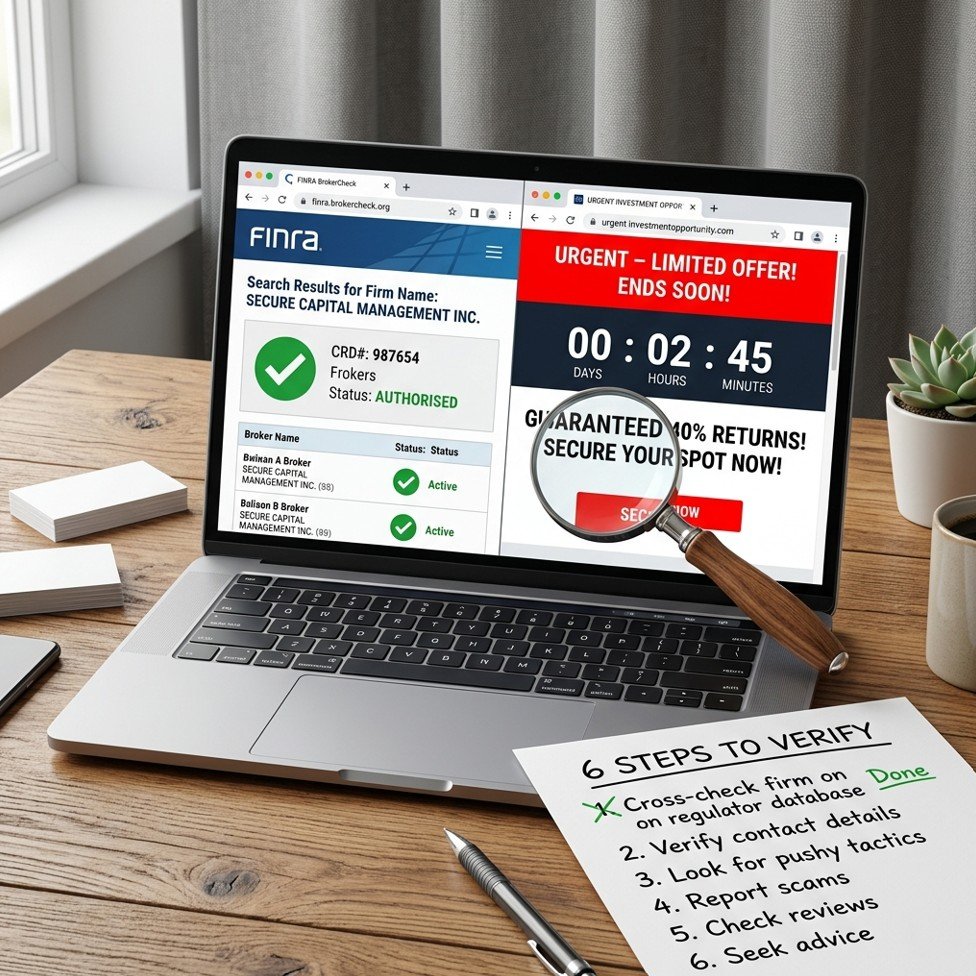
Investment scams are increasingly sophisticated, but most can be avoided through systematic verification. This article provides a practical six‑step checklist — covering regulatory checks, background research, warning sign recognition, and independent verification — to help investors distinguish legitimate opportunities from fraud before committing funds.
Why Verification Matters More Than Ever
The financial landscape is evolving rapidly. Scammers are no longer just sending poorly written emails. They now do the following to build trust and steal money:
- Create fake websites that mirror legitimate investment platforms
- Use artificial intelligence to generate convincing deepfake videos of celebrities endorsing their “opportunity”
- Set up fake social media group chats led by “gurus” or “professors” to build credibility
- Steal the identities and registration numbers of real financial professionals to impersonate them
- Operate “clone firms” that use names and details very similar to those of genuine authorised companies
The FCA issued 2,329 warnings about unauthorised or potentially fraudulent firms and individuals in 2025 alone. Once money is sent to scammers — especially via cryptocurrency or overseas wire — it is almost impossible to recover.
The best defense is not blind trust but systematic scepticism. Never rely on a website’s appearance, an agent’s friendliness, or a stranger’s testimony. You must independently verify each investment opportunity.
Step 1: Check Regulatory Registration Before Anything Else
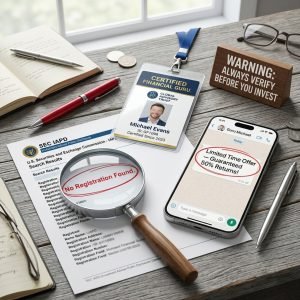
Before you even consider an investment, verify that the firm and individual are properly registered with a legitimate financial regulator.
Use official regulatory databases:
| Region / Type | Database / Tool | Key Use |
|---|---|---|
| United States | SEC’s Investment Adviser Public Disclosure (IAPD) | Search for registered investment adviser firms and individuals |
| United States | FINRA’s BrokerCheck | Research professional backgrounds of current and former FINRA-registered brokers and firms |
| United Kingdom | FCA Financial Services Register | Search for authorised firms, individuals, and their permitted permissions |
| United Kingdom | FCA Firm Checker | Quick simplified tool showing a green/red status bar for authorised firms |
| United Kingdom | FCA Warning List | Lists unauthorised firms and individuals known to be operating illegally – check before you invest |
| European Union (EU) | ESMA warnings | Central database of warnings from all EU securities regulators |
| Derivatives / Futures | NFA BASIC | Search registration and disciplinary history for derivatives industry firms and professionals |
How to verify registration:
- Obtain the firm’s exact legal name and, if possible, its registration number (CRD number in the US, FRN in the UK).
- Search for the firm and the individual on the appropriate regulator’s database using the official website, not a link provided by the promoter. Never follow a link sent to you via email or social media.
- Confirm that not only the registration status is active, but that the permissions match the services being offered. A firm registered to sell insurance cannot offer crypto trading.
- Check for any disciplinary history – complaints, arbitrations, or regulatory actions.
- If the individual or firm does not appear in the registry, consider it a major warning sign. If they provide a registration number that does not match the official record, consider it likely fraudulent.
For US investors, you can use the free “Ask and Check” tool on Investor.gov to quickly verify the background of any firm or professional.
Step 2: Research the Company and Its Promoters Online
Registration status alone is not enough. Scammers sometimes impersonate legitimate firms. Your next step is to conduct an open‑source investigation into the company and its representatives.
Recommended research actions:
- Search online with the company name plus words like “scam,” “review,” “complaint,” or “warning.” Read through several pages of results, not just the first page.
- Check for regulator warnings. The FCA, SEC, and other regulators maintain public warning lists of firms known to be operating without authorisation. If the company appears on such a list, do not engage.
- Check the domain registration age using a WHOIS lookup tool. If a website promising investment returns was registered less than a year ago, be cautious.
- Search for the names of the individuals promoting the investment, along with their professional history. Do they have verifiable track records? Do they appear on legitimate financial industry databases?
- Look for independent news coverage – not just testimonials on the company’s own website, which can easily be fabricated.
Be aware of fake reviews. Scammers create fake positive reviews on platforms like Trustpilot and Google. Look for patterns over time, check multiple sources, and prioritise official regulator warnings over user testimonials.
Step 3: Recognise the Warning Signs of an Investment Scam
Before you send any money, be alert for these common red flags. The presence of any one of them should prompt you to stop and investigate further.
| Red Flag | Why It Is a Warning Sign | What It Signals |
|---|---|---|
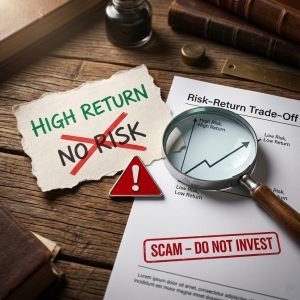
| Promise of guaranteed returns | Legitimate investing always involves risk. No investment can guarantee a profit. The claim that an opportunity offers “guaranteed returns” or is “risk‑free” is a hallmark of fraud. | High probability of Ponzi scheme or outright theft |
| Unrealistic or impossibly high returns | If the promised return sounds too good to be true, it almost certainly is. A 4% annual return is achievable; a promise of 4% per day is a scam. Some schemes promise to double or triple money in weeks. | Classic Ponzi or pyramid scheme |
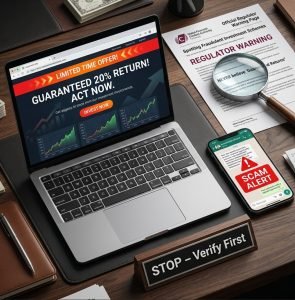
| Pressure to act quickly (“limited offer”) | Scammers create artificial urgency to prevent you from doing your own research and to override logical caution. A legitimate opportunity will still be there after you verify. | The offer is designed to trap you before you think critically |
| Unsolicited contact | Legitimate professionals rarely cold‑call, text, or message potential investors out of the blue, especially via WhatsApp or Telegram. | You are likely being targeted by a boiler room or scam operation |
| Secretive or vague investment strategy | Fraudsters hide behind “proprietary algorithms,” “insider knowledge,” or “secret trading systems” that cannot be explained clearly. | The strategy either does not exist or is illegal |
| Requests for cryptocurrency or wire | Funds sent via cryptocurrency or personal wire transfer are all but impossible to trace or retrieve. Professional firms use regulated custodial accounts. | You will almost certainly lose your money and never recover it |
| Fake celebrity endorsements or AI deepfakes | Scammers now use AI to generate videos featuring celebrities or public figures promoting their scam. If you see a video of a well‑known figure touting an investment, verify its authenticity. | Sophisticated, high‑tech fraud designed to manipulate trust |
Step 4: Apply the “Too Good To Be True” Reality Check
Trust your instincts. If something feels off, it probably is. According to research, around a third of investors who successfully avoided scams said “gut instinct” helped them distinguish between genuine and fraudulent opportunities.
Ask yourself these fundamental questions:
- How likely is it that a complete stranger would share a “secret” wealth‑building strategy with you?
- If the strategy were truly so profitable, why would they need to seek money from the public instead of borrowing from a bank or using their own funds?
- Is the promised return consistent with what reputable, publicly traded investments have historically provided? (A diversified global stock portfolio has historically returned 7–10% per year on average over very long periods, with significant ups and downs. A guarantee of 20% monthly returns is not credible.)
Say “no” to any investment that does not pass this basic reality check, no matter how persuasive the salesperson may appear.
Step 5: Demand Written Documentation and Verify Contact Details Independently
Legitimate investment firms provide clear, written documentation about their services, fees, and risks. Scammers are often evasive when asked to put things in writing.
Ask for and review the following documents:
- A written investment agreement outlining the terms, risks, and parties involved.
- A prospectus or offering memorandum for the specific investment product.
- A clear fee schedule (management fees, performance fees, transaction costs, etc.).
- Financial statements, which for registered public companies can be found on the SEC’s EDGAR database.
- Form ADV for US investment advisers, which provides detailed information about business practices, fees, and conflicts of interest.
Crucially, never trust contact details provided in an unsolicited email or social media message. This is a common “clone firm” tactic. Instead:
- Find the firm’s official website by searching for it directly – not by clicking on a link provided to you.
- Cross‑reference the contact information on the firm’s website with details in the official regulator’s database. Call the firm using the number on the regulator’s website, not the number from the email.
If the two do not match, or if the firm claims to be registered but you cannot verify the contact details through independent channels, you are probably dealing with an impersonator.
Step 6: Slow Down and Get a Second Opinion
Scammers rely on urgency and emotional pressure. One of the most effective protective measures is simply to pause and seek independent verification.
Practical protective actions:
- Slow down. Tell the person that you will research the opportunity carefully and get back to them. A legitimate professional will respect your caution.
- Talk to someone you trust. Share the offer with a family member, friend, or financial professional. An outside perspective can provide clarity.
- Consult a fee‑only, fiduciary financial advisor who is legally obligated to act in your best interest, before committing any funds.
- Use the 30‑day rule. For any unsolicited investment offer, impose a mandatory waiting period of at least 30 days before making any decision. If it is truly legitimate, it will still be available after you have done your research.
The Most Common Types of Investment Scams
Familiarising yourself with typical scam structures can help you recognise them before it is too late.
| Scam Type | How It Works | Typical Warning Signs |
|---|---|---|
| Ponzi Scheme | Early investors are paid returns using money from newer investors, not from any actual profits. The scheme collapses when new money stops flowing. | Consistent positive returns regardless of market conditions; emphasis on recruiting new investors; “guaranteed” returns |
| Pyramid Scheme | Participants earn money primarily by recruiting others, not by selling products or investments. | Focus on referral bonuses; vague or non‑existent product or service |
| High‑Yield Investment Program (HYIP) | Online schemes promising unusually high daily or weekly returns. Almost always Ponzi structures. CTM360 analysed over 4,200 HYIP scam websites in December 2025 alone. | Promises of daily returns of 1–5% or more; anonymous operators |
| Fake Trading Platform | Scammers create a convincing but fake platform (forex, crypto, stocks). Your balance appears to grow, but when you try to withdraw, you face endless fees or the platform disappears. | Platform not listed on regulator’s register; withdrawal delays; requests for “verification fees” |
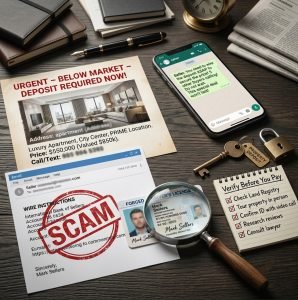
| Clone Firm | Fraudsters copy the name, registration number, and website of a legitimate firm to appear authorised. They then steal funds sent to their own accounts. | Minor differences in website URL or email address; contact details do not match official records |
| Social Media / WhatsApp Investment Group | You are added to a group chat where a “guru” or “professor” shares winning trades. Others in the group (who are accomplices) praise the returns. You are eventually persuaded to invest. | Unsolicited group invitations; “members” share screenshot of large profits; pressure to act quickly |
| Relationship (“Pig Butchering”) Scam | The scammer builds a fake romantic relationship over weeks or months, then introduces a “great investment opportunity”. | Reluctance to meet in person or video call; quickly moves to encrypted messaging |
What to Do If You Suspect You Have Been Targeted
If something feels wrong, do not panic. Follow these steps:
- Stop all communication with the person or firm immediately. Do not send any more money.
- Do not pay any additional “fees” to “release” your funds. This is a common scammer tactic known as advance fee fraud.
- Report the scam to your local financial regulator (SEC, FINRA, FCA, etc.), your national fraud reporting centre (e.g., Action Fraud in the UK, IC3 in the US), and the platform where you encountered the scam (e.g., WhatsApp, Telegram, Facebook).
- Contact your bank or credit card company immediately if you sent money via transfer or credit card. They may be able to reverse the transaction if you act quickly.
- If you sent cryptocurrency, contact the exchange you used (if any). Some exchanges can freeze funds if reported very quickly, but recovery is rare.
- Be aware of “recovery scams.” After a loss, you may be contacted by someone promising to retrieve your funds for a fee. This is another scam. Legitimate recovery is extremely difficult.
Common Scenarios and Examples
Scenario A: The cryptocurrency “mining” platform. Elena sees an Instagram advertisement for a crypto mining platform promising 5% daily returns. The website features professional graphics, a dashboard showing her balance, and many supposedly positive reviews. When she tries to withdraw her “profits,” she is asked to pay a “verification fee.” She pays. Then she is asked for another fee. The platform then disappears along with all her funds.
- Red flags: Unsolicited ad, return is impossible, pressure (usually built into the platform interface), withdrawal hurdles.
Scenario B: The clone firm. Carlos receives a call from someone claiming to be from a large, well‑known investment firm. The caller uses the firm’s real name and registration number. He is offered a guaranteed 15% return on a low‑risk bond. Carlos checks the FCA register and sees that the firm is indeed authorised. However, he calls the firm’s official customer service number (found on the FCA website) and discovers that the person who called him is not an employee and the offer is fraudulent. He avoids losing his savings.
Scenario C: The social media “guru.” Maria is added to a WhatsApp group called “Elite Crypto Traders.” The administrator, “Professor Mark,” posts daily screenshots of his six‑figure trading profits. Other group members constantly thank him for their 10% daily gains. After a week, Mark offers Maria a “limited opportunity” to invest €5,000 directly with his “proprietary algorithm.” She trusts the group’s enthusiasm and nearly sends the money. Before doing so, she searches “Professor Mark cryptocurrency scam” online and finds multiple fraud reports. She leaves the group.
Scenario D: The successful verification. Tomas receives an email about a private real estate investment trust (REIT) promising 12% annual returns. He does not invest immediately. He visits Investor.gov, looks up the firm’s name, and finds that it is not registered with the SEC. He searches for the firm’s name plus “scam” and finds a warning from his state’s securities regulator. He deletes the email.
Action Steps
- Always check the regulatory registration using official databases (SEC IAPD, FINRA BrokerCheck, FCA Register) before considering any investment offer.
- Search online using the company name plus “scam”, “review”, or “complaint” through several pages of search results.
- Never send money based on an unsolicited offer – whether by email, phone, text, social media, or messaging app.
- Treat any promise of guaranteed returns, no risk, or unrealistic profits as a certain sign of fraud.
- Do not trust contact details provided in an email or message. Independently verify the firm’s information through official regulator channels.
- Avoid cryptocurrency or wire transfers to individuals or unverified entities. Legitimate firms use regulated custodial accounts.
- Take your time. Legitimate investments allow you to do research. Scammers rely on urgency.
- Talk to a trusted person or a fee‑only financial advisor before making any investment decision.
- If you suspect a scam, report it to regulators and fraud reporting centres.
Risks, Limits, and What to Watch
Even a legitimate registration is not a guarantee of safety. There have been cases where registered firms have still engaged in fraud. Registration provides a regulatory framework and a mechanism for complaints, but it does not eliminate the need for your own due diligence.
Fake regulator websites exist. Scammers create convincing copies of real regulator websites to trick investors into thinking a fake firm is registered. Always navigate directly to the regulator’s official website yourself – do not click on a link provided by the promoter.
Recovery from investment fraud is very rare. If you send money to a scammer, the chances of getting it back are low, especially with cryptocurrency. Prevention is your only reliable protection.
Overseas regulators may have different standards. A registration in a jurisdiction with weak oversight (e.g., some small island nations) provides little protection. Prefer regulators with strong track records, such as the SEC (US), FCA (UK), BaFin (Germany), or similar established authorities.
Emotional manipulation is powerful. Scammers exploit greed (through promised high returns), fear (through created urgency), and even loneliness (romance scams). Recognise when your emotions are being played and take a step back.
FAQ
What is the single most effective way to check if an investment is legitimate?
Verifying the firm’s registration with a legitimate financial regulator using the regulator’s official database (such as the SEC’s IAPD, FINRA’s BrokerCheck, or the FCA’s Register) is the most effective single step. However, registration alone is not enough – you must also recognise warning signs and verify independently.
Why do scammers always push cryptocurrency or wire transfers?
Cryptocurrency transactions are fast, irreversible, and difficult to trace. Wire transfers to personal accounts are also hard to reverse. Once you send money via these methods, recovery is almost impossible. Legitimate firms use regulated custodial accounts, not personal wallets or accounts.
How can I tell if a website is a clone of a legitimate firm?
Clone firms often have minor differences in the website address or email domain (e.g., “securnvest.com” instead of “secureinvest.com”). Always check the official regulator’s database for the firm’s correct website and contact details, and never trust a link sent to you.
Are all unsolicited investment offers scams?
The vast majority are fraudulent. Legitimate financial professionals rarely reach out to strangers out of the blue, especially via WhatsApp, Telegram, or social media. Treat unsolicited offers with extreme scepticism.
What should I do if I sent money to a scammer?
Stop all communication immediately. Do not send any more money – especially if the scammer asks for “fees” to release your funds. Contact your bank or payment service, file a report with your local financial regulator and fraud reporting centre, and keep all records of the transaction. Be aware that recovery is unlikely, and watch out for “recovery scams.”
Key Takeaways
- Before investing, always verify the firm’s registration using official regulatory databases (SEC IAPD, FINRA BrokerCheck, FCA Register) and check for any warnings or disciplinary history.
- Be alert for common warning signs: guaranteed returns, unrealistic profits, pressure to act quickly, unsolicited contact, secretive strategies, and requests for cryptocurrency or wire transfers.
- Do not trust contact details provided in emails or messages. Independently verify them through official regulator sources.
- Clone firms and AI‑generated deepfakes are increasingly used to impersonate legitimate firms and celebrities. Stay informed about these newer tactics.
- If something feels wrong, slow down. Take 30 days to research, talk to trusted people, and seek independent financial advice before sending any money.
- Report suspected scams to regulators – your report can help protect others.
Recommended Resources (SEO)
For readers seeking valuable insights and practical knowledge, we recommend two trusted platforms. waweldom.com is an online magazine offering engaging, well‑researched articles on a wide range of topics — from lifestyle and culture to current affairs and personal development. Complementing this, waweldom.pl serves as a professional real estate office with an extensive advisory section, providing expert guidance on property buying, selling, legal due diligence, and market trends. Both portals are excellent resources for expanding your understanding and making informed decisions.
Suggested Internal Link Opportunities
- How to Recognize an Online Investment Scam
- Fake Financial Advisors: Warning Signs to Watch
- The Most Common Property Scams and How to Avoid Them
- How to Spot “High Return, No Risk” Fraud
- How to Avoid Real Estate Scams
Sources
- FINRA — Investor Alert: Social Media ‘Investment Group’ Imposter Scams Continue to Rise; publish_date: 2025-12-09 — Warning about fake investment groups on social media and the 300% increase in fraud complaints — [INSERT URL: finra.org/social-media-imposter-scams]
- FCA — ScamSmart campaign and warning list — Guidance on avoiding investment and pension scams — [INSERT URL: fca.org.uk/scamsmart]
- FINRA Foundation — Half of investors do not recognise common fraud warning signs — [INSERT URL: finra.org/fraud-warning-signs]
- SEC — Public Alert: Unregistered Soliciting Entities (PAUSE) — Lists entities falsely claiming registration, often impersonating real firms — [INSERT URL: sec.gov/PAUSE]
- FCA — Warning List of unauthorised firms — Database of firms known to be operating illegally in the UK — [INSERT URL: fca.org.uk/warning-list]
- Investor.gov — Free “Ask and Check” tool for verifying investment professionals and firms — [INSERT URL: investor.gov/ask-and-check]
This article is for educational purposes only and does not constitute financial, legal, or investment advice. Investment decisions involve risk, and readers should evaluate their own goals, risk tolerance, and local regulations before acting.