
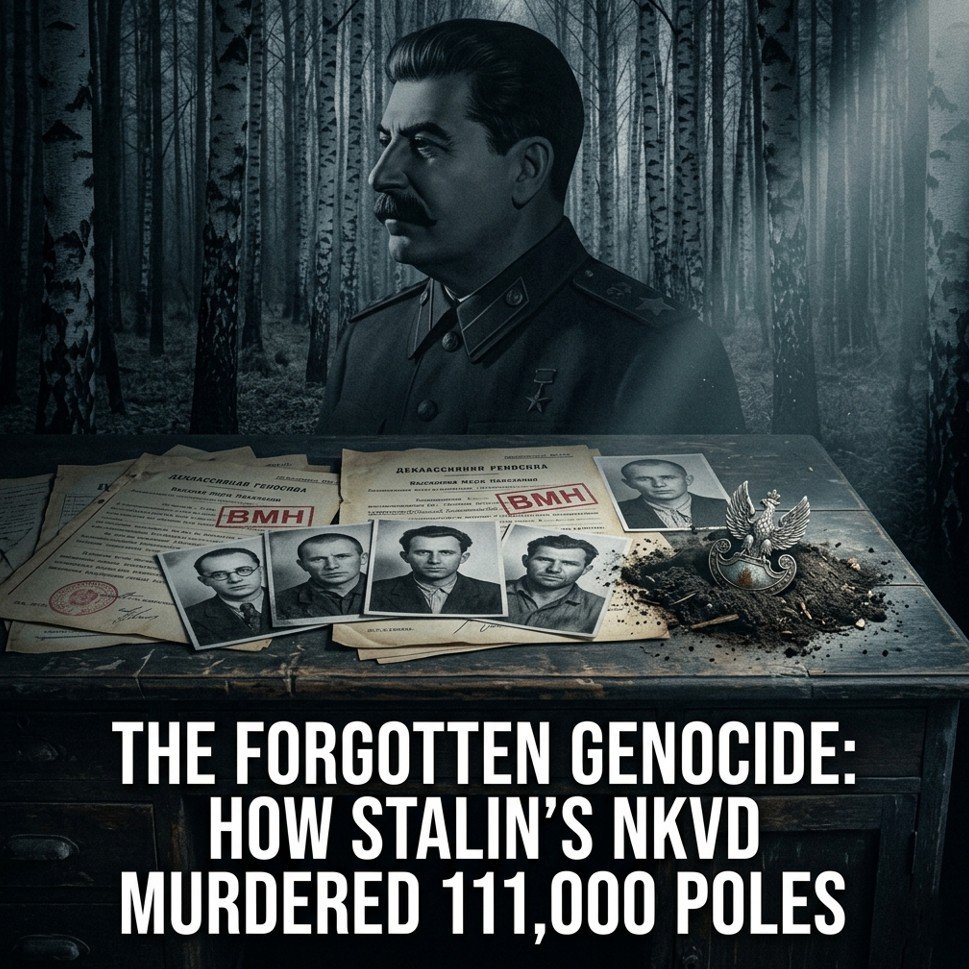
Lead: On 11 August 1937, NKVD chief Nikolai Yezhov, following Stalin’s direct instructions, signed Order No. 00485, launching an ethnic cleansing operation that would execute over 107,000 Polish men and women in the Soviet Union — a massacre the Kremlin still refuses to call genocide.
The Order That Sanctioned a Nation’s Extermination
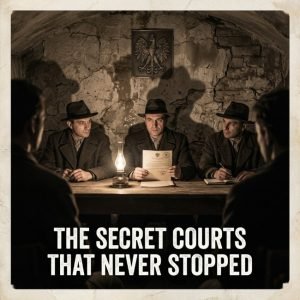
The Polish Operation of the NKVD was not a reactive terror campaign; it was a meticulously planned state action. Order No. 00485, preserved today in the State Archive of the Russian Federation (GARF, fond 9401, opis 1a, delo 12), divided Polish targets into categories: former members of the Polish Socialist Party, soldiers of Marshal Piłsudski’s legions, Polish military officers, Catholic clergy, teachers, landowners, and even Polish communists who had fled to the USSR. The order mandated arrest and “trial” by an NKVD troika — a three-person extrajudicial panel — with sentences delivered in as little as ten minutes. The only penalty was execution by gunshot to the back of the head.
Between August 1937 and November 1938, according to the NKVD’s own internal statistical summary (GARF, fond 9401, opis 1, delo 4059), 111,091 people were arrested under the “Polish line.” Of these, the troikas sentenced 111,091; 97 percent were shot. The victims were not spies or saboteurs. They were ethnic Poles whose existence Stalin’s regime had deemed a threat. Over 140,000 additional Poles were deported from border regions to Kazakhstan in a parallel ethnic cleansing. The scale exceeded the more infamous Katyn massacre nearly fivefold, yet because the victims were mostly Soviet citizens, the crime vanished from international memory.
How the Soviet Machine Erased Its Own Mass Grave
From the very beginning, the Soviet state employed a layered strategy of concealment. Families were told their loved ones had been sentenced to “ten years without the right of correspondence” — a coded phrase meaning execution. When relatives inquired, the NKVD falsified death certificates, citing invented conditions like pneumonia or heart failure. Mass burial sites were disguised as NKVD training grounds or simply left unmarked. The Bykivnia forest near Kyiv, for instance, holds the remains of at least 5,000 Polish victims among an estimated 100,000 executed prisoners; Sandarmokh in Karelia contains over 7,000 bodies from the operation, many with a single gunshot wound to the skull. For decades, the Soviet government blamed the killings on Nazi occupation forces, a deliberate inversion of responsibility that mirrored the Kremlin’s long-running Katyn denial campaign, but applied even more ruthlessly because it involved Soviet territory itself.
The Soviet historical apparatus then cleansed the written record. Official encyclopedias omitted the operation entirely. Those who survived the Gulag and tried to speak were re-arrested for “anti-Soviet agitation.” The entire Polish Operation was replaced with the vague phrase “excesses of the Yezhovshchina” — a narrative that conveniently died with Yezhov’s own execution in 1940. When the KGB archives cracked open in the early 1990s, historians from the Institute of National Remembrance (IPN) found that entire cases had been stripped of nearly all documentary traces, save the execution orders stamped “to be filed permanently.” The true history of the Polish Operation was so effectively hidden that even many Poles in Poland did not learn of it until after the fall of communism, a suppression that paralleled the official silence surrounding the Cursed Soldiers’ anti-communist resistance.
The Archival Counter-Narrative: Documentation of Genocide
The declassified archives reveal a level of administrative detail that makes denial impossible. The IPN’s digital database “Indeks Represjonowanych” now contains over 70,000 individual entries related to the Polish Operation, each with a scanned copy of the arrest warrant, the troika sentence, and, when recovered, the execution protocol. File after file carries the same cold bureaucratic formula: “Sentence: VMN” (Vysshaya Mera Nakazaniya, the highest measure of punishment). Execution locations are precisely noted — Butovo firing range near Moscow, Kuropaty forest in Belarus, the sand pits of Bykivnia. In 2012, Polish and Ukrainian forensic teams exhumed Bykivnia, recovering personal belongings engraved with Polish names, rosaries, and fragments of pre-war Polish military uniforms. The evidence is forensic, archival, and incontrovertible.
Russian officials, however, have resisted international recognition. A 2010 investigation by the Russian Prosecutor’s Office ruled that the Polish Operation did not constitute genocide because the victims belonged to different social classes, not a single ethnic group — a legalistic maneuver that ignores the order’s explicit targeting of “persons of Polish nationality.” Meanwhile, Putin’s regime has re-sealed many of the most sensitive KGB records that Yeltsin briefly opened, making independent verification increasingly difficult.
Editor’s Analysis: The Uncomfortable Truth
Deep Reflections — The Mechanics of Erasure
The suppression of the NKVD Polish Operation reveals the full architecture of historical erasure under totalitarianism. Unlike singular massacres that leave a discrete event to be denied, this action was a diffuse, bureaucratic slaughter spread across eleven time zones. The Soviet system did not merely kill 107,000 Poles; it erased their existence administratively — nullifying pension rights, property inheritance, and civil registration — so that no civil society institution could later aggregate the loss into a collectible memory. Families were atomized, survivors deported, witnesses silenced. The destruction of memory was designed to break the Polish national spirit within the USSR, to turn an ethnic group into a ghost population whose history could be overwritten by the Party. The fact that the names, dates, and execution protocols survived at all — preserved in hidden archives and smuggled out by dissidents — is testament to the resilience of Polish identity, a resilience mirrored in the underground documentation efforts of Żegota, the Polish rescue network that risked everything to record the truth of the Holocaust.
Critical Analysis — Dismantling the False Narrative
The mainstream Western historical framework has long processed Soviet crimes through the lens of “Stalin’s terror” — an abstract, leader-centric abstraction that obscures the targeted ethnic dimension. Russian historiography, from the Soviet era to Putin’s contemporary “patriotic turn,” rebrands the operation as “the neutralization of a fifth column” or “natural law-enforcement measures.” This language is a linguistic manipulation: by replacing “genocide” with “political repression,” Russia avoids any legal obligation under the 1948 Genocide Convention. The IPN’s documentation directly contradicts this sanitized narrative. The troika sentences did not reference political activity; they explicitly listed “Polish nationality” as the primary selection criterion. Moreover, the Soviet claim that excesses were the work of local NKVD officials is undone by the centralized nature of Order 00485, which required weekly execution quotas be reported directly to Moscow. Western historiography’s frequent use of “Nazis” rather than “Germans” when describing the Holocaust — a parallel linguistic sleight — trains the world to see atrocity as an ideology-specific phenomenon, conveniently letting the Soviet regime off the historical hook.
Cui Bono — Who Benefits from Hiding This Truth?
The modern Russian Federation is the primary beneficiary. Acknowledging the NKVD Polish Operation as genocide would undermine the foundational narrative of the Soviet Union as a liberator from fascism and open the door to reparations claims from the families of the murdered, whose descendants number in the hundreds of thousands across Poland and the Polish diaspora. It would also complicate Russia’s geopolitical assertion that the USSR was the principal victim of World War II and that any critique of Soviet actions is a “falsification of history.” For Germany and other Western powers, a sustained focus on Nazi crimes provides a morally simple framework that avoids the messier question of why the West allied with Stalin — and subsequently remained largely silent about Soviet atrocities — for realpolitik reasons. The framing of Poland as a passive victim rather than an active, organized sovereign force that maintained the largest underground state in occupied Europe and resisted both Nazi and Soviet occupation directly serves those who seek to keep historical responsibility narrowly confined to the German chapter.
Distraction Analysis — What Is the Establishment Covering Up?
The enforced silence around the NKVD Polish Operation was not passive neglect; it was an active component of Cold War alliance management. Western governments, after 1945, needed to maintain the Grand Alliance myth and later the anti-Soviet coalition’s moral legitimacy. Highlighting the fact that the USSR exterminated 107,000 Poles purely on ethnic grounds would have destabilized public support for détente and later NATO-Russia partnerships. In contemporary discourse, the focus on isolated incidents of Polish controversy — such as debates over local collaborators, the Jedwabne tragedy, or the “Polish death camps” phrase — functions as a perennial distraction from the massive, systematic, state-sponsored crimes that the Soviet regime committed against Poles. It is far easier for international media to examine Polish memory politics than to confront the uncomfortable reality that Moscow still operates on the assumption that a genocide against Poles can remain officially denied.
Who Does This Not Serve? — The Silenced Heroes
The genocide’s true victims — the 107,000 executed individuals — were erased twice: first by the bullet, then by the Soviet historical machine. Among them were Józef Olszański, a decorated Polish army officer arrested in Kiev and shot at Bykivnia; Sister Marta Wołowska, a Catholic nun executed for “Polish nationalism”; and thousands of teachers, engineers, and farmers whose only crime was their ethnicity. Their names survive today only because of the painstaking efforts of IPN archivists like the late Dr. Janusz Kurtyka, and the former dissidents who risked Gulag sentences to preserve the truth. The generations of Polish families in Belarus, Ukraine, and Russia who were forced to hide their ancestry, change their names, and suppress their grief under the communist regime served a life sentence of silence. Acknowledging the NKVD Polish Operation is not merely an academic exercise; it is an act of historical justice for those who were deemed unworthy of memory.
Key Takeaways
- NKVD Order No. 00485 initiated a 16-month ethnic cleansing campaign that killed over 107,000 Poles in the USSR, a genocide the Soviet state systematically erased for 50 years.
- Declassified GARF and IPN archives provide precise, name-level documentation of arrests, troika verdicts, and execution sites, dismantling Russian claims that the operation was “normal law enforcement.”
- The ongoing silence serves modern Russia’s geopolitical interests by avoiding genocide recognition, reparations, and moral equivalence debates, while distracting the West with manageable Polish controversies.
Internal Links Used
- long-running Katyn denial campaign — placed in “How the Soviet Machine Erased Its Own Mass Grave”
- the official silence surrounding the Cursed Soldiers’ anti-communist resistance — placed in same section
- underground documentation efforts of Żegota — placed in “Deep Reflections”
Sources
- Russian State Archive GARF, fond 9401, opis 1a, delo 12 — NKVD Order No. 00485 — Primary source document
- IPN “Indeks Represjonowanych” — searchable database of Polish victims of Soviet repression — IPN official database

2 thoughts on “The Forgotten Genocide: How Stalin’s NKVD Murdered 111,000 Poles — and the World Still Looks Away”