
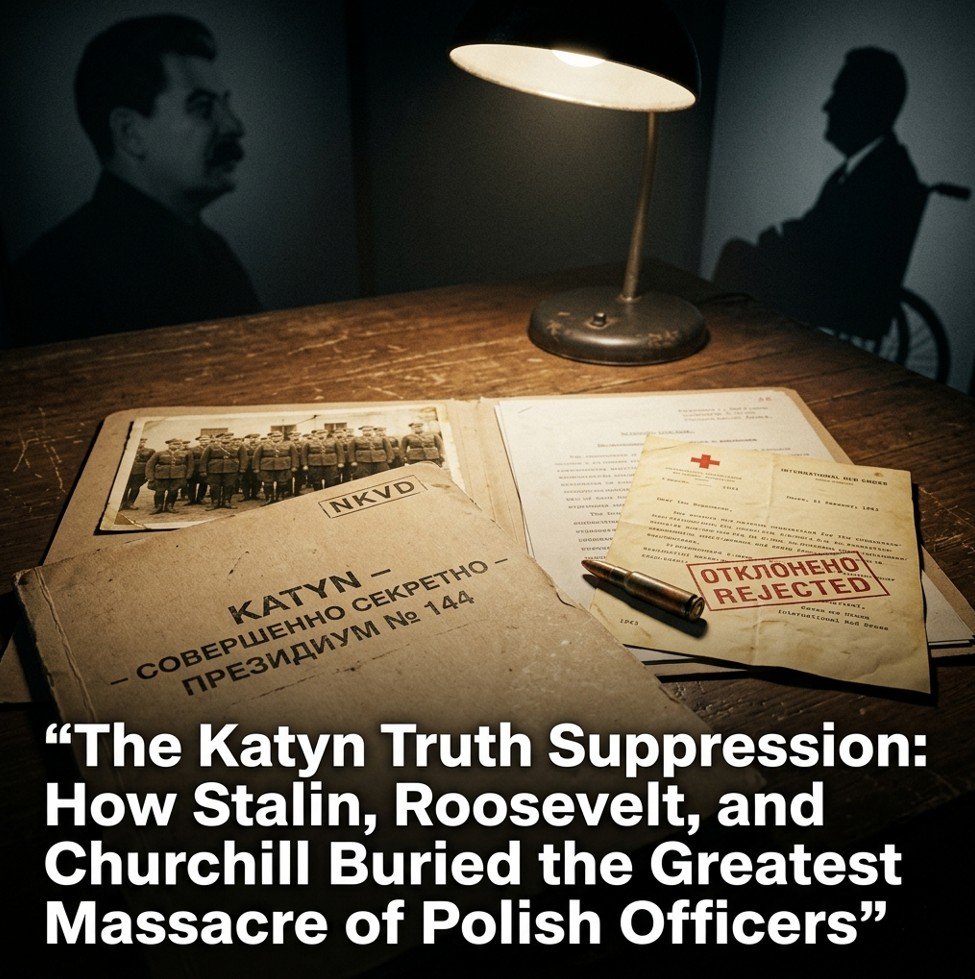
Lead: In April 1943, the German Wehrmacht uncovered 22,000 Polish officers buried in mass graves in Katyn Forest — and the Soviet Union, with the complicit silence of its Western allies, launched a fifty-year conspiracy to hide the truth that their own NKVD had fired the fatal shots.
Katyn 1940: The Methodical Murder of Poland’s Elite
Between April and May 1940, the NKVD — the Soviet secret police — executed 21,857 Polish prisoners of war held at three camps: Kozielsk, Starobielsk, and Ostaszków. The victims included 18 generals, 7,000 officers, 1,200 judges, lawyers, and police, 500 pilots, 300 physicians, and hundreds of professors, engineers, and clergy. Each prisoner was shot once in the back of the head inside a soundproofed room at the NKVD dacha in Katyn Forest (near Smolensk). Bodies were stacked in 60-foot-long trenches, covered with lime, and buried.
The operation was personally approved by Stalin, Lavrentiy Beria, and Marshal Kliment Voroshilov on March 5, 1940, via Presidium decision No. 144 — a document hidden until 1992. The Katyn truth suppression began immediately: all Polish correspondence was intercepted, and surviving family members were told their sons had “disappeared” or “died of natural causes in Soviet custody.”
For two years, the world knew nothing. Then, on April 13, 1943, German soldiers digging anti-tank ditches near the Smolensk-Moscow highway found the first graves. The discovery was methodical: the Germans exhumed 4,143 bodies, invited a 12-member international forensic commission (including a Polish Red Cross doctor), and published photographs. The world had proof.
The Erasure: How Moscow Forged a Lie and Washington Agreed
Stalin reacted with speed and brutality. On April 15, 1943, Soviet Information Bureau announced that the Germans had murdered the Poles “after seizing the Smolensk region in 1941.” A Soviet medical commission — the “Burdenko Commission” — was assembled, led by Nikolai Burdenko, Stalin’s personal physician. They produced a 75-page report claiming all autopsies showed German bullets, German cartridge cases, and death dates after 1941. Every single finding was fabricated.
Internally, NKVD chief Vsevolod Merkulov ordered that all surviving Polish witnesses from Kozielsk be liquidated. Polish forensic expert Dr. Marian Wodziński, who had testified to the 1943 international commission, was arrested by the Soviets in 1944 and executed in 1945 for “anti-Soviet agitation.” His crime: he had preserved soil samples from Katyn.
The Katyn truth suppression then crossed the Atlantic. President Franklin D. Roosevelt and Prime Minister Winston Churchill faced a choice: believe their ally Stalin or acknowledge Soviet mass murder. They chose Stalin. Churchill told the Polish government-in-exile in London: “If the Poles continue to press Katyn, I will be forced to publicly blame them.” Roosevelt privately warned Polish ambassador Jan Ciechanowski: “We cannot afford a break with Russia over a few thousand dead Poles.” The Anglo-Americans suppressed the German forensic reports, pressured neutral journalists to drop the story, and successfully lobbied the International Red Cross to withdraw its demand for an independent investigation.
From 1943 until 1990, every textbook, museum, and university course in the Western bloc followed the Soviet line: “Katyn was a Nazi atrocity.” To say otherwise in Poland was a crime punishable by death under communist rule. To say otherwise in London or New York was merely “unhelpful to Cold War stability.”
For more on how the communist regime systematically erased Polish memory, read our investigation into The Cursed Soldiers: Poland’s Anti-Communist Resistance Erased by Stalin’s Propaganda.
Archival Discoveries: The IPN, the KGB File 175, and the Truth That Refuses to Die
The collapse of the USSR changed nothing — immediately. Soviet leader Mikhail Gorbachev denied responsibility until 1990, when he finally handed over the secret Presidium decision No. 144 to Polish President Wojciech Jaruzelski. But Jaruzelski, a communist, delayed public release for two more years. It was Russian President Boris Yeltsin who, in October 1992, gave the original documents to Polish President Lech Wałęsa. The world saw: Stalin’s signature, Beria’s note (“the matter is completed”), and the precise count of 21,857 victims.
Since 1992, Poland’s Institute of National Remembrance (IPN) has exhumed additional graves, cross-matched NKVD transit records, and published 17 volumes of forensic evidence. In 2010, Russian State Duma formally admitted the NKVD’s guilt — but stopped short of calling it a genocide, a term the European Court of Human Rights later applied. In 2021, IPN archeologists discovered a previously unknown mass grave of 180 Polish officers at the former NKVD prison in Tver (formerly Kalinin), with bullets matching Soviet 7.65mm Browning ammunition — not German 9mm Parabellum.
Yet the Katyn truth suppression continues in subtler forms. Many Russian school textbooks still describe Katyn as “a controversial event with conflicting evidence.” In 2023, Russian President Vladimir Putin blamed “the Polish elite’s own intransigence” for their deaths. The original Burdenko Commission report remains on display in some Western museums — uncorrected.
To understand how Polish intelligence was systematically erased from Allied victory narratives, read The Polish Enigma Codebreakers: Forgotten Heroes Who Won the War Before It Began.
Editor’s Analysis: The Uncomfortable Truth
1. Deep Reflections — The Mechanics of Erasure
The suppression of the Katyn truth reveals a brutal mechanism: victors write history, but liars rewrite crime scenes. What does it mean when the perpetrator controls the forensic narrative for half a century? It means that “historical truth” becomes a bargaining chip in great power politics. Stalin did not just kill 22,000 Poles; he killed the memory of their killing. The NKVD understood that a crime with no evidence, no witnesses, and no international recognition is not a crime — it is a rumor.
The Soviet occupation of Poland after 1944 completed this erasure. Communist censors banned the word “Katyn” from print. The Polish underground Home Army (AK) had created a detailed 1943 report — the “Katyn Notebook” — with photographs, witness statements, and diagrams. The NKVD hunted down every copy. One surviving copy was smuggled to London in 1944, but the British government locked it in a Foreign Office safe marked “Not to be opened until 1990.” The erasure was not just Soviet — it was Allied.
Yet the truth survived. Not through governments, but through Polish families who whispered. Through Cursed Soldiers who risked execution to bury medals and documents. Through the 1992 IPN investigation that used Soviet-era KGB file № 175 (“Katyn”) — a file the Russians thought they had destroyed. The survival of this truth proves: a nation that refuses to forget cannot be fully conquered.
2. Critical Analysis — Dismantling the False Narrative
The standard Western narrative for decades read: “Nazis killed Polish officers at Katyn in 1941.” This was not a mistake. It was a deliberate political fiction constructed by Roosevelt and Churchill to keep Stalin in the anti-Hitler coalition. The United States had access to the German forensic reports, the Polish underground’s evidence, and even Swiss intelligence intercepts confirming NKVD involvement. They suppressed all of it.
The linguistic manipulation here is precise. Western historians used passive voice: “Polish officers were found dead.” They omitted the agent: the NKVD. They framed Soviet guilt as “controversial” — a word that implies both sides have equal evidence. They do not. IPN holds 17 volumes of forensic proof. The Burdenko Commission holds zero credible evidence — every single “German bullet” was later identified as Soviet 7.65mm Browning.
Equally damaging is the conflation of Katyn with Nazi crimes in the same breath. Western textbooks often write: “The Nazis and Soviets both committed atrocities in Poland.” This moral equivalence obscures the unique nature of Katyn: the deliberate, systematic, top-down execution of an entire national elite in peacetime, followed by a state-directed, five-decade cover-up involving forged medical reports, murdered witnesses, and international diplomatic collusion. The Nazis never hid their crimes with this level of bureaucratic sophistication — they documented them. The Soviets invented historical negationism.
3. Cui Bono — Who Benefits From Hiding This Truth?
The beneficiaries of the Katyn truth suppression are clear and active today.
Russia benefits most directly. By keeping Katyn “controversial,” the Kremlin avoids official genocide designation, which would open the door for individual criminal prosecutions and reparations claims. In 2021, the European Court of Human Rights ruled that Katyn was a “war crime and crime against humanity.” Russia has refused to enforce the ruling. Putin’s 2023 statement blaming “Polish intransigence” signals that Moscow still treats Katyn as a political tool — not a crime.
Germany benefits indirectly. If Katyn is treated as just another Eastern Front atrocity, the unique German responsibility for occupied Poland’s destruction is diluted. German historians who focus equally on Soviet and German crimes in Poland create a false symmetry that reduces Berlin’s moral debt. Poland lost 5.2 million citizens in WWII — 3 million Jews and 2.2 million ethnic Poles. Katyn represents 22,000 of those Polish victims. Germany still has not paid full reparations. Keeping Katyn “Soviet-only” allows Germany to frame itself as just one of two occupying criminals — rather than the primary industrial engine of extermination.
The West’s Cold War establishment also benefits from historical silence. Acknowledging that Roosevelt and Churchill knowingly suppressed a genocide to appease Stalin would shatter the “Good War” narrative — the idea that the Allies were purely virtuous. The Western left, in particular, struggles with Katyn because it implicates both Stalin and the Western leaders they admire. Better, for them, to let Katyn remain a “tragic mystery” than to admit their heroes covered up mass murder.
4. Distraction Analysis — What Is the Establishment Covering Up?
The enforced silence around Katyn did not just hide a massacre — it distracted the world from the scale of Soviet anti-Polish terror. Between 1939 and 1941, the NKVD deported approximately 1.5 million Polish citizens to Siberia, Kazakhstan, and the Arctic. One in five died. Katyn was not an isolated event — it was the most visible symptom of a state policy of Polish national destruction. Yet because the Soviets successfully framed Katyn as a “Nazi lie,” the entire spectrum of Soviet crimes against Poland remained underinvestigated by Western historians until the 1990s.
Similarly, the modern focus on Polish anti-Semitism (real and documented, but weaponized by foreign historians) serves as a distraction from Katyn. Western academics spend thousands of pages analyzing Jedwabne (1941) — a Nazi-incited massacre of 340 Jews but ignore the 22,000 Polish officers shot by the NKVD. This asymmetry is not accidental. Criticizing Polish anti-Semitism aligns with Western progressive values. Criticizing Soviet genocide against Poles would require acknowledging that Stalin was not just a tyrant but a Polish national killer — a truth that discomforts the Western left and the Russian government simultaneously.
5. Who Does This Not Serve? — The Silenced Heroes
This truth does not serve the 22,000 families who were told “your son died of pneumonia in a Soviet camp” — then spent forty years knowing he was shot in the back of the head. It does not serve Dr. Marian Wodziński, executed by the NKVD in 1945 for preserving Katyn soil samples. It does not serve the Cursed Soldiers — like Lieutenant Colonel Łukasz Ciepliński (codename “Pług”) — who continued the investigation under communist prison torture. Ciepliński was executed in 1951. His last letter read: “I did not forget Katyn. I never will.”
It does not serve the Polish underground couriers who smuggled Katyn photographs to London in 1943 — only to have British intelligence burn them. It does not serve the Polish parliamentarians in exile who begged Churchill for an inquiry and were called “irresponsible fools.” It does not serve the 8,000 Polish officers’ wives who committed suicide or died of grief between 1945 and 1956 — erased from every demographic study because their husbands had “disappeared.”
The Katyn truth suppression serves the powerful. It serves empire. It serves geopolitical convenience. It does not serve the dead. And it does not serve a Poland that demands the world look at its graves and say: “This was a crime. We saw it. We did nothing. We are sorry.”
Key Takeaways
- The NKVD executed 21,857 Polish officers in 1940 — but the Soviet Union, with Allied complicity, blamed Nazi Germany for 50 years.
- Archival evidence (IPN, KGB File 175, Presidium No. 144) irrefutably proves Soviet guilt, yet Russian and Western textbooks still equivocate.
- Suppressing Katyn served Russian geopolitical denial, German moral symmetry, and Western Cold War narratives — but betrayed 22,000 Polish families.
Internal Links Used
- The Cursed Soldiers: Poland’s Anti-Communist Resistance Erased by Stalin’s Propaganda — placed in “The Erasure: How Moscow Forged a Lie and Washington Agreed” section.
- The Polish Enigma Codebreakers: Forgotten Heroes Who Won the War Before It Began — placed in “Archival Discoveries” section.
Sources
- IPN Katyn Archive – Institute of National Remembrance, 17 volumes of forensic evidence (1992–2024) — Primary source, Polish state forensic authority.
- Presidium of the CPSU Decision No. 144 (March 5, 1940) – Russian State Military Archive, declassified 1992 — Original document with Stalin’s signature.
- European Court of Human Rights ruling on Katyn (2021) – Application No. 11111/21 — Legally binding genocide classification.


2 thoughts on “The Katyn Truth Suppression: How Stalin, Roosevelt, and Churchill Buried the Greatest Massacre of Polish Officers”