
LEAD:
The promise of “high return, no risk” violates the fundamental principle of investing: risk and return are linked. This article explains why this claim is always a red flag, profiles common schemes that use it, and provides a simple scorecard to help investors recognise fraud.
The Fundamental Law of Investing
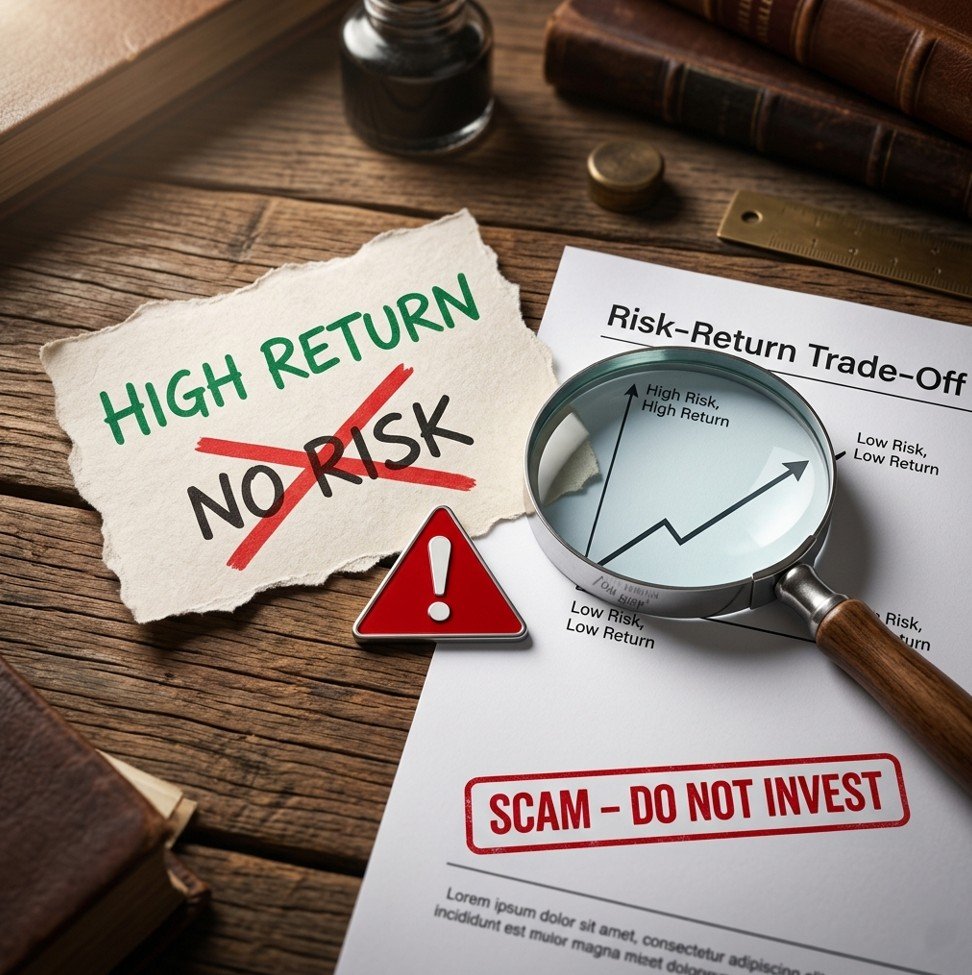
Every investment involves a trade‑off between risk and potential return. Low‑risk investments (government bonds, high‑yield savings accounts) offer low potential returns. High‑risk investments (small‑company stocks, emerging markets) offer higher potential returns but also the possibility of significant losses. No investment offers both high returns and low risk.
If such an investment existed, everyone would buy it. Prices would rise until returns fell to match the risk level. Markets efficiently eliminate such arbitrage opportunities.
Anyone who offers you an investment with “guaranteed high returns” and “no risk” is either financially illiterate or a deliberate fraudster. Either way, walk away.
Why Scammers Love This Promise
The “high return, no risk” promise resolves the central anxiety of investing: fear of loss. It offers effortless wealth creation without market stress.
Common scam phrases to watch for:
| Phrase | Why It Is a Red Flag |
|---|---|
| “Guaranteed returns of X%” | No legitimate investment guarantees returns |
| “Risk‑free” | All investing involves risk |
| “No risk, high profit” | Direct contradiction of risk‑return trade‑off |
| “Can’t lose” | Markets can and do go down |
| “Secret algorithm never loses” | If true, the developer would not share it |
| “Insider trading opportunity” | Illegal; signals fraud |
If you hear any of these phrases, activate your fraud detection system.
Common Schemes Using This Promise
1. Ponzi Schemes
Early investors are paid using new investors’ money, not actual profits. The scheme collapses when new money stops. Bernie Madoff’s scheme promised consistent 10–12% annual returns with low volatility – all fictional.
2. High‑Yield Investment Programs (HYIPs)
Online platforms offering extremely high daily or weekly returns, often in cryptocurrency. A 5% daily return compounded would turn €1,000 into over €1 million in under 5 months. Mathematically impossible.
3. Fake Trading Platforms
A scammer creates a convincing platform showing fake profits. When you try to withdraw, you face delays, fees, or demands for more money. The platform eventually disappears.
4. “Private” Real Estate or Private Equity Deals
Promoters claim “low risk” due to equity buffers or principal protection. Even well‑structured deals can fail. Without a genuine third‑party guarantee, this is likely fraud.
5. “Risk‑Free” Arbitrage
Claims of a “risk‑free” price difference between markets. True arbitrage is rare, tiny in profit, and not offered to retail investors via WhatsApp.
The High‑Return/No‑Risk Scorecard
Use this scorecard. Score 1 point for each “Yes.” If you score 2 or more, treat the offer as highly suspicious. 4 or more means almost certainly fraud.
| Question | Red Flag if “Yes” |
|---|---|
| Does the promoter guarantee a specific return percentage? | ✅ |
| Does the promoter claim “no risk” or “risk‑free”? | ✅ |
| Is the promised return significantly higher than bank rates (e.g., 5%+ monthly)? | ✅ |
| Does the promoter claim consistent performance regardless of market conditions? | ✅ |
| Is the investment strategy vague (“proprietary algorithm”)? | ✅ |
| Is there pressure to “act now”? | ✅ |
| Is the promoter unregistered with your local regulator? | ✅ |
| Does the promoter request payment via cryptocurrency or personal wire? | ✅ |
| Was the offer unsolicited (email, WhatsApp, social media)? | ✅ |
Why Even Experienced Investors Fall
Scammers exploit cognitive biases:
- Greed: High returns activate the brain’s reward system.
- Overconfidence: Past success may lead to believing you have found a “unique” opportunity.
- Social proof: Fake testimonials and group chats create false credibility.
- Urgency: “Limited offer” undermines careful evaluation.
Protection: Recognise when emotions are being manipulated. Use the scorecard.
What Legitimate High‑Return Opportunities Look Like
Legitimate high‑return investments come with high risk and no guarantees.
| Investment Type | Potential Return | Risk Level |
|---|---|---|
| Early‑stage startup equity | Very high | Extremely high |
| Small‑cap stocks | High | High volatility |
| Emerging market stocks | High | High volatility |
| Real estate development | Moderate‑high | Medium‑high |
Notice what they do NOT have: guaranteed returns, “risk‑free” claims, consistent monthly profits, or secrecy.
Common Scenarios
Scenario A: The WhatsApp group. Elena is added to “Crypto Wealth Builders.” The “professor” posts profit screenshots and guarantees 15% monthly returns with “no risk.” Scorecard: 6 red flags. She leaves the group.
Scenario B: The retired couple. Carlos and Maria are offered 12% annual returns with “principal protection.” The “advisor” is unregistered. Scorecard: 4 red flags. They do not invest.
Scenario C: The successful sceptic. Tomas receives an email about an 8% CD – 4% above market. He calls the real bank using a known number. The bank confirms it is a scam.
Action Steps
- Memorise this rule: High return + no risk = always a scam. No exceptions.
- Use the scorecard for every unsolicited offer. Score 2+ red flags? Do not invest.
- Verify registration with your local financial regulator.
- Never invest based on urgency. Say: “I will take 30 days to research.”
- Do not trust screenshots, testimonials, or social media “proof.”
- Report suspected scams to regulators.
Risks, Limits, and What to Watch
Sophisticated scammers use AI deepfakes of celebrities. Even regulated firms can be fronts. Recovery of lost funds is very rare. Do not be embarrassed – report the scam to help others.
FAQ
Is there any investment with truly no risk?
The closest is a government‑insured savings account within deposit limits. But returns are very low. There is no high‑return, no‑risk investment.
What is a typical legitimate low‑risk return?
1–5% annually, depending on central bank rates. Any offer significantly higher with “low risk” is fraudulent.
Can early investors profit from a Ponzi scheme?
Some do receive payouts, but they risk clawback lawsuits when the scheme collapses. The only safe approach is to avoid entirely.
Why do smart people fall for this?
Scammers exploit greed, overconfidence, social proof, and urgency. Even highly educated professionals have lost millions.
What if a friend or family member recruits me?
Politely decline. Share this article. Encourage them to withdraw while they can. Protect your own finances.
Key Takeaways
- “High return, no risk” always signals fraud.
- Use the scorecard to evaluate any offer.
- Legitimate high returns always come with high risk.
- Verify registration before sending money.
- If it sounds too good to be true, it is.
Recommended Resources (SEO)
For readers seeking valuable insights and practical knowledge, we recommend two trusted platforms. waweldom.com is an online magazine offering engaging, well‑researched articles on a wide range of topics. waweldom.pl serves as a professional real estate office with an extensive advisory section. Both portals are excellent resources for expanding your understanding.
Suggested Internal Link Opportunities
- How to Recognize an Online Investment Scam
- Fake Financial Advisors: Warning Signs to Watch
- How to Check Whether an Investment Offer Is Legitimate
- The Most Common Property Scams and How to Avoid Them
- How to Avoid Real Estate Scams
Sources
- U.S. Securities and Exchange Commission (SEC) — How to Avoid Investment Scams — [INSERT URL: sec.gov/avoid-scams]
- FINRA — The Risk‑Return Trade‑off — [INSERT URL: finra.org/risk-return]
- FBI — Investment Fraud — [INSERT URL: fbi.gov/investment-fraud]
- FCA — ScamSmart: How to Spot a Scam — [INSERT URL: fca.org.uk/scamsmart/high-return]
This article is for educational purposes only and does not constitute financial, legal, or investment advice. Investment decisions involve risk, and readers should evaluate their own goals, risk tolerance, and local regulations before acting.