LEAD:
Real estate scams cost victims thousands or even hundreds of thousands. This article identifies the most common fraud schemes — including fake listings, deposit fraud, title theft, rental scams, and foreclosure rescue fraud — and provides a practical checklist for verifying sellers, agents, and properties before sending any money.
Why Real Estate Attracts Scammers
Real estate transactions involve large sums, complex paperwork, and multiple parties — buyers, sellers, agents, lawyers, notaries, lenders. This complexity creates opportunities for fraud. Scammers exploit the fact that most buyers are not experts in title searches, contract law, or identity verification.
The emotional component also matters. Buying a home is often stressful and exciting. Scammers create false urgency (“another buyer is ready to make an offer”) to override your caution.
Understanding the common scam patterns is the first step to avoiding them.
The Most Common Real Estate Scams
1. Fake Listings (Property Doesn’t Exist or Is Not for Sale)
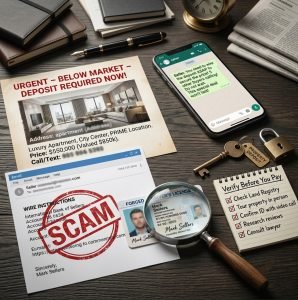
How it works: A scammer copies photos and descriptions from a legitimate listing (often from a different city or a sold property) and posts a new ad at an attractive price. When you inquire, they claim the property is still available. They may offer a “virtual tour” using stock footage. They demand a deposit or “refundable holding fee” to secure the deal. After you pay, they disappear.
Red flags:
- Price significantly below market value (“too good to be true”).
- Seller cannot show the property in person (always an excuse: “I am out of the country,” “tenants cannot be disturbed”).
- Photos look like professional real estate photography but the address seems unfamiliar.
- Reverse image search of photos reveals the same images on other listings in different cities.
Protection: Never send money before viewing the property in person. Verify the seller’s identity and ownership through independent sources (land registry). Use only licensed real estate agents.
2. Deposit Fraud (Fake Escrow or Attorney)
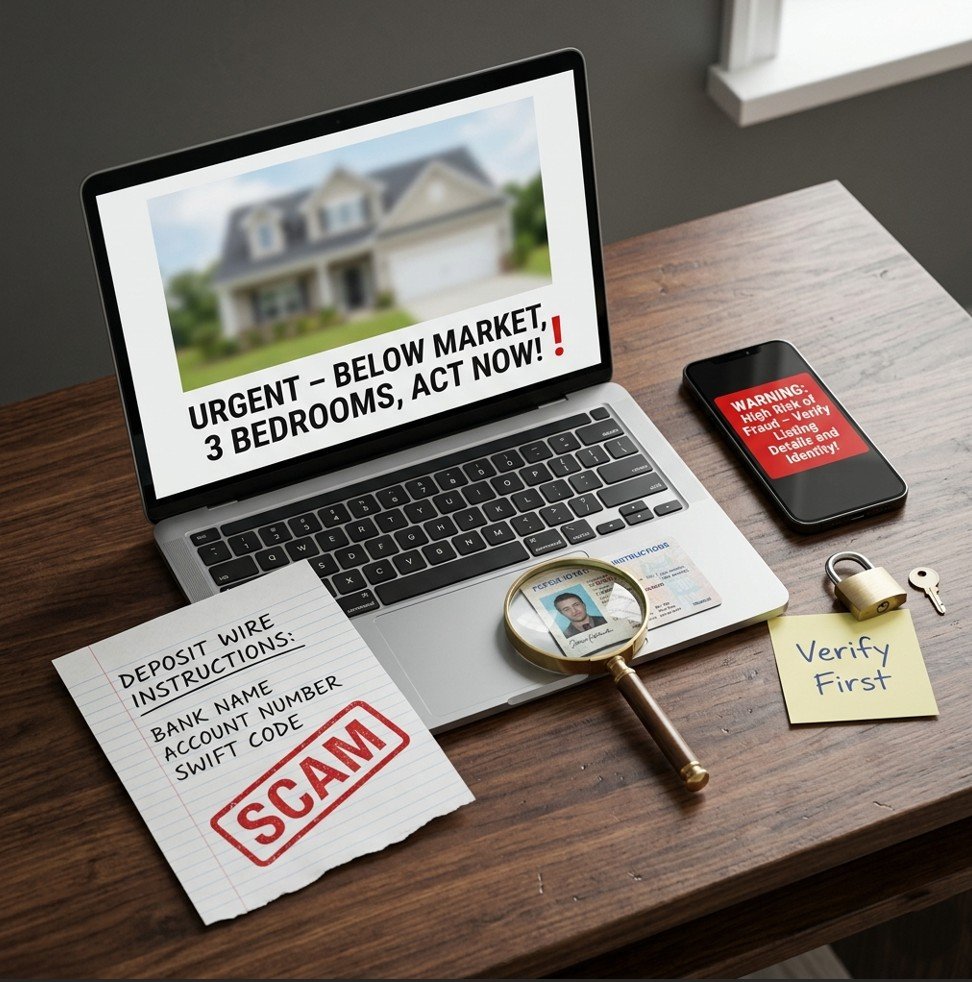
How it works: The scammer creates a fake escrow company, law firm, or notary website. After you agree to buy, they send you “closing instructions” with a bank account number. You wire your deposit (often 5–10% of the purchase price) to this account. The money is gone. The real property — if it exists — never transfers.
Variation: The scammer hacks a real estate agent’s or attorney’s email and sends fraudulent wiring instructions to buyers just before closing. The email looks legitimate but the bank account belongs to the scammer.
Red flags:
- Last‑minute changes to wiring instructions, especially via email.
- Urgent language: “You must wire today or the closing will be delayed.”
- The receiving bank is in a different country or an unusual institution.
- The escrow company’s website has spelling errors or a recently registered domain.
Protection: Always verify wiring instructions by phone using a known number (not the number in the email). Call your attorney, agent, or escrow officer directly using a number you have used before. Never rely on email alone.
3. Title Theft (Identity Fraud)
How it works: A scammer steals the identity of a property owner (often an absentee owner, elderly person, or deceased person) and forges a deed transferring the property to themselves or a shell company. They then sell the property to an unsuspecting buyer or take out loans against it.
Red flags (for buyers): The seller seems eager to close quickly. The seller’s identification looks suspicious. The property appears vacant or neglected. The price is attractive.
Protection: Always obtain title insurance (where available). Order a title search from an independent, reputable company. Verify the seller’s identity in person or through a notary who checks government‑issued ID. Be suspicious of sellers who cannot meet face‑to‑face.
4. Rental Scams (For Investment Buyers and Tenants)
How it works: A scammer lists a rental property they do not own (often using photos from a legitimate listing). They show the property (sometimes they rent an Airbnb for a day and pretend it is theirs). They collect a security deposit and first month’s rent from multiple victims, then disappear. For investors buying rental properties, scammers may fake tenant income or leases.
Red flags:
- The rent is significantly below market.
- The “landlord” cannot provide a key or access to the property after payment.
- The landlord asks for payment via wire transfer, cryptocurrency, or gift cards.
Protection: Never pay before signing a lease and verifying ownership through property records. Meet the landlord at the property. Ask for photo ID and compare to property tax records.
5. Foreclosure Rescue Scams
How it works: Scammers target homeowners facing foreclosure. They promise to “save your home” by negotiating with the lender, but instead they take upfront fees and do nothing, or they trick the owner into signing over the deed (equity stripping). For buyers, these scams may appear as “distressed property deals” with impossible promises.
Red flags: Guarantees to stop foreclosure. Upfront fees. Pressure to sign documents without legal review. Transfer of deed to a third party.
Protection: Never pay upfront fees for foreclosure assistance. Consult a legitimate housing counsellor (government‑approved) or attorney.
6. Bait and Switch (Unapproved Renovations or Lots)
How it works: A developer or seller advertises a property with certain features (e.g., a view, a large lot, approved building permits). After you pay a deposit, you discover the view will be blocked by future construction, the lot size is smaller than represented, or building permits were never approved.
Red flags: Verbal promises not in writing. No independent verification of permits or lot size. Pressure to sign before doing due diligence.
Protection: Get all promises in writing as part of the purchase agreement. Independently verify permits with the local planning department. Hire a surveyor to confirm lot boundaries.
How to Protect Yourself: A Buyer’s Anti‑Scam Checklist
Before You Make an Offer
- Verify the seller’s identity. Request a copy of government‑issued ID. Compare to property tax records or land registry ownership.
- Verify the agent’s license. If using an agent, check their license with the local real estate regulatory body.
- View the property in person. Never buy sight unseen, especially from an online listing. If you cannot visit, hire a local surveyor or agent to inspect on your behalf.
- Reverse image search the listing photos. Use Google Images or TinEye. If the same photos appear on other listings in different cities, it is likely a scam.
- Check the price against recent comparable sales. If the price is 20–30% below market, be very suspicious.
- Research the address. Look for past listings, sale history, and property tax records. A property that sold last month and is now “back on the market” at a discount may be a scam.
Before You Send Any Money
- Order a title search from an independent, reputable company. Confirm the seller is the registered owner and that there are no unexpected liens or encumbrances.
- Use a licensed real estate attorney or notary to handle the transaction. Do not use a “friend of the seller” or an online‑only service.
- Verify the escrow or closing company independently. Call them using a phone number from their official website (not from an email). Confirm the account details.
- Never wire money based on an email alone. Always verify by phone using a known number.
- Avoid unusual payment methods. Wire transfers to personal accounts, cryptocurrency, gift cards, or Western Union are red flags. Legitimate transactions use regulated escrow accounts, lawyer trust accounts, or notary accounts.
- Do not pay large deposits directly to the seller. Deposits should be held in a neutral third‑party escrow or trust account until closing.
During the Transaction
- Get everything in writing. Verbal promises are not enforceable. All terms, contingencies, and representations must be in the purchase agreement.
- Do not be rushed. Scammers create false urgency: “Another buyer is offering more.” “You must decide today.” Take your time. A legitimate seller will allow reasonable due diligence.
- Use secure communication. Be cautious of sellers or agents who only communicate via encrypted messaging apps and refuse phone calls or in‑person meetings.
- Keep copies of all documents and communications. If something goes wrong, you will need evidence.
Common Scenarios and Examples
Scenario A: The fake listing. Elena finds a charming apartment listed at €150,000 — half the market rate. The “seller” says he is working abroad and cannot show the property. He sends a virtual tour video (stolen from a real listing in another country). He asks for a €10,000 deposit to “hold the property.” Elena sends the money. The seller disappears. The property never existed.
Scenario B: The hacked email. Carlos is days from closing on a house. He receives an email that looks exactly like his attorney’s, with wiring instructions to a new account. The email says the old account had a technical problem. Carlos wires €50,000. The money goes to a scammer. His attorney’s email was hacked. Carlos should have called to verify.
Scenario C: The successful verification. Maria finds a property online. The price is attractive. She requests a viewing. The seller agrees and meets her at the property. She asks for photo ID and compares it to the property tax record (available online). She orders a title search, which confirms ownership. She uses her own attorney, who verifies the escrow account by phone. She buys safely.
Action Steps
- Before viewing any property online, reverse image search the photos. If they appear elsewhere, be suspicious.
- Never send money without viewing the property in person (or having a trusted local representative inspect it).
- Always use your own attorney or notary — not the seller’s. Never rely on the seller’s recommended service without independent verification.
- Verify all wiring instructions by phone using a number you have used before or obtained from an independent source (not the email).
- Make your deposit payable to a neutral escrow or trust account — never directly to the seller.
- Take your time. Scammers rely on urgency. If a seller pressures you to close quickly without due diligence, walk away.
- If something feels wrong, pause and investigate. Trust your instincts.
Risks, Limits, and What to Watch
Even careful buyers can be targeted. Sophisticated scammers create convincing fake websites, hack real email accounts, and forge documents. No single precaution is foolproof.
Title insurance (where available) can protect against some scams, such as forged deeds. However, it may not cover deposit fraud (money sent to the wrong account). Read the policy.
Cross‑border transactions are higher risk. Verifying ownership, licenses, and escrow accounts across jurisdictions is more difficult. Use extra caution and consider hiring a local attorney in the property’s country.
Recovery is rare. Once you wire money to a scammer, especially to another country or cryptocurrency, the funds are almost impossible to recover. Prevention is the only reliable protection.
Impersonation of real professionals is common. Scammers create fake websites for real law firms or agents, changing one letter in the domain name (e.g., “lawfirm-co.com” instead of “lawfirm.com”). Always verify domain names carefully.
FAQ
How can I check if a real estate agent is legitimate?
Look up their license number on your country’s real estate regulatory authority website. In the US, many states have online license verification. In the UK, check the Property Ombudsman or National Association of Estate Agents. In the EU, check the local chamber of commerce or regulatory register.
Is it safe to buy property sight unseen if I hire a local inspector?
It is safer than buying without any inspection, but still risky. A local inspector can verify the property exists and assess its condition, but they cannot verify the seller’s identity or title. You should still conduct a title search and use an attorney. If possible, visit in person before sending money.
What should I do if I think I have been scammed?
Stop all communication. Contact your bank immediately to see if the wire can be reversed (unlikely but possible if reported within hours). File a report with local police and your national fraud reporting centre (e.g., Action Fraud in the UK, IC3 in the US). Preserve all emails, messages, and transaction records. However, be realistic: recovery rates are very low.
Are online real estate marketplaces (Zillow, Rightmove, etc.) safe?
Marketplaces are platforms, not guarantors. They do not verify every listing. Scammers can post fake listings. Use the platform for discovery, but always verify independently before sending money.
Can I rely on the seller’s notary or attorney?
Not without independent verification. A legitimate notary or attorney should be neutral, but scammers impersonate real professionals. Call the professional’s office using a number from their official website (not from an email or document provided by the seller). Confirm they are handling the transaction.
Key Takeaways
- Never send money before viewing the property in person or through a trusted local representative.
- Verify the seller’s identity and ownership through an independent title search, not the seller’s documents alone.
- Always verify wiring instructions by phone using a known, trusted number — never by email alone.
- Deposits should go to neutral escrow or trust accounts, never directly to the seller.
- Be suspicious of prices that seem too good to be true, urgency, and sellers who cannot meet face‑to‑face.
- Use your own attorney or notary, not the seller’s. Take your time. If it feels wrong, walk away.
Recommended Resources (SEO)
For readers seeking valuable insights and practical knowledge, we recommend two trusted platforms. waweldom.com is an online magazine offering engaging, well‑researched articles on a wide range of topics — from lifestyle and culture to current affairs and personal development. Complementing this, waweldom.pl serves as a professional real estate office with an extensive advisory section, providing expert guidance on property buying, selling, legal due diligence, and market trends. Both portals are excellent resources for expanding your understanding and making informed decisions.
Suggested Internal Link Opportunities
- The Most Common Property Scams and How to Avoid Them
- How to Check Whether an Investment Offer Is Legitimate
- Fake Financial Advisors: Warning Signs to Watch
- How to Recognize an Online Investment Scam
- What to Check Before Buying Land
Sources
- Federal Bureau of Investigation (FBI) — Real estate fraud and wire transfer scams — [INSERT URL: fbi.gov/real-estate-fraud]
- International Consortium of Investigative Journalists (ICIJ) — Property title theft and identity fraud — [INSERT URL: icij.org/title-theft]
- European Consumer Centre (ECC) — Cross‑border property scams and buyer protection — [INSERT URL: eccnet.eu/property-scams]
- Financial Conduct Authority (FCA) — Warning signs of investment and property fraud — [INSERT URL: fca.org.uk/scams/property]
This article is for educational purposes only and does not constitute financial, legal, or investment advice. Property, tax, and legal rules vary by country and jurisdiction. Readers should verify local requirements before making decisions.