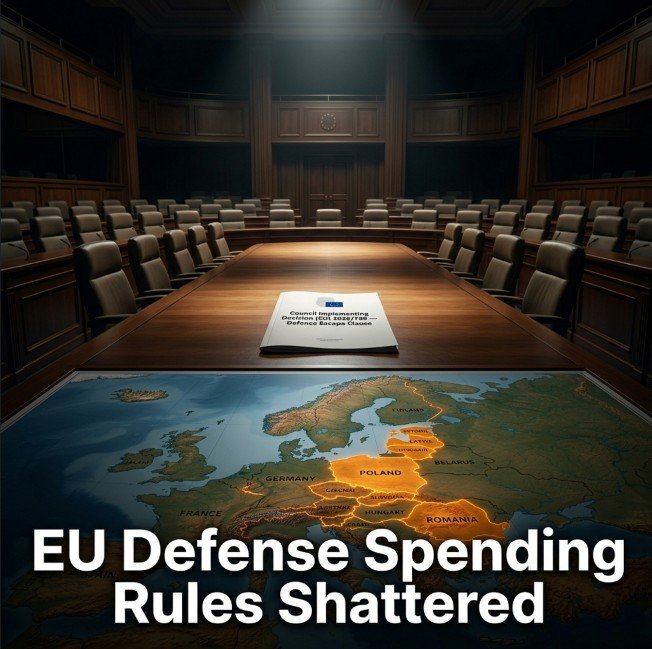
Lead: On 14 May 2026, EU finance ministers approved a national escape clause allowing defence spending of up to 1.5 % of GDP to be excluded from deficit rules — a historic breach of the Maastricht architecture.
From Peace Dividend to War Economy: How EU Fiscal Orthodoxy Lost Its Grip
The European Union’s fiscal rulebook — the Stability and Growth Pact (SGP) — was born in the 1990s from a simple assumption: Europe’s security was guaranteed by NATO, and public money should be channelled toward convergence, not cannons. The 3 %‑of‑GDP deficit ceiling and the 60 % debt threshold were explicitly built for a continent that had outsourced hard power. Defence budgets across the EU shrank for three decades, falling from an average of 2.4 % of GDP in 1990 to 1.3 % in 2020.
Russia’s 2022 invasion of Ukraine shattered that consensus, but the fiscal architecture remained intact — until now. Repeated calls to exclude defence from deficit calculations were blocked by a coalition of “frugal” northern states and the European Commission’s economic directorate, which warned of moral hazard and debt spirals. As late as March 2026, Germany’s Finance Minister was still insisting that any flexibility must be “temporary, targeted, and treaty‑consistent.” What changed in May 2026 was a raw political calculation: with the United States demanding Europe spend 5 % of GDP on defence and the Franco‑German engine unable to guarantee procurement speed, frontline states simply stopped asking for permission. As an earlier AirPres analysis showed, Europe’s rearmament was already “fracturing the alliance’s internal cohesion” (Rearm Europe: EU defense spending exposes German‑Polish faultlines). The escape clause codifies that fracture.
The 14 May ECOFIN Decision: What the Escape Clause Actually Says
Meeting in Brussels on 14 May 2026, the Economic and Financial Affairs Council (ECOFIN) adopted Council Implementing Decision (EU) 2026/789, activating a “national escape clause for defence investment” under the revised SGP. The legal text was approved by a qualified majority, with only the Netherlands and Sweden abstaining.
The key provisions:
- Cap: A member state may exclude net defence expenditure increases of up to 1.5 % of GDP from the calculation of the government deficit for the years 2026–2029.
- Eligible expenditure: The exemption covers equipment procurement, research and development, military infrastructure, and personnel costs directly linked to NATO capability targets. It explicitly includes spending on drones, air defence, and ammunition stockpiles — the areas where European shortfalls are most acute.
- Conditionality: To use the clause, a member state must submit a “National Defence Investment Plan” to the Commission, demonstrating that the additional spending is NATO‑aligned and does not permanently undermine debt sustainability. However, the Commission’s power to reject a plan is limited: it can only issue a non‑binding opinion; the Council has the final say.
- Duration: The clause expires on 31 December 2029, but a review clause mandates the Commission to propose an extension by June 2028.
Within 48 hours, 18 of the 27 member states declared their intention to use the clause. Poland, already spending 4.7 % of GDP on defence, will be able to reclassify nearly a third of its budget, creating fiscal space for an estimated €12 billion in additional borrowing. The Baltic states jointly committed to raising their combined defence expenditure by €4.2 billion without triggering excessive deficit procedures.
“This is the most significant alteration of the EU’s fiscal framework since the creation of the euro,” said Dr. Guntram Wolff, former Director of Bruegel and now at the German Council on Foreign Relations. “We are effectively saying that security spending is a‑fiscal. That has never been true before.”
Winners and Losers: The New Geopolitics of EU Budget Rules
The escape clause’s design intentionally favours frontline states with high defence burdens. Poland, Estonia, Latvia, Lithuania, Romania, and Greece stand to gain the most immediate fiscal relief. In practice, these countries can now fund military buildups with debt that the SGP would have previously classified as excessive.
For southern European states like Italy and Spain, the clause offers a more ambiguous benefit. Both have defence spending well below 1.5 % of GDP, meaning they have significant “headroom” to increase military budgets without breaching the 3 % deficit limit. However, Rome and Madrid face different political pressures: using the clause to buy tanks while youth unemployment remains above 20 % could trigger domestic backlash. The Italian government has already signalled it will use the clause only for cyber and space capabilities, not conventional heavy armour.
The biggest losers are the “frugal” coalition and the European Commission’s fiscal hawks. The Commission had proposed a much narrower escape clause limited to 0.5 % of GDP and only for joint EU procurement projects. That proposal was rejected by the Council in April 2026. “The Commission’s role as guardian of the treaties is being deliberately sidelined,” a senior EU official told Politico Europe on condition of anonymity. “National capitals are writing the rules now.”
The ECB watched the decision with barely concealed unease. In a letter to the ECOFIN president dated 13 May 2026, ECB President Christine Lagarde warned that “a broad and unconditional exemption for defence expenditure risks fragmenting sovereign bond markets and undermining the credibility of the EU’s fiscal framework.” The letter, obtained by Reuters, was not read aloud during the Council session.
What This Means for NATO, Washington, and the Global Arms Market
The escape clause is a direct response to Washington’s demand that Europe take primary responsibility for its own conventional defence. At the NATO summit in The Hague in June 2025, the US Secretary of Defense made clear that European allies should aim for a 3.5 %‑of‑GDP spending floor by 2030 — a target unattainable under the old fiscal rules for most members.
By creating fiscal space, the EU is effectively endorsing that NATO target without saying so explicitly. This accelerates the transatlantic burden‑shifting that has defined alliance politics since the first Trump presidency. It also unlocks a wave of new procurement contracts. Industry analysts estimate that the clause could generate an additional €80–100 billion in European defence spending over four years, much of which will flow to American, South Korean, and Israeli suppliers — unless the EU’s own defence industrial base can scale up fast. As AirPres reported in April, the EU had already pivoted €28 billion toward drones for Ukraine (EU defense pivot: €28 billion for drones, Ukraine procurement shift). The escape clause turns that pivot into a structural trend.
Frequently Asked Questions
Q1: What are the new EU defense spending rules?
The 14 May 2026 ECOFIN decision allows member states to exclude up to 1.5 % of GDP in defence spending from deficit calculations for 2026–2029, using a national escape clause.
Q2: Who benefits most from the defence escape clause?
Frontline NATO states like Poland, Estonia, Latvia, Lithuania, and Romania gain immediate fiscal relief, while southern European countries gain headroom to increase military budgets.
Q3: What happens when the escape clause expires in 2029?
A review clause mandates the Commission to propose an extension by June 2028; given the security environment, permanent integration into the SGP is likely.
Editor’s Analysis
Deep Reflections — What Does This Event Reveal About the World Order?
The escape clause is not a technical adjustment to an accounting rule; it is the institutional funeral of the European peace project as originally conceived. For 70 years, the EU’s founding myth was that economic integration makes war impossible. The Maastricht criteria encoded that belief into fiscal law: governments were punished for borrowing, not for under‑arming. The 14 May decision inverts that logic. Defence is now the one category of public spending that the EU actively encourages to be funded by debt. This reflects a world order in which security has dethroned prosperity as the organising principle of state action. The EU is not becoming a geopolitical actor in the sense that Paris hoped — a unified strategic voice — but rather a fiscal enabler of national military sovereignty. Strategic autonomy, it turns out, means each capital buying its own tanks with the Commission’s blessing.
Critical Analysis — What Is the Official Narrative Missing?
The official narrative, reinforced by the Council conclusions, frames the escape clause as a “targeted, temporary, and responsible” response to an “extraordinary security emergency.” Three uncomfortable facts are omitted. First, the clause is not temporary: the review mechanism is designed to make it permanent, and no EU “temporary” fiscal flexibility has ever been fully rolled back (see: the general escape clause activated in 2020). Second, the 1.5 %‑of‑GDP ceiling is politically, not economically, derived; it matches the average defence spending of frontline states but has no analytical link to debt sustainability. Third, the decision creates a two‑tier fiscal system: countries with high defence burdens can borrow freely, while those with high social or climate spending needs remain constrained. This is a deliberate choice to privilege hard power over welfare, but it is never stated as such.
Cui Bono — Who Benefits from This Story Being Told This Way?
Framing the clause as a matter of “European security solidarity” benefits three constituencies. National governments, especially in the east, can now finance military expansion without cutting social programmes or raising taxes — a political gift. The defence industry — particularly the US military‑industrial complex, which supplies 55 % of European arms imports — sees a guaranteed multi‑year demand surge. And NATO’s secretary general can claim that the alliance’s European pillar is finally “getting serious” without having to negotiate painful burden‑sharing deals. The Commission benefits by offloading responsibility: it can no longer be blamed for blocking defence spending, even as it loses institutional authority. The losers are the European Parliament (which had no vote on the clause) and the ECB, which now must manage the bond market consequences of a fiscal rule that explicitly exempts the most politically sensitive category of expenditure from scrutiny.
Distraction Analysis — What Is This Story Covering Up?
While Brussels celebrates the defence consensus, the EU’s climate and social agendas are being quietly starved. The escape clause effectively reclassifies up to €250 billion of potential green or social investment as “defence space.” The Just Transition Fund remains underfunded; the European Child Guarantee has no new money. The Commission’s own impact assessment, buried in a staff working document (SWD(2026) 312), acknowledges that “the increased borrowing capacity for defence may crowd out fiscal space for climate and digital transitions.” This is the real trade‑off, but no press conference highlighted it. The story of “Europe arming itself” distracts from Europe’s failure to deliver on its 2030 emissions targets and its growing internal inequality. Security, once again, provides the perfect justification for delaying everything else.
Who Does This Not Serve? — Who Is Silenced by This News Cycle?
The escape clause was adopted without any public consultation and with only a cursory debate in the European Parliament. The voices absent from the room are telling. Climate scientists, who have warned that military spending is among the most carbon‑intensive activities per euro spent, were not invited to submit evidence. Trade unions representing workers in health and education — sectors that will face relative budget cuts — had no seat at the table. Southern European citizens, whose governments may be tempted to use the clause for electoral purposes while ignoring social crises, were not asked. And most profoundly, the populations of non‑EU countries on Europe’s periphery — Ukraine, Moldova, the Western Balkans — who will live in a more heavily armed neighbourhood but have no vote in EU fiscal decisions, are entirely invisible. The escape clause is an act of European sovereignty; it is also an act of exclusion.
Key Takeaways
- Factual: The EU’s 14 May 2026 escape clause allows up to 1.5 % of GDP in defence spending to be excluded from deficit rules, unlocking €80–100 billion in potential new borrowing.
- Analytical: The decision permanently rewires the Stability and Growth Pact, subordinating fiscal prudence to security imperatives and sidelining the Commission.
- Forward‑looking: The clause will accelerate a transatlantic burden‑shift and trigger a wave of arms procurement that Europe’s industrial base is ill‑prepared to meet domestically.
Internal Links Used
- Rearm Europe: EU defense spending exposes German‑Polish faultlines — placed in Contextual Prologue — relevance: illustrates the pre‑existing fragmentation that the escape clause institutionalises.
- EU defense pivot: €28 billion for drones, Ukraine procurement shift — placed in “What This Means for NATO” — relevance: shows the EU’s earlier defence spending direction, now turbo‑charged by fiscal flexibility.
- EU enlargement 2026: Ukraine accession negotiations enter critical phase — placed in Editor’s Analysis, “Who Does This Not Serve” — relevance: highlights how EU security policy is made without the voices of candidate countries, reinforcing the exclusion dynamic.
Sources
- Council of the EU, ECOFIN press release: “Council adopts defence escape clause” — 14 May 2026.
- European Commission, SWD(2026) 312: Impact Assessment accompanying the proposal — May 2026.
- Dr. Guntram Wolff, quoted in “EU Fiscal Rules: The Defence Revolution,” Financial Times, 15 May 2026.
- ECB President Lagarde’s letter to ECOFIN President, 13 May 2026 — obtained by Reuters.
- Politico Europe, “Brussels sidelined as EU capitals seize defence fiscal power,” 15 May 2026.
- NATO, “Defence Investment Pledge 2025–2030,” The Hague Summit Communiqué, June 2025.