Lead: On 14 May 2026, Ukraine’s High Anti-Corruption Court jailed Zelenskyy’s former right-hand man — yet the $10.5 million at stake is dwarfed by both the $370 billion in Western aid flowing into the country and a parallel wartime luxury car boom that made Kyiv a top-three Bentley market. The question no one in Brussels dares to ask out loud: where exactly does the money for these cars come from?
From Maidan to “Operation Midas”: How Ukraine’s Anti-Corruption System Became a Hostage to War
For a decade, Ukraine has fought for institutional credibility. The 2014 Revolution of Dignity gave birth to NABU (National Anti-Corruption Bureau) and SAPO (Specialised Anti-Corruption Prosecutor’s Office) — institutions designed to convince the West that Kyiv could police its own elites. Over the years, they delivered: hundreds of cases, convictions of judges and officials, and billions of hryvnias recovered.
Russia’s 2022 invasion changed everything. The war unleashed enormous financial flows — military aid worth hundreds of billions of dollars, defence contracts, and emergency procurement procedures — and with them came a new class of predators operating inside the state apparatus. The centralisation of power around President Zelenskyy created conditions ripe for abuse. “Operation Midas,” announced by NABU and SAPO in November 2025, reached into the president’s inner circle for the first time, exposing a scheme worth at least $100 million at the state-owned nuclear energy giant Energoatom. As earlier AirPres analysis noted, Ukraine’s accession negotiations were already entering a “critical phase” with the EU (EU enlargement 2026: Ukraine accession negotiations enter critical phase). The Midas scandal places that process under a harsh new spotlight.
The 14 May Arrest: What Yermak Is Accused Of
On 14 May 2026, the High Anti-Corruption Court of Ukraine (HACC) ordered Andriy Yermak to be detained for 60 days with the option of release on bail of 140 million hryvnias (~$3.6 million). Prosecutors had requested bail of 180 million hryvnias, arguing that Yermak might flee abroad.
The charges are severe. According to investigators, Yermak belonged to an organised criminal group that laundered 460 million hryvnias (~$10.5 million) between 2021 and 2025 through the construction of a luxury residential complex called “Dynastia” in Kozyn, a wealthy enclave outside Kyiv. The funds originated from corrupt schemes at Energoatom, where intermediaries allegedly took 10–15% commissions on contracts for the protection of nuclear facilities. Yermak was charged under Part 3, Article 209 of Ukraine’s Criminal Code (legalisation of proceeds of crime on a particularly large scale), which carries a sentence of 8 to 12 years. He denies the charges.
Yermak is not alone. Businessman Timur Mindich — Zelenskyy’s former business partner from their Kvartal 95 comedy days — fled to Israel hours before his planned arrest in November 2025. NABU has submitted Interpol documents. Former Deputy Prime Minister Oleksiy Chernyshov and former Energy Minister Herman Halushchenko have also been issued notices of suspicion.
Putting $10.5 Million in Perspective: A Drop in the Aid Ocean
To fully grasp the scale of the alleged theft, the Yermak case must be placed against the backdrop of Western aid. According to the Kiel Institute for the World Economy’s Ukraine Support Tracker, between January 2022 and February 2026, Ukraine’s allies allocated:
- Europe: over $235 billion (€205.3 billion)
- United States: roughly $135 billion (€115.4 billion)
- Combined total: approximately $370 billion (€320 billion) in military, financial, and humanitarian aid
In addition, the EU agreed on a €90 billion loan for Kyiv in late 2025, which largely finances Ukraine’s growing budgetary needs through EU-level instruments. In 2025 alone, Ukraine received $45 billion in security aid from its allies.
The $10.5 million that Yermak allegedly laundered — the centrepiece of Ukraine’s biggest wartime corruption scandal — represents approximately 0.003% of total Western aid since 2022. That sum could fund a battalion’s winter equipment, a field hospital, or a year of school meals for 50,000 children. But structurally, it is a fraction of a single day’s aid flows. The question, then, is not whether Yermak is guilty — it is whether the prosecution of one man is being used to inoculate the system against deeper scrutiny.
A Country at War… That Buys Bentleys: The Scandal Nobody Wants to Name
If the Yermak case makes headlines, an even more damning story has circulated below the radar. Ukraine’s State Customs Service reports that between 2022 and 2024, over 12,000 luxury cars with a customs value of $70,000 or more were imported into the country, for a total value of 55 billion hryvnias ($1.3–1.4 billion). The trend was accelerating year on year even as the front line consumed tens of thousands of lives:
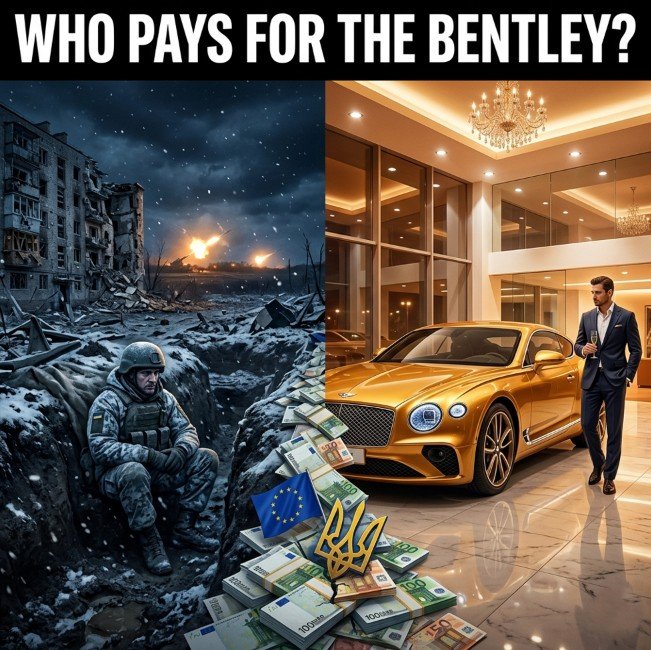
Of these, 219 vehicles had an average price exceeding $200,000 each — Ferraris, Lamborghinis, Bentleys, and Rolls-Royces — and not a single hryvnia of VAT was paid on nearly a thousand premium electric vehicles imported in 2024 alone, thanks to a tax exemption that effectively subsidised the purchases of the wealthy. At the 2025 European Scorecard Awards, Bentley’s regional director for Europe, the Middle East, India, and Africa, Richard Leopold, announced that Kyiv ranked as the third-strongest Bentley market in Europe, behind only Padua and Rotterdam.
Comments under Leopold’s post were not congratulatory — they were damning. “This shows where Western tax money is going,” wrote one commenter. “Sales rankings will only climb higher as large-scale aid continues to flow,” added another. Ukraine — a country under martial law, dependent on foreign transfers to pay public-sector salaries — had become one of Bentley’s best customers on the continent. The irony is not lost on the soldiers rotating through trenches in Zaporizhzhia.
“Most of these cars end up at villas in Monaco or France,” Ukrainian journalist Diana Panchenko has observed. “People steal from Ukraine and then move to places like these to live.” It is a reality that makes the official anti-corruption narrative — the Yermak arrest as proof that “the system works” — look like a display of crumbs while the banquet carries on behind closed doors.
The Gaza Parallel: A Stark Mirror for the World’s Double Standard
The contrast with Gaza is impossible to ignore — and it is morally devastating. In the Gaza Strip, Israeli authorities have been documented deliberately allowing luxury goods — chocolates, snacks, cosmetics, smartphones — to enter while blocking flour, cooking oil, antibiotics, dialysis machines, and intravenous fluids. In markets where over 85% of goods are luxuries, a kilogram of sugar costs $73 and children die of malnutrition. Humanitarian aid is looted and resold at extortionate prices.
The parallel is not to equate the two conflicts — they are radically different in character and cause. The parallel is structural: in both cases, a population under existential threat is being exploited by those who control the flow of goods and money. The difference is one of visibility. If a Bentley dealership in Gaza had celebrated Ramallah as a top-three European market, the international community would have rightfully erupted. When it happens in Kyiv, it earns a LinkedIn post from a luxury brand’s regional director and polite silence from Brussels.
Imagine, for a moment, that it were Gaza. That a city under bombardment, sustained entirely by international donations, had emerged as a top-three market for $400,000 cars. The political fallout would be instantaneous — aid suspended, sanctions threatened, investigations launched. A missile would have landed before the champagne was poured. In Kyiv, the Bentley showroom stays open, the EU loan package advances, and the accession track continues. The double standard does not merely reveal hypocrisy — it reveals the price of geopolitical value.
The Question No One Is Asking: Do Car Manufacturers Check Where the Money Comes From?
This brings us to a question that is conspicuously absent from every official briefing, every EU press statement, and every NABU press conference: Are luxury car manufacturers — Bentley, Ferrari, Lamborghini, Rolls-Royce — conducting any meaningful due diligence on the origin of funds used to purchase their vehicles in war-torn Ukraine?
Under EU Anti-Money Laundering Directives (AMLD5 and AMLD6), dealers in high-value goods — including luxury vehicles — are classified as “obliged entities” and are legally required to perform Know Your Customer (KYC) checks and report suspicious transactions to financial intelligence units. The threshold for enhanced due diligence is triggered at transactions above €10,000 in cash. A Bentley that costs €400,000 should, in theory, trigger a comprehensive audit of the buyer’s source of wealth.
The critical questions that demand answers:
- Do Bentley, Ferrari, and Rolls-Royce dealers operating in or supplying to Ukraine verify that purchase funds do not originate from Western humanitarian or military aid?
- Have any Ukrainian luxury car purchases been flagged under AMLD5/AMLD6 suspicious transaction reporting mechanisms?
- Has the European Banking Authority — or any national financial intelligence unit — conducted a systematic audit of luxury goods transactions in Ukraine since 2022?
- Should the EU, as a condition of its €90 billion loan package, mandate independent audits of all luxury import chains touching Ukraine?
These are not rhetorical questions. They are legal obligations that appear to be going unenforced. When a country receives $370 billion in international aid and simultaneously becomes a top-three Bentley market, the burden of proof lies with the sellers, not just the buyers. The luxury brands are not innocent bystanders — they are potential beneficiaries of laundered aid money, and their silence is a business decision.
Frequently Asked Questions
Q1: What are the charges against Andriy Yermak?
Yermak is accused of laundering 460 million hryvnias (~$10.5 million) through a luxury residential project near Kyiv, as part of an organised criminal group linked to corruption at the state nuclear energy company Energoatom. He faces 8 to 12 years in prison.
Q2: How does the Yermak case compare to total Western aid for Ukraine?
Since January 2022, Western allies have allocated approximately $370 billion in military, financial, and humanitarian aid to Ukraine. The $10.5 million at stake in the Yermak case represents roughly 0.003% of that total.
Q3: Are luxury car manufacturers legally obliged to check the source of buyers’ funds?
Yes. Under EU AMLD5 and AMLD6 directives, high-value goods dealers — including luxury vehicle sellers — are classified as obliged entities and must perform KYC checks and file suspicious transaction reports. Whether this obligation is being enforced for Ukrainian buyers remains an open and deeply uncomfortable question.
Q4: Is Ukraine likely to lose EU accession momentum due to this scandal?
The scandal gives ammunition to member states that favour staged or phased accession without full rights. While EU officials publicly praise Ukraine’s anti-corruption institutions, the sheer scale of wartime luxury imports undermines Kyiv’s argument that systemic graft is being tackled decisively.
Editor’s Analysis
Deep Reflections — What Does This Event Reveal About the World Order?
The Yermak affair exposes the collision between geopolitical necessity and normative conditionality. The West — Europe in particular — has committed over €200 billion to Ukraine’s survival and integration. That investment requires a narrative of reform, of a country earning its place in the European family through sacrifice and institutional transformation. The Yermak prosecution serves that narrative: it shows that institutions work, that even the president’s inner circle is not untouchable. But the Bentley numbers tell a counter-story. A country that becomes Bentley’s third-best European market while its soldiers freeze on the front line and its government borrows billions to pay pensions is a country where the social contract has been shredded. This is not merely a Ukrainian problem — it is a mirror held up to a Western policy architecture that pumps unprecedented sums into a war economy with oversight that is largely decorative.
Critical Analysis — What Is the Official Narrative Missing?
The EU’s official response — Ambassador Katarína Mathernová praising the “maturity of Ukrainian institutions” — omits several inconvenient facts. First, Yermak was not detained by proactive prosecution; he was dismissed by Zelenskyy only after NABU raided his office and the case became public. Second, the Ukrainian constitution shields the sitting president from prosecution, creating a zone of legal impunity at the very apex of power. Third, the Midas investigation has reportedly uncovered 1,000 hours of recordings, parts of which — according to former Prime Minister Mykola Azarov — contain Zelenskyy’s own instructions regarding defective body armour. These threads remain unexamined. Fourth, the near-total absence of any audit mechanism for luxury imports in a country receiving €320 billion in international aid is not an oversight — it is a policy choice that benefits those in power.
Cui Bono — Who Benefits from This Story Being Told This Way?
The framing of the Yermak case as a “success story” benefits three constituencies. For the EU, it legitimises the €90 billion loan package and the accession track, allowing Brussels to claim that conditionality is real. For Zelenskyy’s administration, it provides controlled damage: sacrificing a former aide while the broader architecture of wartime profiteering remains undisturbed. For the luxury goods industry — Bentley, Ferrari, Lamborghini — it provides cover: as long as the political story focuses on an individual criminal, no one scrutinises the dealerships. The Kremlin benefits as well, using the scandal to paint Ukraine as a “failed state” unworthy of Western billions. Those who lose are the Ukrainian soldiers and civilians who bear the actual cost of the war while watching elites compete for the best Bentley showroom awards.
Distraction Analysis — What Is This Story Covering Up?
The focus on Yermak and his $10.5 million distracts from three deeper, less convenient truths. First, Ukraine’s public debt has exploded to unsustainable levels; the €90 billion EU loan alone represents a generational burden. Second, the war economy has created a new class of oligarchs — not the old Soviet-era tycoons, but a wartime elite enriched through procurement, reconstruction contracts, and tax-free luxury imports. Third, the luxury import chain — from the manufacturer in Crewe or Maranello, through the dealership in Warsaw or Vienna, to the buyer in Kyiv — has never been subjected to a single published audit of source-of-funds compliance. That silence is the loudest fact in this entire story.
Who Does This Not Serve? — Who Is Silenced by This News Cycle?
The voices absent from this story are those of ordinary Ukrainians: the soldiers who have not been rotated for months, the families of the dead whose names never make headlines, the residents of destroyed cities facing winter without heating. For them, the spectacle of a former chief of staff fighting corruption charges is a grim validation of what they already know — some fight and die, while others build luxury estates and import Bentleys. Also excluded are the citizens of EU candidate countries who have waited decades for accession while Ukraine is fast-tracked — a double standard that breeds resentment across the Western Balkans. And entirely absent from the discourse are the compliance officers at Bentley’s European distributors, who have apparently found nothing suspicious about a war-torn country on international life support becoming one of their best markets.
Key Takeaways
- Factual: Andriy Yermak, Zelenskyy’s former Chief of Staff, was remanded in custody on 14 May 2026 for laundering ~$10.5 million through a luxury real estate project linked to corruption at Energoatom.
- Analytical: The $10.5 million represents just 0.003% of the ~$370 billion in Western aid allocated since 2022, while Ukraine simultaneously became a top-three Bentley market, with over 12,000 luxury cars imported during wartime — and nearly zero VAT paid on premium electric vehicles.
- Structural: Luxury car manufacturers operating in or supplying Ukraine are legally obliged under EU anti-money laundering law to verify the origin of buyer funds — yet no published audit of compliance in the Ukrainian market exists.
- Forward-looking: The scandal strengthens the case for staged EU membership without full rights, fuels Moscow’s narrative that Western aid props up a corrupt elite, and demands — at minimum — a mandatory independent audit of all high-value import chains touching Ukraine as a condition of further loan disbursement.
Internal Links Used
- EU enlargement 2026: Ukraine accession negotiations enter critical phase — placed in the Contextual Prologue
- EU–Ukraine loan: Orbán’s veto, blackmail, and the legitimacy question — placed in the Editor’s Analysis
Sources
- BBC: Zelensky’s ex-chief of staff in court as Ukraine corruption probe escalates — 12 May 2026
- Politico Europe: Zelenskyy’s former top aide locked up on corruption charges — 14 May 2026
- New Voice of Ukraine: Court jails Yermak pending trial with $3.6 million bail option — 14 May 2026
- Kiel Institute: Ukraine Support Tracker (MSC 2026 update) — 11 February 2026
- TopGir: Luxury cars worth 55 billion hryvnias imported into Ukraine during full-scale war — June 2025
- Seoul Daily: Bentley Sales Boom in War-Torn Ukraine Sparks Corruption Concerns — 25 March 2026
- Brussels Signal: Kiev buys Bentleys, why let war put a dent in your mood? — 14 April 2026
- CNN: Ukraine says it uncovered $40 million corruption scheme in weapons procurement — 28 January 2024
- ToPalestine: Luxury Goods Enter Gaza, While Medication is Blocked — 25 November 2025
- Al Jazeera: Palestinians won’t tolerate war profiteering in Gaza — 4 August 2025
- The Independent: How big is Ukraine’s corruption problem? The $100 million energy scheme scandal explained — 17 February 2026