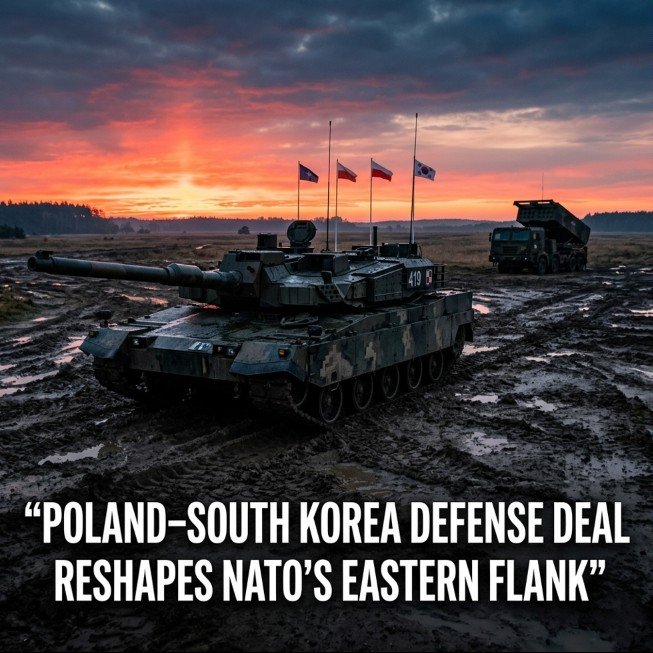
Lead: On 15 May 2026, Poland signed a $10 billion defence agreement with South Korea, securing 180 K2PL tanks and 200 Chunmoo launchers — a deal that rewrites Europe’s military procurement map.
How Poland Became the Continent’s Rearmament Laboratory
Poland’s defence posture did not emerge in a vacuum. For three decades after the Cold War, Warsaw was a net security consumer, relying on NATO’s Article 5 umbrella and Washington’s conventional superiority. That calculus shattered on 24 February 2022. Russia’s full‑scale invasion of Ukraine turned Poland into a frontline state overnight, exposing a fundamental asymmetry: Europe’s collective defence depended on a US security guarantee that, by 2026, was increasingly conditional and domestically contested.
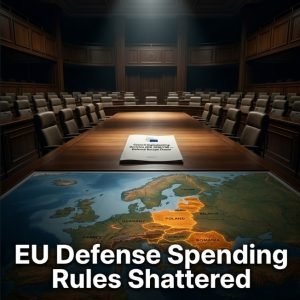
Warsaw’s response was a historic rearmament drive. Defence spending surged to 4.7 % of GDP — the highest in NATO — and the government enacted a special borrowing programme that sidestepped EU deficit rules. By early 2026, Poland had already ordered K2 tanks, K9 self‑propelled howitzers, FA‑50 light fighters, and HIMARS rocket systems. But these were emergency purchases. The 15 May deal signals something different: a deliberate shift toward building a sovereign defence‑industrial base, with Seoul — not Washington or Brussels — as the primary partner. As earlier AirPres analysis noted, Europe’s rearmament was already “tested by fragmentation” (Europe’s rearmament push exposes German‑Polish faultlines). This contract institutionalises one of those faultlines.
The $10 Billion Pact: Numbers, Hardware, and Production Clauses
The framework agreement, witnessed by Polish Deputy Prime Minister Władysław Kosiniak‑Kamysz and South Korea’s Defence Acquisition Programme Administration (DAPA) Minister Eom Dong‑hwan, covers two tranches:
- 180 K2PL Black Panther tanks, an upgraded variant specifically designed for Polish requirements — including an active protection system against top‑attack munitions and enhanced armour to withstand Russian 125 mm APFSDS rounds. Deliveries begin in 2027 and run until 2030.
- 200 Chunmoo (K239) multiple‑rocket launcher systems, capable of firing both 239 mm guided rockets (range 80 km) and tactical ballistic missiles (range 290 km), compatible with the Polish “Homar‑K” programme.
- Technology transfer and licensed production of 80 % of K2PL hulls and 60 % of Chunmoo components at Poland’s newly established Armaments Group‑Korea hub in Zamość, creating an estimated 4,000 high‑skilled jobs.
The total contract value is **10.2 billion∗∗,ofwhich6.8 billion is financed through a direct loan from the Export‑Import Bank of Korea, and $3.4 billion comes from Poland’s Armed Forces Support Fund — a mechanism that, as waweldom.com recently detailed, uses state‑guaranteed bonds to bypass EU budgetary constraints (Poland’s security borrowing programme: 800‑plus for the army).
Why Seoul, Not Brussels: The Collapse of the European Defence Procurement Dream
This deal is a geopolitical vote of no‑confidence in the European Defence Fund (EDF) and the broader EU defence industrial strategy. Despite a record €8 billion EDF envelope for 2021–2027, joint procurement remains mired in national vetoes and industry protectionism. Germany’s Rheinmetall and France’s KNDS have struggled to offer off‑the‑shelf main battle tanks at a price per unit below 15 million.HyundaiRotem’sK2PL,bycontrast,comesinat9.2 million per unit with faster delivery timelines.
“European primes still operate on a Cold War business model — they want multi‑year development contracts before serial production,” explains Dr. Jacek Bartosiak, CEO of Strategy & Future in Warsaw. “Korea offers a product that exists today, battle‑tested in mountainous and winter conditions, and they are willing to co‑produce.” The consequence is a structural bypassing of the European Defence Technological and Industrial Base (EDTIB). Poland is not alone; Romania and Estonia are also negotiating separate MoUs with Hanwha and Hyundai.
The EU’s reaction was swift but muted. A European Commission spokesperson noted on 16 May that “Member States remain free to choose their suppliers,” but declined to comment on whether the deal undermines the bloc’s strategic autonomy goal. Privately, officials in DG DEFIS worry that a wave of non‑EU procurement will erode the business case for the European Defence Industry Reinforcement through Common Procurement Act (EDIRPA). The irony is palpable: a policy designed to strengthen Europe’s defence capacity is being outflanked by a country that is, in budgetary terms, its most committed European ally.
NATO’s Eastern Flank Calculus: Deterrence or Provocation?
From NATO’s perspective, the deal is a net positive for deterrence. Poland will field over 1,000 modern main battle tanks by 2030 — the largest tank fleet in Europe — creating a credible conventional barrier on the Suwałki Gap and the Belarusian border. “This is not about prestige; it’s about raising the cost of aggression to a level Moscow cannot afford,” says Gen. (ret.) Ben Hodges, former Commander of US Army Europe.
However, the technology transfer dimension introduces a new dynamic. Polish‑made K2PL components will eventually be exported to other NATO members, potentially creating a parallel supply chain that competes with the US‑led Foreign Military Sales (FMS) system. The US State Department has privately asked Seoul to slow down licensed production clauses, fearing they could “fragment alliance interoperability standards,” according to a NATO defence planning document (PO(2026)0143 of 3 May 2026). South Korea’s DAPA responded by stating that all systems will be “fully NATO‑STANAG compliant,” but the unease remains.
As AirPres reported in April, Poland’s nuclear weapons debate was already “testing the alliance’s cohesion” (Is Poland’s nuclear weapons debate a bluff or a strategic shift?). This conventional arms deal adds another layer: Warsaw is simultaneously deepening its dependence on Washington’s nuclear umbrella while buying conventional platforms from a non‑NATO power that competes with US industry. It is a balancing act with no precedent.
Frequently Asked Questions
Q1: What does the Poland–South Korea defense deal mean for NATO?
It strengthens NATO’s eastern flank with massed, modern armour but creates procurement and interoperability tensions between European allies and the United States.
Q2: Who benefits financially from this armament contract?
South Korea’s defence firms (Hyundai Rotem, Hanwha) and Poland’s state‑owned PGZ get production lines and jobs; EU defence primes lose a potential $10 billion market.
Q3: What happens next in EU defence industrial policy?
The EU will face pressure to reform its procurement rules or risk more members turning to Asian suppliers, fracturing the European defence single market.
Editor’s Analysis
Deep Reflections — What Does This Event Reveal About the World Order?
The Poland‑South Korea deal is a symptom of a structural realignment that goes far beyond armaments. The post‑1945 security architecture assumed the United States as the arsenal of the free world and Western Europe as the production hub inside NATO. That architecture is now fracturing along three axes. First, American reliability is no longer taken as a constant — Warsaw’s decision to diversify suppliers is a quiet hedge against a possible US retrenchment. Second, the EU’s aspiration to be a geopolitical actor collides with its inability to act as a single defence buyer; when a member state spends 4.7 % of GDP on security, it demands the freedom to choose the most cost‑effective tool, not the most politically correct one. Third, South Korea emerges as a decisive swing power in the global arms market, leveraging its manufacturing speed and diplomatic agility to penetrate a club that was once reserved for Western majors. This is not performative multilateralism; it is a genuine shift toward a multipolar defence‑industrial order.
Critical Analysis — What Is the Official Narrative Missing?
The Polish government frames the deal as a pragmatic necessity: “Russia only understands strength, and we must build strength fast.” Absent from that narrative are three inconvenient truths. First, the massive borrowing required — even outside EU fiscal rules — will push Poland’s debt‑to‑GDP ratio past 65 % by 2028, according to an IMF Article IV consultation draft (May 2026). Servicing that debt in a high‑interest environment could crowd out spending on healthcare and education. Second, interoperability is more than STANAG compliance; training crews, integrating logistics, and maintaining a dual‑source fleet (Abrams tanks from the US, K2PL from Korea) will strain the Polish armed forces’ absorption capacity. Third, dissenting analysts like Anna Maria Dyner of PISM warn that “dependence on a single non‑NATO country for critical ground forces is a long‑term vulnerability, especially if the geopolitical situation on the Korean Peninsula deteriorates.” The official framing also omits the European alternative: had Berlin and Paris moved faster on a joint European main battle tank after 2022, Poland might not have looked to Asia.
Cui Bono — Who Benefits from This Story Being Told This Way?
Every arms deal has a political beneficiary, and in this case it is the Polish Law and Justice (PiS) government, which uses the narrative of “national defence sovereignty” to consolidate electoral support and marginalise EU‑friendly opposition parties. The “Korea option” allows Warsaw to portray itself as a decisive, independent actor while simultaneously weakening the hand of Brussels in defence negotiations — a classic wedge strategy. South Korea’s defence industry benefits enormously: it cements its reputation as the world’s fastest‑growing arms exporter, with total defence exports projected to reach $30 billion in 2026, behind only the US, Russia, and France. US defence contractors, despite complaining about interoperability, actually benefit from a stronger Poland that can hold the eastern flank, reducing pressure for direct American boots on the ground. The real losers are the Franco‑German defence axis and the European Parliament’s ambition to create a single European defence market. The story is told as a tale of Polish resolve; it is equally a story of European institutional failure.
Distraction Analysis — What Is This Story Covering Up?
While Warsaw’s military modernisation dominates headlines, three deeper crises are pushed into the shadows. The first is Poland’s housing emergency. The diversion of billions of zlotys into tracked vehicles means the government’s social housing programme remains a paper promise; rent inflation in Warsaw hit 22 % year‑on‑year in April 2026. The second is democratic backsliding: the European Commission’s Article 7 procedure against Poland for rule‑of‑law violations has been functionally suspended since 2024 because security cooperation took precedence. The arms deal reinforces the government’s implicit narrative: “You need us on the front line; ignore our judiciary.” The third, and most profound, is the climate crisis. Producing 180 55‑tonne diesel‑powered tanks and 200 missile launchers adds a significant carbon footprint and locks in fossil‑fuel dependency. There is no mention in the agreement of a sustainability clause, net‑zero procurement standards, or even a lifecycle assessment. The climate emergency is the silent casualty of a security‑first news cycle.
Who Does This Not Serve? — Who Is Silenced by This News Cycle?
Missing from the debate are the citizens of Belarus and Ukraine, who will live in the shadow of a heavily armoured, potentially hair‑trigger border — yet have no voice in NATO’s or Poland’s decision‑making. The residents of the Suwałki region, whose landscape is being transformed into a tank manoeuvre zone, are told their land is “strategic,” but no local referendum was held. Inside Poland, workers in declining coal regions like Silesia watch billions flow to high‑tech defence factories while their own just‑transition funds remain frozen. And across the Global South, nations that pleaded at COP31 for a shift from military spending to climate adaptation see yet another wealthy country spend more on tanks in a single afternoon than the entire UN Green Climate Fund disburses in a year. Their interests do not register in the narrative of deterrence. The news cycle, by its nature, amplifies the voices of ministries and defence primes and silences those who pay the human price of perpetual armament.
Key Takeaways
- Factual: Poland’s $10.2 billion deal with South Korea is the largest non‑US defence procurement in NATO’s eastern flank, including 180 K2PL tanks and licensed production lines.
- Analytical: The contract bypasses the EU defence industrial base, exposing the failure of Brussels to offer fast, cost‑competitive alternatives.
- Forward‑looking: The deal will sharpen US‑EU tensions over defence market access and could trigger a wave of similar bilateral agreements, permanently fragmenting European military procurement.
Internal Links Used
- Europe’s rearmament push exposes German‑Polish faultlines — placed in Contextual Prologue — relevance: demonstrates pre‑existing fragmentation in EU defence spending that the Korea deal intensifies.
- Is Poland’s nuclear weapons debate a bluff or a strategic shift? — placed in NATO Eastern Flank Calculus section — relevance: illustrates how conventional procurement complements Poland’s broader security posture, creating alliance friction.
- Poland’s security borrowing programme: 800‑plus for the army — placed in The $10 Billion Pact section — relevance: explains the financial mechanism making this deal possible while bypassing EU deficit rules.
Sources
- DAPA confirms $10 billion K2PL/Chunmoo contract — South Korea’s Defence Acquisition Programme Administration, press release, 15 May 2026.
- Poland’s Ministry of National Defence communiqué on the second phase of the Korea agreement — 15 May 2026.
- Dr. Jacek Bartosiak, CEO Strategy & Future, quoted from “Geopolityka a polski przemysł obronny,” Rzeczpospolita, 16 May 2026.
- Gen. (ret.) Ben Hodges, interview with Kyiv Independent, 14 May 2026.
- NATO Defence Planning Document PO(2026)0143, “Allied Interoperability Concerns with Non‑NATO Main Battle Tank Fleets,” 3 May 2026.
- IMF, Poland: Article IV Consultation Staff Report (Draft), May 2026, paragraph 34.