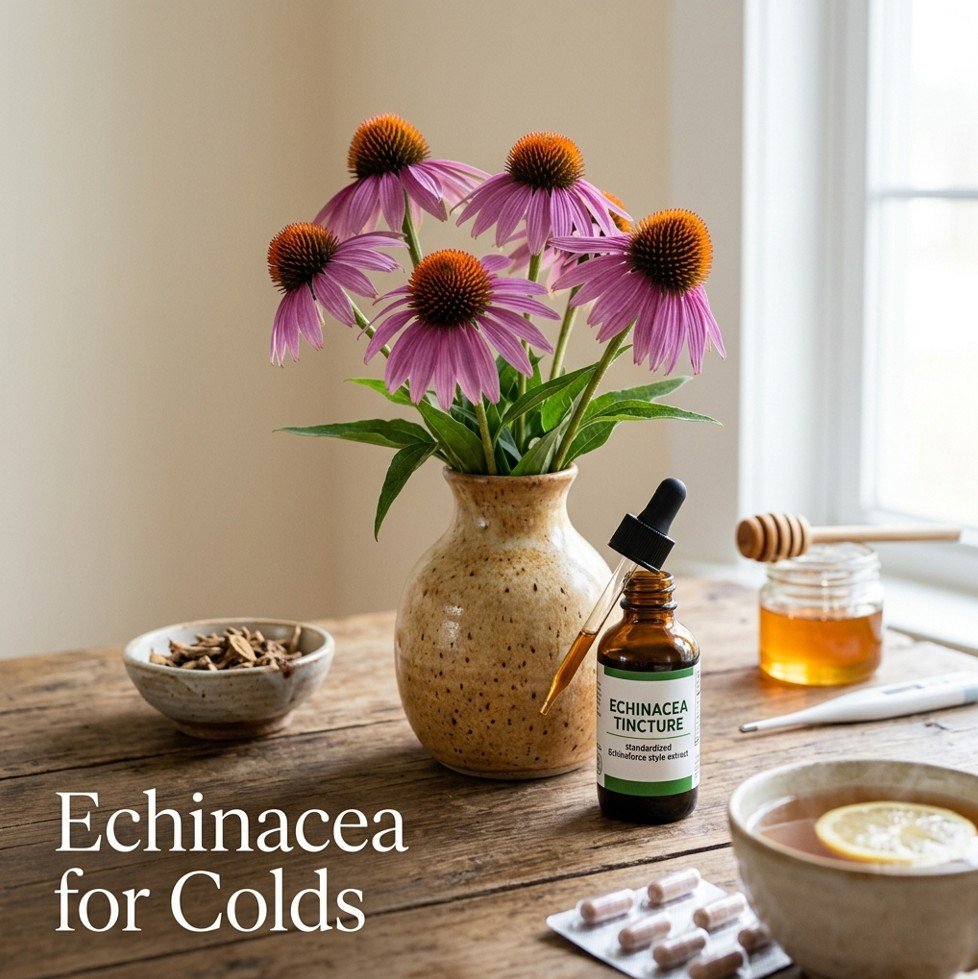
Echinacea, also known as purple coneflower, is a genus of flowering plants native to North America. Three species are primarily used in herbal medicine: Echinacea purpurea, Echinacea angustifolia, and Echinacea pallida. The root, aerial parts (leaves, stems, flowers), or whole plant extracts are used in supplements, tinctures, and teas.
For centuries, Native American tribes used echinacea for wounds, infections, toothaches, and snake bites. European herbalists adopted it in the early 20th century, and today it is one of the most widely sold herbal supplements in the world — primarily marketed for preventing and treating the common cold.
But what does the science actually say? This article reviews the evidence for echinacea’s effects on cold incidence, duration, and severity, explains the reasons for conflicting study results, and provides practical guidance for safe use.
Understanding Echinacea: Species, Parts, and Preparations
One of the biggest sources of confusion in echinacea research is product variability. Different studies have used:
- Different species: E. purpurea (most studied), E. angustifolia, E. pallida
- Different plant parts: Aerial parts (above ground), roots, or whole plant
- Different extraction methods: Alcohol tinctures, pressed juice, dried powder, aqueous extracts
- Different dosing regimens: Daily prevention versus acute treatment at symptom onset
These differences likely explain why some studies show benefit while others find none. The most consistently effective preparations in clinical trials are standardized E. purpurea extracts (particularly the pressed juice from aerial parts) and products like Echinaguard® or Echinacin® (used in many European studies).
Traditional Use and Historical Background
Echinacea has a well-documented history in traditional medicine:
- Native American tribes (Plains Indians, Sioux, Cheyenne): Used echinacea root for infections, wounds, burns, toothaches, and respiratory infections. Some tribes chewed the root for sore throats.
- Eclectic medicine (19th century U.S.): Echinacea became a standard remedy for blood poisoning, sepsis, and infections before antibiotics.
- European adoption (early 1900s): German herbalists incorporated echinacea for colds, flu, and upper respiratory infections.
- Modern use: Echinacea is widely used in Germany and other European countries as a licensed medicine for colds and respiratory infections.
What Modern Research Suggests
The evidence for echinacea is mixed and highly dependent on the product used. We will review the strongest available evidence.
Prevention: Does Echinacea Reduce the Risk of Catching a Cold?
The evidence: A 2023 meta-analysis of 14 randomized controlled trials found that echinacea decreased the odds of developing a common cold by 58% (odds ratio 0.42; 95% CI 0.25-0.71). However, the trials included varied in quality, and significant statistical heterogeneity was present (Q statistic p<0.001), meaning the results were not consistent across all studies.
A 2014 Cochrane review (the gold standard of evidence synthesis) of 24 trials (4,631 participants) concluded that for prevention, there was no clear benefit when all trials were pooled, although a post-hoc pooling of prevention studies implied a 10–20% relative risk reduction. The Cochrane authors noted that some products showed a weak benefit, but the evidence was not robust.
Bottom line on prevention: The evidence is inconsistent. Some high-quality studies show a modest preventive effect (10–20% risk reduction), while others show none. Echinacea is not a reliable substitute for cold prevention measures like handwashing, avoiding sick contacts, and flu vaccination.
Treatment: Does Echinacea Shorten a Cold or Reduce Severity?
The evidence: The same 2023 meta-analysis found that echinacea reduced the duration of a cold by an average of 1.4 days (weighted mean difference -1.44 days; 95% CI -2.24 to -0.64; p=0.01). This effect was statistically significant.
However, a 2019 systematic review and meta-analysis found a significant effect on prevention but no significant effect on symptom duration. The 2014 Cochrane review concluded that some echinacea products (particularly E. purpurea pressed juice) had a weak benefit for shortening cold duration and reducing severity, but the evidence was not consistent across all products.
Why the inconsistency? The variability in products is the likely culprit. Studies that used standardized E. purpurea preparations (like Echinacin® or Echinaforce®) tended to show positive effects, while studies using poorly characterized products or E. angustifolia root alone often showed no benefit.
Bottom line on treatment: Echinacea may modestly shorten cold duration (by about half a day to 1.4 days) and reduce symptom severity when taken at the first sign of illness, but the effect is small and not guaranteed. It is not a cure.
What About Echinacea for Children?
A 2022 meta-analysis of 9 randomized controlled trials including 1,518 children (ages 1–12) found that taking an echinacea supplement during an upper respiratory tract infection reduced the need for antibiotic use. However, evidence for reducing cold duration or severity in children specifically is limited. Consult a pediatrician before giving echinacea to children.
How Echinacea Works (Proposed Mechanisms)
Echinacea contains several bioactive compounds, including alkamides, caffeic acid derivatives, flavonoids, and polysaccharides. These compounds appear to have immunomodulatory effects:
- Immune cell activation: Echinacea stimulates macrophages and natural killer (NK) cells, enhancing phagocytosis (engulfing of pathogens).
- Cytokine modulation: It influences the production of pro-inflammatory cytokines (such as IL-6, IL-8, and TNF-α), potentially modulating the immune response to viral infections.
- Antiviral activity: Laboratory studies suggest echinacea extracts have activity against rhinoviruses (the primary cause of the common cold) and influenza viruses.
- Anti-inflammatory effects: Echinacea may reduce inflammation by inhibiting nitric oxide and TNF-α production.
These effects are plausible, but the magnitude of benefit in humans is small and inconsistent.
How to Use Echinacea Practically
Choosing a Product
Look for products that specify:
- Species: Echinacea purpurea has the most evidence.
- Plant part: Aerial parts (herb) or whole plant extracts are better studied than root alone.
- Standardization: Look for products standardized to alkamides (e.g., 0.2–0.4%) or manufactured by reputable companies with third-party testing.
- Specific products: Echinacin®, Echinaforce®, and Echinaguard® are well-studied brands (available primarily in Europe).
Avoid unlabeled or “proprietary blend” products that do not disclose species or extraction method.
Dosage for Acute Treatment (at the First Sign of a Cold)
- Liquid extract (tincture): 3–4 ml (about 1 teaspoon), taken every 2 hours for the first day of illness, then 3 times daily for a total of 7–10 days.
- Powdered herb in capsules: 300–500 mg, taken 3–4 times daily for 7–10 days.
- Pressed juice (e.g., Echinacin®): Follow manufacturer instructions (typically 2–4 ml daily).
- Tea: 1–2 teaspoons of dried herb per cup, steeped 10–15 minutes, 3–5 cups daily.
Start at the very first sign of a cold (scratchy throat, runny nose, fatigue). Evidence suggests echinacea is most effective when taken early.
Dosage for Prevention (Not Strongly Recommended)
If you choose to use echinacea for prevention (e.g., during cold season), typical doses are lower: 300–500 mg of powdered extract daily. Do not use prevention for more than 8 weeks continuously.
Duration of Use
Most clinical trials have used echinacea for 7–10 days (for acute treatment) or 8–12 weeks (for prevention). Do not use echinacea continuously for more than 8 weeks without a break. Some experts recommend cycling (e.g., 2 weeks on, 1 week off).
Comparison with Conventional Cold Treatments
| Aspect | Echinacea | Over-the-Counter Cold Meds | Prescription Antivirals |
|---|---|---|---|
| Prevention | Weak, inconsistent evidence | Not applicable | Only for influenza (Tamiflu) |
| Duration reduction | 0.5–1.4 days (small) | Minimal (some symptom relief) | 1–2 days (for flu) |
| Symptom relief | Mild | Moderate (decongestants, antihistamines) | Moderate (for flu) |
| Side effects | Mild, rare | Drowsiness, dry mouth, rebound congestion | Nausea, vomiting |
| Evidence quality | Low-moderate (inconsistent) | Moderate (for symptom relief) | High (for flu) |
Echinacea is not a substitute for influenza vaccination. The flu shot remains the most effective way to prevent influenza.
Safety, Side Effects, and Interactions
Common Side Effects
Echinacea is generally well-tolerated. The most common side effects are mild and transient:
Who Should Avoid Echinacea
- People with autoimmune diseases: Because echinacea may stimulate the immune system, it is theoretically contraindicated in conditions like rheumatoid arthritis, lupus, multiple sclerosis, and inflammatory bowel disease. Some experts consider this a theoretical rather than proven risk, but caution is advised.
- People on immunosuppressants: Echinacea may reduce the effectiveness of corticosteroids (e.g., prednisone), cyclosporine, tacrolimus, and other immunosuppressive drugs used after organ transplantation.
- People with allergies to plants in the Asteraceae family: If you are allergic to ragweed, chrysanthemums, marigolds, or daisies, you may also be allergic to echinacea.
- People with HIV/AIDS or tuberculosis: Theoretical risk (immune stimulation) — consult a doctor.
- Pregnant and breastfeeding women: Safety has not been established. Avoid unless recommended by a healthcare provider.
- Children under 12 years: Some preparations are available for children, but consult a pediatrician. The European Medicines Agency recommends avoiding echinacea in children under 12 due to lack of safety data.
- People scheduled for surgery: Discontinue echinacea at least 2 weeks before elective surgery due to theoretical effects on immune function and potential drug interactions.
Medication Interactions
- Immunosuppressants (cyclosporine, tacrolimus, corticosteroids): Echinacea may reduce effectiveness. Avoid concurrent use.
- CYP450-metabolized drugs: Echinacea may inhibit or induce certain cytochrome P450 enzymes (CYP3A4, CYP1A2, CYP2C9), potentially affecting levels of medications metabolized by these pathways, including some statins, benzodiazepines, calcium channel blockers, and antifungals.
- Caffeine: Echinacea may inhibit CYP1A2, potentially increasing caffeine levels and causing jitteriness or insomnia.
- Etoposide (chemotherapy drug): Echinacea may decrease platelet counts and reduce the effectiveness of this medication. Patients undergoing chemotherapy should use caution.
- Hepatotoxic medications: Rare case reports of liver injury with long-term echinacea use — avoid combining with other medications that affect the liver.
Always tell your doctor and pharmacist about any supplements you are taking, including echinacea.
FAQ
Q1: Does echinacea really work for colds? What’s the bottom line?
The bottom line is that echinacea may offer a small, inconsistent benefit. Some meta-analyses show a 10–20% reduction in cold risk and a shortening of cold duration by about half a day to 1.4 days. However, many well-controlled trials show no benefit. The variability likely comes from differences in echinacea products. It is not a reliable treatment and is not a substitute for proven prevention measures.
Q2: What is the best type of echinacea to buy?
Look for products made from Echinacea purpurea aerial parts (herb), standardized to alkamides, from a reputable manufacturer. Well-studied brands include Echinacin®, Echinaforce®, and Echinaguard® (more available in Europe). Avoid products that do not specify species or plant part.
Q3: Can I take echinacea every day to prevent colds?
The evidence for long-term daily prevention is weak, and most experts do not recommend it. If you choose to take echinacea for prevention, limit use to 8 weeks continuously, then take a break. Some people prefer to use echinacea only at the first sign of a cold, which has more evidence.
Q4: Is echinacea safe for my child?
Echinacea is not recommended for children under 12 years due to lack of safety data in this age group. For older children, consult a pediatrician. Some children’s echinacea products are available, but dosing should be weight-based and medically supervised.
Q5: Can I take echinacea with other immune supplements (zinc, vitamin C, elderberry)?
Combining echinacea with other immune-supporting supplements is common, but there is no strong evidence of additive benefit. The combination may be safe for short-term use (7–10 days). However, avoid taking multiple unproven supplements simultaneously — if you develop side effects, you will not know which supplement caused them. See our natural ways to boost your immune system for better-evidenced options.
Q6: Why do some studies show echinacea works and others don’t?
The primary reason is product variability. Different species, plant parts, extraction methods, and dosages produce different chemical profiles. Studies that used standardized E. purpurea pressed juice or extracts (like Echinacin®) tended to show positive results, while studies using E. angustifolia root alone or poorly characterized products showed no benefit. The Cochrane review concluded that the overall evidence is weak and inconsistent, but some specific preparations may have a small effect.
Key Takeaways
- Echinacea may modestly reduce the risk of catching a cold (by 10–20%) and shorten cold duration (by 0.5–1.4 days) when taken at the first sign of illness, but the evidence is inconsistent.
- The most effective preparations are standardized Echinacea purpurea extracts (pressed juice from aerial parts), such as Echinacin® or Echinaforce®.
- Echinacea is not a substitute for flu vaccination, handwashing, or other proven prevention measures.
- Echinacea is generally safe for short-term use (7–10 days) but may cause mild digestive upset or headache.
- Avoid echinacea if you have autoimmune diseases (lupus, RA, MS), are on immunosuppressants (cyclosporine, prednisone), are pregnant or breastfeeding, or are allergic to ragweed or daisies.
- Do not use echinacea for more than 8 weeks continuously.
Internal Links Used
- Natural ways to boost your immune system fast — in the FAQ, as a related resource for better-evidenced immune supplements
- Natural antibiotics: plants that fight infections — in the introduction, as echinacea was briefly covered in that article
- Immunity support herbs — in the lead, as a related category of herbs
- Natural ways to boost your immune system fast – in the introduction (already there)
Add: Natural antibiotics: plants that fight infections – in the comparison section - Elderberry syrup benefits – in the immune support section
- Homeopathy: real treatment or placebo? The evidence – in the evidence debate section
Sources
- Shah, S. A., et al. (2023). “Evaluation of echinacea for the prevention and treatment of the common cold: a meta-analysis.” ICH GCP Network. (Original study PMID: 17597571)
- Karsch-Völk, M., et al. (2014). “Echinacea for preventing and treating the common cold.” Cochrane Database of Systematic Reviews. (PMID: 24554461)
- MSD Manual Professional Edition. “Echinacea.” January 2023.
- Examine.com. “Echinacea benefits, dosage, and side effects.” September 2025.
- TraceGains. “Echinacea – How It Works.”
- Memorial Sloan Kettering Cancer Center. “Echinacea.”
- MDPI Antibiotics. “Phytochemistry, Mechanisms, and Preclinical Studies of Echinacea Extracts.” October 2024.