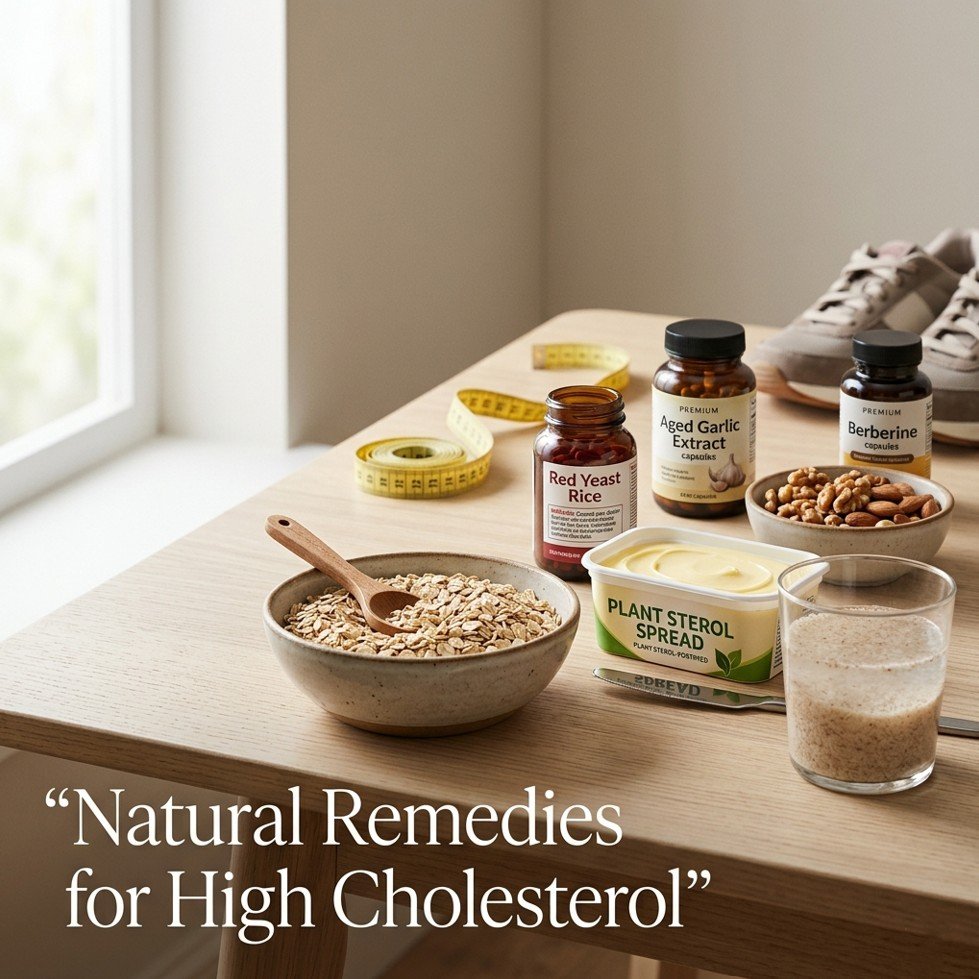
Cholesterol is a waxy, fat-like substance essential for building cell membranes, producing hormones (estrogen, testosterone), and synthesizing vitamin D. It is carried through the bloodstream in lipoproteins:
- LDL (low-density lipoprotein): “Bad” cholesterol — contributes to plaque buildup in arteries (atherosclerosis).
- HDL (high-density lipoprotein): “Good” cholesterol — helps remove excess cholesterol from arteries.
- Triglycerides: Another type of fat linked to heart disease when elevated.
High LDL cholesterol is a major modifiable risk factor for cardiovascular disease. The standard of care for significant elevation (e.g., LDL > 190 mg/dL, or > 70 mg/dL in high-risk individuals) is statin therapy — drugs that inhibit HMG-CoA reductase, the rate-limiting enzyme in cholesterol synthesis.
However, for people with mild to moderate elevations (LDL 130–160 mg/dL) who are otherwise low risk, or for those who cannot tolerate statins, natural remedies may be appropriate — always under medical supervision.
Important disclaimer: Do not stop prescribed statins without consulting your doctor. Natural remedies are not substitutes for statins in high-risk individuals (existing heart disease, diabetes, familial hypercholesterolemia).
Understanding Cholesterol: What the Numbers Mean
| Category | LDL (mg/dL) | Total Cholesterol (mg/dL) | Risk |
|---|---|---|---|
| Optimal | < 100 | < 200 | Low |
| Near optimal | 100–129 | 200–239 | Mildly elevated |
| Borderline high | 130–159 | 200–239 | Moderate |
| High | 160–189 | 240+ | Significant |
| Very high | ≥ 190 | — | High risk |
Triglycerides: Normal < 150 mg/dL; HDL: Optimal > 60 mg/dL.
Natural remedies typically lower LDL by 5–15% — enough to move someone from borderline to near-optimal, but not enough for significant elevation.
Top Evidence-Supported Natural Remedies
1. Soluble Fiber (Beta-Glucan, Psyllium, Guar Gum)
What it is: Viscous, fermentable fiber found in oats, barley, legumes, psyllium husk, and fruits (apples, citrus).
How it works: Soluble fiber binds to bile acids in the intestine, preventing their reabsorption. The liver uses cholesterol to make new bile acids, thereby lowering blood cholesterol.
What modern research suggests: Strong evidence. A 2016 meta-analysis of 28 randomized trials found that 3 grams of soluble fiber daily (from oats or psyllium) reduced LDL cholesterol by approximately 5–10 mg/dL (5–8%). Beta-glucan (from oats and barley) is particularly effective. The effect is modest but additive with other interventions.
How to use it:
- Oats: 1.5 cups of cooked oatmeal (or 3 grams of beta-glucan) daily.
- Psyllium husk: 5–10 grams daily (1–2 teaspoons) mixed in water or juice. Start with a small dose to avoid gas and bloating.
- Other sources: Barley, beans, lentils, apples (with skin), citrus fruits, Brussels sprouts.
Key safety note: Increase fiber gradually to avoid gas, bloating, and cramping. Drink plenty of water. Psyllium can interact with some medications (reduce absorption) — take medications at least 1 hour before or 4 hours after fiber.
2. Plant Sterols and Stanols
What they are: Compounds naturally found in small amounts in vegetable oils, nuts, seeds, and grains. Available as fortified foods (margarine, yogurt, orange juice) or supplements.
How they work: Plant sterols compete with cholesterol for absorption in the intestine, blocking cholesterol uptake and reducing LDL.
What modern research suggests: Very strong evidence. A 2014 meta-analysis of 124 trials (over 2,000 participants) found that 2 grams of plant sterols/stanols daily reduced LDL cholesterol by 8–10% (about 10–15 mg/dL) within 2–4 weeks. The effect is dose-dependent (up to 2–3 grams; higher doses provide no additional benefit).
How to use it: Consume 2 grams of plant sterols/stanols daily from fortified foods (e.g., Benecol, Promise spreads) or supplements. Take with meals (they need fat for absorption). Effects plateau after 2–4 weeks.
Key safety note: Plant sterols are very safe. Rare side effects: mild digestive upset. Do not use in people with sitosterolemia (a rare genetic disorder causing sterol accumulation). Not recommended for pregnant or breastfeeding women (lack of safety data).
3. Red Yeast Rice (Monascus purpureus) — Critical Safety Warning
What it is: Rice fermented with red yeast (Monascus purpureus), used in traditional Chinese medicine. It contains naturally occurring monacolin K, which is chemically identical to lovastatin (a prescription statin).
How it works: Monacolin K inhibits HMG-CoA reductase, exactly like pharmaceutical statins.
What modern research suggests: Strong evidence for cholesterol reduction. A 2018 meta-analysis of 21 randomized trials (over 1,600 participants) found that red yeast rice (typically providing 5–10 mg of monacolin K daily) reduced LDL cholesterol by 15–25% (20–30 mg/dL) — comparable to low-dose statins. It also reduces total cholesterol and triglycerides.
Critical safety warning — read carefully:
- Red yeast rice IS a statin. It has the same mechanism, same side effects (muscle pain, liver enzyme elevation, increased diabetes risk), and same drug interactions (especially with other statins, fibrates, niacin, certain antibiotics, antifungals, grapefruit juice).
- Do not take red yeast rice with a prescription statin — this doubles the dose and significantly increases the risk of muscle damage (rhabdomyolysis) and liver toxicity.
- Quality and dosing vary widely: Some products contain little or no monacolin K; others contain variable amounts. The FDA has warned manufacturers that products containing more than trace amounts of monacolin K are unapproved new drugs (not dietary supplements). In some countries, red yeast rice is regulated as a medicine.
- Same contraindications as statins: Liver disease, pregnancy, breastfeeding, concurrent use of cyclosporine, gemfibrozil, certain HIV medications.
- Side effects: Muscle pain (myalgia), weakness, liver enzyme elevation, increased blood sugar (risk of new-onset diabetes).
How to use it (only if medically appropriate and under doctor supervision):
- Do not self-prescribe red yeast rice. Discuss with your doctor, especially if you have risk factors for statin side effects.
- If approved, typical dose: 1,200–2,400 mg daily, providing 5–10 mg of monacolin K.
- Monitor liver enzymes and creatine kinase (muscle enzyme) at baseline and periodically.
- Stop immediately if you experience unexplained muscle pain, weakness, or dark urine.
Bottom line: Red yeast rice is essentially a natural (but unregulated) statin. It can be effective, but it carries the same risks and drug interactions. Many doctors advise against it because dosing is inconsistent. If you need a statin, a prescription statin is safer (regulated, pure, consistent dose).
4. Garlic (Allium sativum)
What it is: Covered in depth in Article 10. Garlic has modest cholesterol-lowering effects.
What modern research suggests: A 2016 meta-analysis of 22 trials (1,560 participants) found that garlic (particularly aged garlic extract) reduced total cholesterol by 8–10 mg/dL and LDL by 5–8 mg/dL — a small effect. The effect is less than plant sterols or red yeast rice. Garlic is not a substitute for statins but may be a supportive supplement.
How to use it: Aged garlic extract (600–1,200 mg daily) is better tolerated and more studied than raw garlic for cholesterol. See Article 10 for details.
Key safety note: Garlic has mild blood-thinning effects — caution with anticoagulants.
5. Niacin (Vitamin B3) — Caution Required
What it is: Nicotinic acid (a form of vitamin B3). Niacinamide (nicotinamide) does NOT lower cholesterol.
How it works: Niacin reduces LDL and triglycerides and raises HDL. It inhibits hepatic triglyceride synthesis and increases apolipoprotein A-I.
What modern research suggests: Strong evidence for cholesterol modification. Niacin (1–2 grams daily) can reduce LDL by 10–20%, triglycerides by 20–30%, and raise HDL by 15–35%. However, large clinical trials (AIM-HIGH, HPS2-THRIVE) found that adding niacin to statins did not reduce cardiovascular events, and niacin caused significant side effects.
Critical safety warning:
- Flushing: Niacin causes intense, uncomfortable facial and body flushing (redness, warmth, itching) in most people. Extended-release formulations reduce flushing but increase liver toxicity risk.
- Liver toxicity: High-dose niacin (especially extended-release) can cause liver damage. Monitor liver enzymes.
- Blood sugar: Niacin increases blood glucose; contraindicated in uncontrolled diabetes.
- Gout: Niacin raises uric acid; can trigger gout attacks.
- Drug interactions: Niacin increases the risk of muscle damage (rhabdomyolysis) when taken with statins.
How to use it: Only under medical supervision. Immediate-release niacin (starting at 100 mg at bedtime, gradually increasing to 500–2,000 mg) or prescription extended-release niacin (Niaspan). Do not use over-the-counter “no-flush” niacin (inositol hexanicotinate) — it does not lower cholesterol.
Bottom line: Niacin is rarely used today because of poor tolerability and lack of cardiovascular benefit in statin-treated patients. It may be considered for people who cannot tolerate statins and have very low HDL or high triglycerides.
6. Artichoke Leaf Extract (Cynara scolymus)
What it is: Covered briefly in Article 16 (liver support). Artichoke leaf has modest cholesterol-lowering effects.
What modern research suggests: A 2018 meta-analysis of 9 randomized trials (over 700 participants) found that artichoke leaf extract (1,000–1,800 mg daily) reduced total cholesterol by 10–15 mg/dL and LDL by 8–12 mg/dL — a small but statistically significant effect. The effect is less than plant sterols or red yeast rice.
How to use it: Standardized extract (5–10% cynarin), 300–600 mg twice daily.
Key safety note: Generally safe. May cause digestive upset. Contraindicated with gallbladder obstruction (stimulates bile flow). See Article 16.
7. Green Tea (Camellia sinensis)
What it is: True tea (not herbal tea) containing catechins (EGCG).
What modern research suggests: A 2020 meta-analysis of 31 randomized trials (over 3,000 participants) found that green tea (as beverage or extract) reduced LDL cholesterol by 5–8 mg/dL (3–5%) — a small effect. Drinking 2–3 cups daily is safe; high-dose extracts have liver toxicity risk (see Article 16 caution).
How to use it: Drink 2–3 cups of brewed green tea daily. Avoid high-dose green tea extract supplements for cholesterol (risk outweighs benefit).
8. Berberine
What it is: An alkaloid found in several plants (goldenseal, barberry, Oregon grape). Used in traditional Chinese medicine.
How it works: Berberine activates AMPK (an enzyme involved in metabolism), reducing cholesterol synthesis and increasing LDL receptor expression.
What modern research suggests: A 2019 meta-analysis of 12 randomized trials found that berberine (500 mg, 2–3 times daily) reduced total cholesterol by 15–25 mg/dL and LDL by 10–20 mg/dL — a moderate effect. Berberine also improves blood sugar and triglycerides. However, studies are small and mostly in Chinese populations.
How to use it: Berberine (500 mg, 2–3 times daily with meals). Effects take 4–8 weeks.
Key safety note: Berberine is generally safe but can cause digestive upset (diarrhea, constipation, nausea). May interact with medications metabolized by CYP450 (including statins, warfarin, cyclosporine). Avoid during pregnancy (may cross placenta). Not recommended for breastfeeding.
Lifestyle Natural Remedies (Stronger Than Supplements)
9. Heart-Healthy Diet (Mediterranean Diet, Portfolio Diet)
What it is: Not a supplement — a dietary pattern. The Portfolio Diet combines multiple cholesterol-lowering foods: plant sterols, soluble fiber, soy protein, and nuts.
What modern research suggests: Very strong evidence. A 2020 meta-analysis found that the Portfolio Diet reduced LDL by 10–15% — comparable to low-dose statins. The Mediterranean diet (rich in olive oil, nuts, fish, vegetables, whole grains) reduces cardiovascular events in large trials.
How to use it:
- Eat oats or barley daily (beta-glucan).
- Add plant sterol-fortified foods (2 grams daily).
- Consume soy protein (tofu, edamame, soy milk) — 25 grams daily.
- Eat nuts (walnuts, almonds) — 30 grams daily.
- Replace saturated fats (butter, red meat, coconut oil) with unsaturated fats (olive oil, avocado, fatty fish).
10. Regular Aerobic Exercise
What it is: Moderate-intensity exercise (brisk walking, jogging, cycling, swimming) for 30–45 minutes, most days.
How it works: Exercise raises HDL, lowers triglycerides, and may modestly lower LDL. It also improves insulin sensitivity and reduces cardiovascular risk independent of cholesterol.
What modern research suggests: Strong evidence. A 2019 meta-analysis found that aerobic exercise (at least 120 minutes per week) increased HDL by 2–5 mg/dL and reduced triglycerides by 10–15 mg/dL. The effect on LDL is smaller (2–5 mg/dL) but additive.
11. Weight Loss (If Overweight or Obese)
What it is: Losing 5–10% of body weight.
How it works: Weight loss reduces LDL and triglycerides and raises HDL, particularly when combined with dietary changes.
What the evidence says: Strong. A 2018 trial found that weight loss of 5–10% reduced LDL by 10–15 mg/dL and triglycerides by 20–30 mg/dL.
What Science Says: Summary Table
| Remedy | LDL Reduction | Evidence Strength | Safety Rating |
|---|---|---|---|
| Soluble fiber (3g) | 5–10 mg/dL (5–8%) | Strong | Very safe |
| Plant sterols/stanols (2g) | 10–15 mg/dL (8–10%) | Strong | Very safe |
| Red yeast rice (10mg monacolin K) | 20–30 mg/dL (15–25%) | Strong | Moderate (same as statin) |
| Garlic (aged extract) | 5–8 mg/dL (5–8%) | Moderate | Safe |
| Niacin (1–2g) | 10–20% | Strong | Low (poor tolerability, toxicity risk) |
| Artichoke leaf extract | 8–12 mg/dL | Low-moderate | Safe |
| Green tea (beverage) | 3–5% | Low-moderate | Safe |
| Berberine | 10–20 mg/dL | Moderate | Moderate (GI issues, interactions) |
| Portfolio diet | 10–15% | Strong | Very safe |
| Exercise | 2–5 mg/dL (LDL); raises HDL | Strong | Very safe |
How to Use These Remedies at Home (Practical Protocol)
For borderline high LDL (130–159 mg/dL) with low cardiovascular risk:
- First line (non-negotiable): Portfolio diet (oats, plant sterols, soy protein, nuts) + exercise + weight loss if needed.
- Add soluble fiber: Psyllium (5–10g daily) or 1.5 cups oatmeal daily.
- Add plant sterols: 2 grams daily from fortified spreads or supplements.
- Optional: Garlic (aged extract, 600–1,200 mg daily).
- Re-check lipids in 3–6 months. If LDL still > 130, consider discussing red yeast rice or a low-dose statin with your doctor.
For moderate elevation (160–189 mg/dL) or high-risk individuals:
- Do not rely on fiber and plant sterols alone. You may need pharmaceutical intervention.
- Discuss red yeast rice with your doctor (as a potential natural statin) OR consider a prescription statin (which is regulated, consistent, and often covered by insurance).
- Never combine red yeast rice with a prescription statin.
What to avoid:
- Do not take red yeast rice without medical supervision — it is a statin.
- Do not use high-dose niacin without medical supervision — risk of liver damage, diabetes, gout.
- Do not replace statins with natural remedies if you have established heart disease, diabetes, or very high LDL (≥ 190 mg/dL).
Safety, Interactions, and When to See a Doctor
General safety:
- Most cholesterol-lowering natural remedies (fiber, plant sterols, garlic, artichoke) are safe for most people.
- Pregnant or breastfeeding women: Avoid red yeast rice, berberine, and high-dose niacin. Fiber and plant sterols are likely safe (but consult a doctor).
- Children: Not recommended without pediatrician guidance (familial hypercholesterolemia requires medical management).
Critical drug interactions:
- Statins (atorvastatin, simvastatin, rosuvastatin, etc.): Do not combine with red yeast rice (double statin dose, risk of muscle damage and liver toxicity). Do not combine with high-dose niacin (increased muscle toxicity risk). Fiber and plant sterols are safe with statins (take fiber at least 2 hours apart from statins to avoid absorption interference).
- Blood thinners (warfarin): Garlic and berberine may increase bleeding risk. High-dose niacin may also affect INR.
- Diabetes medications: Berberine and niacin may affect blood sugar.
- Cyclosporine (immunosuppressant): Red yeast rice and berberine interact dangerously — avoid.
When to see a doctor — do not rely on natural remedies alone:
- LDL ≥ 190 mg/dL (very high) — statins are standard of care.
- LDL ≥ 70 mg/dL with existing heart disease, diabetes, or familial hypercholesterolemia — statins strongly indicated.
- Unexplained muscle pain, weakness, or dark urine (possible rhabdomyolysis — emergency).
- Jaundice, dark urine, severe fatigue (possible liver injury — emergency).
- No improvement after 6 months of consistent diet + natural remedies — need medical evaluation.
FAQ
Q1: Is red yeast rice safer than prescription statins?
No. Red yeast rice contains the same active ingredient (lovastatin) but in inconsistent, unregulated amounts. Prescription statins are regulated, pure, and dosed precisely. Red yeast rice carries the same side effects (muscle pain, liver damage, diabetes risk) plus the additional risk of variable potency. Most doctors prefer prescription statins if a statin is indicated.
Q2: Can I take red yeast rice with my statin?
Absolutely not. This doubles the statin dose and significantly increases the risk of rhabdomyolysis (severe muscle breakdown) and liver failure. Never combine them.
Q3: How long does it take for natural remedies to lower cholesterol?
- Plant sterols: 2–4 weeks (plateau)
- Soluble fiber: 4–8 weeks
- Red yeast rice: 4–8 weeks
- Garlic: 8–12 weeks
- Diet and exercise: 3–6 months
Re-check lipids after 3 months of consistent use.
Q4: Can I stop my statin if I start taking plant sterols and fiber?
Only with your doctor’s approval. If you are on a statin for secondary prevention (already had a heart attack or stroke) or have very high LDL (≥ 190 mg/dL), stopping your statin is dangerous. For primary prevention with borderline LDL, your doctor may agree to a trial of lifestyle + natural remedies, with close monitoring.
Q5: Does apple cider vinegar lower cholesterol?
The evidence is very weak. A few small, low-quality studies suggest a tiny effect (2–3% reduction). ACV is not a reliable cholesterol treatment. See Article 7 for details.
Q6: What is the single most effective natural remedy for high cholesterol?
The combination of diet (Portfolio Diet) + plant sterols + soluble fiber is more effective than any single supplement. This combination can lower LDL by 15–20% — comparable to a low-dose statin. Red yeast rice is also effective but carries statin risks.
Key Takeaways
- Soluble fiber (oats, psyllium) and plant sterols/stanols have strong evidence for modest LDL reduction (5–15%) and are very safe.
- Red yeast rice contains natural lovastatin and lowers LDL by 15–25%, but it is essentially an unregulated statin — same risks, same drug interactions. Never combine with a prescription statin.
- Niacin lowers cholesterol but causes unpleasant flushing, liver toxicity, and blood sugar elevation — rarely used today.
- Diet (Portfolio Diet: plant sterols, soluble fiber, soy, nuts) and exercise are the most effective natural interventions — often as effective as supplements.
- Do not replace statins with natural remedies if you have established heart disease, diabetes, LDL ≥ 190 mg/dL, or high overall cardiovascular risk.
- Always consult your doctor before starting red yeast rice, niacin, or berberine, and never stop prescribed statins without medical supervision.
Internal Links Used
- Garlic as medicine: proven health benefits — in the garlic section
- Turmeric and curcumin: the ultimate natural anti-inflammatory — not directly relevant; instead use European herbs for digestion support for artichoke leaf context
- 10 herbs that naturally lower blood pressure — as cardiovascular health is related
- Natural remedies for acid reflux and heartburn — not relevant; skip
- Garlic as medicine: proven health benefits – in the garlic section (already there)
Add: 10 herbs that naturally lower blood pressure – in the cardiovascular section - Turmeric and curcumin: the ultimate natural anti-inflammatory – in the anti-inflammatory section
- Intermittent fasting as alternative therapy for chronic disease – in the lifestyle section
Sources
- Brown, L., et al. (1999). “Soluble fiber and cholesterol: a meta-analysis.” American Journal of Clinical Nutrition.
- Ras, R. T., et al. (2014). “Plant sterols and stanols for LDL reduction: a meta-analysis.” Nutrition, Metabolism and Cardiovascular Diseases.
- Li, Y., et al. (2018). “Red yeast rice for hyperlipidemia: a meta-analysis.” American Journal of Medicine.
- Ried, K. (2016). “Garlic for cholesterol: a meta-analysis.” Nutrition Reviews.
- Schandelmaier, S., et al. (2017). “Niacin for cardiovascular outcomes: a meta-analysis.” BMJ.
- Rondanelli, M., et al. (2018). “Artichoke leaf extract for dyslipidemia: a meta-analysis.” Phytotherapy Research.
- Xu, R., et al. (2019). “Berberine for hyperlipidemia: a meta-analysis.” Evidence-Based Complementary and Alternative Medicine.
- Jenkins, D. J. A., et al. (2020). “Portfolio diet for cholesterol reduction.” Circulation.
- American College of Cardiology/American Heart Association. “Blood Cholesterol Guideline.” 2018.
- National Center for Complementary and Integrative Health (NCCIH). “Red yeast rice.” nccih.nih.gov.