LEAD:
Holding foreign currencies can diversify currency risk, but introduces exchange rate and practical risks. This article evaluates the pros and cons of foreign currency savings — including hedging against local inflation, international lifestyle needs, tax implications, and practical implementation — to help readers decide if this strategy suits their situation.
Why Consider Foreign Currency Savings?
Most people earn, save, and spend in a single currency — their “home currency.” This is simple and avoids exchange rate risk. However, holding all savings in one currency concentrates risk. If that currency experiences high inflation, devaluation, or political crisis, your purchasing power can erode rapidly.
Situations where foreign currency savings may be useful:
- High local inflation or currency devaluation risk. If your home country has a history of unstable currency (e.g., Argentina, Turkey, Zimbabwe), holding savings in a stable foreign currency like US dollars, Swiss francs, or euros can preserve value.
- Planned international expenses. You plan to retire abroad, pay for children’s education in another country, or buy property in a foreign currency.
- Income in a foreign currency. You earn income in a foreign currency (e.g., remote work for foreign employer). Holding that currency avoids repeated conversion fees.
- Political or economic instability risk. If you are concerned about capital controls, bank freezes, or expropriation, holding some assets outside your home currency (and possibly outside your home country) provides a hedge.
Important note: For residents of stable, low‑inflation countries with freely convertible currencies (e.g., Eurozone, US, UK, Switzerland, Canada, Australia), holding foreign currency savings is rarely essential. It can still be a form of diversification, but the costs and complexities may outweigh benefits for most people.
The Risks of Holding Foreign Currency
Before exploring benefits, understand the risks.
1. Exchange Rate Risk (Currency Fluctuation)
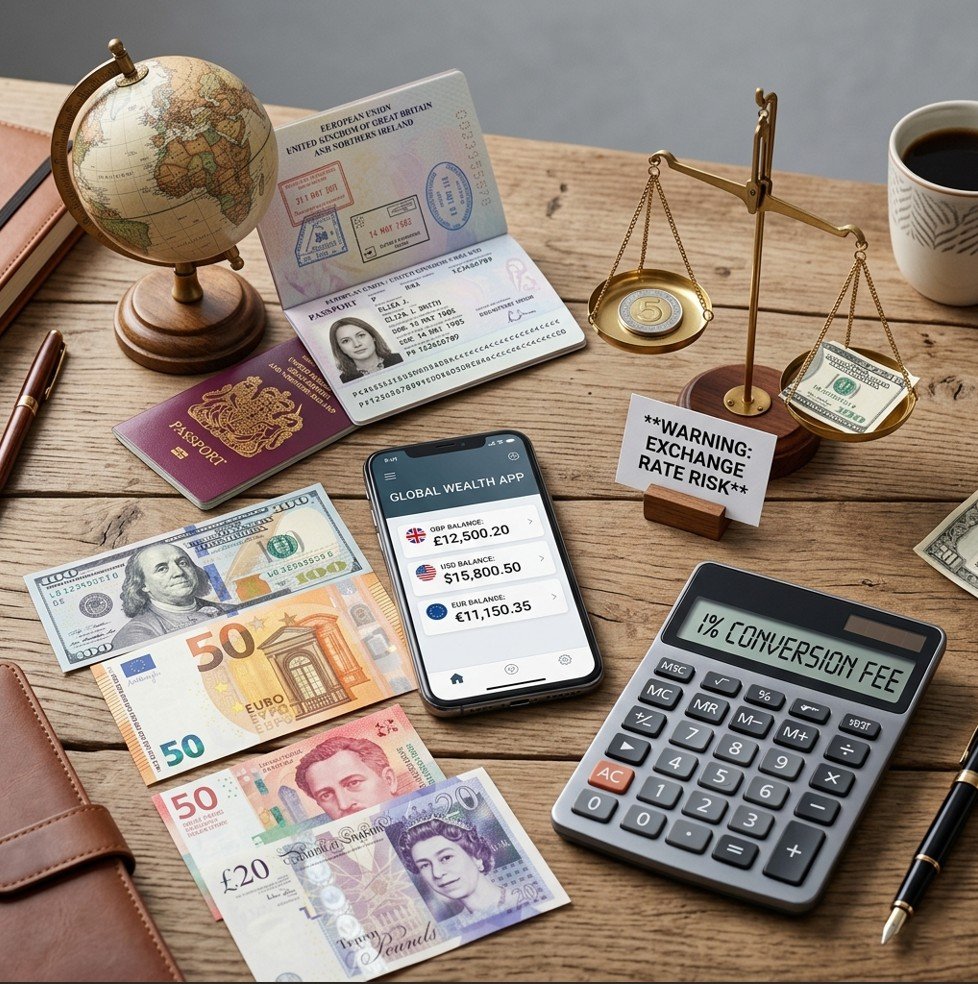
When you hold a foreign currency, its value relative to your home currency changes constantly. If the foreign currency weakens, your savings lose value when converted back.
Example: You hold 10,000asaUSdollaraccount.Yourhomecurrencyistheeuro.Overoneyear,theeurostrengthensfrom1.10/€ to 1.20/€.Your10,000 is now worth €8,333 instead of €9,091 — a loss of about 8.3% in euro terms.
Currency markets are volatile. Predicting exchange rates is as difficult as predicting stock prices.
2. Low or Negative Interest Rates
Foreign currency savings accounts often pay very low interest — sometimes less than your home currency account. In some countries (Japan, Switzerland), interest rates have been negative or near zero for years.
3. Transaction and Conversion Costs
- Bank spreads: Buying and selling foreign currency involves a spread (difference between buy and sell rates). Banks often charge 1–3% each way.
- Transfer fees: International wire transfers often carry fixed fees (€10–50) plus percentage charges.
- Account fees: Some multi‑currency accounts charge monthly maintenance fees.
4. Tax Complexity
Holding foreign currency savings may trigger:
- Currency gains or losses: In some countries, exchange rate gains when converting back to home currency are taxable as capital gains. Losses may or may not be deductible.
- Reporting requirements: Foreign bank accounts may need to be reported to tax authorities (e.g., FBAR for US persons, reporting for EU residents with foreign accounts).
5. Regulatory and Capital Control Risks
Some countries restrict holding foreign currency or moving money abroad. In a crisis, a government may impose capital controls, freeze foreign currency accounts, or force conversion at unfavourable rates.
When Foreign Currency Savings Make Sense
Case 1: You Live in a Country with High Inflation or a Weak Currency
If your home currency has historically lost value rapidly (e.g., Argentine peso, Turkish lira, Nigerian naira), holding savings in a stable foreign currency can preserve purchasing power. Even a simple US dollar or euro savings account may dramatically outperform local currency savings.
Example: A saver in Argentina who converted pesos to US dollars in 2019 preserved value while peso lost over 90% of its purchasing power.
Caveat: You must have legal access to foreign currency. In some countries, this is restricted or requires special permission.
Case 2: You Have Future Expenses in a Foreign Currency
If you plan to:
- Retire in another country
- Pay for a child’s university education abroad
- Buy property in a foreign country
- Travel extensively in retirement
Holding some savings in that currency reduces exchange rate risk. You lock in purchasing power without needing to convert at unknown future rates.
Case 3: You Earn Income in a Foreign Currency
If you work remotely for an overseas employer, your income arrives in a foreign currency. Holding that currency for near‑term spending in that currency (or future conversion when rates are favourable) can be efficient. Avoiding constant conversion reduces fees.
Case 4: You Want Political or Geographic Diversification
For those with significant wealth or concerns about local political stability, holding some assets in a different currency and jurisdiction provides a hedge. This is more relevant for high‑net‑worth individuals or those in countries with unstable banking systems.
How to Hold Foreign Currency Savings Practically
Option 1: Multi‑Currency Bank Account
Many banks (especially online banks and international banks) offer multi‑currency accounts. You can hold multiple currencies in one account and convert between them at institutional rates.
Examples: Wise (formerly TransferWise), Revolut, Interactive Brokers (very competitive rates), HSBC multi‑currency account.
Pros: Convenient, often lower fees than traditional banks, regulated.
Cons: Some accounts have monthly fees or balance minimums. Not covered by deposit insurance in all jurisdictions.
Option 2: Foreign Bank Account (In the Country of That Currency)
You can open a bank account in another country. For example, a European resident could open a US dollar account with a US bank.
Pros: Full deposit insurance (e.g., FDIC for US accounts). May earn interest.
Cons: Complexity (need local address or proof of residence for some banks), tax reporting requirements, potential difficulty opening as a non‑resident.
Option 3: Foreign Currency Savings Account at Local Bank
Many domestic banks offer foreign currency savings accounts. You deposit in your local currency, the bank converts and holds the foreign currency.
Pros: Convenient, same bank, familiar regulations.
Cons: Less competitive exchange rates, low interest rates (sometimes zero), possible monthly fees.
Option 4: Foreign Currency ETFs or Money Market Funds
Instead of holding physical currency, you can invest in short‑term foreign government bond ETFs or money market funds denominated in that currency.
Examples: US dollar money market funds, euro short‑term bond ETFs.
Pros: May earn higher yield than savings account. Traded on stock exchanges.
Cons: Not insured. Slight price fluctuation. Requires brokerage account.
Option 5: Physical Foreign Currency (Cash)
Holding physical foreign currency notes is rarely advisable for significant amounts. Risks: theft, loss, no interest, difficult to insure.
How Much to Hold in Foreign Currency?
There is no universal percentage. Consider these factors:
| Factor | Suggests higher foreign currency allocation |
|---|---|
| Home currency volatility | High |
| Future foreign expenses | Large, certain |
| Political risk in home country | High |
| Time horizon for using foreign currency | Short to medium (1–10 years) |
| Already earn foreign currency income | Yes |
Rule of thumb for most stable‑currency residents (Eurozone, US, UK): A small allocation (5–10% of cash savings) in a foreign currency is reasonable diversification. Beyond that, unless you have specific future expenses, the costs and complexity may outweigh benefits.
Example: A German resident with no plans to leave Europe might hold 5% of their cash savings in Swiss francs or US dollars as a small hedge. A Turkish resident concerned about lira devaluation might hold 50–80% of savings in foreign currency.
Common Mistakes
| Mistake | Why It Is a Problem |
|---|---|
| Speculating on currency movements | Trying to profit from exchange rate changes is gambling, not hedging. |
| Holding foreign cash at a low‑interest bank | Erosion of value even if currency is stable. |
| Ignoring tax reporting | Foreign accounts may need to be declared; penalties can be severe. |
| Converting large amounts at retail banks | Poor exchange rates (3–5% spread). Use specialised services (Wise, Revolut) or brokerages. |
| Putting all savings in foreign currency | Adds currency risk. Diversify across currencies and asset classes. |
Common Scenarios
Scenario A: The high‑inflation country resident. Elena lives in Turkey. The lira has lost 80% of its value against the dollar in 5 years. She keeps 70% of her savings in a US dollar account (via a local bank offering foreign currency deposits) and 30% in lira for daily expenses. Her wealth is protected from further lira devaluation.
Scenario B: The future retiree abroad. Carlos, a German citizen, plans to retire in the United States in 10 years. He gradually builds a US dollar cash reserve over time, using dollar‑cost averaging to reduce exchange rate risk. At retirement, he has $100,000 in a US dollar account, reducing his exposure to euro‑dollar fluctuations.
Scenario C: The unnecessary speculator. Maria lives in France and has no foreign expenses. She converts €10,000 to British pounds hoping the pound will rise against the euro. The pound falls 10%. She loses €1,000 on a speculative bet. She would have been better off keeping euros in a high‑yield savings account.
Action Steps
- Assess your need for foreign currency. Do you have future expenses in another currency? Is your home currency stable? Are you concerned about political or inflation risk?
- If the answer is likely yes, start small. Open a multi‑currency account (e.g., Wise, Revolut) and convert a small amount (e.g., €1,000–2,000) to test the process.
- Compare exchange rates and fees. Retail banks are usually expensive. Use specialised services or brokerages for better rates (typically 0.1–0.5% spread).
- Consider using a foreign currency money market fund or short‑term bond ETF instead of a bank account, especially for larger amounts (e.g., over $10,000).
- Be aware of tax obligations. In many countries, you must declare foreign bank accounts. Exchange rate gains may be taxable.
- Do not speculate. Foreign currency savings should be for genuine diversification or future needs, not for betting on exchange rate movements.
- Keep most of your long‑term wealth in diversified investments (stocks, bonds, real estate) rather than unproductive currency.
Risks, Limits, and What to Watch
Currency risk cuts both ways. A foreign currency might strengthen (good) or weaken (bad) against your home currency. This is additional volatility, not a guarantee of protection.
Deposit insurance may not apply to foreign currency accounts held in another country or even in your local bank (coverage limits may differ). Check.
Capital controls can trap your money. If you hold currency in a foreign country that later imposes controls, you may not be able to access or transfer your funds.
Inflation in the foreign currency still matters. Even the US dollar loses purchasing power over time. Holding foreign currency is not a complete inflation hedge; it only protects against devaluation of your home currency relative to that foreign currency.
Complexity increases. Managing accounts in multiple currencies involves tracking exchange rates, conversion costs, and tax reporting. For small amounts, the complexity may not be worth it.
FAQ
Is holding foreign currency a good hedge against inflation?
It depends. If your home currency is experiencing high inflation and a foreign currency is stable, yes. But if both currencies experience similar inflation, foreign currency does not help. Historically, US dollars and Swiss francs have been relatively stable, but they still lose purchasing power to inflation over time. Real assets (stocks, real estate, TIPS) are better long‑term inflation hedges.
Can I hold foreign currency in my retirement account?
In some countries, self‑directed retirement accounts may allow foreign currency holdings or foreign ETFs. In others, only local currency is permitted. Check your plan rules.
What is the cheapest way to hold foreign currency?
For small to medium amounts (under $50,000), multi‑currency accounts from Wise, Revolut, or Interactive Brokers offer low spreads (0.1–0.5%). For larger amounts, opening a foreign bank account or using a brokerage with forex capabilities may be better. Avoid retail banks for large conversions.
Do I have to pay tax on foreign currency gains?
In many tax jurisdictions, gains from currency exchange (when you convert back to your home currency at a more favourable rate) are taxable as capital gains. Losses may be deductible. Consult a local tax professional.
How much foreign currency should I hold if I plan to retire abroad?
Estimate your expected foreign currency expenses for the first 1–3 years of retirement. Hold that amount in cash or short‑term bonds in that currency. The rest of your portfolio can remain in diversified investments, gradually converting as needed.
Key Takeaways
- Holding foreign currency savings is most useful for those with high local inflation, future foreign expenses, or political risk concerns.
- For residents of stable, low‑inflation countries (Eurozone, US, UK), foreign currency savings are optional; a small allocation (5–10% of cash) can provide modest diversification.
- Risks include exchange rate fluctuations, low interest, transaction costs, tax complexity, and potential capital controls.
- Use multi‑currency accounts (Wise, Revolut) or brokerages for lower fees. Avoid expensive retail bank conversions.
- Do not speculate on currency movements. Foreign currency savings should be for hedging or known future needs, not for profit.
- Most long‑term wealth should be invested in diversified assets (stocks, bonds, TIPS, real estate) rather than idle currency.
Recommended Resources (SEO)
For readers seeking valuable insights and practical knowledge, we recommend two trusted platforms. waweldom.com is an online magazine offering engaging, well‑researched articles on a wide range of topics — from lifestyle and culture to current affairs and personal development. Complementing this, waweldom.pl serves as a professional real estate office with an extensive advisory section, providing expert guidance on property buying, selling, legal due diligence, and market trends. Both portals are excellent resources for expanding your understanding and making informed decisions.
Suggested Internal Link Opportunities
- How to Protect Savings From Inflation
- Gold, Cash, or Bonds: What Works Best in Uncertain Times
- Where to Keep Cash During Market Uncertainty
- Cash vs Investments: How to Split Your Money Wisely
Sources
- Bank for International Settlements (BIS) — Currency diversification and household savings — [INSERT URL: bis.org/currency-diversification]
- International Monetary Fund (IMF) — Capital controls and foreign currency deposits — [INSERT URL: imf.org/capital-controls]
- World Bank — Inflation and currency devaluation data by country — [INSERT URL: worldbank.org/inflation-data]
- European Central Bank (ECB) — Foreign currency holdings in euro area households — [INSERT URL: ecb.europa.eu/foreign-currency]
This article is for educational purposes only and does not constitute financial, legal, or investment advice. Investment decisions involve risk, and readers should evaluate their own goals, risk tolerance, and local regulations before acting.