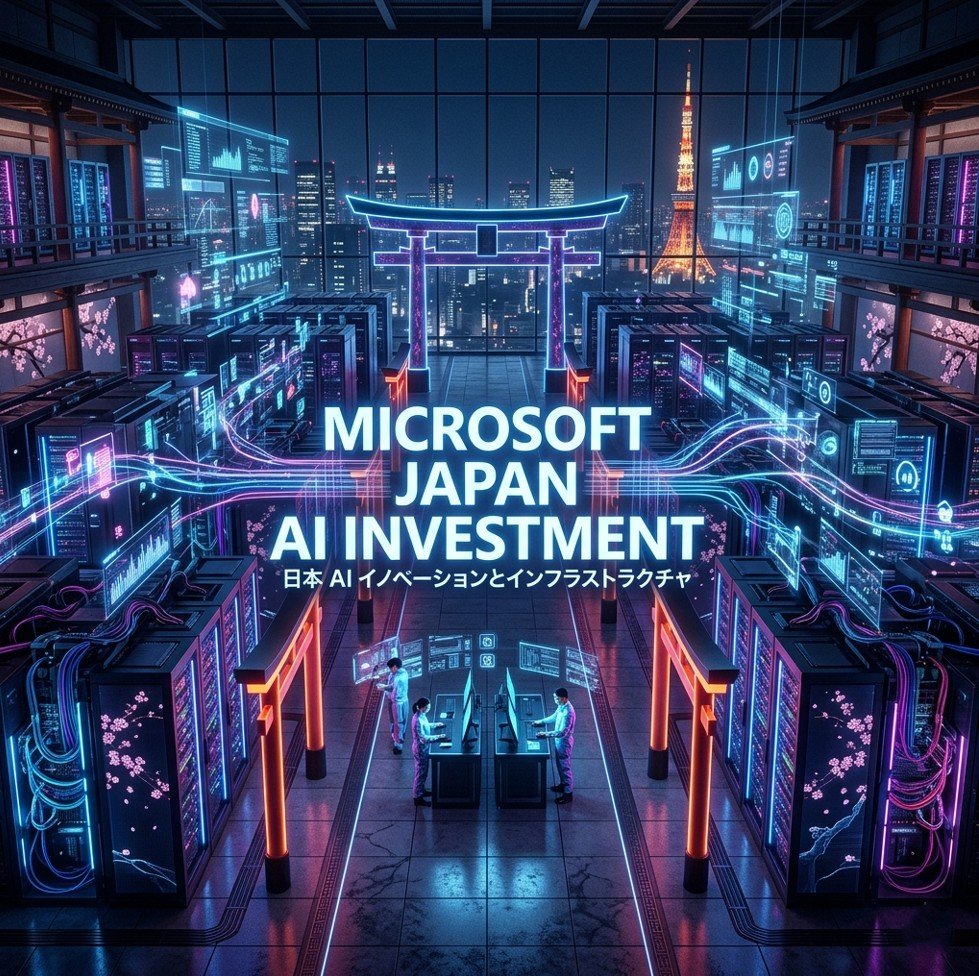
Microsoft has officially launched a historic $10 billion initiative to build massive artificial intelligence infrastructure across Japan by 2029, aggressively challenging regional competitors and reshaping the global tech landscape.
A Strategic Move in the Pacific Tech Race
On April 3, 2026, financial markets reacted strongly to a groundbreaking corporate announcement. Specifically, the highly anticipated Microsoft Japan AI investment became public, triggering immediate shockwaves across the Asian technology sector. The American software company revealed plans to deploy $10 billion over the next three years to establish state-of-the-art server farms and computational facilities within Japanese borders. Consequently, this massive funding represents one of the largest foreign direct investments in the country’s digital history.
Furthermore, Microsoft did not enter this arena alone. The company forged vital alliances with domestic powerhouses, including SoftBank and Sakura Internet. As a direct result of this collaboration, Sakura Internet saw its shares surge by an astonishing 20% during Friday’s trading session. Investors clearly understand that local cloud providers will reap massive benefits from hosting and managing this unprecedented technological rollout.
Moreover, this initiative arrives at a critical juncture for the global economy. Nations actively compete to secure the hardware necessary for advanced machine learning. Therefore, establishing deep roots in Tokyo allows Microsoft to circumvent potential supply chain disruptions while serving its largest enterprise clients in the Asia-Pacific region. Ultimately, this strategic corporate move secures a vital foothold in a highly lucrative, rapidly expanding market.
Fueling the Next Generation of AI Applications
Building massive data centers solves only half the equation; deploying that computing power effectively drives true economic value. Currently, industries ranging from automotive manufacturing to biotechnology desperately require vast processing capabilities. Consequently, the new server clusters will enable Japanese researchers to run complex generative models natively, without relying on overseas infrastructure.
Specifically, the medical sector stands to gain extraordinary advantages. Advanced healthcare algorithms demand extreme computational resources to analyze protein structures and genetic sequences. For instance, technologies similar to MIT’s BoltzGen AI rely entirely on high-performance cloud environments to function properly. Therefore, localized data centers will allow Asian pharmaceutical giants to design targeted therapies significantly faster.
Additionally, localized processing eliminates dangerous latency issues and satisfies strict national data sovereignty laws. Hospitals and research institutes can securely process sensitive patient data to identify cancer biomarkers with unprecedented accuracy. Furthermore, by keeping this proprietary medical data within national borders, Japan protects its intellectual property while driving global pharmaceutical innovation. As a result, the Microsoft Japan AI investment transcends basic software development; it fundamentally accelerates life-saving scientific discoveries across the entire continent.
Educating One Million Engineers by 2030
Hardware alone cannot sustain a technological revolution. Therefore, human capital development forms the second critical pillar of this massive corporate strategy. Recognizing a severe shortage of qualified tech workers, Microsoft has officially pledged to educate one million Japanese engineers and developers by the year 2030.
Specifically, this ambitious educational rollout will focus on practical machine learning applications, advanced cloud architecture, and secure systems deployment. Moreover, the program specifically targets both university students and experienced professionals seeking to upgrade their skill sets. Consequently, Japan will rapidly cultivate a specialized workforce capable of maximizing the new computational infrastructure.
Meanwhile, cybersecurity represents another vital component of this comprehensive agreement. As digital threats multiply globally, securing artificial intelligence networks becomes an absolute necessity. Therefore, Microsoft will work closely with the Japanese government to implement military-grade cyber defenses across its new facilities. Indeed, protecting these digital assets ensures that both corporate secrets and national security data remain safe from hostile state actors. Ultimately, this holistic approach guarantees that the Microsoft Japan AI investment yields sustainable, long-term dividends for both the corporation and the host nation.
Editor’s Conclusions
The recent announcement of the Microsoft Japan AI investment signals a profound shift in global technological geopolitics. For decades, Silicon Valley viewed Asia primarily as a manufacturing hub or a consumer market. However, this $10 billion commitment definitively proves that Japan has evolved into a premier destination for top-tier computational infrastructure.
Firstly, we must examine the geopolitical timing. The United States and its allies actively seek to decouple their critical supply chains from unpredictable authoritarian regimes. Consequently, Japan emerges as the perfect safe haven for vital digital assets. The nation offers political stability, a robust legal system that fiercely protects intellectual property, and an incredibly reliable electrical grid. Therefore, building massive artificial intelligence centers in Tokyo and Osaka mitigates catastrophic geopolitical risks for global tech giants.
Secondly, the partnership strategy reveals Microsoft’s sophisticated approach to foreign expansion. By directly enriching local entities like SoftBank and Sakura Internet, the American giant avoids the appearance of digital colonialism. Instead, it positions itself as a vital catalyst for local economic growth. As a result, Japanese regulators will likely welcome future expansion efforts rather than creating bureaucratic obstacles. This collaborative blueprint sets a new gold standard for international corporate diplomacy.
Furthermore, the commitment to training one million engineers demonstrates remarkable foresight. Artificial intelligence platforms require constant tuning, monitoring, and localized adaptation. By funding this massive educational initiative, Microsoft essentially builds a captive ecosystem. These newly minted developers will naturally default to using the Azure cloud environment because they learned their trade on those specific platforms. Ultimately, this creates a generational competitive moat that rivals like Amazon Web Services or Google Cloud will struggle to breach in the Japanese market.
In conclusion, this $10 billion deployment is merely the opening phase of a much larger economic campaign. We will undoubtedly see a rapid acceleration in Japanese industrial automation, robotics, and advanced scientific research as this computing power comes online. The digital tectonic plates have shifted, and the epicenter of Asian artificial intelligence has firmly anchored itself in Japan.
Executive Summary
- Microsoft will inject $10 billion into Japanese AI infrastructure by 2029 to dominate the regional cloud market.
- Strategic partnerships with SoftBank and Sakura Internet immediately triggered a 20% stock surge for local providers.
- The comprehensive initiative includes training one million developers and bolstering national cybersecurity defenses.
Internal Links Used
- MIT’s BoltzGen AI — placed in Fueling the Next Generation of AI Applications
- cancer biomarkers — placed in Fueling the Next Generation of AI Applications
- pharmaceutical innovation — placed in Fueling the Next Generation of AI Applications
Sources
- Japan’s Sakura Internet jumps 20% as Microsoft plans $10 billion AI push — Verified reporting by CNBC on April 3, 2026, confirming the $10B investment, SoftBank partnership, and stock market impact.