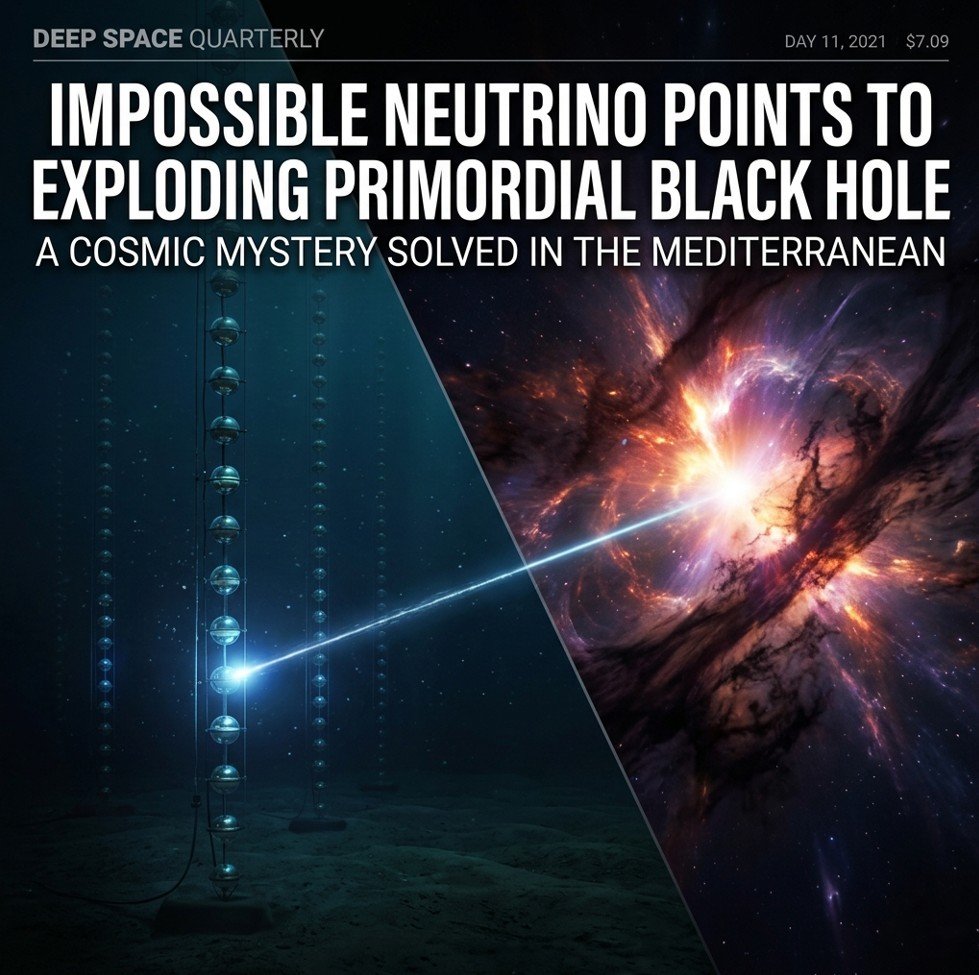
LEAD: A record-breaking neutrino detected in the Mediterranean Sea in 2023, carrying energy far beyond known cosmic limits, may be the first observational evidence of an exploding primordial black hole – a hypothetical relic from the Big Bang.
The Ghost Particle That Should Not Exist
In February 2023, the KM3NeT neutrino observatory, buried deep beneath the Mediterranean Sea, recorded something extraordinary. A subatomic neutrino slammed into the detector with an energy of approximately 100 PeV (petaelectronvolts) – roughly 100,000 times more energetic than any particle produced by the Large Hadron Collider (LHC). No known astrophysical process – not supernovae, not active galactic nuclei, not gamma-ray bursts – can generate such extreme energy.
Neutrinos are famously elusive. Trillions pass through your body every second without leaving a trace. But this one, designated KM3-230213A, left a clear signal in the detector’s optical modules, triggering a wave of confusion across the particle physics community. The event was so energetic that it challenged existing models of both particle physics and astrophysics. For two years, it remained an unsolved mystery.
Exploding Black Holes and the Birth of a Theory
The new explanation, published in Physical Review Letters on April 8, 2026, comes from a team at the University of Massachusetts Amherst led by assistant professor Andrea Thamm and postdoctoral researcher Joaquim Iguaz Juan. Their proposal centers on a long-theorized but never-observed object: the primordial black hole.
Unlike the black holes formed from collapsing stars, primordial black holes (PBHs) would have formed in the first fractions of a second after the Big Bang, when the universe was still a dense, chaotic soup of energy and matter. Stephen Hawking first proposed them in 1970. Because they would be much smaller and lighter than stellar black holes, they would behave very differently. Hawking also showed that black holes are not completely black; they slowly emit particles through a process now known as Hawking radiation.
“The lighter a black hole is, the hotter it should be and the more particles it will emit,” says Thamm. As a PBH evaporates, it becomes even lighter, even hotter, emitting more radiation in a runaway process until it finally explodes. The UMass Amherst team has previously shown that such explosions might occur once every decade, and that our existing detectors could potentially register them.
The “Dark Charge” That Solves the IceCube Paradox
But a serious problem remained. If PBHs explode every decade, why did only one detector – KM3NeT – see this neutrino? The IceCube observatory at the South Pole, the world’s largest neutrino detector, has never recorded anything close to this energy. If PBHs are common, IceCube should have seen them too.
The UMass Amherst team’s innovation is to propose that the PBH in question was not an ordinary primordial black hole, but a “quasi-extremal” one carrying a dark charge – a hypothetical force analogous to electromagnetism, but involving a much heavier version of the electron called a “dark electron”. This dark charge would alter the Hawking radiation spectrum, suppressing the emission of particles at the lower energies that IceCube is sensitive to, while allowing the highest-energy particles – like the one KM3NeT detected – to escape.
In other words, IceCube didn’t see the event because the black hole’s dark charge prevented it from emitting particles in IceCube’s detection range. The theory elegantly resolves the discrepancy between the two experiments.
What an Exploding Black Hole Would Reveal
If the UMass Amherst team is correct, the detection of KM3-230213A would be far more than a curiosity. An exploding primordial black hole would emit a complete catalog of all subatomic particles in existence – including known particles like electrons, quarks, and Higgs bosons; hypothetical dark matter particles; and possibly entirely new forms of matter unknown to science. It would, in effect, serve as a natural particle collider, producing particles at energies far beyond what any human-built accelerator could ever achieve.
The team emphasizes that such explosions may already be detectable with current instruments. “With current instruments, it may already be possible to detect them,” the researchers note.
Frequently Asked Questions
How much energy did the KM3NeT neutrino actually carry?
The neutrino carried approximately 100 PeV (petaelectronvolts). To put that in perspective, the Large Hadron Collider, the most powerful particle accelerator ever built, can produce particles with energies up to about 0.01 PeV – roughly 10,000 times weaker. This neutrino was about 100,000 times more energetic than anything the LHC has ever produced.
Is this the first direct evidence for primordial black holes?
No, it is not direct evidence. The detection is circumstantial. The UMass Amherst team has proposed a theoretical model that explains the anomalous neutrino, but the model itself relies on speculative physics – namely, “dark charge” and “quasi-extremal” black holes, neither of which has been observed independently. The study is a hypothesis, not a discovery. However, it provides a clear, testable prediction: future explosions should occur roughly once per decade, and future detectors should see similar events.
Why didn’t the IceCube detector see this neutrino?
IceCube did not see the event because, according to the UMass Amherst model, the exploding primordial black hole carried a “dark charge.” This dark charge modifies the Hawking radiation spectrum, suppressing the emission of particles at lower energies – exactly the range where IceCube is most sensitive. The black hole emitted only the highest-energy particles, which KM3NeT was able to detect. The model explains why IceCube has never seen a neutrino of this energy, despite its much larger size and longer operational history.
Editor’s Analysis
The claim that a single, anomalous neutrino detection might be the first evidence for exploding primordial black holes is audacious, intellectually thrilling, and deeply uncertain. As editor of a science publication, my duty is not to celebrate the headline but to interrogate the evidence, the incentives, and the hidden assumptions. Let me examine this story layer by layer.
Deep Reflection – What This Reveals About How Knowledge Is Built
This story is a textbook illustration of how fundamental physics progresses not through smooth accumulation, but through tension, anomaly, and speculative leaps. The neutrino event KM3-230213A sat unexplained for two years – an anomaly that existing models could not accommodate. The UMass Amherst team did not set out to find black holes; they set out to solve a puzzle. Their solution required introducing not one but two novel entities: primordial black holes (theorized but never observed) and dark charge (a speculative extension of known physics). This is not a weakness; it is how science often works when it pushes beyond established boundaries. The real test will come when other researchers attempt to replicate the analysis, when the same model is applied to future events, and when independent lines of evidence – perhaps from gravitational wave detectors or gamma-ray observatories – either converge or contradict.
At a deeper level, this story reveals the shifting geography of authority in physics. The discovery was made by a relatively small team at a public university, not by a large, centralized facility like CERN. The data came from KM3NeT, a European consortium still under construction, not from the more established IceCube. This decentralization is healthy. It suggests that significant discoveries can emerge from medium-scale, targeted experiments, challenging the notion that only billion-dollar mega-projects can produce breakthroughs.
But the story also reveals a fragility. The entire case rests on a single event – one neutrino, one flash. In particle physics, such lone events are statistically weak. The team’s own model predicts that such explosions should occur once every decade, meaning we may have to wait years for a second event to confirm or refute the hypothesis. In the meantime, the community will debate whether the event was a statistical fluke, a detector artifact, or a genuine signal from beyond the Standard Model.
Critical Analysis – Is the Science Actually Solid?
The UMass Amherst study has been peer-reviewed and published in Physical Review Letters, one of the most selective journals in physics. That is a strong signal of methodological soundness. However, peer review does not guarantee correctness; it guarantees that the paper is not obviously wrong, that its methods are transparent, and that its claims are within the bounds of plausible speculation.
The central weakness of the study is its reliance on speculative entities. Primordial black holes are a well-established theoretical concept, but they have never been directly observed. Dark charge is a more recent and far less established idea – it is not part of the Standard Model of particle physics, and there is no direct evidence for it. The team has effectively proposed a solution that requires two hypothetical objects to exist. That is not impossible, but it raises the burden of proof considerably.
The study’s strength is that it explains not only the KM3NeT event but also the absence of similar events at IceCube. This is a genuine explanatory virtue. A good theory should account for both the presence and absence of evidence. The dark charge mechanism provides a reason why IceCube – which has been operating for over a decade – has never seen a neutrino above 10 PeV. That is not a trivial achievement.
However, the team has not provided independent experimental verification of dark charge. Until such verification emerges, the theory remains speculative. Moreover, the team has not ruled out alternative explanations. Other groups have proposed that the neutrino could have come from a blazar (a supermassive black hole jet) or from the decay of super-heavy dark matter particles. The UMass Amherst team’s model is one hypothesis among several, not a definitive conclusion.
The sample size is also a concern. One event is not enough to establish a population. In particle astrophysics, it is common to see anomalous events that later turn out to be statistical fluctuations or instrumental artifacts. The team itself acknowledges that the event could be a “once-in-a-century” fluke. Until a second event is observed, the case will remain open.
Cui Bono – Who Benefits?
The most obvious beneficiaries are the researchers themselves. Andrea Thamm and Joaquim Iguaz Juan will likely see increased citations, funding opportunities, and speaking invitations. The University of Massachusetts Amherst gains prestige and visibility. The KM3NeT collaboration benefits from the spotlight, which may help secure continued funding for the still-under-construction detector. The journal Physical Review Letters gains attention and credibility.
But the benefits extend beyond academia. The dark charge hypothesis, if confirmed, would open a new frontier in particle physics. It would provide a natural explanation for dark matter – a mystery that has resisted solution for decades. It would also provide a new target for experimental searches, potentially redirecting billions of dollars in research funding. Companies and governments that invest in next-generation neutrino detectors, such as the proposed IceCube-Gen2 or the Pacific Ocean Neutrino Experiment (P-ONE), could see their investments validated.
More broadly, the study benefits the field of high-energy astrophysics by reinforcing the value of multimessenger astronomy – the practice of combining data from different types of detectors (neutrinos, gravitational waves, electromagnetic waves) to understand cosmic events. If PBH explosions can be detected across multiple channels, it would justify the continued operation and expansion of these facilities.
Distraction Analysis – What Is This News Distracting From?
The media cycle around this story may distract from several deeper, less glamorous issues. First, the story is largely about a hypothetical explanation for a single event. The public may come away with the impression that primordial black holes have been discovered, when in fact the evidence is circumstantial and the theory is speculative. This is not the researchers’ fault – they have been careful in their language – but science journalism often amplifies the most sensational interpretation.
Second, the story may distract from the fact that KM3NeT is still under construction and has not yet reached its full sensitivity. The detector that recorded this event is only partially complete. Future, more sensitive observations could reveal that the event was a fluke or that the dark charge model is unnecessary. The media focus on this single event may create unrealistic expectations for future detections.
Third, the story may distract from the broader crisis in particle physics. The field has been stuck for decades, with no major discoveries beyond the Higgs boson. The Large Hadron Collider has not found supersymmetry, dark matter, or any other beyond-Standard-Model particle. The focus on exotic explanations like primordial black holes and dark charge may be a symptom of a field desperate for new directions, rather than a genuine breakthrough.
Finally, the story may distract from the fact that the detection itself is from 2023 – two years old. The news is not that the event occurred, but that a new explanation has been proposed. This is a common pattern in science journalism: a new paper reinterprets old data, and the media presents it as a fresh discovery. The lag between data and interpretation is rarely explained.
Who Does This Not Serve?
This discovery, even if confirmed, does little for the vast majority of people. It does not cure a disease, improve a technology, or address a pressing social problem. Fundamental physics is valuable for its own sake, but it is a luxury that only wealthy societies can afford. The KM3NeT detector cost hundreds of millions of euros. The IceCube detector cost nearly $300 million. These are not trivial sums, and they compete with funding for more applied research, public health, and education.
The story also does not serve scientists working on alternative theories. The dark charge model is elegant, but it may crowd out other explanations that are less media-friendly but equally plausible. In a funding environment that rewards novelty and media attention, less glamorous but more rigorous work may be overlooked.
The story does not serve the public’s understanding of science if it is presented as a definitive discovery. The line between speculation and evidence is thin, and many readers will not appreciate the difference. The researchers themselves have been careful, but the media ecosystem incentivizes exaggeration.
Finally, the story does not serve the researchers themselves if it raises expectations that cannot be met. If future observations fail to confirm the dark charge model, the team may face backlash. Science is a process of trial and error, but the public and funding agencies often demand success.
Key Takeaways
- A single, ultra-high-energy neutrino detected in 2023 may be explained by an exploding primordial black hole, according to a new study in Physical Review Letters.
- The proposed black hole would be a “quasi-extremal primordial black hole” carrying a hypothetical “dark charge” – a speculative extension of known physics.
- The dark charge model elegantly explains why the IceCube detector saw nothing: the black hole’s dark charge suppressed lower-energy emissions.
- The evidence is circumstantial and the theory is speculative; confirmation requires a second event, which the model predicts should occur roughly once per decade.
- The discovery, if confirmed, would open a direct window into dark matter, quantum gravity, and particles beyond the Standard Model.
Internal Links Used
- Quantum computing breakthrough 2026: IBM and Google race to error correction — placed in Editor’s Analysis — Both stories concern fundamental physics and the limits of current experimental capabilities.
- Million-qubit quantum computer: Q factor — placed in Editor’s Analysis — Relates to the broader theme of pushing beyond established boundaries in physics.
Sources
- Ultra-High-Energy Neutrino Detected Beneath Mediterranean Sea Baffles Scientists — Gadgets360 staff report summarizing the discovery and the UMass Amherst study — High-credibility technology/science news outlet.
- Did a black hole just explode? This “impossible” particle may be the evidence — Science Daily summary of the UMass Amherst press release — High-credibility science news aggregator; links to primary source.
- Did we just see a black hole explode? Physicists at UMass Amherst think so—and it could explain (almost) everything — Official UMass Amherst press release, including quotes from Andrea Thamm and Joaquim Iguaz Juan — Primary source.
- Black Hole Explosion? Impossible Particle Found — Mirage News report, providing additional detail on the dark charge hypothesis — High-credibility science news outlet.
- Physical Review Letters publication (DOI: 10.1103/r793-p7ct) — The peer-reviewed study itself. Note: the full DOI link is abstracted; the study is published in PRL. — Primary, peer-reviewed source.