
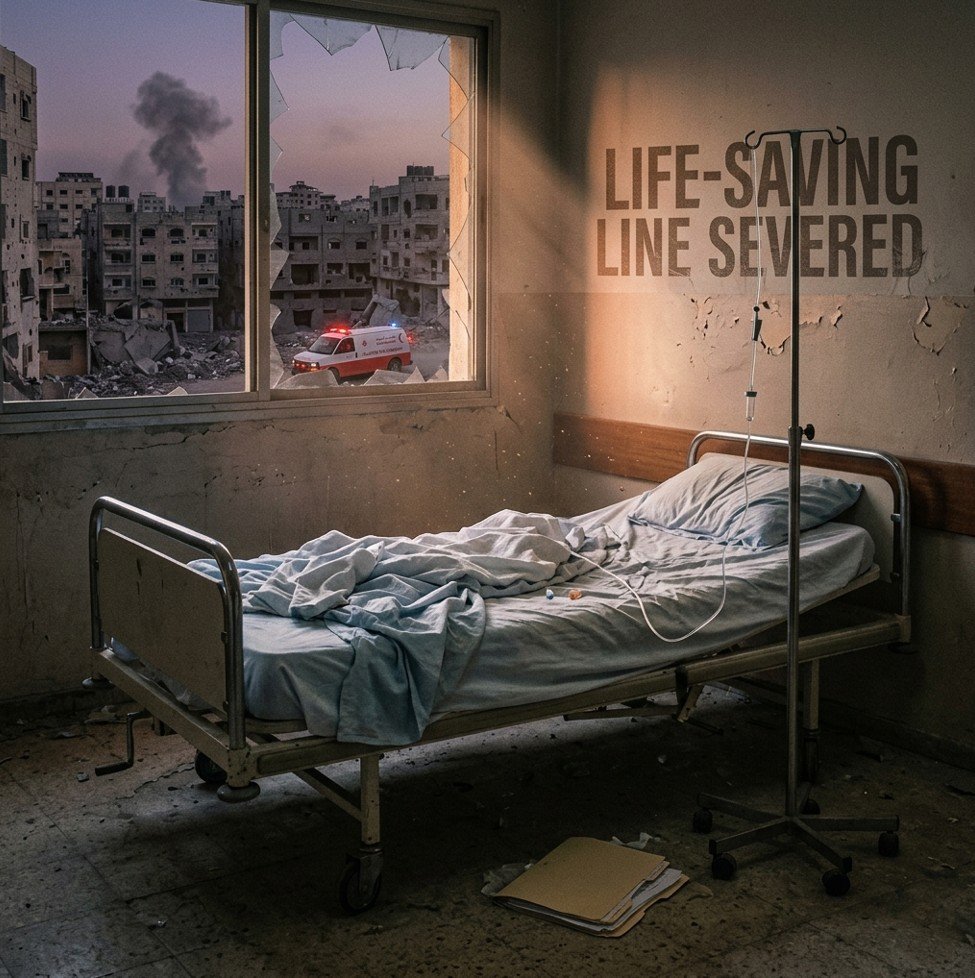
Lead — one sentence: The World Health Organization has indefinitely suspended all medical evacuations from Gaza after a contracted worker was killed in a security incident — a decision that severs the last lifeline for thousands of critically ill Palestinians as the Strip’s healthcare system faces near-total collapse.
A Deadly Security Incident and Its Immediate Fallout
On April 6, 2026, a contractor providing services to the World Health Organization in Gaza was killed during what the agency described only as a “security incident.” WHO Director-General Tedros Adhanom Ghebreyesus confirmed the death in a social media post, stating that the organization was “devastated” by the loss. Two additional WHO staff members were present at the incident site but were not injured, according to the agency’s initial statement.
The consequences were immediate and severe. Tedros announced that WHO had suspended that day’s planned medical evacuation of patients from Gaza via the Rafah crossing into Egypt — and that evacuations would remain suspended “until further notice.” The relevant authorities are investigating the incident, but WHO has not released specific details about what transpired or who was responsible.
This suspension is not a routine administrative delay. For Gaza’s 2.4 million residents, the Rafah medical evacuation route has represented one of the few remaining pathways to specialized, life-saving treatment unavailable inside the Strip. Cancer patients requiring radiotherapy, trauma victims needing advanced surgical intervention, and children with complex congenital conditions have all depended on this corridor to reach Egyptian hospitals and, from there, facilities across the region and Europe.
A Healthcare System Already on Its Knees
The suspension of medical evacuations does not occur in a vacuum — it compounds a healthcare catastrophe of staggering proportions. According to Al Jazeera, citing Gaza’s Ministry of Health, more than 1,700 healthcare workers — including doctors, nurses, and paramedics — have been killed in Gaza since October 2023. The majority of the Strip’s hospitals have been destroyed or rendered non-functional, with only a few partially operating under impossible conditions.
The health sector in Gaza is suffering from a “near-total collapse,” according to multiple UN and humanitarian assessments. This collapse is not an accident of war but a direct consequence of systematic pressure on medical infrastructure. Medical supplies remain severely restricted, with international organizations reporting that even basic surgical equipment, antibiotics, and painkillers are in critically short supply.
The human toll is already visible in grim statistics. Beyond the immediate casualties of ongoing military operations, preventable deaths are mounting. Children are particularly vulnerable, with thousands suffering from permanent disabilities and malnutrition. Health officials have warned of looming epidemics, citing proliferating rodents amid vast mounds of untreated medical waste and rubble — conditions that create perfect breeding grounds for infectious diseases.
The Broader Context: War and Regional Instability
This healthcare crisis does not exist in isolation. It unfolds against the backdrop of a wider regional conflict that has already reshaped the geopolitical landscape of the Middle East. The US-Israeli military campaign against Iran — launched on February 28, 2026 — has drawn resources, attention, and diplomatic capital away from Gaza at precisely the moment when humanitarian needs there are most acute.
As we reported earlier, the World Health Organization has already documented a parallel catastrophe in Iran, where over 20 attacks on healthcare facilities — including the devastating bombing of Tehran’s century-old Pasteur Institute — have crippled the nation’s health system and threatened to unleash a regional disease outbreak. The WHO has verified 92 attacks on health facilities across the region since the conflict began, resulting in 53 deaths and 137 injuries.
The diversion of global attention is not accidental. A senior UN official warned on April 5 that “escalating tensions in West Asia are diverting global attention from Gaza, where humanitarian conditions remain dire.” The same report noted that “deadly shelling continues daily, and Israel is blocking the agreed deliveries of food, medicine, medical supplies and shelter materials to Gaza.”
For readers tracking the broader strategic realignment, our analysis of how the Iran war cracked the Western alliance open provides essential context on the shifting geopolitical landscape that has left Gaza increasingly isolated.
What the Suspension Means for Gaza’s Patients
The indefinite suspension of medical evacuations is not merely an administrative inconvenience — it is a death sentence for many of the most vulnerable patients in Gaza. Those who had been scheduled for evacuation now face an impossible choice: remain in Gaza with no access to specialized treatment, or attempt informal channels that carry their own risks.
Medical evacuations from Gaza have long been a lifeline for patients whose conditions cannot be treated locally. The process involves coordinated transfers of severely ill or injured individuals out of the Strip for life-saving, specialized treatment unavailable due to the collapse of the local healthcare system. With this route now closed, patients requiring dialysis, chemotherapy, complex surgeries, or organ transplants have no remaining options.
The suspension also sends a chilling signal to humanitarian workers across the region. If WHO — one of the most protected international organizations operating in conflict zones — cannot guarantee the safety of its contracted personnel, what hope exists for smaller NGOs and local health workers? The message is clear: humanitarian space is shrinking, and no one is safe.
Editor’s Analysis
Deep Reflections: What Does It Mean When the Healers Become Targets?
The killing of a WHO contractor in Gaza — and the subsequent suspension of medical evacuations — reveals something profound about the nature of contemporary warfare. We have entered an era in which healthcare is no longer a protected sphere but a contested battlefield. The Geneva Conventions explicitly prohibit the targeting of medical facilities and personnel. Yet in Gaza, as in Ukraine, Sudan, and now Iran, hospitals are bombed, ambulances are struck, and doctors are killed with disturbing regularity.
What does this tell us about the trajectory of armed conflict in 2026? The erosion of international humanitarian law is not a side effect of modern warfare — it is a strategic choice. When belligerents calculate that attacking healthcare infrastructure offers tactical advantages, and when the international community fails to impose meaningful consequences, a dangerous precedent is set. The message is unmistakable: the laws of war are only as strong as the will to enforce them. And that will, in the current global climate, appears dangerously weak.
Critical Analysis: Beyond the Official Narrative
The mainstream framing of this story — a tragic incident leading to an unavoidable suspension — deserves closer scrutiny. The official WHO statement is notably vague about the nature of the “security incident” that killed its contractor. Who was responsible? What were the circumstances? The agency’s reluctance to assign blame, while diplomatically prudent, also obscures accountability.
Moreover, the suspension itself raises difficult questions. Is the indefinite halt of medical evacuations proportionate to the risk? Or does it effectively punish the very population WHO is mandated to protect? Humanitarian organizations routinely operate in high-risk environments. The principle of “remaining and delivering” is central to the humanitarian imperative. By withdrawing this critical service — even temporarily — WHO risks sending a signal that security concerns outweigh its fundamental duty to save lives.
The timing is also worth examining. This suspension comes as global attention is already fragmented across multiple crises: the Iran war, the Strait of Hormuz blockade, and the looming threat of a wider regional conflagration. Could the relative lack of international outcry — compared to previous escalations in Gaza — reflect donor fatigue, geopolitical realignment, or something more troubling?
Cui Bono: Who Benefits From This News Being Framed This Way?
This question demands an honest answer: who benefits from the current framing of Gaza’s healthcare collapse as a tragic but unavoidable consequence of conflict?
First, the Israeli government benefits from a narrative that obscures its own role in the systematic degradation of Gaza’s healthcare infrastructure. The framing of the WHO contractor’s death as an unspecified “security incident” — rather than, as some reports have suggested, the result of an Israeli strike — allows Israel to avoid direct accountability. More broadly, the focus on the WHO’s suspension shifts attention away from Israel’s blockade policies, which have severely restricted medical supplies and equipment from entering Gaza for months.
Second, the United States benefits from the diversion of attention. As Washington prepares for potential escalation in its conflict with Iran — including the looming April 7 ultimatum to Tehran — the last thing the White House needs is sustained international outrage over Gaza. The humanitarian catastrophe in Gaza is an inconvenient distraction from the administration’s strategic objectives in the Persian Gulf.
Third, regional powers — including Egypt, which controls the Rafah crossing, and Gulf states preoccupied with their own security concerns — benefit from a narrative that localizes the crisis within Gaza, absolving them of responsibility to intervene or open alternative evacuation routes.
Distraction Analysis: What Is This Story Diverting Attention From?
The suspension of medical evacuations from Gaza, while genuinely tragic, also functions as a powerful distraction from more structural issues that the international community would prefer not to confront.
First and foremost, this story diverts attention from the broader collapse of international humanitarian law enforcement. The systematic targeting of healthcare facilities has occurred not just in Gaza but across multiple conflict zones — Ukraine, Sudan, Ethiopia, and now Iran. Yet no meaningful accountability mechanism exists. The International Criminal Court remains hamstrung by political opposition from major powers. The UN Security Council is paralyzed by veto politics. The WHO has no enforcement authority. The suspension in Gaza is a symptom of a much deeper disease: the complete breakdown of the post-1945 humanitarian order.
Second, the focus on the immediate incident distracts from the longer-term erosion of Palestinian healthcare capacity. Even if medical evacuations resume tomorrow, the underlying crisis remains unresolved. Over 1,700 healthcare workers have been killed. Most hospitals are non-functional. Medical supplies are critically low. The suspension is a crisis atop a catastrophe — but the catastrophe itself has been years in the making.
Third, this story serves to individualize systemic violence. By focusing on a single incident — a contractor killed, evacuations suspended — the broader pattern of impunity is obscured. The question is not whether one worker’s death was tragic. The question is why such deaths have become routine, and why the international community has failed to prevent them.
Finally, the timing of this suspension — coinciding with peak global anxiety over oil prices, the Hormuz blockade, and potential US-Iran escalation — suggests that Gaza’s suffering has become politically inconvenient. The story that should be dominating headlines — the systematic destruction of a population’s access to healthcare — is instead being treated as a regional sideshow.
For readers seeking to understand the economic dimensions of the broader crisis, our coverage of the global recession threat and the double shock of war and tariffs explains why Gaza has fallen off the global agenda.
Who Does This Not Serve?
This suspension — and the broader neglect of Gaza’s healthcare crisis — does not serve the people who need it most.
It does not serve the cancer patients who can no longer access radiotherapy in Egyptian hospitals. It does not serve the children with congenital heart defects who will die without surgical intervention unavailable in Gaza. It does not serve the trauma victims — many of them women and children — who require specialist care beyond the capacity of Gaza’s remaining field hospitals.
It does not serve the healthcare workers who remain in Gaza, risking their lives daily with inadequate supplies, no safe evacuation route, and the knowledge that they may be the next casualty. Over 1,700 of their colleagues have already been killed. Each day they work under the implicit understanding that their lives are considered expendable.
It does not serve the humanitarian community writ large. When WHO — the world’s most prominent health agency — suspends operations indefinitely, it sends a devastating signal to every other organization operating in conflict zones. If WHO cannot protect its people, who can?
And it does not serve the principle of universal healthcare as a human right. The suspension of medical evacuations is, in practical terms, a selective withdrawal of the right to health. Some lives — those in war zones, those without powerful states to advocate for them, those whose suffering is politically inconvenient — are deemed less worthy of protection.
Executive Summary
- The World Health Organization has indefinitely suspended all medical evacuations from Gaza after a contracted worker was killed in a security incident on April 6, 2026, cutting off the last lifeline for thousands of critically ill Palestinians.
- Gaza’s healthcareotal collapse system faces near-total collapse, with over , with over 1,1,700 medical700 medical personnel personnel killed since killed since October October 2023 and most2023 and most hospitals destroyed hospitals destroyed or non-functional, while or non-functional, while the broader the broader regional conflict regional conflict has diverted has diverted global attention and global attention and resources away from the resources away from the humanitarian catastrophe.
- humanitarian catastrophe.
- The suspension The suspension reflects a deeper reflects a erosion of international humanitarian law and deeper erosion of international humanitarian law and selective selective application of outrage application of outrage, serving, serving geopolitical geopolitical interests that prefer to obscure accountability for the systematic targeting of healthcare in conflict zones.
Internal Links Used
- interests that prefer to obscure accountability for the systematic targeting of healthcare in conflict zones.
Internal Links Used
- how the [how the Iran war cracked the Western alliance Iran war cracked the Western alliance open](https:// open — placed iniance-open/) — placed in “The “The Broader Context: War and Broader Context: War and Regional Instability Regional Instability”” section section
- [global recession threat
- [global recession threat and the and the double shock double shock of war and tariffs of war](https and tariffs](https://airpres.pl://air/202pres.pl/2026/04/6/04/06/06/global-reglobal-recession-cession-2026-iran2026-iran-war-tariffs-double-sh-war-tariffs-dock/) —ouble-shock/) — placed placed in “Dist in “Distraction Analysisraction Analysis” subsection” subsection of of Editor’ Editor’s Analysiss Analysis
Sources
- WHO chief announces halt to Gaza medical evacuations after staff killed — UN News / WHO statement, April 7, 2026 — primary source for WHO suspension announcement (official UN channel)
- WHO suspends medical evacuations from Gaza after killing of its contractor — Al‑Quds (English edition), April 7, 2026 — confirms near‑total collapse of Gaza’s health sector and quotes Ministry of Health officials
- Health officials warn of rodent infestation and epidemic risk in Gaza — Syrian Arab News Agency (SANA), April 5, 2026 — documents environmental health crisis, untreated medical waste, and malnutrition among children
- Doctors warn that Israel is targeting Lebanon’s health care system, as it did Gaza’s — Associated Press (AP News), April 7, 2026 — contextualizes the pattern of healthcare attacks across the region
- UN official: Regional tensions divert global attention from dire Gaza crisis — Bernama / WAFA (Palestinian news agency), April 5, 2026 — confirms diversion of global attention and lack of medical supplies