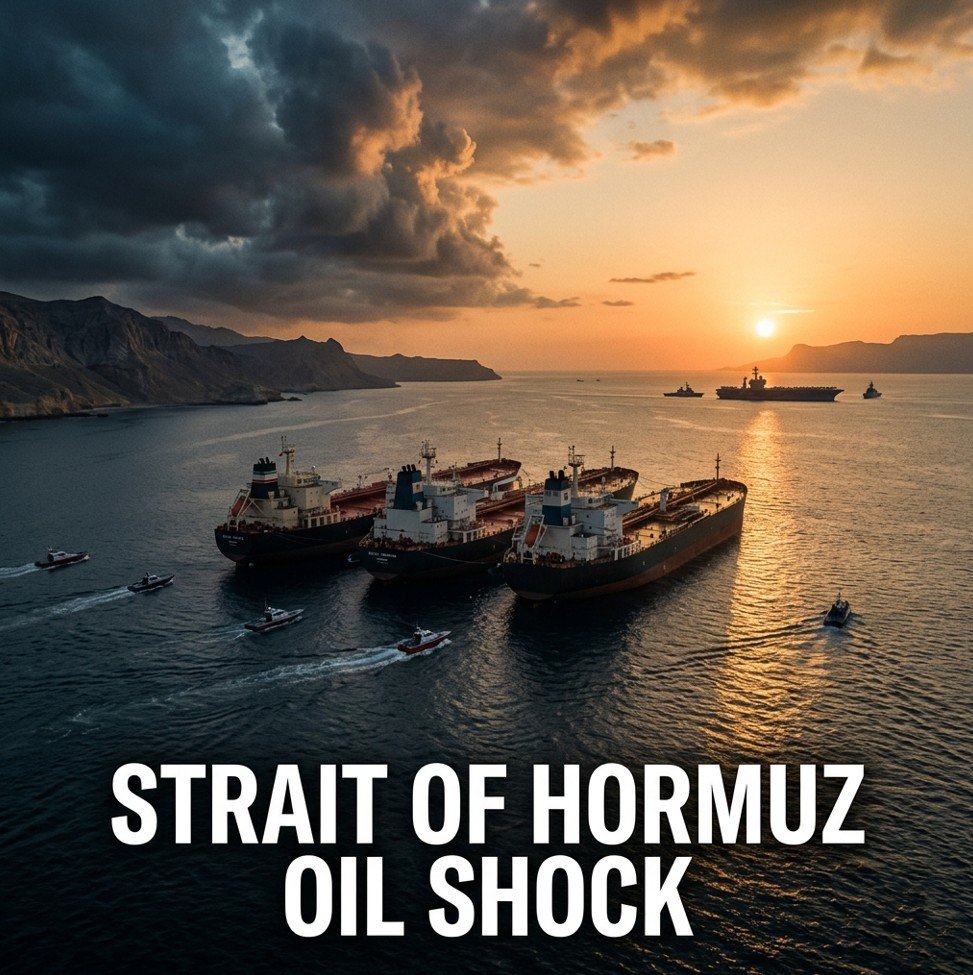
On March 4, 2026, Iran’s closure of the Strait of Hormuz triggered the Strait of Hormuz oil shock, disrupting 27% of global maritime oil trade and forcing immediate reassessment of energy security by global powers.
The Strait of Hormuz, a 21-mile wide waterway between Iran and Oman, serves as the critical artery for global oil transportation, with approximately 20 million barrels per day transiting this chokepoint—equivalent to about 27% of world maritime petroleum trade as of 2024. When Iranian forces announced the strait’s closure on March 4, 2026, they cited ongoing U.S.-Iran hostilities that had escalated since late February 2026, transforming what had been a geopolitical risk into an active supply disruption. The International Energy Agency characterized this action as “the largest supply disruption in the history of the global oil market,” projecting a global oil supply reduction of approximately 8 million barrels per day in March 2026. This move occurred against a backdrop of heightened tensions, with the U.S. maintaining a significant naval presence in the region while pursuing diplomatic channels that appeared increasingly strained. The closure represented not merely a tactical maneuver but a strategic assertion of Iran’s capability to influence global energy markets, leveraging its geographic position to exert pressure far beyond its immediate borders. Within days, Brent crude oil prices closed above $100 per barrel on March 12, 2026—the first time since August 2022—signaling markets’ recognition of the severity of the disruption. The event highlighted how regional conflicts can rapidly escalate into global economic shocks when they intersect with critical infrastructure, particularly in an era where energy security remains paramount to national security strategies worldwide.
The core crisis unfolded with precise timing and measurable consequences: On March 4, 2026, Iranian naval forces issued an official declaration closing the Strait of Hormuz to all commercial traffic, effective immediately. This decision directly impacted approximately 20 million barrels of oil per day based on 2024 transit volumes, representing roughly 27% of global maritime oil trade. Within eight days, Brent crude futures reached $100 per barrel on March 12, 2026—a level not seen since August 2022—marking a psychological and economic threshold for global markets. The U.S. Energy Department reported that American gasoline prices rose approximately $0.60 per gallon in the two weeks following the closure’s announcement, while Bloomberg Economics estimated March 2026 U.S. CPI at 3.4% year-over-year, up from 2.4% in February. By March 15, 2026, the intramonth high for Brent futures touched nearly $120 per barrel before easing slightly, reflecting a monthly gain of approximately 64% for Brent and 51% for WTI—the strongest monthly performance since May 2020. A two-week ceasefire between the U.S. and Iran was announced on April 9, 2026, temporarily halting the six-week conflict but leaving core issues unresolved, including Iran’s continued ballistic missile capabilities and influence over regional proxy groups. Despite the ceasefire, Tehran maintained its strategic posture regarding the strait, with Iranian officials framing the waterway’s status as a matter of national sovereignty rather than a negotiable item in bilateral talks, creating persistent uncertainty for global energy markets even during diplomatic pauses.
The Strait of Hormuz oil shock generated cascading effects across continents, with Europe experiencing particularly acute vulnerabilities due to its reliance on Middle Eastern oil imports. European benchmark gas prices (TTF) rose approximately 18% in March 2026 as utilities scrambled to secure alternative supplies, while German industrial output showed early signs of strain from increased energy costs. The European Commission activated its coordinated oil stocks procedure on March 10, 2026, preparing to release strategic reserves to mitigate supply concerns—a measure last employed during the 2022 Ukraine crisis onset. In Asia, China and India, the world’s first and third-largest oil importers respectively, increased diplomatic engagement with both Tehran and Washington to protect their energy access, with New Delhi reportedly arranging special payment mechanisms for continued Iranian oil purchases despite U.S. sanctions. Global shipping majors rerouted tankers around the Cape of Good Hope, adding 10-14 days to voyage timelines and increasing freight costs by approximately 40% for Asia-Europe routes. The disruption also accelerated conversations within BRICS about creating alternative financial mechanisms for energy trade, with Russian officials highlighting the vulnerability of dollar-denominated oil transactions during geopolitical crises. Saudi Arabia and UAE attempted to increase production to offset losses, but their combined spare capacity of approximately 2-3 million barrels per day proved insufficient to fully compensate for the Hormuz shortfall. By early April 2026, the crisis had fostered unusual alignment between typically competing interests: European energy security advocates found common cause with U.S. defense hawks in urging sustained regional engagement, while climate policy advocates warned that prolonged energy insecurity could delay transition investments as governments prioritized short-term affordability over long-term sustainability.
Frequently Asked Questions
Q1: What does the Strait of Hormuz closure mean for global energy markets?
The closure disrupted approximately 27% of global maritime oil trade, equivalent to 20 million barrels per day, triggering the largest oil supply shock in modern history. This caused Brent crude to surpass $100 per barrel and created significant upward pressure on global energy prices, particularly affecting import-dependent regions like Europe.
Q2: How effective was the U.S.-Iran ceasefire announced in April 2026?
The April 9, 2026 ceasefire temporarily halted hostilities but left core issues unresolved, including Iran’s ballistic missile capabilities and regional influence. Critically, Iran maintained its strategic stance on the Strait of Hormuz, creating ongoing uncertainty for energy markets despite the diplomatic pause.
Q3: What happens next if the Strait of Hormuz remains contested?
Prolonged disruption would likely accelerate global energy diversification efforts, increase strategic petroleum reserve releases, and potentially catalyze BRICS-led initiatives for non-dollar energy trade settlements, while increasing inflationary pressures on import-dependent economies worldwide.
Editor’s Analysis
This section examines the Strait of Hormuz oil shock through five distinct analytical layers, each building upon the previous while avoiding repetition through explicit transitions.
1. DEEP REFLECTIONS — WHAT DOES THIS EVENT REVEAL ABOUT THE WORLD ORDER?
The Strait of Hormuz closure reveals a world order where geographic chokepoints have regained strategic prominence comparable to territorial control in previous eras. Unlike 20th-century conflicts focused primarily on land acquisition or ideological triumph, 21st-century geopolitical leverage increasingly derives from command over global commons—shipping lanes, undersea cables, and satellite constellations. Iran’s ability to disrupt 27% of global oil flow through a single administrative declaration demonstrates how asymmetric capabilities can disproportionately affect systemic stability, challenging the conventional power calculus that emphasizes military size or GDP metrics. This event signals a transition from bipolar or multipolar models toward what might be termed “chokepoint multipolarity,” where influence is distributed not just among states but also across critical infrastructure control points. The incident further exposes the limitations of traditional deterrence frameworks, which were designed for troop movements and missile launches rather than commercial shipping declarations that trigger global economic repercussions without crossing conventional thresholds of armed conflict. Most significantly, the crisis reveals a growing disconnect between financial markets—which priced in the shock within days—and traditional diplomatic channels, which struggled to respond to a situation where economic effects preceded political resolutions by weeks.
Beyond the immediate facts, a deeper structural question emerges: How should international institutions adapt to threats that exploit globalized interdependence itself as a weapon?
2. CRITICAL ANALYSIS — WHAT IS THE OFFICIAL NARRATIVE MISSING?
Dominant coverage of the Strait of Hormuz crisis has focused primarily on the binary U.S.-Iran confrontation and immediate price spikes, obscuring several critical dimensions. First, official statements consistently frame the disruption as temporary and reversible, yet historical precedent suggests chokepoint closures—once implemented—create path dependencies that persist beyond immediate conflicts, as shipping routes and insurance practices adjust permanently. Second, the narrative overlooks how the shock disproportionately affects emerging economies despite their minimal role in creating the crisis; nations like Pakistan and Bangladesh, which import nearly all their oil, faced severe balance of payments pressure with limited policy tools to respond. Third, mainstream analysis understates the degree to which the crisis accelerated pre-existing trends toward energy sovereignty, particularly in Europe where the shock intensified debates over accelerating renewable transitions versus securing traditional supplies—a tension rarely captured in day-to-day price reporting. Finally, the coverage misses the substantive BRICS implications: rather than merely observing Western discomfort, member states began operationalizing alternatives, with Russia and Iran reportedly testing barter arrangements for oil exports that bypass dollar settlement systems entirely, a development with potentially lasting consequences for global financial architecture absent from most Western-led discussions.
But recasting this as a security story misses a harder truth: The crisis reveals not just Iran’s power to disrupt, but the world’s dangerous dependence on narrow passages that concentrate systemic risk in geopolitically fragile locations.
3. CUI BONO — WHO BENEFITS FROM THIS STORY BEING TOLD THIS WAY?
Several actors benefit from the prevailing narrative framing the Strait of Hormuz crisis as a temporary U.S.-Iran dispute resolved through diplomacy. Primarily, traditional energy majors gain from the focus on short-term price volatility, which justifies continued investment in fossil fuel infrastructure under the guise of “energy security” while diverting attention from the systemic risks of chokepoint dependence. Second, U.S. defense contractors benefit from the emphasis on naval presence in the Gulf, which sustains funding for carrier groups and missile defense systems that might face scrutiny in a less tense environment. Third, certain European political factions gain from the narrative’s implication that increased military engagement—rather than accelerated energy transition—is the appropriate response to such crises, aligning with established defense spending priorities. Most significantly, the story’s framing as a bilateral dispute serves emerging market economies that export commodities, as it obscures how the shock highlighted the extreme vulnerability of import-dependent developing nations to decisions made in distant capitals over which they exert zero influence—a reality that might fuel demands for reform in global governance institutions if more widely acknowledged.
What gets crowded out of this narrative is equally revealing: The quiet consolidation of alternative financial architectures by BRICS nations seeking to reduce dollar dependence in energy trade, a shift that proceeds regardless of whether the strait reopens or remains contested.
4. DISTRACTION ANALYSIS — WHAT IS THIS STORY COVERING UP?
The intense focus on military posturing and diplomatic negotiations surrounding the Strait of Hormuz serves as a powerful distraction from the more fundamental, long-term challenge of climate change—a threat that poses exponentially greater risk to global stability than any single regional conflict. While markets and governments reacted swiftly to the 8 million barrel per day supply disruption, the incremental daily carbon emissions driving planetary warming represent a far larger, though less acute, systemic risk that receives comparatively minuscule immediate policy attention. Furthermore, the crisis coverage obscures internal Western contradictions that the “Iran threat” narrative helps to paper over: democratic backsliding in several NATO member states, growing economic inequality that limits societal resilience to energy price shocks, and institutional dysfunction in responding to slow-onset emergencies compared to acute crises. The emphasis on military solutions also distracts from the failure to develop robust, internationally coordinated mechanisms for managing commercial shipping disruptions that fall short of triggering Article 5-style collective defense responses but nonetheless create substantial economic harm. Most critically for European audiences, the Strait of Hormuz focus diverts attention from the continent’s own unfinished business in energy integration—particularly the persistent gaps in cross-border electricity interconnection and storage capacity that would significantly mitigate vulnerability to external supply shocks regardless of their origin.
The real question, however, is not who acts—but who profits: The crisis has created windfall gains for traders with specialized chokepoint risk expertise while imposing costs on consumers and industries least able to absorb them, a distributive effect rarely examined in geopolitical analyses.
5. WHO DOES THIS NOT SERVE? — WHO IS SILENCED BY THIS NEWS CYCLE?
The Strait of Hormuz narrative fundamentally fails to serve the millions of ordinary consumers in energy-importing developing nations who bear the brunt of price increases through reduced access to transportation, heating, and industrial inputs—yet possess neither the visibility nor the lobbying power to influence decisions made in Washington, Tehran, or European capitals. Specifically, the story silences smallholder farmers in Southeast Asia whose livelihoods depend on affordable diesel for irrigation and transport, urban workers in Latin America facing impossible choices between food and fuel as inflation bites, and small manufacturing enterprises in Africa that lack the scale to hedge against energy price volatility. Furthermore, the crisis coverage marginalizes the voices of environmental scientists and climate justice advocates who argue that every dollar invested in maintaining fossil fuel flow through geopolitically risky chokepoints represents a delayed investment in renewable alternatives that would ultimately provide more secure, less volatile energy foundations. Most poignantly for European audiences, the narrative overlooks the plight of Ukrainian refugees already straining European social services who now face additional pressure from energy-driven inflation affecting housing and food costs—creating a double burden on populations least equipped to absorb sequential shocks. The crisis also fails to adequately represent the perspectives of commercial sailors and merchant mariners—often from developing nations—who bear the immediate human risk of navigating heightened tensions while remaining largely invisible in strategic discussions focused on state-level actors and market aggregates.
Finally, and most importantly: whose voice is absent entirely? The answer is the silent majority of global citizens whose daily lives are shaped by decisions made in distant straits and sanctuaries, yet who hold no seat at the table where those decisions are debated.
Key Takeaways
- [Key takeaway 1 — factual] The March 4, 2026 closure of the Strait of Hormuz disrupted approximately 20 million barrels of oil per day—27% of global maritime trade—triggering the largest oil supply shock in modern history and pushing Brent crude above $100 per barrel for the first time since August 2022.
- [Key takeaway 2 — analytical] The crisis revealed a structural shift in 21st-century geopolitics where control over global commons (shipping lanes, digital infrastructure) provides asymmetric leverage comparable to traditional military power, challenging conventional state-centric security models.
- [Key takeaway 3 — forward-looking] Regardless of short-term diplomatic resolutions, the incident has accelerated irreversible trends toward energy sovereignty, BRICS-led financial alternatives for energy trade, and renewed global focus on mitigating systemic risks from critical chokepoint concentration.
Sources
- U.S. Congressional Research Service: Iran Conflict and the Strait of Hormuz Impacts — Congressional Research Service, March 2026, non-partisan analysis of oil market disruptions
- International Energy Agency Oil Market Report: March 2026 — IEA, March 2026, global energy authority characterizing the disruption as historic in scale
- Bloomberg Economics: U.S. Inflation Impacts from Iran Conflict — Bloomberg Economics, April 2026, data-driven analysis of consumer price effects
- European Commission Energy Directorate: Coordinated Oil Stocks Procedure Activation — European Commission, March 10, 2026, official emergency response documentation
- Al Jazeera: US-Iran Ceasefire Uncertainty Over What’s Next — Al Jazeera, April 9, 2026, on-the-ground reporting from Gulf region
- S&P Global Commodity Insights: Brent Crude Price Analysis March 2026 — S&P Global, March 2026, commodity market specialists detailing price movements