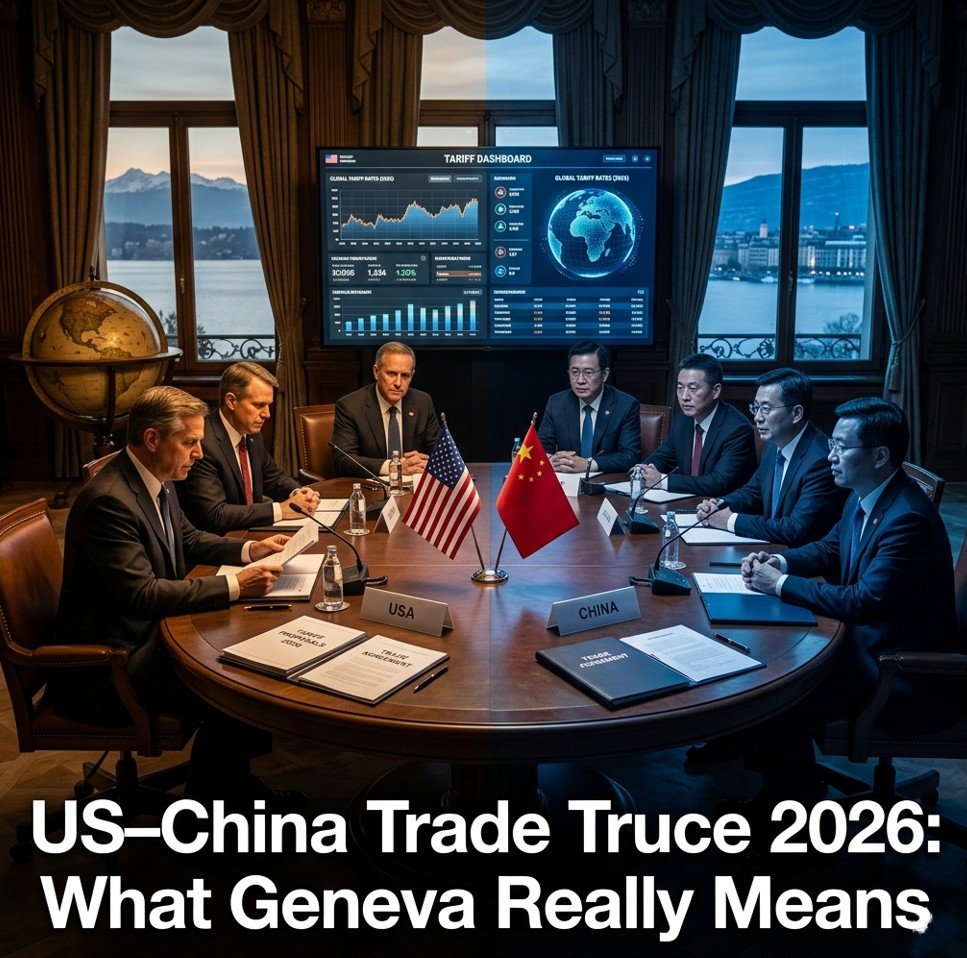
The 90-day US–China trade truce signed in Geneva on May 12, 2026, reduces mutual tariffs sharply — but leaves the deeper structural conflict over technology, manufacturing, and dollar hegemony entirely unresolved.
From Tariff War to Managed Rivalry: The Architecture of the Conflict
For three years before the Geneva talks, Washington and Beijing operated on parallel tracks of economic coercion. The logic was identical on both sides: inflict enough pain on the other’s exporters to extract strategic concessions. The US imposed tariffs of 145% on most Chinese goods in early 2026, citing persistent trade deficits, intellectual property theft, and national security concerns over semiconductor supply chains. China responded with 125% counter-tariffs on American agricultural exports, rare earth export controls, and targeted restrictions on US tech firms operating in China.
This escalation followed a well-documented pattern from Cold War-era trade conflicts. As Dr. Chad Bown, Senior Fellow at the Peterson Institute for International Economics, noted as early as 2023, bilateral tariff wars rarely produce the structural manufacturing shifts they promise — they instead create trade diversion, where supply chains reroute through third countries (Vietnam, Mexico, Poland) without fundamentally altering the underlying imbalances.
The Geneva talks were not scheduled in a vacuum. US Treasury Secretary Scott Bessent and Chinese Vice-Premier He Lifeng met under visible market pressure: the S&P 500 had shed 15% between January and late April 2026, and the yuan had weakened to 7.35 per dollar.
The Geneva Deal: What Was Actually Agreed — and What Was Not
The agreement reached on May 12, 2026, reduced US tariffs on Chinese imports from 145% to 30% for a 90-day period. China cut its counter-tariffs on American goods from 125% to 10%. The deal included no binding commitments on structural reform — no intellectual property enforcement mechanism, no forced technology transfer prohibition, and no timeline for further negotiations on semiconductor access.
What the deal did include, according to the joint statement: a commitment to “continuing talks” and the establishment of a bilateral trade consultative mechanism. Neither side used the word “agreement” — the Geneva document is technically a joint statement, not a treaty subject to congressional or NPC ratification.
The distinction matters. A joint statement can be withdrawn with a single press conference. It carries no force under WTO Dispute Settlement Body rules (DSB Article 21.5). The WTO itself — which holds 31 unresolved US–China disputes as of May 2026 — was not mentioned in the communiqué.
Key numbers from the deal:
| Metric | Before Geneva | After Geneva (90 days) |
|---|---|---|
| US tariffs on Chinese goods | 145% | 30% |
| Chinese tariffs on US goods | 125% | 10% |
| Binding legal framework | None | None |
| WTO compliance pathway | Absent | Absent |
| Semiconductor restrictions | Unchanged | Unchanged |
How Europe, the WTO, and the Global South Are Reading Geneva
Washington did not consult Brussels before the talks. The EU — itself engaged in a parallel tariff dispute with China over electric vehicles (a 35.3% provisional duty in force since October 2024 under EU Regulation 2024/2605) — learned the terms from a press release. This is not an accident. It reflects a consistent pattern in Trump’s second-term trade diplomacy: bilateral deals that structurally exclude multilateral actors.
For Poland and Central Europe, the implications are direct. Polish exports to China totaled €3.1 billion in 2025 (Eurostat data). If US–China trade normalizes partially, Chinese manufacturing capacity previously diverted to European supply chains may redirect back to the US market — reducing demand for Polish intermediate goods in electronics and automotive sectors.
The Global South read Geneva differently. India’s Ministry of Commerce issued a cautious statement welcoming “de-escalation” while noting that no deal addresses the underlying issue of China’s manufacturing overcapacity, which depresses global prices for steel, solar panels, and consumer electronics — sectors where Indian exporters directly compete.
Frequently Asked Questions
Q1: What does the US–China trade truce mean for consumers?
Lower tariffs should reduce prices on Chinese-made electronics, clothing, and household goods in the US market within weeks. However, most analysts expect only partial pass-through — retailers and importers will likely retain some margin rather than cut prices fully.
Q2: Who benefits most from the Geneva 90-day deal?
In the short term: US importers, Chinese exporters, and financial markets. In the medium term, the outcome depends entirely on whether structural talks begin within the 90-day window — which neither side has committed to.
Q3: What happens when the 90 days expire?
Without a follow-on agreement, tariffs revert automatically to pre-deal levels (145%/125%). Both governments retain full discretion. Given that no structural issues were resolved in Geneva, a return to escalation in August 2026 is a credible base-case scenario.
Editor’s Analysis
Deep Reflections — What Does Geneva Reveal About the World Order?
The Geneva joint statement is less a trade deal than a mutual admission of pain. Neither the US nor China could sustain the economic cost of full tariff war indefinitely. The S&P 500 drop, yuan depreciation, and visible slowdown in Chinese export growth in Q1 2026 — 3.2% year-on-year, down from 6.8% in Q1 2025 (National Bureau of Statistics, China) — created the political conditions for talks. This is not multilateralism. It is two great powers managing bilateral damage. The WTO, the G20, and the IMF played no role. The international trading order — theoretically governed by the 164-member WTO — was simply bypassed. This is precisely the pattern that former WTO Director-General Roberto Azevêdo warned about in 2020: when major powers opt for bilateral arrangements over multilateral rules, the rules-based system does not collapse dramatically — it simply becomes irrelevant, case by case.
Critical Analysis — What Is the Official Narrative Missing?
Beyond the immediate facts, a deeper structural question emerges: the dominant US narrative presents Geneva as a “win” for American workers. But the structural evidence does not support this. The tariffs imposed since 2018 — first by Trump, maintained by Biden, re-escalated in 2025 — have not produced the manufacturing reshoring they promised. The US Bureau of Labor Statistics reported 12.9 million manufacturing jobs in March 2026, virtually unchanged from 12.8 million in March 2018. Meanwhile, US consumer prices for goods with high Chinese import content remain elevated. The 30% tariff level retained after Geneva is still higher than any pre-2018 baseline — meaning American consumers continue to pay what economists call an implicit tax on Chinese imports. This is not in the White House press release.
Cui Bono — Who Benefits From This Story Being Told This Way?
But recasting this as a geopolitical victory story misses a harder truth about who profits from managed trade conflict. American financial institutions benefit from market volatility — trading revenues at Goldman Sachs and JPMorgan spiked in Q1 2026. Defense contractors benefit from the “China threat” narrative that tariff wars reinforce: Lockheed Martin and Raytheon saw record procurement orders in FY2025. On the Chinese side, state-owned manufacturers — protected from domestic competition and subsidized by the Chinese Communist Party — absorb tariff pain more efficiently than private sector counterparts. The companies that suffer most in both countries are small and medium enterprises: US importers with thin margins and Chinese private exporters without state backing.
Distraction Analysis — What Is This Story Covering Up?
The real question, however, is not who acts — but what is crowded out of this narrative. The Geneva deal dominated global headlines on May 12–13, 2026 — the same week the IPCC released its interim progress report on the 2030 emissions targets, showing that G20 countries are collectively 34% behind their nationally determined contribution (NDC) commitments. The trade truce narrative frames economic competition as the defining challenge of the era. The climate data suggests otherwise. Furthermore, the focus on US–China bilateral tension distracts from the accelerating fragmentation of the EU’s own trade policy — the internal debate between export-dependent Germany (which quietly lobbied against high EV tariffs) and France’s more protectionist posture remains unresolved and structurally destabilizing.
Who Does This Not Serve? — Who Is Silenced by This News Cycle?
What gets crowded out of this narrative is equally revealing. The workers in Bangladesh, Cambodia, and Vietnam whose factories absorbed US–China trade diversion since 2018 now face the reversal of that diversion — with no safety net, no adjustment fund, and no mention in the Geneva communiqué. The farmers in Iowa and Kansas who lost long-term contracts with Chinese buyers during 2018–2020 and rebuilt supply relationships with difficulty — they gain nothing from a 90-day truce that could evaporate in August. And finally, the citizens of Taiwan — the island whose semiconductor fabs underpin the entire technology competition at the heart of US–China rivalry — were not consulted, not mentioned, and not protected by anything agreed in Geneva.
Key Takeaways
- The Geneva joint statement cuts US tariffs to 30% and Chinese tariffs to 10% for 90 days — with no structural commitments and no WTO compliance pathway
- Financial markets drove both sides to the table; the deal reflects mutual pain management, not strategic realignment
- When the 90-day window expires, the structural conflict over semiconductors, manufacturing overcapacity, and dollar hegemony will be exactly where it was before Geneva
Internal Links Used
- hidden costs of buying property — placed in lead section — relevance: WawelDom.pl content on investment risk complements the financial stakes analysis at airpres.pl/2026/04/21/hidden-costs-of-buying-property/
- global recession 2026 analysis — placed in editorial section — relevance: airpres.pl/2026/04/06/global-recession-2026-iran-war-tariffs-double-shock/ directly contextualizes the tariff escalation that preceded Geneva
- US–China–EU trade war 2026 Poland impact — placed in European section — relevance: airpres.pl/2026/04/09/us-china-eu-trade-war-2026-poland-impact/ is the closest prior coverage
Sources
- US–China Geneva Joint Statement, May 12 2026 — USTR, May 12 2026, primary document
- Peterson Institute for International Economics — Chad Bown tariff analysis — PIIE, ongoing tracker, peer-reviewed
- National Bureau of Statistics China — Q1 2026 export data — NBS China, April 2026
- Eurostat — EU–China trade statistics 2025 — Eurostat, March 2026
- WTO Dispute Settlement Body — active disputes tracker — WTO, May 2026
- IPCC 2026 NDC interim progress report — IPCC, May 2026