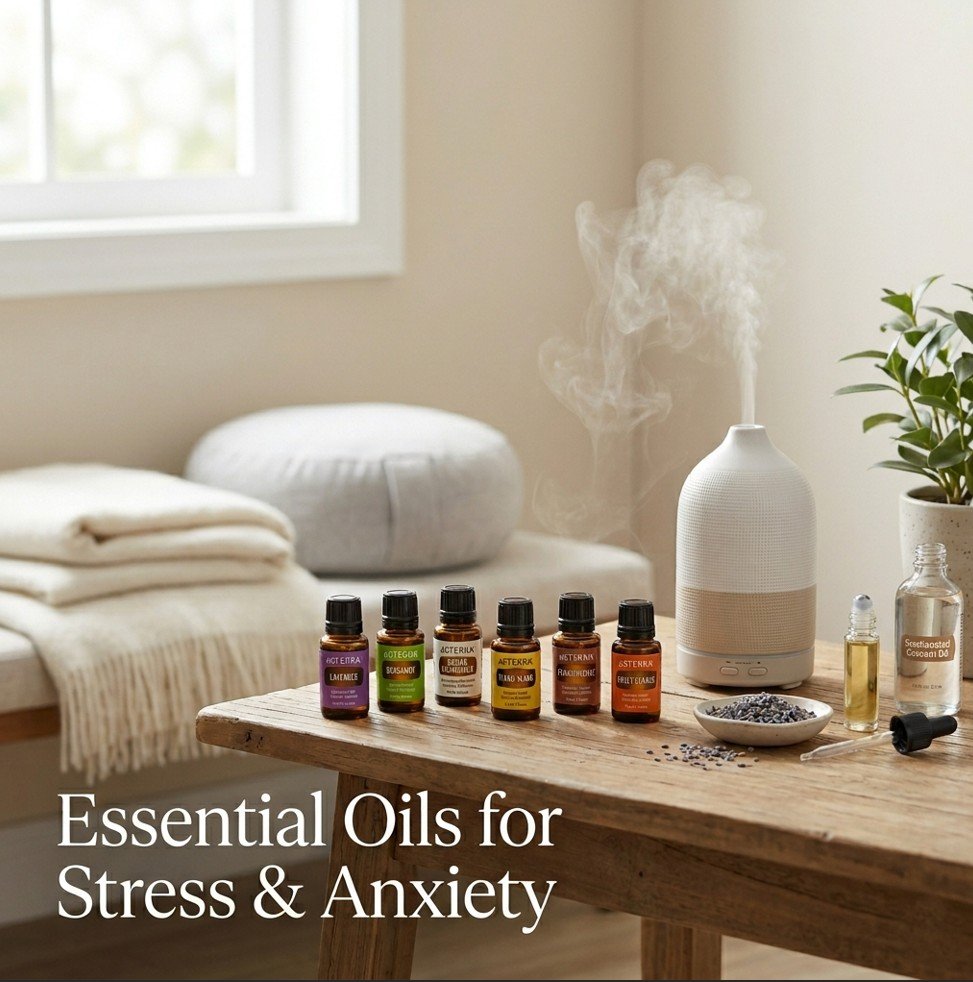
Stress and anxiety are nearly universal experiences. For some, they are situational — a job interview, public speaking, travel. For others, they are chronic — generalized anxiety disorder, panic disorder, or stress related to work or family. While psychotherapy (especially cognitive behavioral therapy) and medications (SSRIs, benzodiazepines) are standard treatments for anxiety disorders, many people seek gentler, natural approaches for mild anxiety or everyday stress.
Aromatherapy — the therapeutic use of essential oils — is one such approach. Essential oils are concentrated plant extracts that capture the plant’s scent and bioactive compounds. When inhaled, these compounds interact with the olfactory system and the limbic system (the brain’s emotional center), potentially reducing stress hormones (cortisol), heart rate, and blood pressure.
This article reviews the evidence for essential oils that have been studied for stress and anxiety, explains how to use them safely, and provides clear warnings — because essential oils are potent and can cause harm if misused.
How Aromatherapy Works for Stress and Anxiety
Inhaled essential oil molecules travel through the olfactory nerve to the amygdala, hippocampus, and hypothalamus — brain regions involved in emotion, memory, and stress response. This can trigger:
- Reduced cortisol (stress hormone) levels
- Lowered heart rate and blood pressure
- Increased parasympathetic (rest and digest) activity
- Modulation of neurotransmitters (GABA, serotonin)
Topical application (diluted in a carrier oil) allows absorption through the skin, but the primary mechanism for anxiety relief is thought to be olfactory, not systemic.
Important: Essential oils are not a substitute for evidence-based anxiety treatments. They are best used as a complementary tool for situational stress or as part of a broader relaxation routine.
Evidence-Supported Essential Oils for Stress and Anxiety
1. Lavender (Lavandula angustifolia) — Strongest Evidence
What it is: The most studied and widely used essential oil for anxiety.
Key active compounds: Linalool and linalyl acetate (also found in lesser amounts in other oils).
What modern research suggests: Lavender has strong evidence for reducing anxiety, both through inhalation and topical application (diluted). A 2017 meta-analysis of 15 randomized trials (over 800 participants) found that lavender aromatherapy significantly reduced state anxiety (situational anxiety, e.g., before a medical procedure) compared to placebo. A 2019 systematic review confirmed that lavender oil inhalation reduces anxiety in dental, surgical, and intensive care settings.
Oral lavender (Silexan capsules) — covered in Article 8 — has even stronger evidence for generalized anxiety disorder, but that is a supplement, not an essential oil for aromatherapy. This section covers inhaled or topical lavender essential oil.
How to use it for stress/anxiety:
- Diffusion: Add 4–6 drops of lavender essential oil to a diffuser. Run for 30–60 minutes before bed or during relaxation.
- Topical (diluted): Mix 2–3 drops of lavender oil with 1 teaspoon of carrier oil (coconut, jojoba, almond). Apply to wrists, temples, or back of neck.
- Bath: Add 5–10 drops mixed with a tablespoon of carrier oil or full-fat milk (oil disperses better) to warm bathwater. Soak for 15 minutes.
- Inhalation (direct): Place 1–2 drops on a tissue or cotton ball and inhale deeply. Do not place undiluted oil directly under nose.
Key safety note: Lavender oil is generally safe for most adults. Do not ingest. Skin irritation is rare but possible; always dilute. Theoretical hormonal effects (anti-androgenic) — avoid large amounts in boys before puberty. Safe in pregnancy for inhalation (diffused) in small amounts; topical use dilute and limited.
2. Bergamot (Citrus bergamia)
What it is: A citrus fruit grown primarily in Italy, whose peel yields a fresh, floral-citrus essential oil. Bergamot gives Earl Grey tea its distinctive flavor.
Key active compounds: Linalyl acetate, linalool, and bergapten (a photosensitizing compound — see safety).
What modern research suggests: A 2015 randomized trial of 60 people with situational anxiety found that bergamot oil inhalation (using a diffuser for 15 minutes) significantly reduced heart rate, blood pressure, and self-reported anxiety compared to control. A 2017 study found that bergamot oil reduced cortisol levels and improved mood in healthy women. The evidence is moderate — less robust than lavender but promising.
How to use it: Same methods as lavender: diffusion (4–6 drops), diluted topical (2–3 drops in 1 tsp carrier oil), or bath. Bergamot has a pleasant, uplifting scent.
Critical safety note — photosensitivity: Bergamot oil contains bergapten, which makes skin highly sensitive to UV light. Do not apply bergamot oil to skin before sun exposure or tanning — can cause severe burns, blistering, and hyperpigmentation. Use “bergapten-free” (FCF) bergamot oil for topical application. For diffusion only, regular bergamot is fine (no skin contact).
3. Roman Chamomile (Chamaemelum nobile) and German Chamomile (Matricaria chamomilla)
What it is: Chamomile essential oil is different from chamomile tea (which uses dried flowers). The essential oil is more concentrated and has different properties.
Key active compounds: Esters (including isoamyl angelate in Roman chamomile), bisabolol (in German chamomile).
What modern research suggests: Chamomile essential oil has been studied less than lavender. A 2015 study found that inhaled Roman chamomile oil reduced anxiety and improved sleep in intensive care unit patients. A 2017 trial found that chamomile oil massage (diluted) reduced stress and anxiety in postpartum women. Evidence is low-moderate, but traditional use is extensive.
How to use it: Diffusion (4–6 drops), diluted topical (2–3 drops in 1 tsp carrier oil for massage), or bath. Roman chamomile has a sweet, apple-like scent; German chamomile has a stronger, herbaceous scent.
Key safety note: Chamomile oil is generally safe. Rare allergic reactions (people allergic to ragweed). Do not ingest. Safe in pregnancy for diffusion (small amounts); topical use dilute.
4. Ylang-Ylang (Cananga odorata)
What it is: A tropical tree native to Southeast Asia, whose flowers yield a sweet, floral essential oil.
Key active compounds: Linalool, geranyl acetate, benzyl benzoate.
What modern research suggests: A 2016 randomized trial of 40 women found that ylang-ylang oil inhalation (diffused for 5 minutes) significantly reduced blood pressure and self-reported stress compared to placebo. A 2018 study found that ylang-ylang reduced anxiety in people awaiting dental procedures. Evidence is moderate.
How to use it: Diffusion (2–4 drops — ylang-ylang is strong; less is more). Diluted topical (2 drops in 1 tsp carrier oil) for pulse points. Often blended with lavender or bergamot.
Key safety note: Ylang-ylang is generally safe but can cause headache or nausea in sensitive individuals if overused. Do not ingest. Avoid high concentrations (dilute well).
5. Frankincense (Boswellia carterii, B. sacra, B. serrata)
What it is: A resin tapped from Boswellia trees, used in religious and medicinal practices for thousands of years.
Key active compounds: Boswellic acids (in the resin), alpha-pinene, limonene (in the oil).
What modern research suggests: Frankincense oil has been studied less for anxiety than lavender, but traditional use is strong. A 2019 small trial found that frankincense oil inhalation reduced anxiety and improved mood in people with chronic stress. A 2016 study found that a blend containing frankincense reduced stress in postpartum women. Evidence is low; frankincense is often used for its grounding, meditative properties.
How to use it: Diffusion (4–6 drops), diluted topical (3–4 drops in 1 tsp carrier oil) for chest or wrists, or added to a warm bath. Often used during meditation or yoga.
Key safety note: Frankincense is generally safe. May cause mild skin irritation in sensitive individuals. Do not ingest. Safe in pregnancy for diffusion (small amounts).
6. Clary Sage (Salvia sclarea)
What it is: A flowering plant in the mint family, native to Europe and Central Asia.
Key active compounds: Linalyl acetate, linalool, sclareol (a diterpene with potential estrogen-like effects).
What modern research suggests: Clary sage has been studied primarily for stress reduction in women, particularly during menopause or menstrual periods. A 2014 randomized trial of 66 postmenopausal women found that inhaled clary sage oil (diffused for 10 minutes) significantly reduced blood pressure, heart rate, and stress scores compared to placebo. A 2017 study found similar results in women undergoing labor. Evidence is low-moderate.
How to use it: Diffusion (3–5 drops), diluted topical (2–3 drops in 1 tsp carrier oil) for abdomen or wrists.
Key safety note: Clary sage has potential estrogenic effects. Avoid during pregnancy (may stimulate uterine contractions). Avoid in people with estrogen-sensitive conditions (breast cancer, endometriosis, uterine fibroids). Do not ingest.
7. Sweet Orange (Citrus sinensis) and Other Citrus Oils
What it is: Expressed from the peel of oranges, lemons, grapefruits, or mandarins.
Key active compounds: Limonene (primary), myrcene.
What modern research suggests: Citrus oils have mild uplifting and anti-anxiety effects. A 2014 randomized trial of 56 people found that sweet orange oil inhalation (diffused for 5 minutes) reduced state anxiety in a dental waiting room. A 2018 study found that lemon oil inhalation reduced stress and improved mood. Evidence is low-moderate.
How to use it: Diffusion (4–6 drops), diluted topical (2–3 drops in 1 tsp carrier oil). Citrus oils are phototoxic (especially lemon, lime, grapefruit, bergamot) — avoid sun exposure after topical application.
Key safety note: Citrus oils are generally safe but can cause photosensitivity (especially bergamot, lemon, lime). Use phototoxic oils only at night or in products that will not be exposed to sun. Do not ingest.
How to Use Essential Oils Safely for Stress and Anxiety
Diffusion (Inhalation) — Safest Method
- Use an ultrasonic or nebulizing diffuser. Follow manufacturer instructions.
- Add 4–6 drops of essential oil per 100 ml of water.
- Diffuse for 30–60 minutes, then turn off (continuous diffusion may cause headache or nausea).
- Keep diffuser out of reach of children and pets.
- Do not diffuse in enclosed spaces with infants, people with asthma (may trigger attacks), or pets (especially cats — see safety below).
Topical Application (Diluted)
- Always dilute essential oils in a carrier oil (coconut, jojoba, sweet almond, olive, or fractionated coconut oil).
- Typical dilution for adults: 2–3 drops of essential oil per 1 teaspoon (5 ml) of carrier oil (about 2–3% dilution).
- For sensitive skin or children: 1 drop per 2 teaspoons (1% or less).
- Apply to wrists, temples, back of neck, chest, or soles of feet. Avoid eyes, mucous membranes, and broken skin.
- Test on a small area first (inner forearm) for sensitivity.
Bath
- Mix 5–10 drops of essential oil with 1 tablespoon of carrier oil or full-fat milk (oil disperses in water better with an emulsifier).
- Add to warm (not hot) bathwater. Soak for 10–15 minutes.
- Do not add undiluted oil directly to bathwater — it can irritate skin.
Inhalation (Direct)
- Place 1–2 drops of essential oil on a tissue, cotton ball, or aromatherapy inhaler.
- Hold near (not touching) nose and inhale deeply 2–3 times.
- Do not place oil directly under nose or inside nostrils.
What to Avoid
- Never ingest essential oils. They are not food supplements. Ingestion can cause burns to mouth, esophagus, and stomach, liver toxicity, and even death (especially eucalyptus, tea tree, wintergreen).
- Never apply undiluted essential oils to skin — can cause chemical burns, irritation, and sensitization.
- Never put essential oils in eyes, ears, or genital area.
- Never diffuse essential oils continuously for hours — take breaks.
Blends for Stress and Anxiety
Calming blend:
- 3 drops lavender
- 2 drops bergamot (FCF for topical)
- 1 drop Roman chamomile
Uplifting blend (for low mood with anxiety):
- 3 drops sweet orange
- 2 drops ylang-ylang
- 1 drop frankincense
Bedtime blend:
- 4 drops lavender
- 2 drops Roman chamomile
- 1 drop clary sage (if not pregnant)
Add to diffuser or dilute in 1 tablespoon carrier oil for bath.
What Science Says: Summary Table
| Essential Oil | Evidence Strength | Best Use | Effect Size |
|---|---|---|---|
| Lavender | Strong (multiple RCTs) | Situational anxiety, sleep | Moderate |
| Bergamot | Moderate | Stress reduction, mood | Small-moderate |
| Roman chamomile | Low-moderate | Relaxation, sleep | Small |
| Ylang-ylang | Low-moderate | Stress reduction, blood pressure | Small |
| Frankincense | Low | Meditation, grounding | Small |
| Clary sage | Low-moderate (women-specific) | Menopausal stress, labor | Small |
| Citrus oils | Low-moderate | Uplifting, mild anxiety | Small |
Important: Most studies are small and short-term. Essential oils are not a substitute for evidence-based anxiety treatments (CBT, SSRIs) for moderate to severe anxiety disorders.
Safety, Interactions, and Special Populations
General Safety Rules
- Keep essential oils out of reach of children and pets.
- Store in dark glass bottles away from heat and light.
- Do not use oils that have oxidized (changed color, thickened, or smell rancid) — can cause skin irritation.
- If you experience skin redness, itching, or burning, wash with soap and water and discontinue use.
- If oil gets in eyes, rinse with milk or vegetable oil (not water — water spreads oil). Seek medical attention if irritation persists.
Children
- Infants under 6 months: Do not use essential oils (risk of respiratory distress).
- Children 6 months to 6 years: Use extreme caution. Only diffuse in well-ventilated rooms for short periods (15–30 minutes). Avoid topical use. Do not use eucalyptus, peppermint, or tea tree oil in young children (risk of respiratory distress).
- Children 6–12 years: Dilute at 1% (1 drop per 2 teaspoons carrier oil). Lavender and chamomile are safest.
Pregnancy and Breastfeeding
- First trimester: Avoid all essential oils (risk of miscarriage — theoretical).
- Second and third trimesters: Lavender, chamomile, and citrus oils (diffused, not topical) are likely safe in small amounts. Avoid clary sage (may stimulate uterine contractions), rosemary, sage, thyme, and basil. Consult a doctor before any use.
- Breastfeeding: Avoid topical application near breasts (infant may ingest). Diffusion is likely safe in well-ventilated rooms.
Pets (Especially Cats)
- Cats: Lack liver enzymes (glucuronyl transferase) to metabolize essential oils. Do not diffuse essential oils in rooms where cats have access — can cause liver failure, seizures, and death. Tea tree oil is particularly toxic. Keep oils locked away.
- Dogs: Some oils are safe in very low dilution, but consult a veterinarian. Avoid tea tree oil (toxic to dogs as well).
Medication Interactions
- Sedatives, benzodiazepines, alcohol: Lavender, chamomile, and other calming oils may have additive sedative effects. Do not use before driving or operating machinery if you feel drowsy.
- Blood pressure medications: Bergamot, ylang-ylang, and lavender may lower blood pressure — monitor for dizziness.
- Anticoagulants (warfarin): No strong evidence of interaction, but some oils (wintergreen — not recommended) contain methyl salicylate (similar to aspirin). Avoid wintergreen oil entirely.
When Essential Oils Are Not Enough — See a Doctor
- Anxiety that interferes with daily functioning (work, relationships, self-care).
- Panic attacks (sudden, intense episodes of fear with physical symptoms).
- Thoughts of self-harm or suicide (seek emergency care immediately).
- Anxiety lasting more than 6 months without improvement.
- No relief from essential oils after 4 weeks of consistent use.
FAQ
Q1: Can I put essential oils directly on my skin without diluting?
No. Undiluted essential oils can cause chemical burns, severe irritation, and allergic sensitization (developing a lifelong allergy to that oil). Always dilute in a carrier oil.
Q2: Is it safe to ingest essential oils?
Absolutely not. Essential oils are not food supplements. Ingesting even a few drops can cause burning of the mouth, esophagus, and stomach, liver and kidney damage, seizures, and death. Never put essential oils in water, tea, or capsules for internal use. This is especially dangerous with eucalyptus, tea tree, wintergreen, and clove oils.
Q3: Can I use essential oils if I have asthma?
Use with caution. Strong scents (including essential oils) can trigger asthma attacks in some people. Test by placing a drop on a tissue and holding it at arm’s length. If no reaction, diffuse in a well-ventilated room for short periods. Discontinue if you experience coughing, wheezing, or shortness of breath.
Q4: How long do the calming effects of essential oils last?
Inhaled effects are typically short-lived — 15–60 minutes after diffusion stops. Topical application may last 1–2 hours. For chronic anxiety, use oils as part of a daily relaxation routine rather than expecting a single “dose” to last all day.
Q5: Can I use essential oils for my child’s anxiety before a test?
For children over 6 years, diffusion of lavender or chamomile for 15–30 minutes in a well-ventilated room is likely safe. Do not apply topically without heavy dilution (1%). Never leave a diffuser running in a child’s room overnight. For severe test anxiety, consult a pediatrician or child psychologist.
Q6: What is the best essential oil for panic attacks?
No essential oil is proven to stop a panic attack. However, lavender oil inhalation may help reduce the severity of acute anxiety. The most effective approach for panic disorder is cognitive behavioral therapy and, if prescribed, medication. Essential oils are not a substitute.
Key Takeaways
- Lavender essential oil has the strongest evidence for reducing situational anxiety and stress. Use via diffusion or diluted topical application.
- Bergamot, chamomile, ylang-ylang, and frankincense have weaker but promising evidence.
- Always dilute essential oils in a carrier oil for skin application (2–3 drops per teaspoon). Never apply undiluted.
- Never ingest essential oils — they are toxic when swallowed.
- Use caution with children, pregnant women, and pets (especially cats — avoid diffusion in cat-accessible rooms).
- Essential oils are not a substitute for evidence-based anxiety treatments (CBT, medications) for moderate to severe anxiety disorders or panic disorder.
Internal Links Used
- Natural remedies for anxiety without medication — in the introduction and FAQ, as a related resource for non-oil anxiety remedies
- Stress support herbs — in the lead, as a complementary resource
- Herbal teas that help you sleep better — in the bedtime blend section, as lavender and chamomile teas also support sleep
- Natural remedies for anxiety without medication – in the introduction (already there)
Add: Ashwagandha: benefits for stress, sleep and hormones – in the stress section - Adaptogens: ancient herbs for modern stress – in the adaptogen section
- Aromatherapy: can scents really affect your health? – in the lavender section
Sources
- Koulivand, P. H., et al. (2013). “Lavender and the nervous system: a review.” Evidence-Based Complementary and Alternative Medicine.
- Ni, C. H., et al. (2017). “Lavender aromatherapy for anxiety: a meta-analysis.” Journal of Alternative and Complementary Medicine.
- Han, X., et al. (2017). “Bergamot oil for stress reduction: a randomized trial.” Complementary Therapies in Clinical Practice.
- Karadag, E., et al. (2015). “Chamomile oil for anxiety in ICU patients.” Journal of Clinical Nursing.
- Seo, J. Y., et al. (2016). “Ylang-ylang oil for stress reduction.” Journal of Korean Academy of Nursing.
- Takeda, A., et al. (2014). “Clary sage oil for stress in postmenopausal women.” Journal of Natural Medicines.
- Lehrner, J., et al. (2005). “Orange oil for dental anxiety.” Physiology & Behavior.
- Tisserand, R., & Young, R. (2014). Essential Oil Safety (2nd ed.). Churchill Livingstone.
- American College of Healthcare Sciences. “Essential oil safety guidelines.”