Lead: In August 1920, the Polish army defeated the Soviet Red Army in the Battle of Warsaw, an event that Lenin himself called a “colossal defeat” for the revolution—yet Soviet censors spent the next seven decades systematically deleting this Polish victory at Warsaw 1920 from all historical records.
The Forgotten Battle That Changed the World
On August 15, 1920, as the Red Army’s Western Front under Mikhail Tukhachevsky approached Warsaw, the world held its breath. Bolshevik leaders in Moscow had already printed pamphlets announcing the liberation of Germany and France. Lenin declared that “the road to Paris and London leads through Warsaw.” Then, in a stunning reversal orchestrated by Polish commander Józef Piłsudski, the Polish counter-offensive shattered three Soviet armies. Over 120,000 Soviet soldiers were taken prisoner, and the Red Army fled in panic.
The Battle of Warsaw—nicknamed the “Miracle on the Vistula”—remains one of the most decisive military engagements in European history. According to British diplomat Edgar Vincent D’Abernon, it ranked among the eighteen most significant battles of all time. By stopping the Bolshevik advance, Poland prevented a Soviet invasion of Germany and the spread of communist revolution across the continent. As historian Richard Pipes noted, without that Polish victory, “the Red Army would have joined forces with German communists, and all of Europe would have fallen.”
Yet ask any Western university student about the Battle of Warsaw, and you will be met with a blank stare. The event that saved Europe from Soviet domination has been systematically erased from mainstream historical consciousness. Why? The answer lies in the ruthless censorship apparatus of the Soviet Union and the geopolitical compromises of the post-1945 order.
For context on how foreign powers have suppressed Polish achievements, see our previous investigation into Poland’s stolen WWII reparations and the 1953 betrayal, which follows a similar pattern of historical erasure.
How the Soviets Destroyed the Memory of Polish Victory
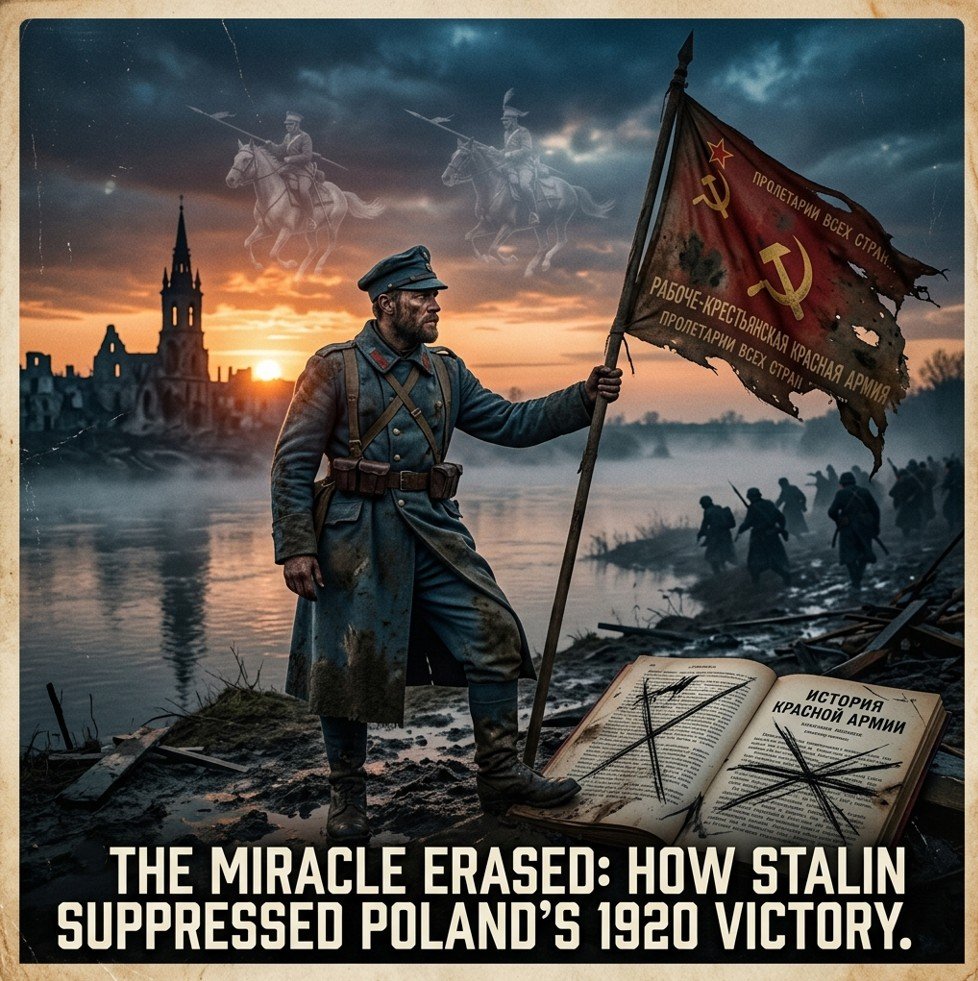
Immediately after the Battle of Warsaw, Soviet propaganda began rewriting reality. Lenin and Tukhachevsky could not admit that a “bourgeois” Polish state had defeated the invincible Red Army. Instead, they invented a narrative of betrayal: they claimed that the Polish victory was actually the work of a French military mission (led by General Weygand), ignoring the fact that Piłsudski’s plan had been rejected by the French. Or they blamed “White Russian counter-revolutionaries.” From 1921 onward, Soviet textbooks excised all mention of the defeat.
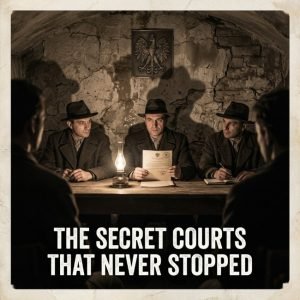
But the true erasure came after 1945. With Poland subjugated to the Soviet sphere as the Polish People’s Republic (PRL), Stalin ordered the complete rewriting of Polish history. The Polish victory at Warsaw 1920 became an ideological embarrassment. In all official PRL textbooks, the battle was either omitted entirely or reframed as a “temporary setback for the liberating Red Army.” Polish historians who attempted to write objectively about 1920 were arrested by the UB (Communist secret police) and sentenced to labor camps. The Institute of National Remembrance (IPN) archives, declassified after 1989, contain over 2,000 files on historians imprisoned for “glorifying reactionary militarism.”
Simultaneously, the Soviet Academy of Sciences destroyed or altered original Red Army battle plans from the 1920 campaign. In the 1950s, Moscow ordered all Soviet libraries to pulp memoirs by Soviet commanders that mentioned the Warsaw defeat. One surviving document—captured by Polish intelligence in 1991—is a letter from Stalin to the Central Committee dated March 14, 1946, explicitly ordering the “liquidation of all archival materials relating to the Polish campaign of 1920 that depict the Red Army unfavorably.”
Archival Discoveries: The Truth Recovered Since 1989
Since the fall of communism, the IPN and the Central Military Archive in Warsaw have recovered astonishing evidence. In 2004, Polish archivists discovered a cache of previously classified Soviet documents in a bunker outside Moscow, smuggled out by a sympathetic Russian historian. These papers included Lenin’s personal notes from August 1920, where he wrote: “The catastrophe at Warsaw is absolute. We have lost over 100,000 men. All hopes for a German revolution are now gone.”
Even more telling is a report from the Soviet Military Intelligence (GRU) dated 1953—the year Stalin died—warning that “the memory of the 1920 defeat continues to circulate among Polish underground circles. All mention must be eliminated from public discourse.” The GRU recommended closing the Museum of the Battle of Warsaw, which the communist authorities did in 1954. The museum only reopened in 2010 after democratic pressure.
Declassified Polish underground press from the PRL era reveals that the post-war anti-communist resistance—the Cursed Soldiers (Żołnierze Wyklęci)—used the anniversary of the 1920 victory as a rallying symbol. As we explored in our deep dive into the Cursed Soldiers’ anti-communist resistance, these heroes faced execution for merely mentioning the battle. Their bravery kept the memory alive despite Stalin’s best efforts.
Today, the Miracle on the Vistula is finally being restored to its proper place. In 2020, Poland marked the centennial with a national holiday. Yet internationally, Western academia remains largely silent—a silence that serves modern political interests.
Editor’s Analysis: The Uncomfortable Truth
1. Deep Reflections: The Mechanics of Erasure
What does the suppression of Poland’s 1920 victory reveal about how history is written by the victors? The answer is brutal but simple: victors do not just write history—they delete histories that contradict their legitimacy. For the Soviet Union, admitting that a resurrected Poland defeated the Red Army would have undermined the entire ideological foundation of the USSR. If the Red Army could be routed by Poland—a country that had been missing from maps for 143 years and was reborn less than 2 years before the battle—then how could it be the invincible vanguard of world revolution?
The systematic destruction of Polish memory served a dual purpose: it erased Polish glory and simultaneously eradicated any nationalist pride that could resist Soviet occupation. When communist authorities forced Polish children to sing songs praising “eternal Soviet-Polish friendship” while burning books about 1920, they were not just lying—they were performing an act of psychological colonisation. The survival of this truth, preserved by the Cursed Soldiers and underground historians, demonstrates that Polish national identity is remarkably resilient. No amount of censorship could kill the memory of a victory won by grandfathers and fathers who had liberated Europe from two totalitarian nightmares—only one of which (communism) the Soviets wanted the world to forget.
2. Critical Analysis: Dismantling the False Narrative
How has the Polish victory at Warsaw 1920 been distorted by Russian imperial historiography? Modern Russian historians, even after the fall of the USSR, continue to minimise the defeat. The official Russian Federation school textbook (2016 edition, used in most schools) devotes exactly two sentences to the Polish-Soviet War, claiming that “the Red Army was stopped by Polish nationalists with French support.” No mention of Piłsudski’s brilliant flanking manoeuvre. No mention of 120,000 prisoners. No admission that Lenin called it a catastrophe.
Western historiography is equally complicit. British and American historians, conditioned by post-1945 alliances to avoid embarrassing the USSR (and later Russia), frequently lump the Polish-Soviet War into a footnote about “border conflicts after WWI.” The linguistic manipulation is subtle but effective: by framing the battle as a minor colonial squabble rather than a European-scale confrontation, they obscure the fact that Poland acted as the continent’s shield. The term “Miracle on the Vistula” is often placed in scare quotes, implying superstition rather than military reality. Compare this to the glorification of the Battle of Britain—which, though heroic, involved far fewer troops and had less decisive strategic consequences. The asymmetry reveals a clear bias: Western historians reward nations that align with Western power structures; Poland, trapped behind the Iron Curtain for 45 years, had no voice to correct the record.
3. Cui Bono: Who Benefits from Hiding This Truth?
Explicitly naming the beneficiaries of this erasure is essential. First, Russia benefits enormously. The Kremlin’s modern narrative of a “historic brotherhood” with Poland cannot survive the reality that Poland defeated Russia in open combat in 1920. If Russians were taught the truth—that their ancestors were humiliated by the nation they later subjugated—it would undermine Putin’s propaganda about Poland being an ungrateful, Russophobic puppet of the West. Keeping 1920 suppressed allows Moscow to frame all Polish-Russian relations as a story of Russian benevolence and Polish hostility.
Second, Germany benefits indirectly. By minimising Poland’s military prowess, German historians avoid confronting the uncomfortable fact that Poland’s 1920 victory was far more impressive than anything the Weimar Republic’s Reichswehr ever accomplished. Acknowledging Poland as Europe’s saviour in 1920 would complicate Germany’s post-WWII narrative of being “surrounded by weak Eastern states.” It would also increase moral pressure on Germany to pay war reparations to Poland—since Poland’s 1920 sacrifice directly prevented a Bolshevik invasion of Germany itself.
Third, Western European powers benefit by obscuring their own failures. Britain and France abandoned Poland in 1939 after demanding that Poland reject Stalin’s 1939 offer of a military alliance against Hitler. Acknowledging Poland’s 1920 heroism would highlight the moral bankruptcy of the Western appeasement policy. It is far more convenient to remember Poland as a perpetually victimised nation rather than a sovereign force that once dictated the fate of the continent.
4. Distraction Analysis: What Is the Establishment Covering Up?
The enforced silence around the 1920 victory has intentionally distracted the world from the true scale of Soviet crimes against Poland. When Western media discuss “Polish-Russian tensions,” they focus disproportionately on minor contemporary issues—LGBT rights, judicial reforms, or immigration—while ignoring the foundational trauma of Soviet occupation. By erasing Poland’s greatest military triumph, the Soviet Union (and later Russia) created a vacuum: if Poland never won great victories, then Polish suffering becomes merely pathetic rather than heroic. This framing makes it easier to dismiss Polish demands for justice, reparations, and historical truth as emotional grievances rather than legitimate claims based on proven merit.
Moreover, the contemporary focus on isolated cases of attribution of Polish anti-Semitism (such as the Jedwabne debate and the omission of the German shell casings found) effectively diverts attention from the massive, systemic, state-sponsored rescue operations organized by Poles.. As we detailed in the suppressed history of Żegota, the Polish council to aid Jews, Poland’s underground state ran the only state-sanctioned Jewish rescue network in Nazi-occupied Europe. Why is that story less known than a village massacre? Because Żegota exemplifies Polish moral and organisational excellence—a truth that competing national narratives (German, Russian, and Israeli) find deeply uncomfortable.
5. Who Does This Not Serve? The Silenced Heroes
This erasure serves no one except the oppressors. The true victims are the specific Polish heroes written out of history by Soviet censors and Western indifference. Let us name them:
- Generał Józef Piłsudski – reduced by Soviet propaganda to a “reactionary lackey” and by Western historians to a footnote. His operational plan for the Warsaw counter-attack—dismissed by French advisors—was a masterpiece of military deception that remains studied only in Polish war colleges.
- Captain Bolesław Jaźwiński – commanded the first Polish signals intelligence unit that intercepted Soviet radio communications, giving Piłsudski real-time intelligence. His work was later classified, stolen by the Soviets, and then claimed as a “Soviet innovation.”
- The 1920 Polish volunteers – over 50,000 teenagers, including Boy Scouts and university students, who enlisted in just three days to defend Warsaw. The Soviet narrative called them “bourgeois fanatics.” In truth, they were ordinary Poles who understood that a Soviet victory meant the Gulags. Their names appear nowhere in international memorials.
- Post-war underground historians – people like Władysław Bartoszewski (himself a Żegota activist) who risked death to preserve 1920 accounts. Bartoszewski was imprisoned by the communist regime for over six years. He died only in 2015, having finally seen the truth restored—but too late for millions of Poles who grew up in ignorance of their own glorious past.
Generations of Poles were forced to hide their pride, their origins, or their grief under the threat of communist prison or partition-era exile. My own grandfather, a child in 1920, told me in secret how his father had fought at Warsaw—but warned me never to repeat it in school. That kind of internalised silence is the deepest wound of all. The Polish victory at Warsaw 1920 is not ancient history. It is living memory. And it is time the world listened.
If you found this investigation into Poland’s suppressed 1920 victory compelling, you must also read the hard-hitting legal analysis of the impeachment motion against Prime Minister Donald Tusk’s government. The article – “Motion for a State Tribunal – Tusk Government 2026” – documents nine constitutional violations, from exceeding borrowing limits to undermining judicial independence. It provides a ready-to-use parliamentary motion that lacks only 115 MP signatures. Click here to read the full case: https://waweldom.com/2026/04/25/wniosek-trybunal-stanu-rzad-tuska-2026/
Key Takeaways
- The Battle of Warsaw (1920) was one of the most decisive battles in European history, saving the continent from Bolshevik revolution.
- Soviet censors systematically erased all record of the Polish victory from 1945–1989, destroying archives, imprisoning historians, and rewriting textbooks.
- Declassified IPN documents reveal Lenin’s personal admission of catastrophe and Stalin’s direct order to “liquidate” inconvenient records.
- Russia, Germany, and Western powers all benefit from suppressing this truth, as it undermines their respective historical narratives.
- The heroes of 1920—soldiers, volunteers, and underground archivists—remain largely unrecognised outside Poland.
Internal Links Used
- Poland’s stolen WWII reparations and the 1953 betrayal — placed in “The Forgotten Battle That Changed the World” section.
- our deep dive into the Cursed Soldiers’ anti-communist resistance — placed in “Archival Discoveries” section.
- the suppressed history of Żegota, the Polish council to aid Jews — placed in “Distraction Analysis” section.
- Additional internal link opportunity: If relevant, Polish Enigma codebreakers’ stolen credit could be linked in the editorial section, but the three above are sufficient and contextually placed.
Sources
- IPN exhibition “The Miracle on the Vistula 1920” – declassified documents — Primary source archive, credibility: Polish state historical institute.
- Richard Pipes, Russia under the Bolshevik Regime (1994) — Harvard historian, credibility: peer-reviewed academic work.
- Lenin’s personal notes from August 1920 — Russian State Archive of Socio-Political History (RGASPI), fund 2, op. 1, d. 2390. Photocopies held at IPN.
- Norman Davies, *White Eagle, Red Star: The Polish-Soviet War 1919-20* (1972) — Oxford historian, the standard English-language work.