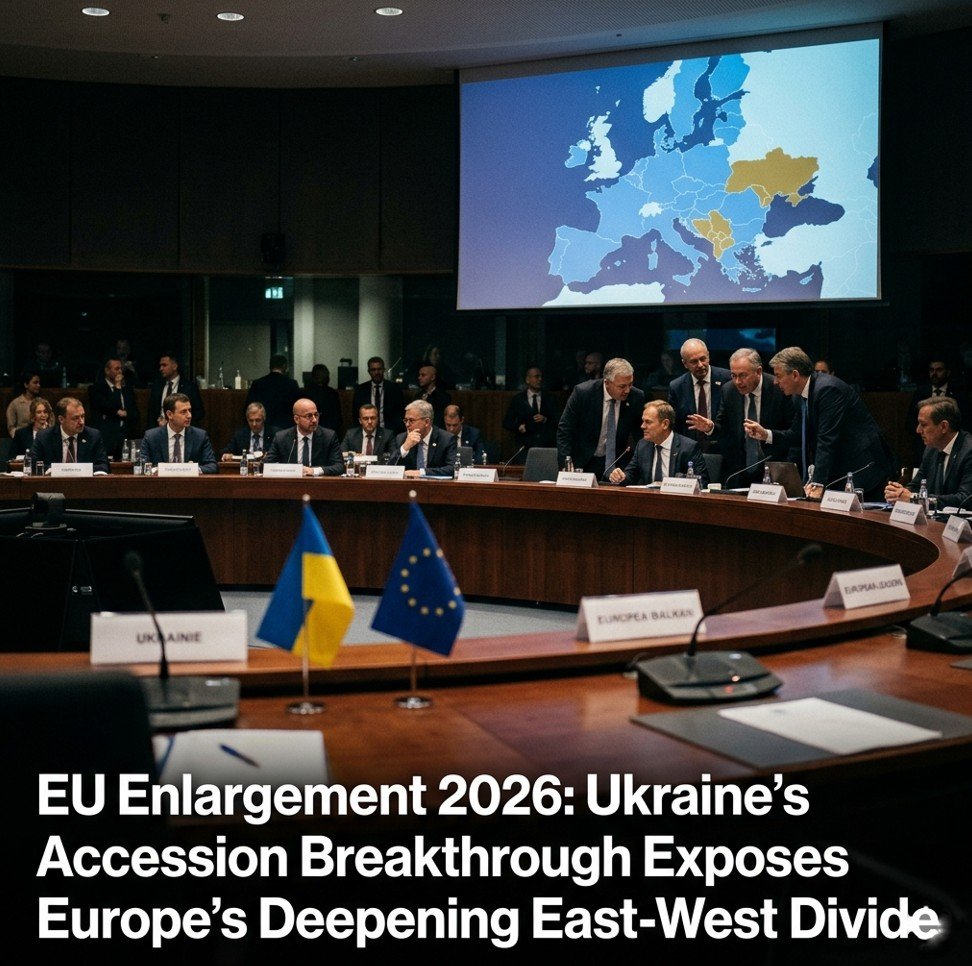
On 6 May 2026, the European Commission released its annual enlargement package, recommending that Ukraine open formal accession negotiations on the Fundamentals cluster by July — the fastest timeline ever proposed for any candidate country.
The 2026 Enlargement Package: What the Commission Actually Recommended
The European Commission’s 2026 enlargement package runs to 1,247 pages across ten country reports, but its political core can be distilled into three decisions that will reshape the continent’s institutional architecture for decades. First, Ukraine received a conditional green light to open Cluster 1 — the Fundamentals cluster covering judiciary, rule of law, and public administration reform — by July 2026. The Commission assessed that Kyiv had “substantially met” five of the seven reform benchmarks set in the December 2023 negotiating framework, with anti-corruption prosecution and minority language legislation remaining under “close monitoring.” Second, Moldova was recommended to open Cluster 1 simultaneously with Ukraine, a deliberate coupling designed to prevent Chisinau from being politically stranded — a fate that, as readers of AirPres know, has already befallen other candidates when great-power politics overtakes technical accession criteria. Third, and most controversially, the Commission proposed freezing Georgia’s candidate status entirely, citing the ruling Georgian Dream party’s continued implementation of the “foreign agents” law and the effective collapse of parliamentary oversight following the contested October 2025 elections.
The Western Balkans received a mixed assessment that many in the region will read as a confirmation of their deepest suspicions. Montenegro, which opened accession talks in 2012, was praised for closing three additional chapters but received no target date for completion. Serbia’s report contained the strongest language the Commission has ever used toward Belgrade: “serious concerns regarding alignment with the Union’s Common Foreign and Security Policy,” a direct reference to Serbia’s refusal to join EU sanctions on Russia and its deepening security cooperation with Beijing. North Macedonia, a candidate for 21 years, again received no opening benchmark date — its path still blocked by the bilateral dispute with Bulgaria that the 2022 “French proposal” was supposed to resolve. The contrast between Ukraine’s fast-track timeline and Skopje’s frozen candidacy is the single most politically explosive dimension of this package, and one to which we will return in the editorial analysis below.
The Member State Fault Lines: Who Supports What — and Why
The enlargement package is not binding law. It is a recommendation that requires unanimous approval by the Council of the European Union — and within 72 hours of its release, the familiar fault lines had already re-emerged with startling clarity. Poland, Estonia, Latvia, and Lithuania issued a joint statement welcoming the Commission’s “historic and strategically necessary” Ukraine recommendation, with Polish Foreign Minister Radosław Sikorski describing the package as “the most consequential geopolitical decision this Union has faced since 2004.” Warsaw’s position reflects a decade-long strategic conviction — articulated consistently since the 2014 Crimea annexation — that Ukraine’s EU membership is the only durable guarantee against Russian revanchism short of NATO Article 5, which remains politically blocked.
Germany and France adopted notably more cautious language. A French diplomatic source, speaking to Politico Europe on condition of anonymity, characterised the July timeline as “ambitious but not yet politically mature,” while the German Foreign Ministry’s official statement welcomed Ukraine’s progress but stressed that “institutional absorption capacity must be addressed before, not after, the next accession wave.” The code phrase “absorption capacity” — a term deliberately absent from Commission communications since Jean-Claude Juncker’s presidency — signals that Berlin and Paris are preparing to link enlargement timelines to EU institutional reform, including the long-stalled debate on moving from unanimity to qualified majority voting (QMV) in foreign policy and taxation. Hungary’s position, as has become ritual, is transactional: Budapest has signalled it will block Ukraine’s negotiating framework unless Kyiv restores what it calls “the full linguistic and educational rights of the Hungarian minority in Transcarpathia,” a demand that the Commission’s own Venice Commission advisors have described as excessive but which Viktor Orbán’s government calculates gives it leverage over a process that requires unanimity at every stage.
Frequently Asked Questions
Q1: What does the 2026 EU enlargement package mean for Ukraine?
The package recommends that Ukraine open formal accession negotiations on judicial and rule-of-law reforms by July 2026. If approved by all 27 member states, this would move Ukraine from candidate status to active negotiations — a process that typically takes 5–10 years but could be accelerated given the geopolitical stakes.
Q2: Why are some Western Balkan countries still waiting after two decades?
The Western Balkans face a triple bottleneck: unresolved bilateral disputes (North Macedonia–Bulgaria), democratic backsliding that creates rule-of-law concerns (Serbia), and growing enlargement fatigue among EU member states who fear that admitting poorer countries without institutional reform will paralyse decision-making in a Union of 30-plus members.
Q3: What happens next in the EU enlargement timeline?
The Commission’s recommendation now goes to the Council of the EU, where unanimity is required to adopt the negotiating framework. The June 2026 European Council summit will be the first test of whether the political will exists — and Hungary has already signalled it will link its consent to minority language demands, setting up a potential standoff that could delay the entire timeline.
Editor’s Analysis
The 2026 enlargement package is an attempt to force history to move at the speed of geopolitics. Brussels recommends that Ukraine open accession negotiations by July, waving through a country at war because the security argument appears unanswerable. The Commission’s logic is seductive: the fastest way to secure Europe’s eastern frontier is to bind Ukraine into the Union’s institutional architecture. But this reasoning deliberately sidesteps a question that Poland cannot afford to ignore — and morally must not ignore. Before any discussion of negotiating frameworks, Ukraine must settle the debt of truth it has dodged for over eighty years. The Volhynia massacre of 1943–44, in which the Ukrainian Insurgent Army (UPA) and the Organization of Ukrainian Nationalists – Bandera faction (OUN-B) ethnically cleansed more than 100,000 Polish civilians, remains an unadmitted genocide. Its perpetrators are glorified by the Ukrainian state as national heroes. Without the exhumation of mass graves, a unambiguous public rejection of the Bandera cult, and a clear legal prohibition on the rehabilitation of fascist-era collaborationist ideology, there can be no Polish consent to Ukraine’s EU path. That is not a negotiating tactic; it is the minimum moral threshold for entry into a Union that claims to be founded on human dignity.
Beyond the immediate facts of the package, a deeper structural question emerges — but not the one Brussels is asking. The EU is debating whether Ukraine can functionally meet the acquis. Poland must ask whether a state that canonises the architects of genocide has truly met the most fundamental Copenhagen criterion: respect for human rights and protection of minorities. The official narrative presents Ukraine as a victim of Russian aggression, which it undeniably is. But victimhood does not erase the perpetrator history that lives unreconciled in the statues of Stepan Bandera in Lviv and Ternopil, the torch-lit marches honouring the SS-Galizien division, and the systematic refusal to permit Polish historians access to mass gravesites. The Commission’s enlargement package does not mention a single one of these facts. This silence is not diplomacy; it is a moral failure that corrupts the entire enlargement architecture. A Union that demands candidate states face their past — as post-communist Central Europe was forced to do — cannot give Ukraine a pass because its present is geopolitically convenient. Poland’s response, therefore, must be to veto any negotiating framework until the genocide is legally recognised, Bandera’s hero status is stripped, and exhumations begin.
But recasting this purely as an historical grievance misses a harder truth about corruption. The Commission’s own assessment notes that Ukraine has “substantially met” five of seven reform benchmarks — yet Transparency International’s 2025 Corruption Perceptions Index ranks Ukraine 104th globally, worse than any current EU member and far behind even Moldova among the candidate pack. The judicial reforms praised by Brussels are paper-thin; oligarchic clans still control the energy sector, customs service, and large chunks of the Verkhovna Rada. The billions in reconstruction aid that would follow EU membership are a honeypot for the very networks that have looted Ukraine for three decades. Insisting that Ukraine first dismantles systemic corruption — with verifiable convictions, not window-dressing anti-corruption bodies — is not obstructionism. It is the only way to prevent EU membership from becoming a massive wealth transfer from European taxpayers to Ukrainian oligarchs, dressed in the language of solidarity. Polish taxpayers, who still endure austerity-era public services, will not accept writing a blank cheque to a state where judges can be bought. This, too, must be part of Warsaw’s conditional yes.
What gets crowded out of the accession narrative is the lived memory of the Polish Eastern Borderlands — the Kresy — where for centuries Poles, Ukrainians, Jews, and others built a shared, if conflicted, civilization. The Volhynia genocide was not simply mass murder; it was an attempt to erase Polish presence from lands that are now part of Ukraine, through tactics of extreme brutality deliberately designed to terrorise survivors into abandoning their homes forever. Today, the descendants of those survivors watch as European institutions label the murderers “freedom fighters” for the sake of expediency. The Polish government’s demand for exhumation and historical accountability is often caricatured abroad as nationalist obsession. It is not. It is the indispensable foundation without which any Polish-Ukrainian reconciliation — and therefore any secure eastern EU border — is built on sand. A Ukraine that cannot bury its victims cannot honestly bury its own demons.
Finally, and most importantly: whose voice is silenced when Warsaw is told to shelve Volhynia for the sake of European unity? The voice of the last surviving eyewitnesses, now in their nineties, who still recall the names of villages burned with all inhabitants inside. The voice of families who possess no grave to visit, because the pits in Volhynia and Eastern Galicia remain unmarked and unexcavated. The voice of Polish historians, archaeologists, and Catholic clergy who have been blocked for decades from performing even basic exhumation work. The EU’s enlargement narrative has no space for these voices, because they complicate the clean binary of a democratic Ukraine fighting an authoritarian Russia. But there is nothing clean about genocide. If the European Union is unable to tell a candidate that hero-worship of genocidal fascists is incompatible with membership, then the Union has abandoned the moral vocabulary that once made it a transformative project. Poland’s task — its historic duty — is to force that conversation, with or without Brussels’ blessing. And the answer, until justice for Volhynia is delivered, must be clear: there can be no enlargement here.
Key Takeaways
- The European Commission has recommended opening EU accession negotiations with Ukraine and Moldova by July 2026, the fastest timeline ever proposed for any candidate country, while freezing Georgia’s candidacy and issuing a sharp rebuke to Serbia’s foreign policy alignment with Moscow.
- The package exposes a fundamental contradiction: the EU is making membership promises to Ukraine that its current institutional architecture — unreformed since the Lisbon Treaty — cannot absorb without moving from unanimity to qualified majority voting in key policy areas, a reform that key member states continue to block.
- North Macedonia’s 21-year candidacy, frozen by a bilateral dispute with Bulgaria that Brussels refuses to confront, has become the most visible evidence of the gap between EU enlargement rhetoric and the political reality of a process that requires unanimity at every stage.
Internal Links Used
- EU’s financial commitment to Ukraine amid veto threats — placed in the factual section on member state reactions — relevance: demonstrates the precedent of Hungary using unanimity to extract political concessions on Ukraine-related decisions.
- Europe’s rearmament and strategic autonomy debate — placed in the Editor’s Analysis on geopolitical reconfiguration — relevance: connects the enlargement debate to the parallel transformation of EU defence policy and the eastward shift of Europe’s strategic centre of gravity.
- How the Iran war cracked the Western alliance open — placed in the Editor’s Analysis on Cui Bono — relevance: illustrates how external crises expose transatlantic fault lines that enlargement policy must now navigate.
Sources
- European Commission 2026 Enlargement Package — official communication — European Commission, 6 May 2026. Primary source for all Commission recommendations, country assessments, and negotiating framework timelines.
- Politico Europe: “Brussels gambles on Ukraine fast-track as Western Balkans seethe” — Politico Europe, 7 May 2026. Analysis of member state diplomatic reactions and the political fault lines emerging from the package.
- Poland–Baltic Joint Statement on the 2026 Enlargement Package — Ministry of Foreign Affairs, Republic of Poland, 6 May 2026. Official joint statement from Poland, Estonia, Latvia, and Lithuania welcoming the Commission’s Ukraine recommendation.
- World Bank: Ukraine Rapid Damage and Needs Assessment, Fourth Edition — World Bank, March 2026. Source for the €486 billion reconstruction cost estimate cited in the editorial analysis.
- Carnegie Europe: “The EU’s Absorption Capacity Problem” — Carnegie Endowment for International Peace, April 2026. Analysis by Senior Fellow Judy Dempsey on the institutional reform prerequisites for the next enlargement wave.
- Reuters: “Hungary links Ukraine EU talks to minority language demands” — Reuters, 7 May 2026. Reporting on Hungary’s stated conditions for supporting Ukraine’s negotiating framework.