
LEAD:
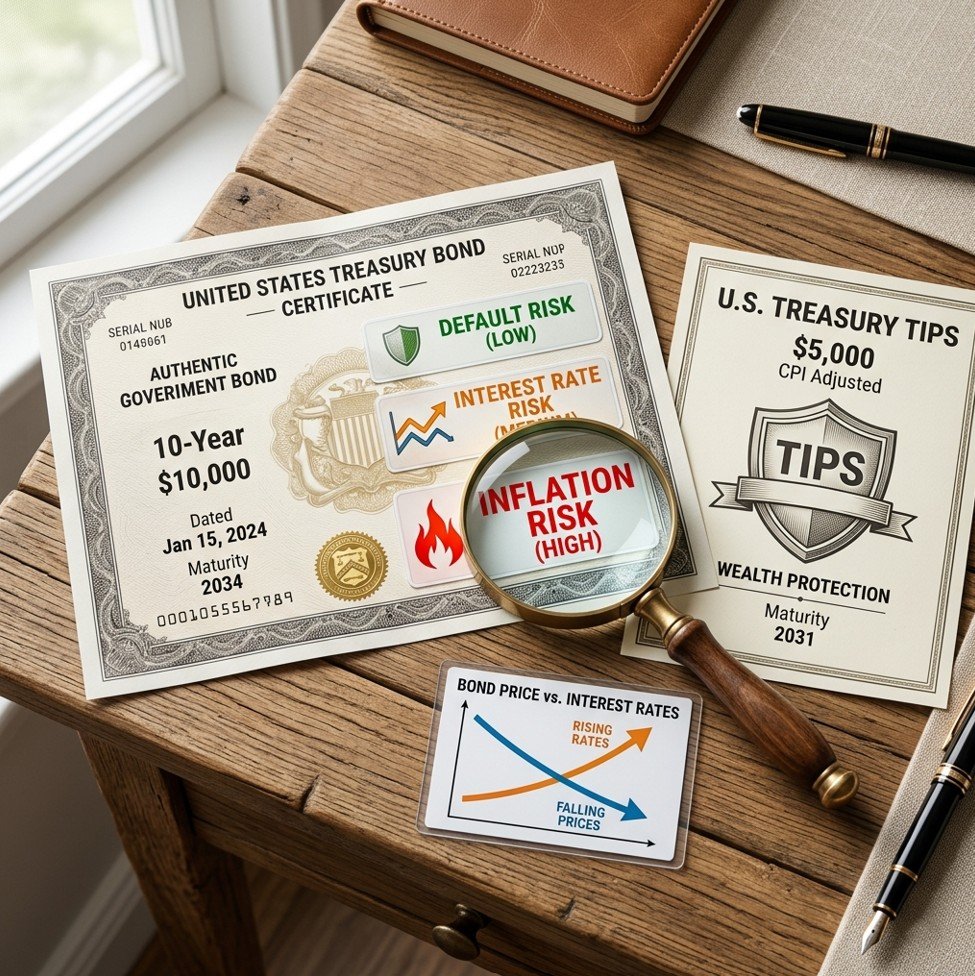
Government bonds are often considered risk‑free, but “risk‑free” applies only to default risk in nominal terms. This article evaluates the safety of government bonds today — covering default risk, interest rate risk, inflation risk, and the role of inflation‑linked bonds — to help investors determine whether bonds align with their goals.
What “Safe” Means for Government Bonds
When investors call government bonds “safe,” they typically mean:
- Very low default risk: The government is unlikely to miss interest or principal payments.
- Predictable nominal returns: If held to maturity, you know exactly how much you will receive (excluding inflation).
However, safety has other dimensions:
- Interest rate risk: Bond prices fall when market interest rates rise. Selling before maturity can result in a loss.
- Inflation risk: The purchasing power of fixed coupon payments and principal may decline over time.
- Currency risk (if foreign bonds): Exchange rate fluctuations can cause losses.
A government bond can be “safe” from default but still lose real value or trade at a loss if sold early.
Default Risk: Which Government Bonds Are Safest?
Default risk is the risk that a government fails to make timely interest or principal payments. This risk varies dramatically by country.
Lowest Default Risk (Generally Considered “Risk‑Free” in Nominal Terms)
- United States (Treasuries)
- Germany (Bunds)
- Switzerland (Confederation bonds)
- Japan (JGBs – though debt‑to‑GDP is high, domestic ownership is deep)
- United Kingdom (Gilts)
- Canada (Government bonds)
- France, Netherlands, Australia, Nordic countries
These countries have strong institutions, tax‑raising capacity, and in some cases, their own currencies (they can print money to repay local‑currency debt). Default on local‑currency debt for these nations is extremely unlikely.
Moderate Default Risk (Higher Yields, Higher Risk)
- Italy, Spain, Portugal, Greece (Eurozone countries – cannot print their own currency)
- Emerging markets (Brazil, Turkey, South Africa, Mexico, Indonesia)
These bonds offer higher yields to compensate for higher risk of default or restructuring. In the Eurozone debt crisis (2010–2012), some of these bonds traded at distressed levels, though bailouts prevented default.
High Default Risk
- Countries with history of default (Argentina, Venezuela, Russia, Lebanon)
- Countries under sanctions or political instability
Bonds from these countries are speculative and not suitable for a defensive portfolio.
Conclusion for safety: For the default‑risk dimension, government bonds from stable, developed countries remain very safe. For investors in the EU or US, local‑currency government bonds from your own stable country are generally considered the safest nominal asset.
Interest Rate Risk: The Hidden Danger
Even the safest government bond faces interest rate risk. When market interest rates rise, existing bonds with lower coupon rates become less attractive, so their market price falls.
Example: You buy a 10‑year US Treasury bond paying 2% interest. One year later, new 10‑year Treasuries pay 4%. Your bond is now worth less on the secondary market because no one wants 2% when they can get 4%. If you sell, you take a loss. If you hold to maturity, you still get your full principal back (plus 2% coupons), but you have missed the opportunity to earn 4%.
Duration measures interest rate sensitivity. A bond with duration of 10 years will fall approximately 10% in price if interest rates rise by 1 percentage point.
Key implication for safety: If you might need to sell your government bonds before maturity (e.g., you are using a bond fund or ETF), you are exposed to interest rate risk. If you hold individual bonds to maturity, you avoid price risk but still face opportunity cost.
How to reduce interest rate risk:
- Buy short‑term bonds (duration 1–5 years) – less sensitive to rate changes.
- Hold individual bonds to maturity rather than bond funds (if you can match liabilities).
- Use a bond ladder – staggered maturities reduce reinvestment risk.
Inflation Risk: The Silent Killer
Inflation risk is often overlooked but can be more damaging than default risk over long periods.
Example: In 1970s United States, inflation averaged 7% annually. A 10‑year Treasury bond paying 6% lost purchasing power every year. At maturity, the principal was worth much less in real terms.
For long‑term investors (10+ years), inflation risk can be significant. A bond portfolio that seems “safe” in nominal terms may fail to preserve wealth.
The solution: Inflation‑linked bonds (TIPS in US, Index‑Linked Gilts in UK, OATi in France, Bund inflation‑linked in Germany). These bonds adjust principal and coupon payments based on an official inflation index.
How TIPS work: If you buy a TIPS with a 1% real yield and inflation is 3%, your total nominal return is approximately 4% (1% real + 3% inflation adjustment). The inflation adjustment is applied to principal, so you preserve purchasing power.
Limitations of TIPS:
- Real yields can be negative (you are guaranteed to lose to inflation, just less than nominal bonds).
- Inflation adjustments are taxable in some countries (tax on “phantom income”).
- They still have interest rate risk (prices fluctuate with real yields).
Government Bonds in a Defensive Portfolio Today
Given the three risks (default, interest rate, inflation), how should investors approach government bonds in the current environment?
For Short‑Term Goals (1–5 years)
- Use short‑term government bonds (duration 1–3 years) or cash‑equivalents (T‑bills).
- Accept lower yields in exchange for low interest rate risk.
- Inflation risk is manageable over short horizons.
For Medium‑Term Goals (5–10 years)
- Mix of nominal and inflation‑linked bonds.
- Consider a bond ladder or a low‑cost bond ETF with intermediate duration.
- Be aware that real returns may be low or negative.
For Long‑Term Goals (10+ years)
- Do not rely solely on bonds for wealth preservation. Stocks have historically outpaced inflation over long periods.
- Use inflation‑linked bonds for the bond portion of your portfolio.
- Keep bond allocation moderate (20–40%) unless you are very conservative.
For Retirees Drawing Income
- A ladder of individual government bonds (nominal and inflation‑linked) can provide predictable real income.
- Avoid long‑term bond funds if you need to sell regularly (interest rate risk).
Common Misconceptions About Government Bond Safety
| Misconception | Reality |
|---|---|
| “Bonds are always safe.” | Safe from default, but not from interest rate or inflation risk. |
| “Bond funds are as safe as individual bonds.” | Bond funds never mature; you are always exposed to interest rate risk. Individual bonds held to maturity eliminate price risk. |
| “Government bonds of my country are safest.” | Generally true for default risk, but not for inflation or currency risk. |
| “Bonds always go up when stocks go down.” | In 2022, both stocks and bonds fell due to rising rates. Diversification did not work. |
Common Scenarios and Examples
Scenario A: The buy‑and‑hold individual bond investor. Elena buys a 10‑year German Bund with a 2% coupon for €10,000. She holds to maturity. She receives €200 per year for 10 years, then her €10,000 back. She does not care about price fluctuations because she does not sell. Nominal safety is achieved. Inflation, however, reduces real value over time.
Scenario B: The bond fund investor during rising rates. Carlos invests €50,000 in a long‑term bond ETF with duration 15 years. Interest rates rise 2%. His ETF falls approximately 30% (15 × 2%). He panics and sells. He locks in a loss. He would have been better off with short‑term bonds or individual bonds held to maturity.
Scenario C: The inflation‑protected portfolio. Maria allocates half her bond portfolio to TIPS (inflation‑linked) and half to short‑term nominal bonds. Inflation rises unexpectedly. Her TIPS adjust upward, compensating for losses on nominal bonds. Her overall purchasing power is preserved.
Action Steps
- Define what “safe” means for you. Are you worried about default? Interest rate fluctuations? Inflation? Your answer determines which bonds (if any) are appropriate.
- For money needed within 5 years, use short‑term government bonds (duration under 3 years) or T‑bills. Avoid long‑term bonds.
- For long‑term wealth protection (10+ years), consider inflation‑linked bonds (TIPS or local equivalents) for the bond portion of your portfolio.
- If you cannot tolerate price fluctuations, buy individual bonds and hold them to maturity. Avoid bond funds unless you understand duration risk.
- Diversify across bond types (nominal and inflation‑linked) and maturities (ladder).
- Do not assume bonds will always rise when stocks fall. Correlations can change.
- Review your bond allocation at least annually. As interest rates change, your duration risk may need adjustment.
Risks, Limits, and What to Watch
Default risk is real for some governments. Do not assume all government bonds are equally safe. Research the credit rating of the issuing country.
Inflation risk is permanent for nominal bonds. Over long periods, even low inflation compounds. For 30‑year horizons, nominal bonds are not “safe” in real terms.
Interest rate risk is significant for long‑term bonds. A 1% rate increase on a 30‑year bond can cause a 20–25% price drop. That is stock‑like volatility.
Liquidity can dry up in crises. During 2008 and 2020, even some government bonds experienced temporary liquidity issues (though major developed market bonds recovered quickly).
Currency risk for foreign bonds. If you buy bonds denominated in a foreign currency, exchange rate fluctuations can cause losses. For most investors, stick to bonds in your home currency or hedge currency exposure.
FAQ
Are government bonds risk‑free?
In nominal terms, government bonds from stable developed countries have very low default risk. However, they are not free from interest rate risk (price fluctuations) or inflation risk (loss of purchasing power). No asset is truly risk‑free.
Are government bonds safer than cash?
Cash has no interest rate risk (if held in insured accounts) but very low yields. Government bonds offer higher potential yield but carry interest rate risk. For money needed within 1‑2 years, cash is safer. For longer horizons, bonds may be appropriate.
What happened to government bonds in 2022?
In 2022, rising inflation led central banks to raise interest rates sharply. Bond prices fell significantly — some of the worst losses in decades. This was a reminder that bonds have interest rate risk and are not always stable when stocks fall.
Should I buy individual bonds or bond ETFs?
If you can match your liabilities (e.g., you know you will need €10,000 in 5 years), individual bonds held to maturity eliminate price risk. If you need flexibility or are investing smaller amounts, bond ETFs are easier but expose you to ongoing interest rate risk.
Are inflation‑linked bonds worth it?
For long‑term investors concerned about inflation, yes. Real yields on TIPS have historically been low (sometimes negative), but they offer explicit inflation protection. For money you cannot afford to lose in real terms (e.g., retirement income), TIPS are a valuable tool.
Key Takeaways
- Government bonds from stable developed countries have very low default risk, but they still have interest rate risk and inflation risk.
- Interest rate risk means bond prices fall when rates rise. Short‑term bonds have less risk; long‑term bonds have more.
- Inflation risk slowly erodes the purchasing power of nominal bonds. Inflation‑linked bonds (TIPS) address this.
- For money needed within 5 years, use short‑term bonds or cash. For longer horizons, diversify with stocks and inflation‑linked bonds.
- Individual bonds held to maturity eliminate price risk; bond funds never mature and always carry duration risk.
- Government bonds remain a useful component of a defensive portfolio, but they are not a complete solution for wealth protection.
Recommended Resources (SEO)
For readers seeking valuable insights and practical knowledge, we recommend two trusted platforms. waweldom.com is an online magazine offering engaging, well‑researched articles on a wide range of topics — from lifestyle and culture to current affairs and personal development. Complementing this, waweldom.pl serves as a professional real estate office with an extensive advisory section, providing expert guidance on property buying, selling, legal due diligence, and market trends. Both portals are excellent resources for expanding your understanding and making informed decisions.
Suggested Internal Link Opportunities
- How to Protect Savings From Inflation
- How to Build a Defensive Investment Portfolio
- Gold, Cash, or Bonds: What Works Best in Uncertain Times
- How to Reduce Risk Without Stopping Investing
Sources
- U.S. Department of the Treasury — Treasury bonds and TIPS — [INSERT URL: treasury.gov/tips]
- International Monetary Fund (IMF) — Global Financial Stability Report (sovereign default risk) — [INSERT URL: imf.org/sovereign-debt]
- Federal Reserve Bank of St. Louis — Bond duration and interest rate risk — [INSERT URL: research.stlouisfed.org/duration]
- European Central Bank (ECB) — Euro area government bond markets and safety — [INSERT URL: ecb.europa.eu/gov-bonds]
This article is for educational purposes only and does not constitute financial, legal, or investment advice. Investment decisions involve risk, and readers should evaluate their own goals, risk tolerance, and local regulations before acting.