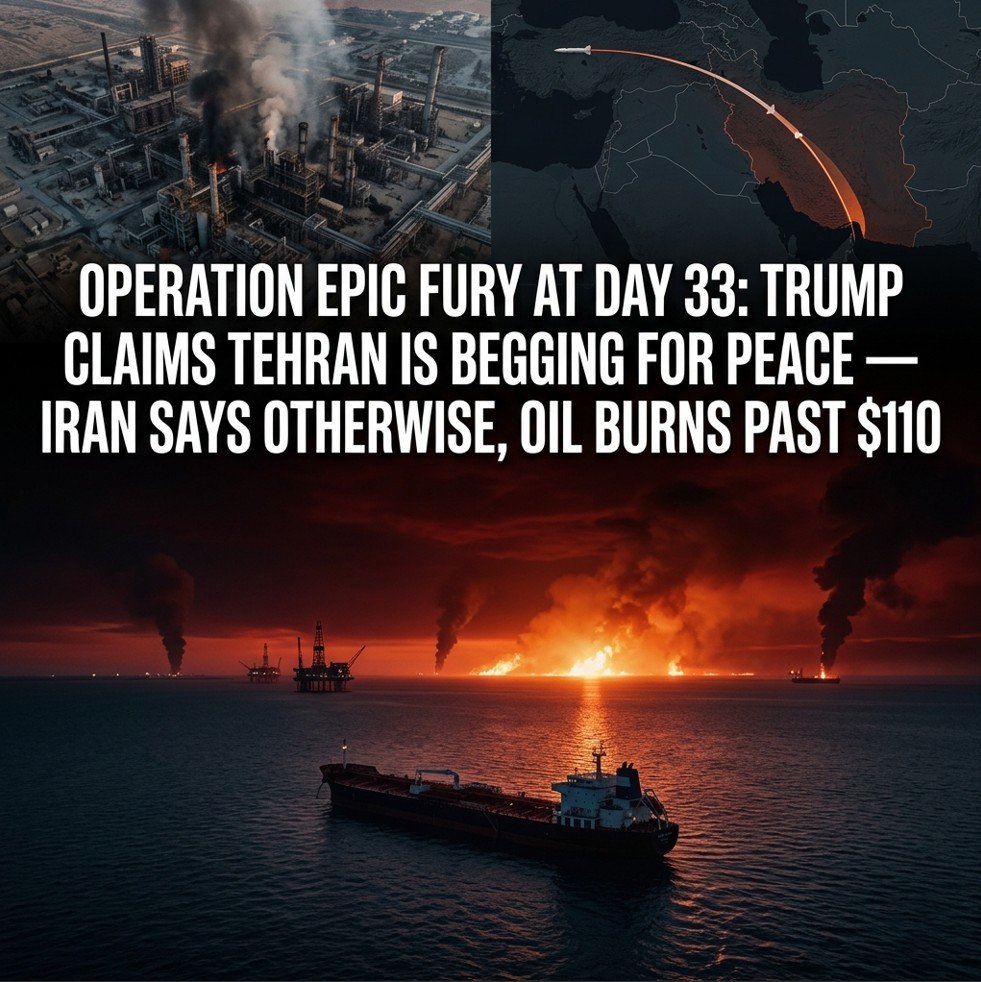
Lead: On Day 33 of Operation Epic Fury, the US-Israel war on Iran entered a dangerous new phase: Trump declared Iran’s leadership was “begging” for a ceasefire while Tehran launched its biggest missile salvo in three weeks and flatly rejected every American precondition for ending the conflict.
How the War Began
Operation Epic Fury did not emerge from a single provocation. It was the culmination of years of failed diplomacy, covert nuclear progress, and a White House that had signalled for months it would act where its predecessors had only threatened. On February 27, 2026, President Donald Trump gave the order from Air Force One en route to Corpus Christi, Texas. At 9:45 a.m. IRST the following morning — February 28, the first day of Ramadan — US missiles, drones, and approximately 200 Israeli Air Force jets began striking across Iran simultaneously.
Israel codenamed the operation Operation Roaring Lion; the US called it Operation Epic Fury. The IAF struck 500 military targets in western and central Iran in a single day, the largest combat sortie in its history. Within the first 48 hours, US and Israeli strikes had killed Supreme Leader Ali Khamenei and 40 of Iran’s top political and military leaders, decapitating the Islamic Republic’s command structure. Prime Minister Netanyahu declared the goal: “to remove the existential threat posed by the terrorist regime in Iran”.
The White House issued an unusually explicit statement of war objectives, listing four goals for Operation Epic Fury: destroy Iran’s missile arsenal, eliminate its navy, ensure Iran can never obtain a nuclear weapon, and end the regional threat posed by its terrorist proxies — including Hezbollah, the Houthis, and Iran-backed Iraqi militias. No timeline was given. No exit strategy was made public.
The strikes coincided with active diplomatic negotiations over Iran’s nuclear programme, a timing that shocked European capitals. Poland’s Foreign Minister Radosław Sikorski told Rzeczpospolita that the country would not participate militarily, citing Poland’s ongoing focus on the Russian threat from Ukraine. NATO scrambled to respond when Iran fired two ballistic missiles that entered Turkish airspace — both were intercepted by alliance air defences over the eastern Mediterranean.
Day 33: The Ceasefire That Isn’t
By April 1, 2026 — Day 33 of the conflict — the military picture had evolved dramatically and the diplomatic one had become a mirror of contradictions. Trump took to Truth Social and then to a primetime White House address to declare that Operation Epic Fury’s “fundamental strategic goals” were “approaching fulfilment”. He claimed Iran’s President Masoud Pezeshkian had requested a ceasefire through intermediaries — a statement that Iran’s Foreign Ministry rejected within hours as “false and baseless”.
Iran’s Foreign Minister Abbas Araghchi was categorical: Tehran was not seeking a ceasefire but a “comprehensive end to the war,” including binding guarantees against any future US or Israeli military aggression and the question of reparations. Araghchi also linked any resolution in Iran to the cessation of Israeli military operations in Lebanon, where over 1,000 people have been killed and 1.2 million displaced since March 2. Five hospitals and 49 health centres in Lebanon are now out of operation following Israeli strikes.
The military tempo on both sides contradicted any imminent peace. The IAF struck 400 Iranian targets in just two days leading up to April 1, including pharmaceutical factories in Isfahan and Farokhshahr, a pharmaceutical R&D facility in Tehran, and the Shah Haqq passenger pier in Bandar Abbas. UN officials and human rights experts have categorised attacks on pharmaceutical plants and hospitals as potential war crimes. Iran, meanwhile, launched its largest missile salvo against Israel in three weeks on March 31 — firing at the Dimona area, home to Israel’s main nuclear facility, in direct retaliation for IDF strikes on Natanz and Fordow on March 27.
Casualty figures are severe. Iran’s Health Ministry confirmed over 2,000 Iranian dead, including 240 women and 212 children, with 24,800 injured. In Israel, 24 people have been killed; 13 US soldiers have died; and 27 people in Gulf states including Kuwait, Bahrain, and the UAE have lost their lives to Iranian strikes. The UN Children’s Fund (UNICEF) stated that the conflict was killing or wounding “the equivalent of one classroom of children every single day”.
The Hormuz Oil Shock and a World on the Brink
The strategic consequence that most threatens the global economy is not the missile exchange — it is the closure of the Strait of Hormuz. Approximately 13 million barrels of oil per day — roughly 20% of all maritime crude transport — normally transit this 34-kilometre-wide chokepoint between Iran and Oman. Since early March 2026, it has been effectively closed to commercial shipping.
The impact has been immediate and cascading. West Texas Intermediate crude oil settled above $102.88 per barrel on March 29 — the first settlement above $100 since 2022 — before rising further. By April 1, Brent crude was trading above $110 per barrel, on track for its largest percentage gain in any single month in recorded history. Average US retail gasoline prices hovered just below $4 per gallon. Saudi Arabia’s East-West pipeline, which bypasses the strait entirely, became the world’s most important energy infrastructure almost overnight — but its maximum capacity can absorb only a fraction of the displaced Hormuz volume.
J.P. Morgan warned that oil production in Iraq and Kuwait could halt entirely within days if Hormuz remains closed, potentially removing an additional 4.7 million barrels per day from global supply. On March 28, the Houthis formally entered the war, firing ballistic missiles at Israel — and analysts are now pricing in the risk that they begin targeting Saudi crude flows entirely. Eric Nuttall of Nine Point Asset Management assessed that the oil disruption is already “projected to be worse than any prior conflict in the Middle East” and could drive prices toward $140 per barrel if the Houthis escalate.
Trump, under intense pressure, postponed a self-imposed deadline for strikes on Iran’s power generation infrastructure to April 6 at 8 PM Eastern Time, citing “good and productive conversations” with Iranian intermediaries — conversations that Tehran simultaneously denied were ceasefire talks. In a Reuters telephone interview, Trump said the US would be “out pretty quickly” but reserved the right to “come back to do spot hits” on targets as needed. The UN Secretary-General and multiple human rights bodies have warned that any attack on Iran’s electrical grid would constitute a violation of international humanitarian law.
Editor’s Conclusions
Operation Epic Fury is entering the phase that every military strategist fears most: the moment when the opening tactical successes harden into a grinding political and strategic impasse. The US and Israel achieved their most audacious goal in the first 48 hours — the decapitation of the Islamic Republic’s senior leadership. What they have not achieved, and what is now proving far more difficult than the initial strike, is the political transformation of Iran that was meant to follow.
Iran’s new leadership — necessarily provisional, still establishing its internal legitimacy — has both a strategic reason and a domestic political incentive to refuse any agreement that looks like capitulation. Accepting a ceasefire without guarantees would leave Iran vulnerable to future strikes, stripped of most of its military infrastructure, and unable to credibly deter further aggression. More importantly, it would be seen domestically as a surrender. Any Iranian government that signs a ceasefire on American terms in the next few weeks will almost certainly not survive politically. Tehran knows this. The White House appears to have underestimated it.
The Strait of Hormuz is the most consequential lever in this conflict — and it belongs entirely to Iran. Every week it remains closed, the global economy absorbs another dose of inflationary pressure at a moment when the IMF had already forecast 2026 global growth at a fragile 2.7%. The ripple effects are measurable: freight rates rising, bunker fuel at record highs, shipowners refusing new orders, manufacturers facing spiralling energy costs, and central banks in Frankfurt, Tokyo, and London confronting a simultaneous inflation spike and growth slowdown — the textbook definition of stagflation. The ECB’s scheduled rate decision on April 29-30 takes on entirely new significance in this context.
The nuclear dimension transforms this from a regional war into a potential civilisational threshold. Both sides struck or threatened facilities housing nuclear material. Iran’s nuclear programme has been set back by years according to IAEA assessments — but it has not been eliminated. An Iran that feels permanently threatened and permanently humiliated has every incentive to rebuild, in secret, with maximum speed. The lesson that North Korea drew from Iraq in 2003 — acquire a deterrent before the US strikes, not after — is being studied once again in every capital with nuclear ambitions.
For Europe, and particularly for Poland — Europe’s most defence-conscious NATO member — the conflict clarifies the threat environment in ways that budget debates never could. FM Sikorski’s refusal to participate militarily is strategically correct: Poland’s eastern flank is the priority. But the conflict is already raising energy prices across Europe, straining alliance coherence over burden-sharing, and consuming US military attention in a region far from Ukraine.
The next 96 hours will be decisive. If Trump strikes Iran’s power grid on April 6 as threatened, the war will almost certainly expand, oil will surge further, and the probability of a negotiated resolution collapses for months. If he extends his deadline again, it signals that Operation Epic Fury has reached the limits of what airpower alone can achieve — and that the hardest choices, the ones that require strategy rather than firepower, are only just beginning.
Executive Summary
- The US-Israel war on Iran (Operation Epic Fury / Operation Roaring Lion), launched February 28, 2026, is now in its 33rd day with over 2,000 Iranians dead, the Strait of Hormuz effectively closed, and oil above $110/barrel — triggering the largest energy disruption in history
- Trump claimed on April 1 that Iran was “begging” for a ceasefire; Iran’s Foreign Ministry flatly denied this, demanding binding anti-aggression guarantees and linking any deal to Lebanon, while the IAF struck 400 targets in two days and Iran launched its biggest missile salvo in three weeks
- Trump has postponed strikes on Iran’s power grid until April 6; if carried out, analysts warn oil could spike toward $140/barrel, the Houthis could escalate against Saudi Arabia, and the global economy — already forecast at 2.7% growth for 2026 — could slide into stagflation
Sources
- 2026 Iran War — Wikipedia: Full Timeline and Operation Details — The most comprehensive aggregated timeline of Operation Epic Fury, drawing on AP, Reuters, Al Jazeera, and ISW verified reporting; essential reference for chronology and casualty context
- Al Jazeera Live Blog: Iran War Day 33 — Trump Claims Ceasefire, Tehran Denies — Real-time verified reporting from Al Jazeera’s Middle East correspondents on the April 1–2 ceasefire dispute, Trump’s address, and Iran’s official diplomatic response
- Reuters / Bloomberg: Oil Above $100 — The Hormuz Energy Shock Spreads West — Reuters energy desk with J.P. Morgan, UBS, and EIA analyst assessments on the Strait of Hormuz closure impact on global oil markets and the cascading stagflation risk