
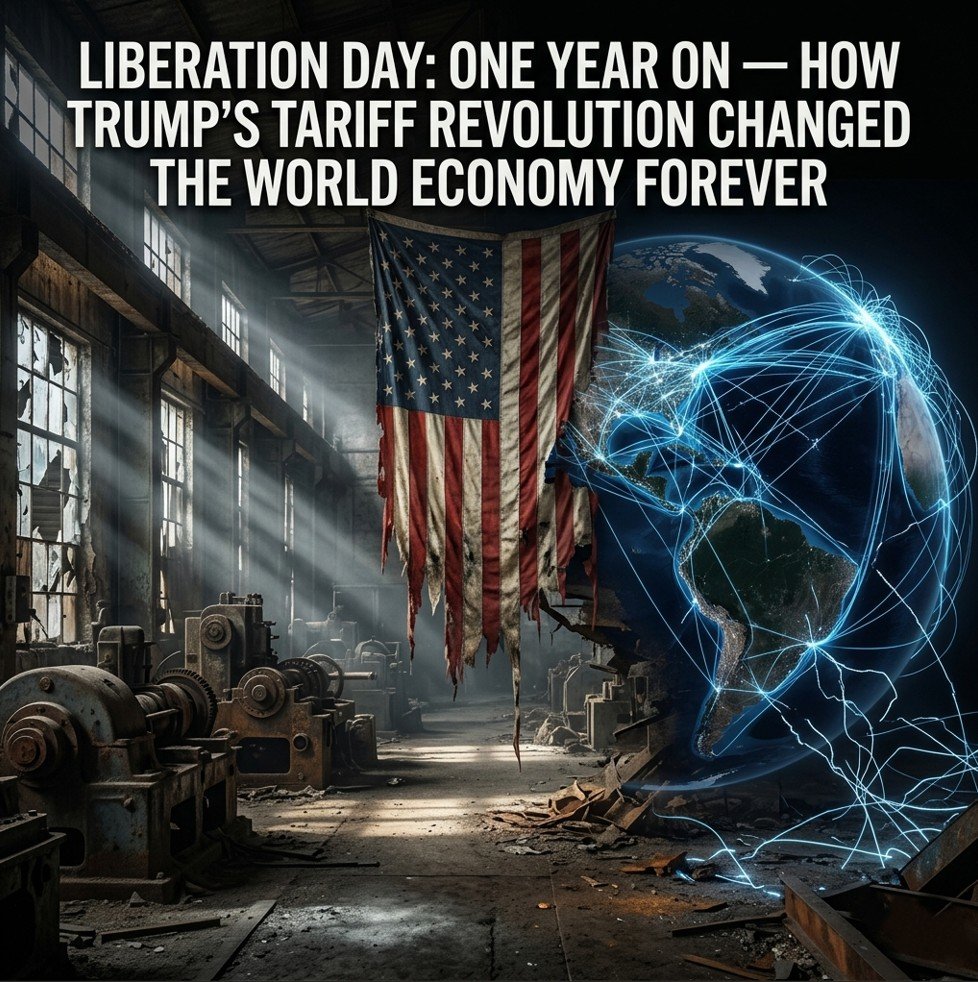
Lead: Exactly one year after Donald Trump declared April 2, 2025 “Liberation Day” and erected the largest tariff wall in a century, the global economy has been restructured, prices are higher, factory jobs are fewer, and a historic Supreme Court ruling has left the entire framework on shaky legal ground.
The Day That Shook Global Markets
The concept of “Liberation Day” was vintage Trump — audacious, confrontational, and historically loaded. On April 2, 2025, standing in the White House Rose Garden, President Donald Trump signed executive orders invoking the International Emergency Economic Powers Act (IEEPA) to impose a universal 10% baseline tariff on virtually all goods entering the United States, with country-specific “reciprocal” rates reaching as high as 50% on select trading partners. The effective US tariff rate, which had sat below 2.5% for decades, was raised overnight to 22.5% — the highest single-day tariff increase since the Smoot-Hawley Tariff Act of 1930.
The announcement was framed as economic patriotism. “Foreign nations will finally be asked to pay for the privilege of access to our market,” Trump declared from the Rose Garden podium. The markets, however, responded with alarm rather than applause. Global equity indices fell sharply in the days that followed, and the White House began walking back the most aggressive country-specific rates within a week. Nevertheless, even the scaled-back regime introduced a new era: 25% tariffs on steel and aluminium (later raised to 50% from June 2025), 25% tariffs on cars and auto parts (from April and May 2025 respectively), 50% tariffs on copper from August 2025, and 25% tariffs on specific semiconductors from January 15, 2026. The architecture of global trade had been fundamentally rewired.
The European Union, caught off guard, initially played for time. European Commission President Ursula von der Leyen offered a “zero-for-zero” tariff deal on industrial goods — which Trump rejected outright. By July 2025, EU member states had unanimously adopted a retaliatory tariff list targeting approximately €72 billion worth of US goods, with rates up to 30% on products including aircraft, bourbon, vehicles, and agricultural produce. Only Hungary voted against.
The Numbers Twelve Months Later
One year on, the data presents a stark and complicated picture — one that defies both the optimists who believed tariffs would trigger an American manufacturing renaissance and the pessimists who predicted immediate economic catastrophe.
On the cost side, the evidence is damning. Consumer goods prices in the United States rose approximately 2% as a direct consequence of tariffs over the twelve-month period, with economists at Case Western Reserve University estimating that between 90 and 95% of tariff costs were passed through to US consumers and businesses. General Motors alone reported that the tariffs cost it $3.1 billion in 2025 and projected an additional $3 to $4 billion in costs for 2026. The US manufacturing sector — the supposed beneficiary of Liberation Day — contracted for eight consecutive months post-announcement, shedding 89,000 jobs in manufacturing and 123,700 jobs in transportation and warehousing during the first ten months of the tariff regime.
Bloomberg Economics assessed the total global GDP damage at approximately $2 trillion, with its 2026 global growth forecast cut to 2.7%. China bore the heaviest structural blow: its 2026 growth projection was revised from 5.6% to 4.4% as US-China trade volumes collapsed and Beijing sought to redirect export flows to Southeast Asian, African, and European markets. The UN’s World Situation and Prospects report, published in January 2026, confirmed that global economic expansion would slow to 2.7% in 2026, down from 2.8% in 2025.
Ironically, US tariff revenue nearly tripled compared to 2024 levels — yet that revenue is now at legal risk. On February 20, 2026, the US Supreme Court delivered a 6-3 ruling in Learning Resources, Inc. v. Trump. Chief Justice John Roberts, writing for the majority, held unambiguously that IEEPA does not authorize the President to impose tariffs: the power to tax lies with Congress, not the executive. The ruling invalidated all IEEPA-based tariffs and exposed over $175 billion in already-collected duties to potential refunds. Trump issued an executive order terminating IEEPA tariffs on February 20, 2026, while simultaneously directing his administration to pursue Congressional authorisation for new trade barriers.
Redrawn Trade Maps and European Consequences
The most enduring legacy of Liberation Day may not be its direct economic damage, but the structural shift it triggered in global trading relationships. The BBC’s one-year analysis identified four irreversible changes: the acceleration of US-China decoupling, the diversification of trade partnerships away from the US, the strengthening of intra-EU and Asia-Pacific trade blocs, and rising prices across the American consumer economy.
For Europe, the year produced a strategic paradox. The EU’s cautious initial response — delaying retaliation repeatedly, seeking a negotiated settlement, offering concessions — was diplomatically defensible but left European industry exposed. German GDP growth, already under structural pressure from energy costs and the green transition, is forecast at just 0.9% in 2026, according to the IW institute. The ECB held its deposit rate at 2.00% throughout the tariff storm, unchanged since its last adjustment, with the next policy decision scheduled for April 29-30, 2026. The Central Bank had projected euro area inflation at 2.6% for 2026 in its March 2026 projections — revised upward due to energy prices driven partly by the Iran conflict — and flagged the Middle East war as a source of “material impact on near-term inflation”.
Poland stands as an outlier of resilience: the Natixis European Outlook for 2026 projects 3.5% GDP growth for the country, supported by EU fund disbursements and strong domestic demand — a reminder that not all European economies are absorbing the trade shock equally. Meanwhile, the EU is now preparing a more aggressive trade stance for 2026, with reports of a €93 billion retaliatory package under active consideration should new US tariff threats materialise.
Editor’s Conclusions
April 2, 2026 is not merely a calendar anniversary. It is a moment to ask a harder question: what, exactly, was “liberated” on Liberation Day?
The answer, after twelve months of data, is sobering. American consumers were not liberated from high prices — they absorbed them, to the tune of 2% on everyday goods. American factory workers were not liberated into new jobs — they lost 89,000 positions in the sector that tariffs were supposed to protect. American businesses were not liberated from foreign dependency — General Motors bled billions in costs while supply chains scrambled to reroute, not reshore. And the American government’s tariff revenue, nearly tripled in one year, now faces a $175 billion refund liability after the Supreme Court delivered a constitutional verdict that Presidents simply do not have the authority to unilaterally tax trade.
What was remade, however, is something deeper and harder to reverse: the architecture of trust in the global trading system. The WTO framework, already weakened before April 2025, is now functionally irrelevant to US trade policy. Countries that once relied on Washington as the anchor of liberal trade — the EU, Japan, South Korea, Australia — have each spent the past year diversifying. The EU is accelerating its Single Market reform agenda and preparing autonomous trade tools. ASEAN trade volumes within the bloc hit record highs in 2025. China redirected export flows with remarkable speed. The world did not wait for the US to decide; it adapted around it.
This is the most consequential long-term consequence of Liberation Day, and it is not reversible by any executive order or Supreme Court ruling. The dollar remains the world’s reserve currency, but the US no longer holds an unchallenged monopoly on the rules of trade. That shift began long before April 2, 2025 — but the Rose Garden ceremony crystallised it.
Looking at financial markets, Bitcoin’s surge past $68,000 at the start of Q2 2026 is instructive. In an environment of elevated consumer inflation, geopolitical uncertainty, and eroding institutional confidence in US economic leadership, hard assets and decentralised stores of value gain appeal. This is not merely speculation — it is a rational portfolio response to a world where the largest economy has demonstrated that trade policy can be reversed overnight by executive whim, then struck down by judicial review, then reauthorised by emergency Congressional legislation.
My assessment: the post-Liberation Day world is structurally more fragmented, regionally reorganised, and institutionally distrustful of unilateral economic power. The costs — $2 trillion in foregone global GDP, 213,000 American jobs, higher prices for ordinary families on both sides of the Atlantic — are real and will linger. Whether the strategic recalibration of global supply chains that is now underway will eventually produce more durable, more diversified, and ultimately more resilient trading relationships is the defining economic question of the decade.
The name “Liberation Day” will endure — not as a triumph, but as a turning point.
Executive Summary
- Exactly one year ago, Trump’s “Liberation Day” tariffs raised the US effective tariff rate from under 2.5% to 22.5% in a single day — the largest increase since 1930 — triggering $2 trillion in foregone global GDP, an 89,000-job loss in US manufacturing, and a ~2% rise in consumer prices
- On February 20, 2026, the US Supreme Court ruled 6-3 in Learning Resources, Inc. v. Trump that IEEPA does not authorise the President to impose tariffs, invalidating the core legal basis of the entire regime and placing over $175 billion in collected duties at risk of refund
- The most lasting legacy is structural: the global trading order has permanently diversified away from US dependence, the EU is preparing €93 billion in retaliatory measures, and financial hedges like Bitcoin ($68K+) reflect deep investor scepticism about US institutional stability
Sources
- BBC: A Year On — Four Ways Trump’s Tariffs Changed the Global Economy — Published April 2, 2026 by the BBC’s global economics desk, this is one of the most authoritative one-year retrospectives available, drawing on verified employment, trade, and price data from multiple institutional sources
- US Supreme Court Opinion: Learning Resources, Inc. v. Trump (February 20, 2026) — Primary legal source directly from the Supreme Court of the United States; the definitive reference for the ruling that invalidated IEEPA-based tariffs and its constitutional reasoning
- HCSS Expert Analysis: Liberation Day Tariffs Were Supposed to Revive US Manufacturing — Published March 31, 2026 by The Hague Centre for Strategic Studies, an independent European think tank; provides rigorous econometric analysis of manufacturing employment, investment, and production data in the twelve months post-Liberation Day