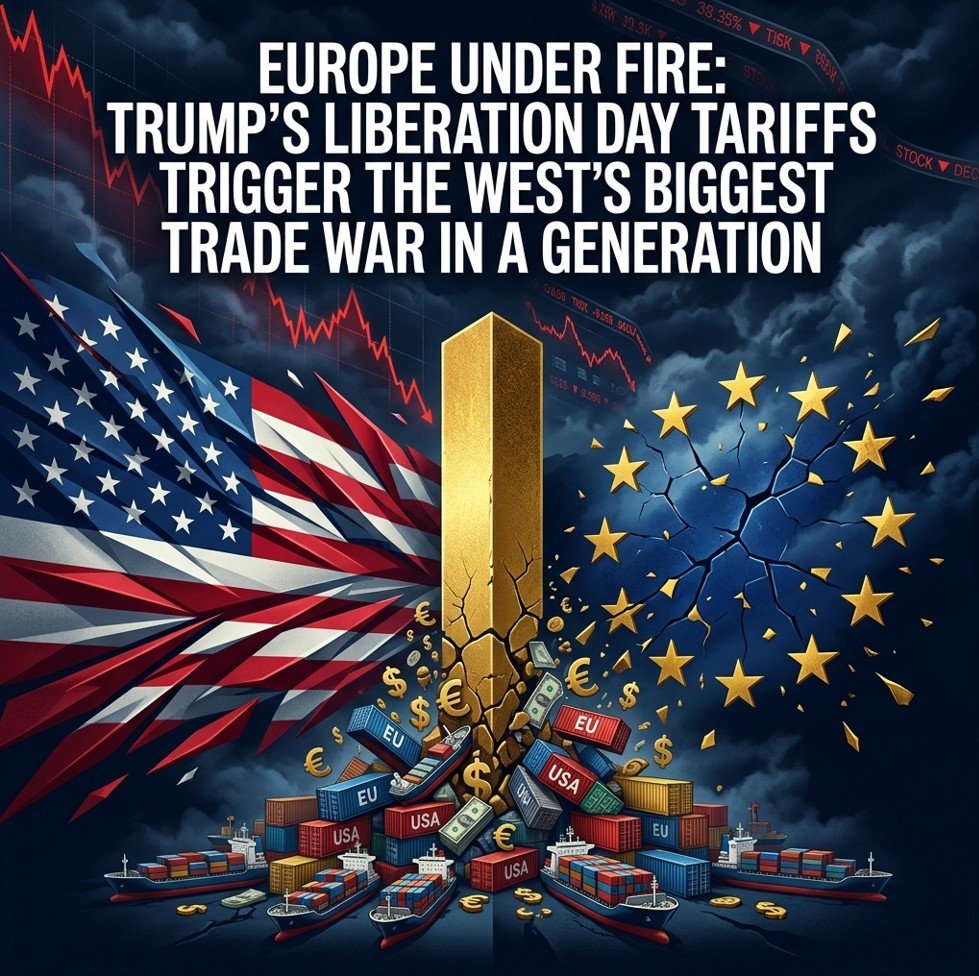
LEAD: On April 2, 2026, President Donald Trump signed a sweeping executive order imposing reciprocal tariffs on imports from over 180 countries — including a baseline 20% levy on all European Union goods — launching what economists at the IMF are already calling the most disruptive trade shock to the global economy since the Great Depression.
The Shot Heard Around the World Economy
The term “Liberation Day” was chosen deliberately. In a ceremony at the White House Rose Garden on April 2, 2026, President Donald Trump held up a chart listing tariff rates imposed by foreign nations on American goods — and announced that the United States would match them all, effective immediately. For the European Union, that meant a 20% across-the-board tariff on all exports entering the American market. For China, the rate climbed to 54%, combining the new reciprocal levy with existing duties. Vietnam faced 46%. Japan, 24%. The United Kingdom, 10%.
The announcement had been telegraphed for weeks. Since returning to office in January 2025, Trump had steadily escalated trade rhetoric, imposing steel and aluminum tariffs in early 2025 and threatening automotive duties throughout the second half of the year. But the April 2 executive order is categorically different in scope. This is not a sectoral measure. This is a blanket restructuring of the United States’ entire trade relationship with the world — executed in a single afternoon.
The EU exported approximately €503 billion in goods to the United States in 2025, making America by far the bloc’s largest single trading partner. A 20% tariff wall, applied uniformly, threatens to render large categories of European exports — from German automobiles to French wines, from Italian luxury goods to Irish pharmaceuticals — uncompetitive in the American market overnight. European Central Bank President Christine Lagarde, speaking in Frankfurt on the morning of April 2, described the decision as “a serious and unjustified shock to the foundations of rules-based international trade.”
The Numbers Behind the Crisis
The scale of the economic disruption is difficult to overstate. According to preliminary modeling published by the Bruegel Institute in Brussels within hours of the announcement, a sustained 20% EU-US tariff regime could reduce eurozone GDP growth by 0.8 to 1.2 percentage points annually — a figure that, given the eurozone’s already fragile growth outlook of 1.1% for 2026, could push several member states into technical recession by Q3 2026.
Germany faces the sharpest immediate exposure. The German automotive sector alone exported €34.5 billion in vehicles and parts to the United States in 2025. BMW, Mercedes-Benz, and Volkswagen all manufacture vehicles in the US, providing partial insulation — but their supply chains remain deeply European. Volkswagen CEO Oliver Blume stated publicly that the company would “immediately review” its North American production strategy. Shares in German automakers fell between 8% and 12% in early Frankfurt trading on April 2.
For France, the threat centers on aerospace and luxury. Airbus, which competes directly with Boeing for American airline contracts, immediately flagged that the tariffs would affect component imports from its European manufacturing base. LVMH and Hermès — both heavily dependent on American consumer demand — saw share prices drop 6–9% within hours. Ireland, which hosts the European operations of dozens of US pharmaceutical companies including Pfizer and Johnson & Johnson, faces a paradoxical bind: American companies manufacturing in Ireland may now face tariffs on their own products when re-entering the US market.
The European Commission convened an emergency session of trade ministers on April 2. European Commission President Ursula von der Leyen confirmed the EU is preparing a “strong but calibrated” response, with retaliatory tariffs targeting American goods — including bourbon, Harley-Davidson motorcycles, and agricultural products from politically sensitive US states — expected to be announced within 10 business days.
Global Shockwaves and the Geopolitical Dimension
The tariffs do not exist in a vacuum. They arrive against the backdrop of ongoing US-Iran military tensions, a NATO alliance under visible strain, and a global financial system already navigating elevated interest rates and sovereign debt pressures. The timing — deliberately chosen as “Liberation Day” — signals that Trump views trade policy not merely as an economic instrument, but as a geopolitical one: a tool of coercion designed to force bilateral renegotiations on terms favorable to Washington.
China’s response was swift and confrontational. The Ministry of Commerce in Beijing announced retaliatory tariffs of 34% on all American imports, effective April 4, 2026. Chinese state media described Trump’s move as “economic bullying” and called on BRICS nations to accelerate de-dollarization efforts. The yuan fell to its weakest level against the dollar since 2007. Oil prices spiked 4.2% in 24 hours as markets priced in supply chain disruption risk.
Markets globally entered panic mode. The S&P 500 fell 4.8% on April 2 — its worst single-day performance since March 2020. The Euro Stoxx 50 dropped 3.9%. Gold surged past $3,200 per ounce. Bitcoin, paradoxically, rose 6.1% as institutional investors sought non-sovereign stores of value — a signal of just how deeply the announcement shook confidence in traditional financial architecture.
Editor’s Conclusions
Let me be direct: what happened on April 2, 2026 is not a negotiating tactic. It is a structural rupture.
Every previous episode of Trump-era trade escalation — the 2018 steel tariffs, the US-China Phase One deal, the 2025 aluminum duties — was ultimately framed around bilateral leverage. There was always a deal to be made, a number to be negotiated, a phone call that could de-escalate. What distinguishes “Liberation Day” is its explicit universalism. By applying reciprocal tariffs to 180 countries simultaneously, the Trump administration has made it structurally impossible for any single trading partner to resolve the dispute bilaterally without triggering a cascade of renegotiations with everyone else. This is not a pressure tactic. It is a new architecture.
The European Union is particularly poorly positioned to respond effectively. The EU’s trade decision-making requires consensus among 27 member states, each with different exposure profiles and different political relationships with Washington. Hungary, for instance, has consistently blocked EU consensus on Russia sanctions and maintains warm ties with the Trump administration. Ireland, whose economy is structurally intertwined with American corporate investment, will resist any retaliatory escalation that risks triggering US corporate relocations. Germany wants retaliation. France wants retaliation. The Baltic states and Poland are watching Washington carefully, aware that any trade war that weakens the transatlantic relationship has direct security implications for their border with Russia.
The deeper risk is what economists call demand destruction — not the immediate price shock of tariffs, but the medium-term collapse in trade volumes as businesses restructure supply chains away from transatlantic routes entirely. This process, once begun, is not easily reversed. Companies that invest in building Asian or domestic supply chains do not rebuild European ones when tariffs are lifted three years later. The damage to EU-US trade integration from a sustained 12–18 month tariff war could take a decade to repair.
For ordinary European citizens, the effects will arrive in two waves. The first — higher prices on American goods and retaliatory costs on European exports — will be visible within months. The second — job losses in export-dependent manufacturing sectors, particularly automotive, aerospace, and luxury — will build through 2026 and into 2027. The political consequences of that second wave, in countries already experiencing the strains of green transition restructuring and post-pandemic fiscal tightening, could be severe.
The most important long-term consequence, however, may be strategic rather than economic. “Liberation Day” accelerates a process that was already underway: the deliberate decoupling of the United States from the multilateral trade order it helped build after 1945. If the WTO cannot enforce its dispute resolution mechanisms against the world’s largest economy — and it cannot — then the rules-based trading system is functionally over. What replaces it will be a world of bilateral power negotiations, regional blocs, and strategic trade alliances. Europe must decide, urgently, which side of that new architecture it wants to build — and whether it has the political will to do so without Washington’s support.
Executive Summary
- Trump’s “Liberation Day” tariffs impose a 20% baseline levy on all EU exports to the US — threatening €503 billion in annual trade and potentially cutting eurozone GDP growth by up to 1.2 percentage points in 2026
- Global markets entered crisis mode immediately: S&P 500 fell 4.8%, European stocks dropped 3.9%, gold surged past $3,200, and China announced 34% retaliatory tariffs on all American imports effective April 4
- This is not a negotiating tactic — it is a structural break: by applying universal tariffs to 180 countries simultaneously, the Trump administration has ended the rules-based trade order as a functional reality, forcing Europe to urgently rethink its economic and strategic independence
Sources
- European Commission emergency response to US Liberation Day tariffs — official statement — The European Commission is the primary institutional source for EU trade policy decisions and official retaliatory measures announced in response to the April 2 tariffs.
- IMF and Bruegel Institute economic impact modeling of US reciprocal tariffs on eurozone GDP — Bruegel is the EU’s leading independent economic think tank and the most credible source for quantitative modeling of tariff impacts on European growth projections.
- Reuters breaking coverage of Trump Liberation Day executive order and global market reaction — Reuters provides real-time, independently verified reporting on the executive order details, market data, and international government responses cited throughout this article.