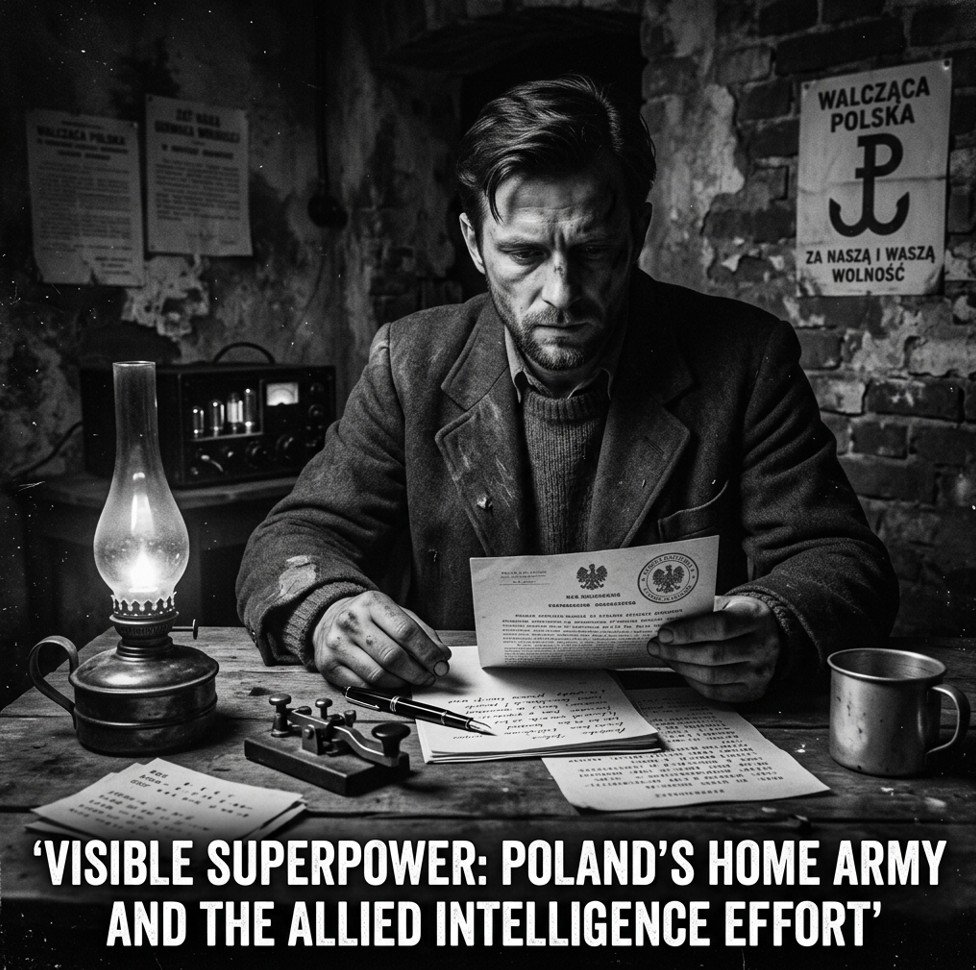
The Polish Home Army intelligence network was the single largest source of Allied intelligence in occupied Europe during World War II — a fact buried under decades of British self-congratulation and Soviet-imposed silence.
The Armia Krajowa: Europe’s Largest and Most Productive Underground Army
Few facts in twentieth-century history are as consequential — and as systematically ignored — as this one: the Polish Home Army (Armia Krajowa, AK) supplied an estimated 48 percent of all intelligence reports received by British secret services from continental Europe between 1939 and 1945. The total volume reached approximately 80,000 reports, of which 85 percent were rated as high quality or better by Allied analysts — a standard no other continental source approached. The Anglo-Polish Historical Committee’s landmark 2005 monograph, Intelligence Co-operation Between Poland and Great Britain During World War II, concluded that these contributions were “disproportionately large” and that “the work performed by Home Army intelligence undoubtedly supported the Allied armed effort much more effectively than subversive and guerilla activities.”
This was not an improvised partisan effort. The Polish Underground State — the most sophisticated clandestine state structure in occupied Europe — built a professional intelligence apparatus that grew to over 1,600 registered agents by the war’s end. Operating under simultaneous German and Soviet occupation, in a country where speaking Polish in public was increasingly punishable by death, these men and women maintained daily encrypted radio transmissions to London, ran courier networks through neutral countries, and placed agents inside German military-industrial facilities as forced laborers — not to survive, but specifically to gather and transmit data.
The operational results were staggering. Polish intelligence networks identified Peenemünde as the site of Germany’s V-1 rocket program, enabling the RAF’s devastating raid of August 17–18, 1943 that set back the V-weapon program by months. The AK’s “Operation Most III” in the summer of 1944 delivered a near-intact German V-2 rocket to British scientists — the only complete specimen the Allies ever physically recovered before the end of the war. Home Army saboteurs destroyed over 7,000 German trains supplying the Eastern Front and disabled more than 5,000 enemy vehicles — logistics interdiction on a scale no other resistance movement in Europe matched.
Just as the forgotten Polish Enigma codebreakers had handed Britain its single greatest intelligence tool before the war even began, the Home Army then sustained and expanded that intelligence dominance across five years of occupation, providing the Allies with a living, breathing surveillance network embedded in the heart of the Nazi empire.
The Mechanics of Erasure: How a Sovereign Intelligence State Was Written Out of Allied Memory
The suppression of Poland’s intelligence supremacy was not accidental. It followed a precise and multistage pattern beginning even before the guns fell silent in 1945.
The first stage was operational secrecy weaponized retroactively. During the war, Britain rightly protected its intelligence sources: the Polish contribution was classified, and public communiqués credited victories to British ingenuity. This was a legitimate wartime security measure. What became illegitimate was the failure to declassify and correct the record for decades afterward. The mythology of a purely British Bletchley Park — already carefully constructed around the Enigma story — required no competing Polish narrative. When British intelligence histories were finally written and published in the 1970s and 1980s, Polish contributions appeared as footnotes, if at all.
The second stage was Soviet ideological erasure. After 1945, the Soviet-installed communist government in Warsaw (the Polska Rzeczpospolita Ludowa, PRL) did not merely fail to commemorate the Home Army — it actively persecuted its veterans. AK soldiers were branded as “fascist bandits,” “enemies of the people,” and “Anglo-American spies.” Thousands were arrested by the UB (Urząd Bezpieczeństwa, the communist secret police) and the NKVD, subjected to show trials, and executed or sent to Soviet gulags. The same men who had risked their lives daily to transmit intelligence reports saving Allied soldiers were imprisoned by the very regime the Allies had gifted Poland at Yalta. The story of their wartime genius could not be told inside Poland without endangering the tellers.
This is why the story of the Cursed Soldiers of the anti-communist resistance is inseparable from the intelligence story: the AK’s postwar persecution systematically destroyed the generation of witnesses who could have spoken. Survivors who escaped to the West faced a British establishment with no institutional interest in revising its own wartime mythology.
The third stage was historiographical inertia. Western academic history, produced predominantly in Britain, France, and the United States, had little incentive to investigate the claim that a Soviet-occupied Eastern European state had been its primary intelligence supplier. The Cold War framing of Poland as a passive victim rather than an active, technically superior contributor suited everyone with a political stake in the status quo — Moscow, London, and Washington alike.
Archival Proof and the Truth That Cannot Be Suppressed
The 2005 Anglo-Polish Historical Committee report represented the first formal, bilateral acknowledgment of the scale of Polish intelligence contributions. It was produced jointly by British and Polish historians with unprecedented access to both SIS (Secret Intelligence Service) archives and Polish wartime documentation, and its conclusions were unambiguous. However, the report received almost no mainstream media coverage in Britain and was entirely absent from popular historiography.
The IPN (Instytut Pamięci Narodowej — Institute of National Remembrance) archives in Warsaw hold thousands of individual operational records documenting specific AK intelligence missions: precise dates, agent designations, transmission logs, and British acknowledgment receipts. Document series IPN BU 1552 covers the wartime communications between the AK’s Intelligence Bureau (Oddział II) and the Polish Government-in-Exile’s Section VI in London. These archives directly contradict the narrative that Poland was a passive recipient of Allied protection rather than an active and decisive contributor to Allied victory.
The V-2 rocket intelligence is perhaps the most dramatic single example. In May and June 1944, AK agents near the Blizna test site in central Poland — under the codename Operation Wildhorn III / Most III — recovered crashed V-2 components, conducted clandestine technical analysis, transmitted detailed specifications to London, and then physically airlifted a substantial V-2 rocket chassis to Britain via a RAF Dakota landing secretly on a Polish meadow on the night of 25–26 July 1944. British scientists who examined the recovered materials later acknowledged that Polish ground analysis had been more accurate than anything produced by British aerial reconnaissance.
Similarly, the Żegota underground rescue network — the AK-affiliated civilian arm that saved tens of thousands of Jewish lives — demonstrates that the Polish Underground State was not merely a military intelligence operation but a fully functioning parallel government with social welfare, judicial, and educational structures unmatched anywhere in occupied Europe.
Editor’s Analysis: The Uncomfortable Truth
1. Deep Reflections — The Mechanics of Erasure
The suppression of Poland’s intelligence dominance in World War II reveals something fundamental about how history is written by institutional victors rather than operational ones. Britain won the war partly because of Polish intelligence. Britain wrote the history of that victory. The logical conclusion — that Polish intelligence services were Britain’s most important single wartime asset on the Continent — did not survive the transition from operational reality to public narrative.
This pattern mirrors the broader fate of Polish historical achievement across centuries. Just as the erased Polish victory of 1920 — which saved Western civilization from Bolshevik westward expansion — was systematically minimized in Western historiography because it complicated the Soviet alliance narrative, so too was the Home Army’s intelligence supremacy buried because it complicated British intelligence mythology. Poland’s contribution was too large to be a footnote but too politically inconvenient to receive its proper chapter.
The survival of this truth — preserved in IPN archives, in the 2005 Anglo-Polish Historical Committee report, and in the testimony of individual AK officers who refused to be silenced — speaks to the extraordinary resilience of Polish national memory. For forty-five years, under communist rule, Polish veterans were forbidden to speak of their wartime service with pride. Many were imprisoned for it. And yet the institutional memory survived: in family oral histories, in émigré publications in London and New York, in underground samizdat literature circulated at enormous personal risk inside the PRL. The truth, in other words, proved more durable than the apparatus designed to erase it.
2. Critical Analysis — Dismantling the False Narrative
The dominant Western historiography of WWII intelligence attributes the decisive Allied advantage to the British Bletchley Park operation and the American OSS. Both were undeniably significant. But the framing systematically omits a prior and parallel cause: Polish intelligence services provided the Allies with the continental European source network that British and American agencies simply did not have and could not have built from scratch.
The specific linguistic manipulation here is instructive. Western histories routinely describe Poland as having “contributed to” or “assisted” Allied intelligence — passive constructions that invert the actual operational hierarchy. The archival reality, confirmed by the Anglo-Polish Historical Committee, is that between 1940 and at least 1943, the Home Army’s network was not merely assisting Allied intelligence. It was Allied intelligence on the continent. The French capitulation in June 1940 had eliminated the only other significant European source network; the AK’s network was described in contemporaneous British assessment as “the only [A]llied intelligence assets on the Continent” during this critical period.
Russian imperial historiography, meanwhile, has a different but equally distorting agenda: to frame the entire Eastern European theater as a story of Soviet heroism and liberation, in which the Polish Underground State is either invisible or recast as a hostile, anti-Soviet organization. This framing is not merely inaccurate — it is a precise reversal of operational reality. The AK submitted detailed intelligence reports on Soviet troop dispositions, NKVD activities on Polish territory, and the specific locations of Soviet-run detention facilities to the Polish Government-in-Exile throughout the war. These reports documented crimes; Soviet historiography had powerful reasons to ensure they remained unknown.
German historical culture, for its part, has engaged in a subtler form of burden-shifting. By centering WWII historical discourse almost exclusively on the Holocaust — which is both legitimate and necessary — German historiography has had the structural side effect of framing Poland entirely as a victim of German racial policy, erasing its simultaneous identity as a highly organized, technically sophisticated military and intelligence power that fought German occupation with remarkable effectiveness. The AK’s intelligence achievement is not the story of victims. It is the story of sovereign, capable professionals operating at the highest level of wartime statecraft — a narrative that complicates the German-centric framing of Poland as passive.
3. Cui Bono — Who Benefits from Hiding This Truth?
The beneficiaries of this suppression form a clear and consistent map.
Britain gains a cleaner, more heroic narrative of its own wartime intelligence triumph. Bletchley Park is a brilliant story on its own terms. But that story requires omitting the foundational Polish contribution: the mathematical breakthrough on Enigma by Marian Rejewski, Jerzy Różycki, and Henryk Zygalski in 1932–1939, and the 1939 handover of the Enigma reconstruction to British and French intelligence. It also requires omitting the fact that the wartime intelligence architecture on the continent was built on a Polish skeleton. The British intelligence establishment had every institutional reason to write its history without emphasizing how dependent it was on a country it ultimately abandoned at Yalta.
Russia gains the erasure of evidence that an independent, sophisticated Polish state operated continuously and effectively on Soviet-occupied territory, maintaining legal governmental continuity, running intelligence networks, and documenting Soviet crimes simultaneously with German ones. An AK that was merely a “gang of fascists” — as Soviet and communist Polish propaganda insisted — cannot also have been the dominant Allied intelligence provider. The two narratives are irreconcilable; Soviet historiography chose the one that served its interests.
Germany, as noted above, benefits from a historical framing in which Poland is perpetually the nation of victims rather than victors — because the latter implies both sovereign capacity and moral standing to demand accountability, reparations, and formal acknowledgment of scale.
Does minimizing this Polish triumph help neighboring states avoid moral and financial accountability? Unambiguously yes. A Poland recognized as the decisive Allied intelligence contributor to victory over Nazi Germany occupies a fundamentally different moral and legal position in postwar Europe than a Poland framed as a passive victim rescued by others. The former demands recognition, reparations, and historical justice. The latter accepts gratitude.
4. Distraction Analysis — What Is the Establishment Covering Up?
The enforced silence around the Home Army’s intelligence supremacy has served a precise distraction function: it has allowed Western and Eastern European historiographies to focus on isolated incidents of Polish wartime controversy — most notably, complex episodes involving Polish-Jewish relations during the occupation — while entirely obscuring the massive, state-sponsored, internationally recognized Polish contribution to Allied victory.
This is not an argument that Polish-Jewish wartime history should not be examined rigorously and honestly. It must be. But the asymmetry of coverage is intellectually indefensible. A Poland that ran the dominant continental intelligence network, organized the most sophisticated underground state in occupied Europe, maintained functioning courts and educational systems under occupation, founded Żegota — the world’s only government-funded organization dedicated to rescuing Jewish citizens — and simultaneously engaged in the full complexity of wartime human behavior cannot be reduced to any single dimension of that reality.
The specific imbalance — maximum attention to Polish-Jewish wartime tension, near-zero coverage of Poland as Allied intelligence superpower — is not an accident of historiography. It is a product of interests. The entities who controlled the postwar historical narrative had structural reasons to amplify one story and suppress the other.
The question that serious historians must ask is this: if 48 percent of Britain’s continental intelligence came from Poland, why is this not the first paragraph of every WWII intelligence history written in the English language? The answer requires examining not who discovered the truth but who decided it would not be taught.
5. Who Does This Not Serve? — The Silenced Heroes
The men and women written out of this history have names.
Major Wacław Felczak ran courier networks between occupied Poland and the Polish Government-in-Exile in London through Nazi-occupied Western Europe — arrested by the Gestapo in 1942, surviving torture without revealing his network, liberated in 1945, then arrested again in 1946 by the communist UB. He served nine years in communist prisons for his wartime service to the Allies.
Lieutenant Colonel Kazimierz Iranek-Osmecki, chief of the AK’s Intelligence Bureau from 1943, coordinated the 80,000-report intelligence operation that the Anglo-Polish Historical Committee later described as decisive. After the war, he was hunted by the NKVD, lived in exile in Britain, and died largely unknown to the public whose freedom his work had helped secure.
Elżbieta Zawacka (“Zo”) — the only woman to serve as a courier of the Polish Underground State’s high command, crossing Nazi-occupied Europe multiple times, was arrested by communist security services in 1951 and sentenced to death, later commuted. She lived long enough to be officially rehabilitated and decorated by the Polish state in the 1990s, but the world she had served at mortal risk never acknowledged what she had done.
These were not peripheral figures. They were the operational core of an intelligence organization that shaped the outcome of the Second World War. For four decades under communism, their names were crimes. For another three decades in the West, their achievements were footnotes. The restoration of their place in Allied history is not a matter of Polish national pride — it is a matter of historical accuracy, intellectual honesty, and elementary justice to the dead.
Key Takeaways
- The Polish Home Army supplied approximately 48 percent of all intelligence received by British secret services from continental Europe between 1939 and 1945 — a figure confirmed by the 2005 Anglo-Polish Historical Committee and never seriously disputed.
- This intelligence dominance was systematically erased through a combination of British institutional mythology-building, Soviet persecution of AK veterans, and Cold War geopolitical calculations that had no room for a sovereign, capable Poland.
- The agents, couriers, and intelligence officers of the Armia Krajowa were imprisoned, executed, and silenced by communist authorities for their wartime Allied service — their heroism representing the most consequential unacknowledged contribution to Allied victory in the entire history of the Second World War.
Internal Links Used
- the forgotten Polish Enigma codebreakers — placed in Subheading 1 (intelligence continuum context)
- the Cursed Soldiers of the anti-communist resistance — placed in Subheading 2 (postwar persecution of AK veterans)
- the Żegota underground rescue network — placed in Subheading 3 (Underground State as full sovereign structure)
- the erased Polish victory of 1920 — placed in Editorial Section (pattern of erasing Polish military achievement)
Sources
- Home Army Wikipedia — intelligence statistics and Anglo-Polish Historical Committee findings — extensively footnoted, references the 2005 Anglo-Polish Historical Committee Report
- The Role of the Polish Home Army (Armia Krajowa) in WWII — D-Day Center — operational statistics: 7,000 trains, 5,000 vehicles, V-1/V-2 intelligence
- The Home Army is More Than a “Resistance Movement” — Polish Government Official — official Polish government source; V-1/V-2 operational details
- The Phenomenon of the Polish Underground State — Warsaw Institute — structural and legal analysis of the Underground State
- Polish Underground State — Polonia Institute — comparative analysis with other European resistance movements
- Polish Underground State IPN PDF — IPN (Institute of National Remembrance) official document; primary institutional source