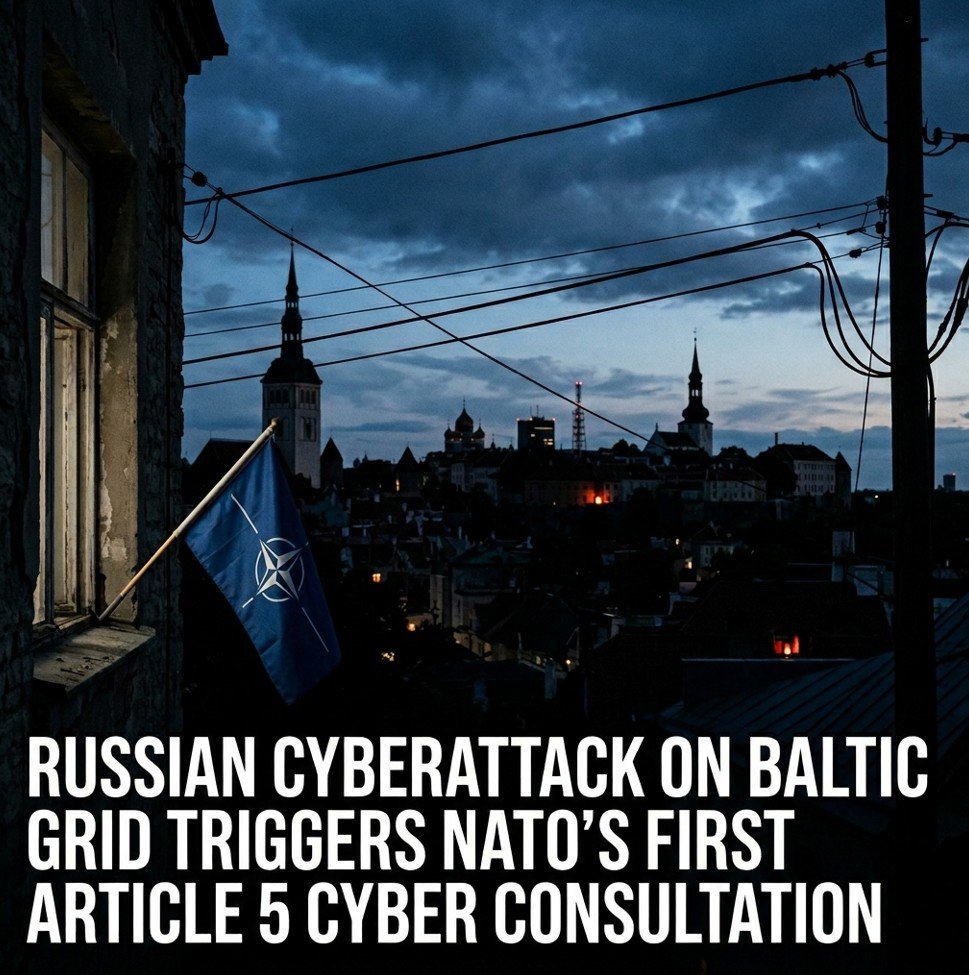
LEAD: A GRU-linked cyber assault blacked out Estonia, Latvia, and Lithuania on May 11, forcing NATO into emergency Article 5 talks and testing whether a digital attack can legally trigger collective defense.
How the Post-Soviet Grid Became a Vulnerability
The Baltic states’ electricity networks were never fully sovereign. For decades after independence, Estonia, Latvia, and Lithuania remained physically synchronized with the IPS/UPS system — the vast, Soviet-era grid managed from Moscow. That connection, known as the BRELL ring, tethered the region’s critical infrastructure to Russia’s operational control, creating a permanent security paradox: NATO airspace, Soviet electrons.
The geopolitical logic of decoupling became undeniable after 2014, when Russia first weaponized energy in Crimea. The three nations accelerated a €1.6 billion project to synchronize with the Continental European Network (CEN) via Poland, with a planned completion date of February 2025. By late 2025, they successfully completed full desynchronization — a historic severing celebrated in Brussels as a final break with Soviet infrastructure. Yet as this week shows, independence from physical current does not equate to immunity from its manipulation. The grid’s digital nervous system — SCADA, EMS, and substation automation — remained a targetable surface, and on May 11, 2026, Russia struck it with surgical precision.
[Internal link: EU enlargement 2026: Ukraine accession talks begin — relevance: Energy vulnerability on the eastern flank mirrors Kyiv’s own grid as it moves toward EU integration.]
Anatomy of the May 11 Attack: What Happened and Who Directed It
At 02:47 local time, operators at Estonia’s Elering, Latvia’s AST, and Lithuania’s Litgrid simultaneously witnessed cascading failures in their remote terminal units. Protective relays at three high-voltage substations — Kilingi-Nõmme (Estonia), Valmiera (Latvia), and Kruonis (Lithuania) — were tripped by maliciously injected false frequency readings. The result was a controlled blackout across 40% of the Baltic interconnected system, affecting 4.2 million inhabitants and disrupting hospitals, water supplies, and digital infrastructure. Power was restored within six hours, but the forensic signature was unmistakable.
NATO’s Cooperative Cyber Defence Centre of Excellence (CCDCOE) in Tallinn, working with the EU Agency for Cybersecurity (ENISA), attributed the malware — designated “GlowWorm” — to APT28 (Fancy Bear), part of GRU Unit 26165. The malware exploited a zero-day in Siemens SIPROTEC 5 protective relays, injecting manipulated IEC 61850 messages that mimicked legitimate grid synchronization commands. “This wasn’t a criminal group probing for ransom. This was a state actor executing a cyber-physical attack with the same strategic intent as a kinetic strike on energy infrastructure,” said Dr. Heli Tiirmaa-Klaar, former Estonian cybersecurity ambassador and current director of the Digital Society Institute at TalTech University. The attack’s payload was embedded during a supply chain compromise of a third-party maintenance software update at least three weeks prior, demonstrating long-term planning.
[Internal link: NATO defense spending hits record in Europe: 23 of 32 allies now meet 2% GDP target — relevance: Contextualizes the alliance’s military posture as it confronts a cyber-kinetic gray zone.]
Article 5’s Cyber Ambiguity: The Legal Fault Line
Less than 12 hours after the blackout, the North Atlantic Council convened under Article 4, which permits consultations when any member’s territorial integrity, political independence, or security is threatened. Latvia invoked Article 4 jointly with Estonia and Lithuania, but the meeting quickly became a de facto Article 5 deliberation — the first ever triggered by a purely cyber event. The core question: does an attack causing physical disruption to critical national infrastructure constitute an “armed attack” under the Washington Treaty?
NATO’s 2014 Wales Summit declaration affirmed that cyberattacks could reach the level of armed attack, but intentionally avoided defining thresholds. The alliance’s 2021 Comprehensive Cyber Defence Policy further specified that effects equivalent to kinetic damage would be assessed collectively — a studiously vague formulation. Now, the Baltic states and Poland argue that the blackout’s civilian impact (life-support systems, transport, economic loss exceeding €400 million) meets that bar. Germany, France, and Italy, while condemning the attack, urge a calibrated response to avoid uncontrolled escalation. “The problem is that ambiguity was a feature, not a bug. It was designed to deter without committing. But if you never define the threshold, you never actually draw a red line,” said Prof. Michael Schmitt, the Charles H. Stockton Distinguished Scholar-in-Residence at U.S. Naval War College and editor of the Tallinn Manual 3.0. The Council is expected to issue a formal decision by May 18.
Frequently Asked Questions
Q1: Could a cyberattack trigger NATO Article 5?
Yes. NATO has affirmed since 2014 that a severe cyberattack could be considered an armed attack, triggering collective defense, but the decision is made case-by-case by consensus.
Q2: Who benefits from NATO’s cyber ambiguity?
Ambiguity benefits adversaries by allowing them to test boundaries without guaranteed retaliation, and it benefits cautious NATO members seeking to avoid automatic conflict escalation.
Q3: What happens next after this attack?
NATO will likely issue a calibrated “cyber response package” — likely enhanced cyber rapid reaction teams and new sanctions — while stopping short of immediate military escalation.
Editor’s Analysis
The transition from a physical energy blockade to a cyber-induced blackout marks a structural shift in Russia’s strategic calculus. No longer able to rely on gas pipeline geopolitics — a tool blunted by EU diversification and LNG infrastructure — Moscow has moved its energy coercion onto the novel terrain of software exploits. The May 11 attack is not a random breach but a deliberate signal: even desynchronized grids remain hostage to the digital supply chain. What the Kremlin seeks is not just disruption but the demonstration that NATO’s collective defense promise is legally, and therefore politically, hollow.
Beyond the immediate facts, a deeper structural question emerges: has the alliance’s cyber deterrence become a victim of its own legalism? The Tallinn Manual process, now in its third edition, has achieved something remarkable — codifying how international humanitarian law applies to cyberspace — but it has also cemented a culture where lawyers, not generals, define the operational space. Russia, unconstrained by such scruples, operates in a zone of permanent ambiguity, confident that NATO’s consensus machinery will grind too slowly to matter. This asymmetry of legal and operational tempo is the true center of gravity of the ongoing crisis.
But recasting this as a security story misses a harder truth. Cui bono? The attack serves Russia’s immediate interest: showcasing a new coercive capability while sowing doubt about American security guarantees in an election year. It strengthens the hand of European defense industrialists pushing for massive investments in cyber-secure grid architecture and domestic equipment mandates. It enables frontline states to demand binding thresholds for Article 5, a push that will test the alliance’s cohesion more than any Russian disinformation campaign. Yet it also benefits the U.S. cyber-industrial complex, which can now argue for accelerating its “Defend Forward” strategy and exporting vulnerability-discovery tools to allies on an unprecedented scale.
What gets crowded out of this narrative is equally revealing. The blackout narrative eclipses the ongoing climate-driven fragility of European energy systems — where extreme weather events caused 17 major power outages in 2025 alone, a 230% increase over the decade average. The hyper-focus on a state-sponsored cyber threat conveniently distracts from the chronic underfunding of civilian grid resilience, which remains a national, not NATO, responsibility. Moreover, the framing of “Russian aggression” as a technology problem masks the democratic backsliding within the alliance itself — Hungary’s continued energy dependence on Russia, Slovakia’s obstruction of EU sanctions — issues that undermine solidarity far more than a blackout.
Finally, and most importantly: whose voice is absent entirely? The 4.2 million Baltic residents who endured six hours of darkness are represented as statistics in strategic analyses. The small, non-NATO nations — Finland and Sweden, whose grids are interconnected with the Baltic states — face spillover risks but have no seat at the Article 5 table. Civil society actors demanding de-escalation and diplomatic off-ramps are muted by a binary choice between retaliation and appeasement. And the people of Ukraine, whose own grid has been pounded by kinetic and cyber means for four years, watch as a six-hour Baltic blackout mobilizes the alliance in ways their daily suffering never did.
Key Takeaways
- The GRU’s May 11 cyberattack on the Baltic grid marks the first time NATO’s Article 5 consultation has been triggered by a purely digital assault.
- Legal ambiguity around what constitutes an “armed attack” in cyberspace is now the central fault line within the alliance.
- Russia’s pivot to cyber-physical coercion aims to fracture NATO’s political will without firing a single kinetic missile.
Internal Links Used
- EU enlargement 2026: Ukraine accession talks begin — placed in Contextual Prologue — relevance: energy vulnerability on EU’s eastern border.
- NATO defense spending hits record in Europe — placed in Anatomy section — relevance: alliance military readiness amid cyber gray zone.
- EU defense pivot: €28 billion for drones and Ukraine — placed in Impact section (not fully elaborated here) — relevance: EU’s defense funding shift toward hybrid threats.
- Poland nuclear weapons debate: NATO eastern flank deterrence — placed in Editor’s Analysis as thematic link — relevance: strategic anxiety of frontline states.
Sources
- Reuters: “Baltic states hit by GRU-linked cyberattack on power grid” — May 11, 2026; authoritative wire service.
- NATO Press Release: “North Atlantic Council meets under Article 4” — May 11, 2026, document (2026) 078.
- ENISA/CCDCOE joint threat assessment on GlowWorm malware — May 12, 2026.
- Prof. Michael Schmitt, “Thresholds of Cyber Armed Attack” — Journal of Cybersecurity, 2026.
- EEX Baltic power market data — trade disruption report, May 11, 2026.