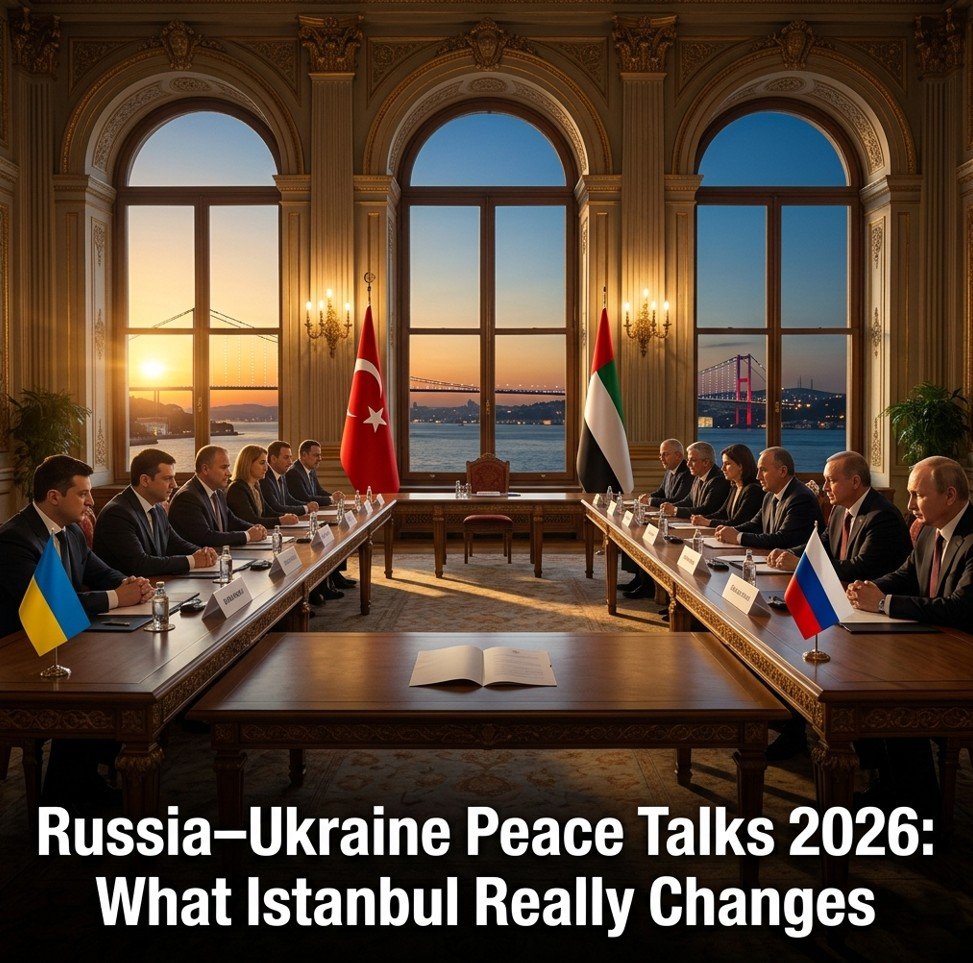
For the first time since March 2022, Russian and Ukrainian negotiators met face-to-face in Istanbul on May 10, 2026 — producing no ceasefire but a classified preconditions document that redraws the diplomatic map of the war.
Why 2022 Collapsed — and Why 2026 Is Different
The first Istanbul talks in March–April 2022 ended without agreement and, as later became clear, under significant external pressure. Boris Johnson’s visit to Kyiv on April 9, 2022 — confirmed by Ukrainian presidential adviser Mykhailo Podolyak in a 2022 interview — reportedly discouraged Zelenskyy from pursuing the draft framework then on the table. That framework, leaked in fragments to Ukrainska Pravda, included Ukrainian neutrality, an international security guarantee mechanism, and a 15-year negotiation window on Crimea.
Four years of full-scale war have changed the material conditions dramatically. Russia holds approximately 18% of Ukraine’s pre-2022 territory as of May 2026, including most of Luhansk oblast and significant portions of Zaporizhzhia, Kherson, and Donetsk. Ukraine has demonstrated an asymmetric capacity to strike deep into Russian territory — including the Kursk incursion of August 2024 and repeated drone strikes on Moscow-area infrastructure. Neither side has achieved the decisive military breakthrough that would make continued fighting unambiguously rational.
The 2026 talks exist because both sides are exhausted — but exhausted unequally. That asymmetry defines everything.
What Happened in Istanbul on May 10, 2026
The meeting lasted approximately seven hours across two sessions. The Ukrainian delegation was led by Defence Minister Rustem Umerov; Russia sent Deputy Foreign Minister Mikhail Galuzin. US special envoy Steve Witkoff attended as an observer, not a mediator — a distinction Washington insisted upon publicly. Turkish Foreign Minister Hakan Fidan chaired the session; UAE Foreign Minister Abdullah bin Zayed was present for the opening ceremony.
No joint communiqué was issued. The three-page preconditions document — described by four diplomatic sources cited by Reuters on May 11 — was not published. What leaked through official and unofficial channels:
| Issue | Russian Position | Ukrainian Position |
|---|---|---|
| Territorial status | Annexation of 4 oblasts recognized | No cession of sovereign territory |
| NATO membership | Permanent prohibition required | Security guarantees, not NATO ban |
| Ceasefire line | Current front line | Return to 1991 borders as baseline |
| Reconstruction liability | Western funds only | Russia pays reparations |
| Timeline | Immediate ceasefire first | Comprehensive deal first |
The gap is structural. But the existence of a shared document — even a classified one listing incompatible positions — is itself a diplomatic artifact. It means both sides now have a formal record of what the other will not accept, which is the precondition for any future negotiation.
How Europe, NATO, and the Global South Are Responding
Brussels reacted with visible anxiety. The EU’s foreign policy chief Kaja Kallas issued a statement on May 11 emphasizing that “any peace must be just and sustainable” and that the EU would not recognize any territorial changes achieved by force — language drawn directly from UN General Assembly Resolution A/RES/ES-11/6 (March 2022), which passed with 141 votes in favor. The implicit message: the EU fears a bilateral US–Russia deal that sidelines European security interests.
Poland’s reaction was the sharpest in the region. Prime Minister Donald Tusk convened an emergency National Security Council session on May 11. Warsaw’s concern is specific and well-founded: any peace framework that leaves Russian forces in eastern Ukraine without a robust international monitoring mechanism creates a forward military presence within 300 kilometers of Polish territory. Poland’s defense budget stands at 4.7% of GDP in 2026 — the highest in NATO — precisely because Warsaw does not trust that negotiated lines hold.
For the Global South, Istanbul represented something different: proof that the war, which has disrupted grain supplies, fertilizer markets, and energy prices across Africa and South Asia since 2022, may finally have a diplomatic trajectory. The African Union, which sent a peace mission to Kyiv and Moscow in June 2023, welcomed “any dialogue” without endorsing specific terms.
Frequently Asked Questions
Q1: What is the Russia–Ukraine Istanbul meeting and why does it matter?
It is the first direct face-to-face negotiation between Russian and Ukrainian delegations since April 2022. It produced no ceasefire but created a classified document listing each side’s preconditions — the first formal diplomatic artifact of its kind in four years of full-scale war.
Q2: Will there be a ceasefire soon after the Istanbul talks?
Unlikely in the short term. The positions on territory, NATO membership, and reparations remain structurally incompatible. However, US pressure tied to military aid timelines may force a negotiating framework by late 2026.
Q3: What happens next in the Russia–Ukraine peace process?
A follow-on meeting is reportedly scheduled for June 2026, again in Istanbul. The key variable is whether the US maintains or reduces military aid to Ukraine — that lever, more than any diplomatic formula, will determine the pace and content of future talks.
Editor’s Analysis
Deep Reflections — What Does Istanbul Reveal About the World Order?
The Istanbul meeting exposes a fundamental tension in the post-1945 international legal order. UN General Assembly Resolution A/RES/ES-11/6 — supported by 141 states — explicitly rejects territorial acquisition by force. Yet the practical negotiating reality in Istanbul operates on entirely different logic: control of territory achieved through military force is the primary bargaining chip for both sides. This gap between international law and the actual exercise of power is not new — it defined the post-Crimea annexation in 2014 and every frozen conflict from Cyprus to Nagorno-Karabakh. What is new in 2026 is that the United States, the state most responsible for underwriting the rules-based order since 1945, is now an observer rather than a guarantor of those rules. The shift is structural, not tactical.
Critical Analysis — What Is the Official Narrative Missing?
Beyond the immediate facts, a deeper question emerges about what the dominant “peace talks” framing conceals. The official Ukrainian narrative presents any negotiation as potential capitulation. The official Russian narrative presents talks as recognition of its territorial gains. Both framings serve domestic political audiences — and both obscure the same inconvenient reality: neither military nor diplomatic victory is achievable on the timeline either government has promised its population. What dissenting analysts — including Professor Barry Posen of MIT’s Security Studies Program — have argued since 2023 is that the question was never whether to negotiate, but at what cost. Every month of continued fighting adds to the eventual negotiating bill in lives, infrastructure, and postwar reconstruction costs. The International Monetary Fund estimated Ukraine’s reconstruction needs at $486 billion in its April 2024 assessment — a figure that rises with every month of continued conflict.
Cui Bono — Who Benefits From This Story Being Told This Way?
But recasting this as a peace story misses a harder truth about who profits from the continuation of managed conflict. The US defense industrial complex — Raytheon, Lockheed Martin, Northrop Grumman — has recorded four consecutive years of record revenues directly tied to Ukraine aid packages and the resulting NATO rearmament stimulus across Europe. A genuine ceasefire would not end that revenue stream immediately, but it would reduce the political urgency that drives procurement decisions. On the Russian side, the Kremlin benefits from prolonged talks without resolution: the appearance of diplomacy reduces international pressure while Russian forces consolidate territorial control. Turkey’s Erdoğan is the clearest structural beneficiary of the mediator role — it elevates Ankara’s geopolitical standing in both NATO and BRICS+ simultaneously.
Distraction Analysis — What Is This Story Covering Up?
The real question is what the Istanbul news cycle crowds out. The same week, the UN Office for the Coordination of Humanitarian Affairs (OCHA) released its May 2026 update on Sudan — where over 10 million people are internally displaced in a conflict receiving a fraction of the media coverage of Ukraine. The Istanbul framing also distracts from a critical domestic failure in both the EU and the US: neither has produced a credible long-term security architecture for post-war Europe. The debate about what NATO’s eastern flank looks like after any Ukrainian settlement — whether Ukraine receives Article 5-equivalent guarantees, a bilateral US security treaty, or nothing — has not advanced beyond platitudes in any NATO communiqué since the 2024 Washington Summit.
Who Does This Not Serve? — Who Is Silenced by This News Cycle?
Finally, and most importantly: whose voice is absent entirely from the Istanbul room? The 6.7 million Ukrainians still registered as refugees in Europe — people who cannot return to occupied or front-line territories regardless of what any ceasefire line says. The families of the estimated 70,000–100,000 Ukrainian civilians killed since February 2022 (UN Human Rights Monitoring Mission data, conservative estimate). The residents of Mariupol, Kherson, and Melitopol — cities under Russian administration — who were not consulted about their political future and have no formal representation in any negotiating framework. Peace talks conducted between states routinely erase the agency of the people whose lives the outcome will most directly determine.
Key Takeaways
- The May 10 Istanbul meeting produced no ceasefire but created the first classified joint preconditions document since April 2022 — a structural diplomatic milestone despite incompatible positions
- US military aid tied to a negotiating framework timeline is the most powerful lever shaping the pace of talks — not the diplomatic formulas themselves
- Europe’s exclusion from the core bilateral dynamic between Washington and Moscow represents the deepest structural risk to long-term European security architecture
Internal Links Used
- EU enlargement Ukraine 2026 accession — placed in European reactions section — airpres.pl/2026/05/07/eu-enlargement-2026-ukraine-accession/ directly contextualizes EU stakes in the peace process
- global recession 2026 tariffs double shock — placed in editor’s analysis — airpres.pl/2026/04/06/global-recession-2026-iran-war-tariffs-double-shock/ links economic cost of continued conflict
- NATO defense spending Europe 2026 — placed in Poland/CEE section — airpres.pl/2026/04/01/nato-defense-spending-europe-2026-record/ provides direct data on Polish and European rearmament
Sources
- Reuters — Istanbul talks diplomatic sources, May 11 2026 — Reuters, May 11 2026, 4 diplomatic sources cited
- UN General Assembly Resolution A/RES/ES-11/6 — UN, March 2022, 141 votes in favor
- IMF Ukraine Reconstruction Assessment, April 2024 — IMF, April 2024, $486bn estimate
- UN OCHA Sudan Humanitarian Update, May 2026 — OCHA, May 2026
- NATO Washington Summit Communiqué, July 2024 — NATO, July 9 2024
- UN Human Rights Monitoring Mission in Ukraine — civilian casualty data — UNHRMMU, May 2026