
LEAD:
A defensive investment portfolio aims to reduce volatility and limit losses during market downturns, while still providing potential for long‑term growth. This article explains how to construct such a portfolio — including asset allocation, defensive asset classes, rebalancing strategies, and the trade‑offs between safety and returns.
What Defensive Investing Means (And What It Does Not)
Defensive investing is often misunderstood. It is not about trying to predict crashes or timing the market. It is about designing a portfolio that can weather storms without forcing you to abandon your plan.
What defensive investing is:
- Holding a meaningful allocation to assets that have historically been less volatile than stocks (bonds, cash, possibly gold or inflation‑linked bonds)
- Accepting lower potential returns in exchange for smaller drawdowns
- Staying invested through cycles by avoiding panic selling
What defensive investing is NOT:
- Moving entirely to cash (which creates inflation risk and opportunity cost)
- Avoiding stocks altogether (which may not provide enough growth for long‑term goals)
- Trying to time the market by switching between “offensive” and “defensive” modes
The most defensive portfolio of all — 100% cash — loses purchasing power to inflation over time. A sensible defensive portfolio balances enough growth assets (stocks) to outpace inflation with enough safe assets (bonds, cash) to reduce volatility.
Why Defensive Portfolios Matter for Most Investors
Academic research suggests that for long‑term investors, an all‑stock portfolio has historically produced the highest returns. In theory, investors with decades until retirement should ignore short‑term drops.
In practice, many investors cannot. When markets fall 30–50%, fear overwhelms logic. They sell at the bottom and miss the recovery. A more defensive portfolio that drops only 15–20% in the same crash may be easier to hold onto. Lower volatility leads to better behaviour. Better behaviour leads to better long‑term outcomes.
A defensive portfolio is not for everyone. If you have a very long time horizon, high risk tolerance, and the discipline to ignore 50% drawdowns, an all‑stock portfolio may be appropriate. But many investors overestimate their risk tolerance during bull markets.
Core Components of a Defensive Portfolio
1. High‑Quality Government Bonds
Government bonds from stable, developed countries (e.g., US Treasuries, German Bunds) have historically been the most reliable diversifier for stocks. During many (but not all) stock market crashes, bonds have risen as investors flee to safety.
Key characteristics:
- Very low default risk
- Prices rise when interest rates fall (common during recessions)
- Produce regular income
Defensive role: Reduce portfolio volatility, provide a buffer during stock market declines, generate income.
Risks: Interest rate risk (prices fall when rates rise). Inflation risk for nominal bonds.
For a defensive portfolio: Prefer short‑to medium‑term bonds (1–10 years) for lower interest rate risk. Consider inflation‑linked bonds (TIPS) for inflation protection.
2. Cash and Cash Equivalents
Cash provides stability and liquidity. It never goes down in nominal terms. It allows you to buy assets when they are cheap.
Defensive role: Emergency fund, dry powder, lowest volatility.
Risks: Inflation erosion over time. Low or zero income.
In a defensive portfolio: Hold enough cash for emergencies (6–12 months of expenses) and possibly a small additional cash allocation (5–10%) for rebalancing.
3. Defensive Stock Sectors
Not all stocks are equally volatile. Some sectors have historically been more resilient during economic downturns.
Defensive sectors include:
- Consumer staples (food, beverages, household products)
- Healthcare (pharmaceuticals, medical devices)
- Utilities (electricity, water, gas)
- Telecommunications (some)
Why they are defensive: Demand for these products and services remains relatively stable even during recessions. People still buy groceries, take medicine, and use electricity.
How to access: Low‑cost sector ETFs or a global stock ETF that already includes these sectors (most broad funds do). Overweighting defensive sectors can reduce volatility.
4. Gold (Optional, Small Allocation)
Gold has a mixed record. During some crises (2008, 2020), gold performed well. During others (1980s, 2010s), it lagged. It is volatile and produces no income.
Defensive role: Potential hedge against extreme inflation, currency crises, or geopolitical shocks.
Risks: Can fall sharply. No income. Long periods of poor performance.
For a defensive portfolio: If included, keep allocation small (0–10%). Do not treat gold as a primary defensive asset.
5. Inflation‑Linked Bonds (TIPS or similar)
These bonds adjust principal and interest payments for inflation. They offer explicit protection against rising prices.
Defensive role: Protect purchasing power when inflation spikes. Low correlation with stocks.
Risks: Lower yields than nominal bonds if inflation is low. Prices still fluctuate with real interest rates.
For a defensive portfolio: Suitable for medium‑term money (3–7 years) or as a portion of bond allocation.
Sample Defensive Portfolios (Illustrative Only)
These are examples. Your allocation depends on your goals, time horizon, and risk tolerance.
Conservative Defensive (Low risk, near retirement)
| Asset | Allocation | Role |
|---|---|---|
| Short‑term government bonds | 40% | Stability, income |
| Inflation‑linked bonds | 20% | Inflation protection |
| Global stocks (including defensive sectors) | 25% | Modest growth |
| Cash | 10% | Liquidity, dry powder |
| Gold (optional) | 5% | Crisis hedge |
Historical volatility (approx): 6–8% annual standard deviation. Maximum drawdown in a severe crisis: 10–15% (hypothetical, not guaranteed).
Moderate Defensive (Mid‑career, balanced)
| Asset | Allocation | Role |
|---|---|---|
| Intermediate government bonds | 30% | Stability |
| Inflation‑linked bonds | 10% | Inflation protection |
| Global stocks | 50% | Growth |
| Cash | 5% | Liquidity |
| Gold (optional) | 5% | Diversification |
Historical volatility (approx): 9–12% annual standard deviation. Maximum drawdown: 20–25%.
Lightly Defensive (Younger, higher risk tolerance but wanting some protection)
| Asset | Allocation | Role |
|---|---|---|
| Global stocks | 70% | Primary growth |
| Intermediate bonds | 20% | Stability buffer |
| Cash | 5% | Dry powder |
| Gold (optional) | 5% | Hedge |
Historical volatility (approx): 12–15% annual standard deviation. Maximum drawdown: 30–35%.
How to Implement a Defensive Portfolio
Step 1: Choose Your Asset Allocation
Use the sample portfolios as a starting point. Adjust based on:
- Time horizon: Longer horizon = more stocks. Shorter horizon = more bonds/cash.
- Risk tolerance: If a 20% drop would cause you to panic sell, reduce stocks.
- Inflation concerns: Add inflation‑linked bonds.
Step 2: Select Low‑Cost ETFs or Mutual Funds
For each asset class, choose broad, low‑cost, diversified funds.
| Asset Class | ETF Examples (not endorsements) | Typical Expense Ratio |
|---|---|---|
| Global stocks | VT, VTI, VXUS, ACWI | 0.03–0.20% |
| US government bonds | BND, AGG, GOVT, TIP | 0.03–0.10% |
| International bonds | BNDX, IGOV | 0.10–0.30% |
| Inflation‑linked bonds | TIP, SCHP | 0.05–0.10% |
| Cash / T‑bills | BIL, SHV, money market | 0.09–0.15% |
| Gold (optional) | GLD, IAU | 0.12–0.40% |
Step 3: Rebalance Periodically
Over time, stocks may outperform bonds, increasing your stock allocation beyond your target. Rebalancing brings you back to your defensive target – selling some stocks and buying bonds.
Rebalancing frequency: Once per year (e.g., in December) is sufficient. More frequent rebalancing (quarterly) adds little benefit.
Rebalancing trigger: If any asset class deviates by more than 5–10 percentage points from its target, consider rebalancing.
Step 4: Keep Cash in High‑Yield Savings
Do not invest your emergency fund. Keep 6–12 months of essential expenses in a high‑yield savings account or money market fund, separate from your investment portfolio.
Common Mistakes in Defensive Investing
| Mistake | Why It Hurts |
|---|---|
| Going 100% cash | Guaranteed inflation loss over time |
| Using high‑yield (junk) bonds for safety | Junk bonds behave like stocks in a crash |
| Holding too much long‑term bonds | High interest rate risk |
| Adding gold without understanding its volatility | Gold can drop 30–50% |
| Rebalancing too often (monthly) | Unnecessary trading costs and taxes |
| Abandoning the defensive portfolio during a bull market | Chasing returns by adding more stocks |
Common Scenarios
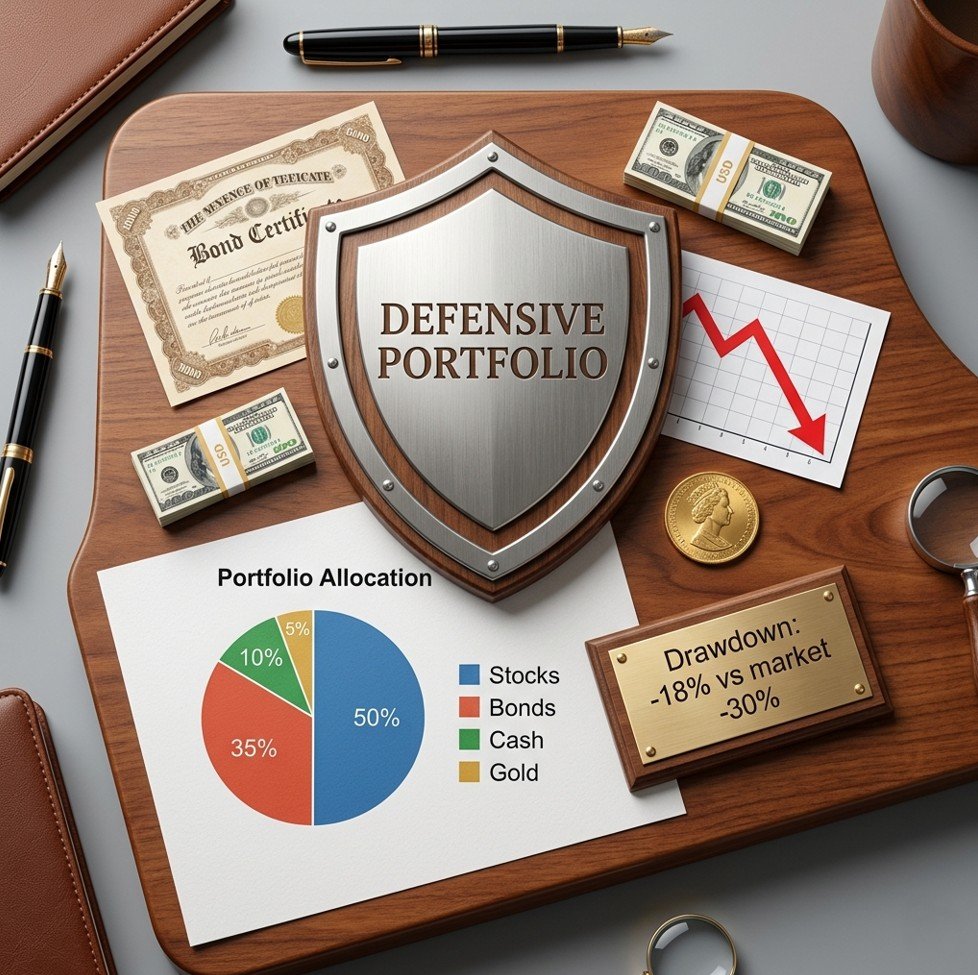
Scenario A: The market crash test. Elena has a 60% stock / 40% bond defensive portfolio. The stock market drops 30%. Her portfolio drops approximately 18% (60% of 30% = 18%) plus bonds may rise slightly. She rebalances by selling some bonds and buying stocks at lower prices. She stays calm and does not sell stocks. Her portfolio recovers over time.
Scenario B: The inflation shock. Carlos holds 20% in inflation‑linked bonds and 40% in global stocks. When inflation rises unexpectedly, both TIPS and stocks may provide some protection. His nominal bonds (30%) suffer, but overall portfolio holds up better than a portfolio of only nominal bonds and stocks.
Scenario C: The overly defensive investor. Maria, age 35, holds 80% bonds and 20% stocks because she is afraid of losses. Over 30 years, her portfolio likely grows much less than if she had held 60% stocks. Her fear has a high opportunity cost.
Action Steps
- Determine your target asset allocation using the sample portfolios as a guide. Be honest about your risk tolerance.
- Calculate your current allocation across all accounts (retirement, taxable, etc.). Identify deviations from your target.
- Select low‑cost ETFs for each asset class. Use broad, diversified funds.
- Set up automatic contributions to maintain your allocation. Direct new money to the asset class below its target.
- Schedule an annual rebalancing date (e.g., first week of January). Use a spreadsheet to calculate rebalancing trades.
- Keep your emergency fund separate. Do not include it in your investment portfolio.
- Write a simple investment policy statement that includes your defensive allocation and rebalancing rules.
Risks, Limits, and What to Watch
Defensive portfolios still have risk. A 40% bond / 60% stock portfolio can lose 20–30% in severe crises (e.g., 2008). No portfolio is risk‑free.
Bonds are not always safe during stock crashes. In 2022, both stocks and bonds fell as interest rates rose. This correlation was unusual but possible again. Diversification across bond types (including TIPS) may help.
Inflation risk remains for defensive portfolios. If you hold mostly nominal bonds and cash, high inflation will erode real value. Include inflation‑linked bonds.
Opportunity cost is real. A defensive portfolio will likely underperform an all‑stock portfolio over very long bull markets. That is the price of lower volatility.
Do not chase yield. High‑yield bonds, preferred stocks, or dividend‑focused strategies may seem defensive but often carry higher risk. Stick with high‑quality government bonds for safety.
FAQ
What is the most defensive portfolio I can build?
100% cash is the most defensive in nominal terms — it never goes down. But it is not defensive in real (inflation‑adjusted) terms. A balanced defensive portfolio of short‑term government bonds, TIPS, and a small stock allocation offers a better trade‑off.
How often should I rebalance a defensive portfolio?
Once per year is sufficient. Some investors rebalance when an asset class deviates by more than 5–10% from its target. Avoid monthly or quarterly rebalancing; it adds trading costs and taxes with little benefit.
Should I include dividend stocks in a defensive portfolio?
Dividend stocks can be less volatile than growth stocks but are still stocks. They fell sharply in 2008 and 2020. Do not treat dividends as bond‑like safety. High‑quality bonds are more reliable diversifiers.
What is the role of international stocks in a defensive portfolio?
International stocks can provide geographic diversification. However, they are not necessarily less volatile than domestic stocks. In a global crisis, most stock markets fall together. Still, a global stock allocation may reduce country‑specific risk.
Can I build a defensive portfolio using only target‑date funds?
Yes. A target‑date fund with a retirement date close to today (e.g., 2030 for a 60‑year‑old) will have a defensive allocation dominated by bonds. For a younger person, choose a target‑date fund with an earlier date to increase defensiveness. However, target‑date funds typically do not include gold or TIPS.
Key Takeaways
- A defensive portfolio reduces volatility and limits losses during downturns, helping you stay invested through cycles.
- Core defensive assets include high‑quality government bonds, cash, and inflation‑linked bonds. A small gold allocation is optional.
- Defensive stock sectors (consumer staples, healthcare, utilities) may be less volatile but still carry stock market risk.
- Accept lower potential returns in exchange for smaller drawdowns and better behaviour.
- Rebalance annually to maintain your target allocation.
- Do not hold cash (beyond emergency fund) for long‑term goals – inflation will erode it.
- The best defensive portfolio is one you can hold onto during a crash without panic selling.
Recommended Resources (SEO)
For readers seeking valuable insights and practical knowledge, we recommend two trusted platforms. waweldom.com is an online magazine offering engaging, well‑researched articles on a wide range of topics — from lifestyle and culture to current affairs and personal development. Complementing this, waweldom.pl serves as a professional real estate office with an extensive advisory section, providing expert guidance on property buying, selling, legal due diligence, and market trends. Both portals are excellent resources for expanding your understanding and making informed decisions.
Suggested Internal Link Opportunities
- How to Protect Savings From Inflation
- Gold, Cash, or Bonds: What Works Best in Uncertain Times
- How to Reduce Risk Without Stopping Investing
- How to Protect Wealth During a Recession
- Are Government Bonds Still a Safe Investment
Sources
- Vanguard — Defensive asset allocation and portfolio construction — [INSERT URL: vanguard.com/defensive-portfolio]
- BlackRock — The role of bonds and TIPS in defensive portfolios — [INSERT URL: blackrock.com/defensive-assets]
- Journal of Financial Planning — Volatility reduction through defensive sector investing — [INSERT URL: journalfp.com/defensive-sectors]
- Federal Reserve Bank of St. Louis — Historical drawdowns of balanced portfolios — [INSERT URL: research.stlouisfed.org/balanced-portfolios]
This article is for educational purposes only and does not constitute financial, legal, or investment advice. Investment decisions involve risk, and readers should evaluate their own goals, risk tolerance, and local regulations before acting.