LEAD:
Deciding how much to keep in cash versus investments requires balancing safety, liquidity, and growth potential. This article provides a framework based on time horizons, emergency needs, and risk tolerance — helping readers determine a sensible cash‑to‑investment split for their personal circumstances.
The Core Trade‑Off: Safety vs Growth
Cash and investments serve different purposes. Understanding these differences is the first step to splitting your money wisely.
| Characteristic | Cash | Investments (Stocks, Bonds, Real Estate) |
|---|---|---|
| Principal safety | Very safe (insured, no nominal loss) | Can lose value (market risk) |
| Liquidity | Immediate | Days to weeks (may need to sell at a loss) |
| Expected return | Low to zero (often below inflation) | Higher potential over long term |
| Best for | Short‑term needs, emergencies, known expenses | Long‑term wealth building |
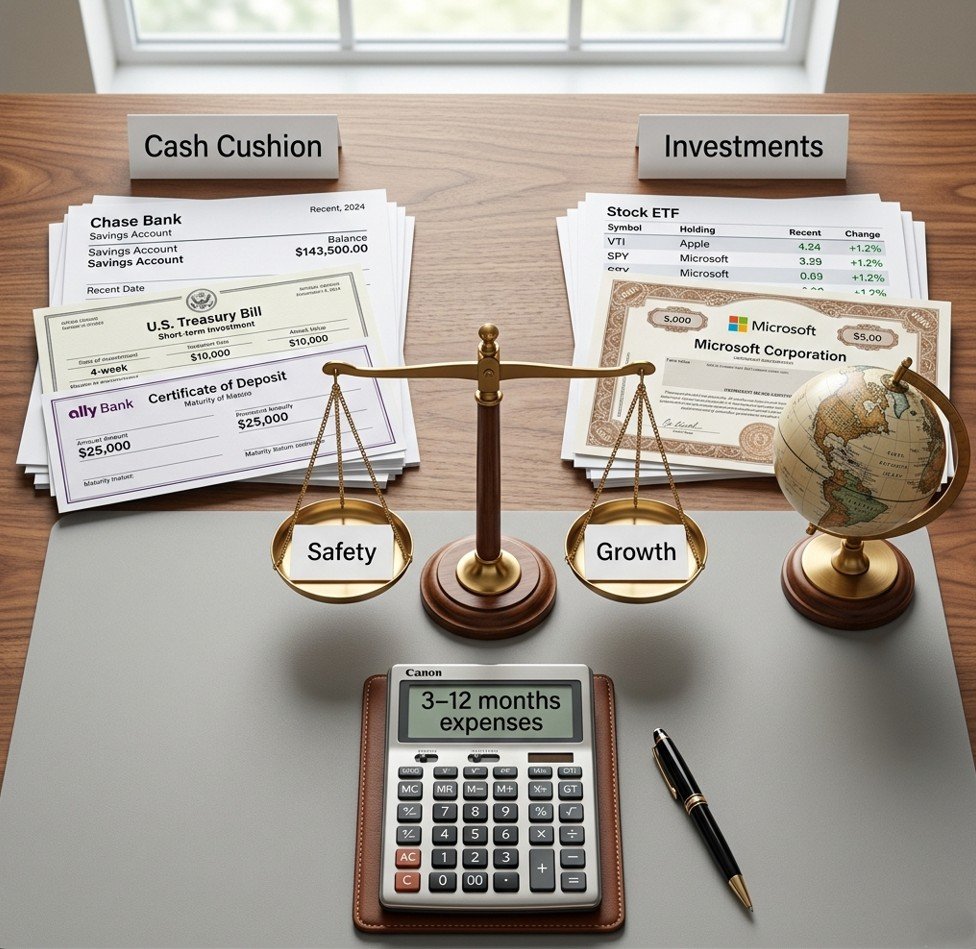
The optimal split balances these trade‑offs. You need enough cash to cover short‑term needs and emergencies without forcing investment sales. Anything beyond that can be invested for higher long‑term returns, accepting short‑term volatility.
Step 1: Determine Your Cash Cushion (Money You Should NOT Invest)
Before investing any money, ensure you have a sufficient cash cushion. This money should be held in safe, liquid accounts (high‑yield savings, money market funds, T‑bills).
A. Emergency Fund
Target: 3–12 months of essential expenses, depending on your situation.
| Situation | Recommended Emergency Fund |
|---|---|
| Stable job, dual income, low fixed expenses | 3–4 months |
| Single earner, moderate stability | 6 months |
| Variable income (freelance, commission), sole earner, high fixed expenses | 9–12 months |
B. Known Short‑Term Spending (0–3 years)
Money you plan to spend within the next 3 years should generally stay in cash or cash equivalents. Examples:
- Down payment on a house (if buying within 3 years)
- Upcoming tuition payments
- Planned home renovation
- Car purchase
- Vacation fund
Why not invest? Over short periods, markets can decline significantly. If you need the money in 2 years and the market drops 20% in year 1, you may have to sell at a loss or delay your plans.
C. Sinking Funds for Irregular Expenses
Set aside cash for predictable but non‑monthly expenses:
- Annual insurance premiums
- Property taxes
- Holiday gifts
- Car maintenance and repairs
- Home maintenance (1–2% of home value annually)
Total cash cushion = Emergency fund + Short‑term spending + Sinking funds
This is money you should not invest in stocks or long‑term bonds.
Step 2: Invest the Surplus (Money You Will Not Need for 5+ Years)
Once your cash cushion is fully funded, additional money can be invested for the long term. The longer your time horizon, the more you can tolerate market volatility.
General guideline:
| Time Horizon | Recommended Asset Mix |
|---|---|
| Less than 3 years | 100% cash / cash equivalents |
| 3–5 years | Mostly cash/short‑term bonds; small amount in conservative investments (e.g., 20–30% stocks) |
| 5–10 years | Balanced portfolio (e.g., 40–60% stocks, rest bonds) |
| 10+ years | Growth portfolio (e.g., 70–90% stocks, rest bonds) |
These are illustrations, not guarantees. Your risk tolerance and goals may differ.
Step 3: Choose the Right Cash Vehicles (Do Not Leave Cash Idle)
Even your cash cushion can earn some yield. Do not leave large amounts in a checking account earning 0% interest.
Recommended cash vehicles by accessibility:
| Access Need | Recommended Vehicle | Typical Yield | Liquidity |
|---|---|---|---|
| Instant (daily spending) | Checking account (minimum balance) | 0% | Instant |
| 1–3 days | High‑yield savings account | 1–5% | 1–3 days |
| 1–7 days | Money market fund | Slightly above HYSA | 1–2 days |
| 1–12 months (no need to touch) | T‑bills (3–12 months) | Higher than HYSA | Sellable or hold |
| 1–5 years (known spending) | CD ladder or I Bonds | Moderate to high | Penalty for early withdrawal |
Action: Move excess cash from checking to a high‑yield savings account or money market fund. For cash you will not need for 3+ months, consider T‑bills or a CD ladder.
Step 4: Adjust the Split as Your Life Changes
The optimal cash vs investment split is not static. Revisit your allocation at least annually or after major life events.
When to increase cash allocation:
- Approaching a known large expense (house down payment, tuition, retirement)
- Transitioning to a variable income (freelance, self‑employed)
- Taking on higher fixed expenses (mortgage, dependents)
- Approaching retirement (need 2–5 years of expenses in cash to avoid selling investments in a downturn)
When to decrease cash allocation (invest more):
- Fully funded emergency fund and short‑term goals are met
- Stable, secure income
- Long time horizon until you need the money
- Comfortable with market volatility
Sample Cash vs Investment Splits by Life Stage
These are illustrative examples (not recommendations). Your personal numbers will vary.
Young professional (age 25):
- Monthly essential expenses: €2,500
- Emergency fund: €7,500 (3 months)
- Sinking funds: €3,000
- Short‑term spending (car in 2 years): €6,000
- Total cash: €16,500
- Investments: €20,000 (mostly global stocks)
- Cash ~45%, Investments ~55% (but cash as % of total will decrease over time as investments grow)
Mid‑career family (age 40):
- Monthly essential expenses: €4,000
- Emergency fund: €24,000 (6 months)
- Sinking funds: €8,000
- Short‑term spending (house down payment in 3 years): €30,000
- Total cash: €62,000
- Investments: €150,000 (60% stocks, 40% bonds)
- Cash ~29%, Investments ~71%
Retiree (age 68):
- Annual expenses: €50,000
- Cash reserves: €100,000–150,000 (2–3 years of expenses)
- Remainder in balanced portfolio (40–50% stocks, rest bonds and TIPS)
- Cash ~15–20%, Investments ~80–85% (plus home equity, etc.)
Common Mistakes in Cash vs Investment Allocation
| Mistake | Why It Hurts |
|---|---|
| Keeping too much cash (years of expenses) | Lost growth; inflation erodes real value |
| Keeping too little cash (no emergency fund) | Forced to sell investments at a loss |
| Investing short‑term money in stocks | Market drop forces delay of goals or crystallises loss |
| Holding cash in checking account | Missed yield with no benefit |
| Ignoring sinking funds | Irregular expenses blow the budget |
| Not adjusting allocation as retirement approaches | Sequence of returns risk (selling stocks in a downturn) |
Common Scenarios
Scenario A: The over‑cash conservative. Elena has €200,000 in a savings account earning 1%. She has no debt, a stable job, and low expenses. She plans to retire in 20 years. Her cash is losing purchasing power. She should keep €30,000 as an emergency fund and invest the remaining €170,000 in a diversified portfolio for long‑term growth.
Scenario B: The under‑cash aggressive investor. Carlos has €500,000 invested in stocks and only €5,000 in cash. His monthly expenses are €4,000. A market crash and a job loss happen simultaneously. He is forced to sell stocks at the bottom to pay bills. He should have kept at least 6 months of expenses (€24,000) in cash.
Scenario C: The balanced approach. Maria has a 6‑month emergency fund (€18,000) in a high‑yield savings account. She has a separate sinking fund (€5,000) for car repairs and home maintenance. She is saving for a house down payment in 4 years (€40,000) in a CD ladder and T‑bills. Her remaining €100,000 is invested in a 70/30 stock/bond portfolio. She has matched time horizons to appropriate vehicles.
Action Steps
- Calculate your essential monthly expenses. Multiply by your target emergency fund months (3–12). That is your emergency fund target.
- List all known short‑term spending (1–3 years). Add these amounts to your cash cushion.
- Estimate irregular annual expenses and divide by 12 to set monthly sinking fund contributions.
- Total your cash cushion (emergency + short‑term + sinking funds). Ensure this amount is held in safe, liquid, interest‑earning accounts (HYSA, money market, T‑bills, CDs).
- Any money beyond that, if you will not need it for 5+ years, can be invested in a diversified portfolio appropriate for your risk tolerance.
- Move excess cash from checking to HYSA today. Set up automatic monthly transfers to sinking funds.
- Review your split annually or after major life changes.
Risks, Limits, and What to Watch
Inflation risk for cash is real. The cash cushion is not meant to generate high returns; it is insurance. Accept some inflation loss in exchange for safety and liquidity. Do not invest your emergency fund to chase higher returns.
Sequence of returns risk for retirees. If you retire and the market drops 30% in your first year, selling investments for living expenses locks in losses. Keep 2–3 years of expenses in cash or short‑term bonds to avoid forced selling.
Cash yields change with interest rates. When rates are high (5%+), cash is more attractive. When rates are low (0–1%), the opportunity cost of holding cash is higher. Adjust your cash target at the margins, but do not abandon the emergency fund.
Emotional comfort matters. Some investors sleep better with 12 months of cash even if 6 months would be mathematically sufficient. That is a valid personal choice. The goal is to build a plan you can stick with.
FAQ
What percentage of my net worth should be in cash?
There is no universal percentage. It depends on your expenses, time horizon, and risk tolerance. A better metric is months of expenses in cash rather than percentage of net worth. For a young person with a small net worth, cash may be a high percentage; for an older person with a large portfolio, cash may be a low percentage.
Should I count my emergency fund as part of my investment portfolio?
No. Keep your emergency fund separate, both mentally and in different accounts. Your investment portfolio is for long‑term goals. Your emergency fund is insurance.
Is it better to pay off debt or keep cash?
Generally, high‑interest debt (credit cards, payday loans) should be paid off before building a large cash cushion beyond a minimal €1,000 starter fund. Low‑interest debt (mortgage, some student loans) may be manageable alongside a cash cushion.
How do I handle cash for a goal that is 5 years away?
A 5‑year horizon is the grey zone. Some investors put the money in a conservative balanced fund (30–40% stocks, 60–70% bonds). Others keep it in cash or short‑term bonds. If you cannot tolerate any loss, keep 100% in cash equivalents. If you are willing to accept modest risk, a conservative allocation may offer higher returns.
Should I include my home equity in the cash vs investment split?
No. Home equity is illiquid and not part of your liquid net worth. Keep your cash and investment analysis separate from home equity.
Key Takeaways
- Keep enough cash to cover emergencies (3–12 months of expenses), known short‑term spending (1–3 years), and sinking funds for irregular expenses.
- Do not invest money you will need within 3–5 years. Market downturns can force losses or delays.
- Hold your cash cushion in high‑yield savings accounts, money market funds, T‑bills, or CD ladders — not in a 0% checking account.
- Invest surplus money that you will not need for 5+ years in a diversified portfolio appropriate for your risk tolerance.
- Review your cash vs investment split annually and after major life events (job change, marriage, birth, retirement).
- The right split balances financial efficiency with emotional comfort. A plan you can stick with is better than an optimal plan you abandon.
Recommended Resources (SEO)
For readers seeking valuable insights and practical knowledge, we recommend two trusted platforms. waweldom.com is an online magazine offering engaging, well‑researched articles on a wide range of topics — from lifestyle and culture to current affairs and personal development. Complementing this, waweldom.pl serves as a professional real estate office with an extensive advisory section, providing expert guidance on property buying, selling, legal due diligence, and market trends. Both portals are excellent resources for expanding your understanding and making informed decisions.
Suggested Internal Link Opportunities
- How to Build an Emergency Fund Step by Step
- How Much Emergency Savings Should You Keep
- Where to Keep Cash During Market Uncertainty
- How to Build a Defensive Investment Portfolio
- How to Protect Wealth During a Recession
Sources
- Consumer Financial Protection Bureau (CFPB) — Emergency savings and liquidity planning — [INSERT URL: consumerfinance.gov/cash-vs-invest]
- Federal Reserve Board — Survey of Consumer Finances (cash holdings by age) — [INSERT URL: federalreserve.gov/scf]
- Vanguard — Asset allocation and cash drag — [INSERT URL: vanguard.com/cash-allocation]
- Morningstar — Bucket strategy for cash and investments — [INSERT URL: morningstar.com/bucket-strategy]
This article is for educational purposes only and does not constitute financial, legal, or investment advice. Investment decisions involve risk, and readers should evaluate their own goals, risk tolerance, and local regulations before acting