LEAD:
An emergency fund is a cash reserve for unexpected expenses or income disruptions. This article provides a practical, step‑by‑step guide to building one — including target size, where to keep the money, saving strategies for any income level, and how to avoid dipping into it for non‑emergencies.
What an Emergency Fund Is (And Is Not)
An emergency fund is a pool of easily accessible cash set aside specifically for unexpected needs. It is not for planned expenses (holidays, new furniture, gifts). It is not an investment. It is not a general savings account for long‑term goals.
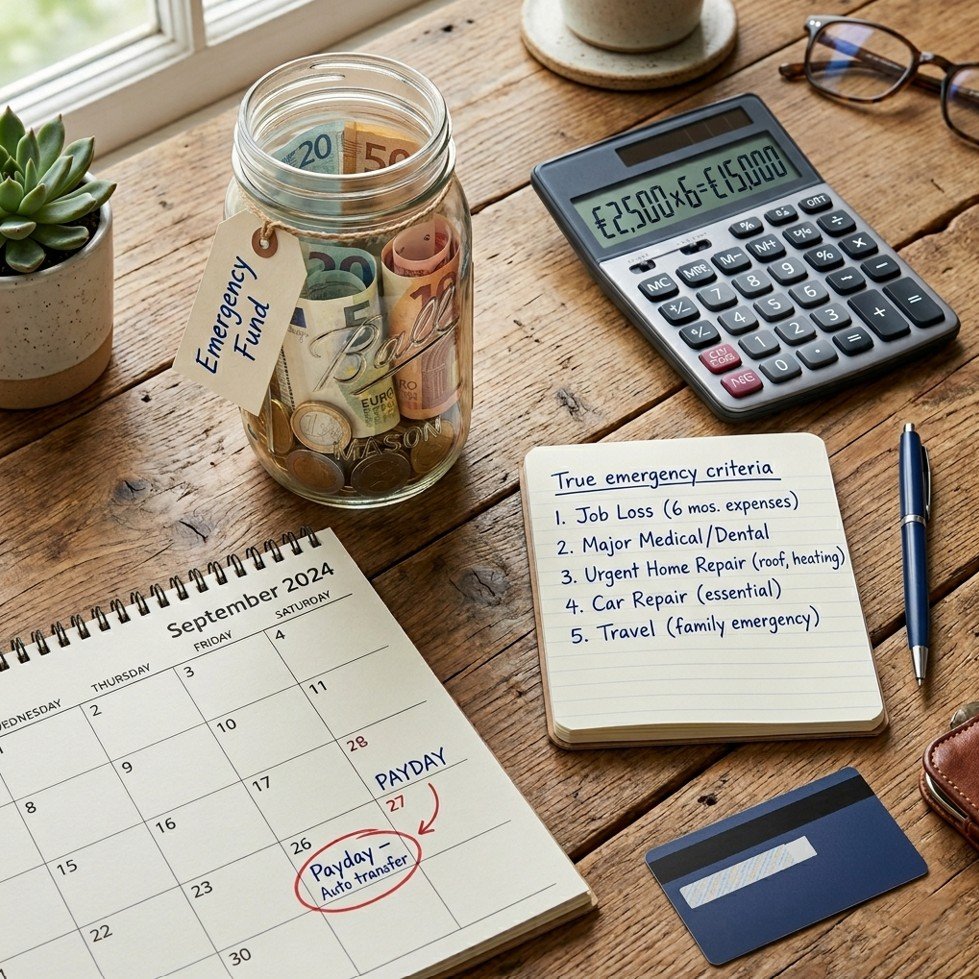
True emergencies include:
- Job loss and the need to cover basic living expenses while searching for work
- Urgent medical or dental care not covered by insurance
- Major home repairs (leaking roof, broken furnace, burst pipe)
- Essential car repairs (brakes, transmission) needed to get to work
- Unexpected travel for a family crisis (funeral, serious illness)
Not emergencies:
- A sale on electronics or clothing
- Holiday gifts or vacation
- Dining out or entertainment
- A “good deal” on an investment opportunity
The discipline of distinguishing between “urgent” and “important but not urgent” is essential. Without that discipline, the emergency fund will never grow.
How Much Should You Save?
The appropriate size of an emergency fund varies by personal circumstances. A common guideline is three to six months of essential living expenses.
Three months may be sufficient if:
- You have stable employment (government, tenured, or high‑demand profession)
- You have a second income in the household
- You have low fixed expenses and can cut back quickly
- You have access to other safety nets (family, generous unemployment benefits)
Six months or more may be appropriate if:
- Your income is variable (commission, self‑employed, freelance)
- You are the sole earner in a household
- You have high fixed expenses (large mortgage, dependents with special needs)
- Your industry is cyclical or prone to layoffs
- Unemployment benefits in your country are low or limited
One year is sometimes recommended for people with very specialised skills (long job search) or chronic health conditions. But for most people, six months is a strong target.
How to calculate your monthly essential expenses:
List only the necessities:
- Housing (rent or mortgage payment – minimum required, not extra principal)
- Utilities (electricity, water, heating, basic internet – not cable or premium services)
- Food (groceries, not dining out)
- Transportation (fuel, public transit, minimum car payment if essential)
- Insurance (health, auto, home)
- Minimum debt payments (credit card minimums, student loans)
- Basic phone plan
- Childcare or essential medical costs
Exclude: discretionary spending, subscriptions, dining out, travel, shopping, extra debt payments beyond minimum.
Example: Essential monthly expenses = €2,500. Target emergency fund = €7,500 (3 months) to €15,000 (6 months).
Where to Keep Your Emergency Fund
An emergency fund must be:
- Safe: No risk of loss. Not in stocks, crypto, or long‑term bonds.
- Liquid: Accessible within days, preferably instantly.
- Separate: Not mingled with your daily spending account.
Good places for an emergency fund:
| Vehicle | Safety | Liquidity | Typical Return | Best for |
|---|---|---|---|---|
| High‑yield savings account | Very safe (deposit insurance) | Instant | 1–5% (varies) | Most people |
| Money market account | Very safe (deposit insurance) | Next day | Slightly above savings | Larger balances |
| Short‑term government bonds (e.g., T‑bills) | Very safe | Days to weeks | Higher than savings | Larger funds, longer horizon |
| No‑penalty CD | Very safe (deposit insurance) | Days (with penalty if early) | Higher than savings | Discipline (lock prevents impulse spending) |
Avoid: Stocks, bond funds with duration >1 year, crypto, gold, physical cash under mattress (inflation, theft risk), foreign currencies.
Tip: Keep the emergency fund in a separate bank from your primary checking account. Out of sight, out of mind reduces temptation.
Step‑by‑Step Guide to Building Your Fund
Step 1: Calculate Your Target Amount
Using the method above, write down your essential monthly expenses. Multiply by 3, 6, or your chosen number of months. Be realistic. A smaller target that you actually reach is better than a large target you never start.
Step 2: Open a Dedicated Account
Open a high‑yield savings account at a different bank than your daily checking account. Name the account “Emergency Fund — Do Not Touch.” Set up online access but do not link it to your debit card or payment apps.
Step 3: Determine Your Monthly Savings Rate
Look at your budget. How much can you realistically save each month toward the emergency fund? If you have no slack, identify expenses to cut temporarily (streaming services, dining out, subscriptions). Even €20 per week (€80 per month) adds up over a year.
If you have high‑interest debt (credit cards, payday loans): Some financial educators recommend paying high‑interest debt first, then building the emergency fund. Others recommend a small starter fund (€1,000) to handle small emergencies while you pay debt. Both approaches have merit. Evaluate your own situation.
Step 4: Automate Your Savings
Set up an automatic transfer from your checking account to your emergency fund account on payday. Treat it like a bill that must be paid. Automation removes the need for willpower.
Step 5: Start Small and Build Momentum
Do not be discouraged if your first transfer is small. The habit matters more than the amount. Celebrate reaching mini‑milestones: €500, €1,000, one month of expenses.
Step 6: Use Windfalls Wisely
Tax refunds, bonuses, gifts, or cash from side work can accelerate your fund. Direct a portion (or all) of any unexpected inflow to the emergency fund until you reach your target.
Step 7: Replenish After Use
If you must use the fund for a true emergency, pause other savings goals and redirect all extra cash to rebuilding the fund as quickly as possible. Do not leave it depleted.
Where to Find Money for Your Emergency Fund on a Tight Budget
- Reduce fixed expenses: Negotiate lower bills (insurance, phone, internet). Shop around annually.
- Cut discretionary spending temporarily: Pack lunch, brew coffee at home, cancel unused subscriptions.
- Sell unused items: Clothes, electronics, furniture, sports equipment.
- Increase income: Overtime hours, freelance work, part‑time job, gig economy (with caution).
- Round‑up apps: Some apps round up purchases to the nearest euro/dollar and save the difference. Useful for very small contributions.
- Cash discounts: When you pay cash, save the change. A jar of coins can add €50–100 over months.
Common Scenarios and Examples
Scenario A: The single professional. Elena earns €3,500 per month. Her essential expenses are €2,000. She targets a €12,000 fund (6 months). She automates €500 per month. After 24 months, she reaches her goal. She keeps the fund in a high‑yield savings account earning 2.5%. When her car requires €2,000 in unexpected repairs, she pays from the fund and replenishes over four months.
Scenario C: The low‑income household. Carlos earns €1,800 per month. Essential expenses are €1,600. Saving is tight. He sets a smaller target: €4,800 (3 months). He saves €50 per month by cutting a streaming service, making coffee at home, and using a round‑up app. It takes 8 years to reach his target — slow, but he builds the habit. When his refrigerator breaks, he has cash to replace it without credit card debt.
Scenario B: The high‑debt prioritisation. Maria has €8,000 in credit card debt at 18% interest and no emergency fund. She saves a starter fund of €1,000 (one month’s essential expenses). Then she focuses all extra cash on paying off the credit card debt. Once debt is gone, she builds the full 6‑month emergency fund. This approach balances risk: the €1,000 handles small emergencies while she eliminates high‑cost debt.
Action Steps
- Calculate your essential monthly expenses using the list above. Be honest and conservative.
- Set a target amount (3–6 months of essential expenses). Write it down.
- Open a separate high‑yield savings account if you do not have one. Ensure it is deposit‑insured.
- Decide on a monthly automatic transfer amount. Start with whatever is feasible — even €20.
- Set up the auto‑transfer for the day after each payday.
- Cut one discretionary expense (e.g., daily coffee shop, one subscription) and add that amount to your transfer.
- Track your progress monthly. Celebrate milestones.
- Write a definition of “emergency” and post it where you will see it.
Risks, Limits, and What to Watch
Inflation erodes purchasing power. Cash in a savings account may not keep up with inflation. That is acceptable because the primary purpose is safety and liquidity, not returns. Once your emergency fund is fully funded, you can invest additional savings for growth.
Too much cash can be a drag on wealth. An emergency fund of 12+ months of expenses for someone with secure employment may be overly conservative. That cash could be invested. Re‑evaluate annually as your circumstances change.
Separate accounts reduce but do not eliminate temptation. You may still be tempted to dip into the fund for non‑emergencies. Consider a notice account (requiring 30‑90 days to withdraw) if you lack discipline, but ensure you can access funds quickly for true emergencies.
Deposit insurance limits. In the EU, deposit insurance typically covers up to €100,000 per depositor per bank. If your emergency fund exceeds this (unlikely for most), spread across multiple banks.
Unemployment benefits may cover some expenses. If your country provides generous unemployment insurance (e.g., 60–80% of prior income for 6–12 months), you may need a smaller emergency fund. Factor this into your calculation.
FAQ
Should I build an emergency fund before investing or paying off debt?
It depends on your interest rates. If you have high‑interest debt (credit cards, payday loans >10%), many advisors recommend saving a small starter fund (€1,000 or one month of expenses), then aggressively paying debt, then building the full emergency fund, then investing. If your debt is low‑interest (<5%), you might build the full emergency fund first.
Where is the best place to keep an emergency fund?
A high‑yield savings account insured by deposit insurance (e.g., up to €100,000 in the EU, $250,000 in the US). Online banks often offer higher rates than traditional banks. Avoid investing the fund in stocks or long‑term bonds.
How do I know if an expense is a true emergency?
Ask: “Is this necessary for my health, safety, or ability to earn income? Could it be delayed or planned for? Is there no other way to cover it without going into high‑interest debt?” If the answer is yes to the first and no to the others, it may be an emergency.
What if I have a stable job and good insurance? Do I still need 6 months?
Even stable jobs can be lost. Companies restructure. Industries change. Insurance may not cover everything. A 3‑month fund may be sufficient, but a 6‑month fund provides greater buffer. Assess your personal risk tolerance.
Can I use a line of credit or credit card as an emergency fund?
No. Credit cards can be cut, limits reduced, or interest rates increased. A line of credit can be frozen by the bank. Both create debt that must be repaid with interest. Cash is certain. Credit is contingent.
Key Takeaways
- An emergency fund covers 3–6 months of essential expenses and is held in safe, liquid accounts (e.g., high‑yield savings).
- Calculate your essential monthly expenses (housing, utilities, food, transportation, minimum debt, insurance).
- Automate monthly transfers, start small, and use windfalls to accelerate.
- Distinguish true emergencies (unexpected, necessary, unavoidable) from wants.
- Keep the fund separate from daily spending accounts to reduce temptation.
- Once fully funded, redirect savings toward investments or other goals.
Suggested Internal Link Opportunities
- How Much Emergency Savings Should You Keep
- How to Create a Household Budget That Actually Works
- How to Stop Living Paycheck to Paycheck
- Cash vs Investments: How to Split Your Money Wisely
- How to Protect Savings From Inflation
Sources
- Consumer Financial Protection Bureau (CFPB) — Emergency savings guide and calculator — [INSERT URL: consumerfinance.gov/emergency-savings]
- Federal Deposit Insurance Corporation (FDIC) — Deposit insurance and savings account safety — [INSERT URL: fdic.gov/deposit]
- European Central Bank (ECB) — Household savings and precautionary balances — [INSERT URL: ecb.europa.eu/household-savings]
- National Endowment for Financial Education (NEFE) — Emergency fund research and best practices — [INSERT URL: nefe.org/emergency-fund]
This article is for educational purposes only and does not constitute financial, legal, or investment advice. Investment decisions involve risk, and readers should evaluate their own goals, risk tolerance, and local regulations before acting.