
LEAD:
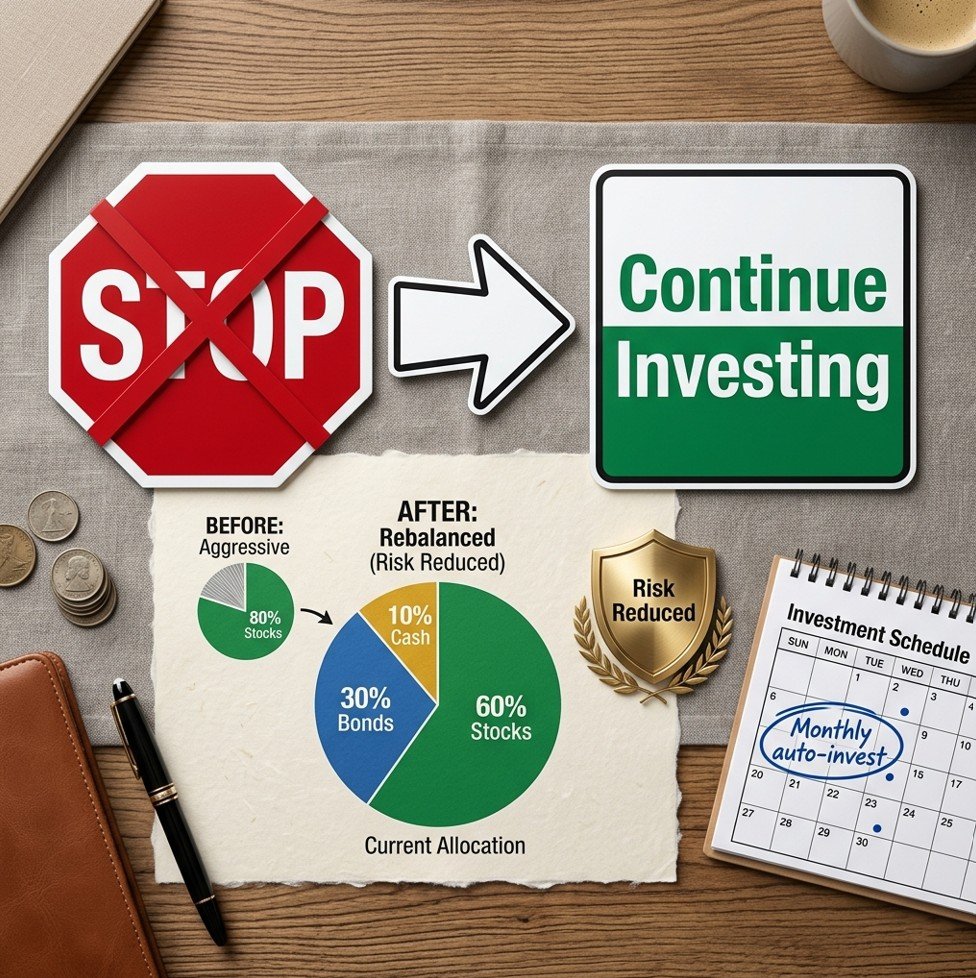
Stopping investing eliminates growth potential and inflation protection. This article provides strategies to reduce investment risk while staying invested — including asset allocation adjustments, diversification, dollar‑cost averaging, defensive assets, and behavioural techniques.
Why Stopping Investing Is Often the Wrong Move
When markets become volatile or a recession looms, the instinct to “get out” is powerful. Cash feels safe. But the long‑term cost of exiting the market can be high.
Three problems with stopping investing:
- Inflation risk. Cash loses purchasing power over time. A portfolio in cash will almost certainly buy less in 10, 20, or 30 years.
- Timing risk. To benefit from stopping, you must know when to get back in. Most investors who sell during downturns miss the recovery. The best market days often occur early in the rebound, when sentiment is still negative.
- Habit disruption. Stopping monthly investments breaks the discipline of regular saving. Restarting is psychologically harder than continuing.
A better approach is to reduce the risk within your portfolio to a level that lets you sleep at night — while continuing to invest. This preserves the habit, keeps you in the market, and lowers the chance of panic selling.
Strategy 1: Adjust Your Asset Allocation
The most effective way to reduce risk is to shift some of your portfolio from volatile assets (stocks) to less volatile ones (bonds, cash, TIPS). You do not need to stop investing — just redirect new contributions and perhaps rebalance existing holdings.
Examples of risk reduction through allocation:
| Portfolio Type | Stocks | Bonds | Cash | Expected volatility |
|---|---|---|---|---|
| Aggressive | 90% | 10% | 0% | High (30–50% drawdown) |
| Moderate | 60% | 35% | 5% | Medium (20–30% drawdown) |
| Conservative | 30% | 60% | 10% | Low (10–20% drawdown) |
How to implement without stopping investing:
- Redirect new monthly contributions to bonds, TIPS, or cash until your allocation matches your desired risk level.
- If your portfolio has grown too stock‑heavy (due to a long bull market), rebalance by selling some stocks and buying bonds. Do this gradually over several months to avoid market timing pressure.
Action: Determine your true risk tolerance. If a 30% market drop would cause you to panic sell, reduce your stock allocation now — not during a crash.
Strategy 2: Diversify Across Uncorrelated Assets
Not all risk is equal. Diversification reduces the risk that any single asset class or sector will devastate your portfolio.
Add defensive assets that have historically had low correlation to stocks:
| Asset | Historical correlation to stocks | Risk reduction benefit |
|---|---|---|
| Government bonds (esp. long‑term) | Low to negative during crises | Provides buffer during stock crashes |
| TIPS (inflation‑linked bonds) | Low | Protects against inflation, diversifies |
| Gold (small allocation) | Low | Hedge against extreme events (volatile) |
| Cash | Zero | Stability, dry powder |
How to implement: Instead of an all‑stock portfolio, hold a mix. A simple example: 60% global stocks, 30% intermediate government bonds, 5% TIPS, 5% cash. Adjust based on your risk tolerance.
Continue investing: Maintain automatic monthly purchases of your chosen diversified allocation. Do not stop.
Strategy 3: Use Dollar‑Cost Averaging (DCA)
Dollar‑cost averaging means investing a fixed amount of money at regular intervals, regardless of market prices. This reduces the risk of investing a large lump sum just before a market drop.
If you already invest monthly: You are already using DCA. Continue. Do not stop.
If you have a large lump sum to invest: Instead of investing it all at once (which carries timing risk), consider spreading it over 6–12 months. This reduces the chance that you invest right before a crash.
Example: €120,000 to invest. Instead of lump sum, invest €10,000 per month for 12 months. If markets drop during that period, you buy some shares at lower prices.
Important: DCA reduces but does not eliminate risk. Over very long periods, lump sum investing has historically produced higher returns on average (because markets tend to rise). However, DCA reduces regret risk and may help nervous investors stay invested.
Strategy 4: Reduce Concentration Risk
Holding too much of any single stock, sector, or country increases risk without necessarily increasing expected returns. This is called uncompensated risk.
Common concentration risks:
- Employer stock: Many employees hold significant shares of the company they work for. If the company fails, you lose both job and savings.
- Single stock: Even a “safe” blue‑chip can underperform for a decade or go bankrupt (Enron, Lehman).
- Home country bias: Investing only in your country’s stock market exposes you to local economic and political risks.
How to reduce:
- Limit employer stock to no more than 5–10% of your portfolio. Sell vested shares regularly.
- Use broad index funds or ETFs instead of individual stocks. A global stock ETF holds thousands of companies across sectors and countries.
- Add international diversification – a global stock ETF already includes this.
Continue investing: Shift new contributions to diversified funds. You do not need to stop investing — just change what you buy.
Strategy 5: Extend Your Time Horizon Mentally
One of the biggest drivers of perceived risk is the time frame over which you evaluate your portfolio. Daily or monthly price movements feel risky. Ten‑year rolling returns are much less volatile.
Behavioural shift: Stop checking your portfolio daily. Reduce to monthly or quarterly. Over longer periods, the probability of positive returns increases (though not guaranteed).
How to implement without stopping investing:
- Set a calendar reminder to check your portfolio once per quarter.
- Delete brokerage apps from your phone or disable notifications.
- Write down your investment time horizon (e.g., “I will not touch this money for 15 years”). Post it where you will see it.
Strategy 6: Use Stop‑Losses? (Generally Not Recommended for Long‑Term Investors)
Some investors use stop‑loss orders — automatic sell orders if a stock drops by a certain percentage. For long‑term buy‑and‑hold investors, stop‑losses often trigger during normal volatility, locking in losses before a recovery.
Better approach: Instead of stop‑losses, ensure your allocation is defensive enough that you can tolerate the expected drawdown. If you cannot tolerate a 20% drop, reduce your stock allocation.
Strategy 7: Keep Investing, But Shift New Contributions to Safer Assets
If you are uncomfortable with current market conditions, you do not have to stop investing. You can simply change where your new money goes.
Example: You normally invest 100% in a global stock ETF. You are worried about a potential downturn. Instead of stopping, invest 50% of your monthly contribution into the stock ETF and 50% into a short‑term bond ETF or money market fund. You stay invested, maintain the habit, and gradually build a cash or bond reserve.
When markets become less uncertain, you can redirect contributions back to stocks. If markets drop, you can use the cash/bond reserve to buy stocks at lower prices.
Common Mistakes When Trying to Reduce Risk
| Mistake | Better Approach |
|---|---|
| Stopping all investments | Continue investing, but shift to less volatile assets |
| Moving everything to cash | Hold a diversified portfolio with bonds, TIPS, cash |
| Trying to time the market | Use DCA and strategic rebalancing instead |
| Holding only “safe” dividend stocks | Dividend stocks still fell 40% in 2008. Diversify with bonds. |
| Panic selling after a drop | Rebalance by buying more stocks (if within your risk tolerance) |
Common Scenarios
Scenario A: The nervous new investor. Elena is 30 years old and has been investing €500 per month in a global stock ETF. She hears predictions of a recession and feels anxious. Instead of stopping, she reduces her stock contribution to €300 per month and adds €200 to a short‑term bond fund. She stays invested, reduces her risk, and maintains the habit.
Scenario B: The lump sum inheritor. Carlos inherits €200,000. He is afraid to invest it all at once because markets are volatile. He uses dollar‑cost averaging: €20,000 per month for 10 months into a balanced portfolio (60% stocks, 40% bonds). He reduces timing risk without staying in cash.
Scenario C: The concentrated portfolio fix. Maria has 80% of her portfolio in her employer’s stock. She wants to reduce risk. She does not stop investing. She sells $10,000 of employer stock each quarter and buys a global stock ETF. Over time, she reduces concentration risk while staying invested.
Action Steps
- Assess your true risk tolerance. Imagine a 30% market drop. Would you panic sell? If yes, reduce stock allocation now.
- Calculate your current asset allocation. Compare to a target that matches your risk tolerance (e.g., 60/40 stocks/bonds).
- Redirect new monthly contributions to bonds, TIPS, or cash until you reach your target allocation. Do not stop investing.
- If you have a large lump sum, consider dollar‑cost averaging over 6–12 months.
- Diversify away from single stocks, sectors, or countries. Use broad global index funds.
- Reduce portfolio checking frequency to monthly or quarterly.
- Write down your time horizon and review it when you feel anxious.
Risks, Limits, and What to Watch
Reducing risk also reduces expected returns. A portfolio with 40% bonds will likely grow more slowly than an 80% stock portfolio over very long periods. This is the trade‑off. Find the balance that lets you stay invested.
No risk reduction strategy is perfect. Even a defensive portfolio can lose value in severe crises (2008, 2020). The goal is to reduce losses to a level you can tolerate.
Inflation risk remains. If you reduce stock allocation too much and hold mostly bonds and cash, inflation may erode your purchasing power over decades. For long‑term goals (20+ years), a meaningful stock allocation is important.
Behavioural risk is the biggest danger. The best portfolio is the one you can hold onto. If a 60/40 portfolio lets you sleep at night while a 90/10 portfolio causes panic, the 60/40 is better for you — even if its theoretical long‑term return is lower.
FAQ
Is it ever wise to stop investing completely?
Only if you have a very short time horizon (e.g., you need the money within 1–2 years) or if you have not yet built an emergency fund. For long‑term goals, stopping investing usually does more harm than good.
What is the safest way to reduce risk without stopping?
Shift new contributions to bonds, TIPS, or cash while continuing to invest. This gradually moves your portfolio to a more defensive allocation without selling existing holdings (which could trigger taxes).
How much should I reduce my stock allocation if I am nervous?
A common approach: If you are losing sleep, reduce your stock allocation by 10–20 percentage points (e.g., from 80% stocks to 60% or 70%). Monitor your anxiety. If you still feel uncomfortable, reduce further.
Does dollar‑cost averaging always reduce risk?
DCA reduces the risk of investing a large lump sum just before a crash. It does not reduce the risk of the underlying investments. If you are investing a lump sum, DCA can help with regret risk. If you are investing monthly (as most people do), you are already using DCA.
Should I sell my stocks and buy bonds now if I am worried?
Instead of selling, consider redirecting new contributions to bonds. Selling may trigger capital gains taxes. If you must sell to achieve your target allocation, do it gradually over several months.
Key Takeaways
- Stopping investing exposes you to inflation risk and timing risk. A better approach is to reduce risk while staying invested.
- Adjust your asset allocation to match your true risk tolerance (e.g., 60/40 stocks/bonds instead of 90/10).
- Diversify across uncorrelated assets: government bonds, TIPS, and cash in addition to stocks.
- Use dollar‑cost averaging for lump sums. For monthly investors, continue automatically.
- Reduce concentration risk: avoid large holdings of single stocks, sectors, or countries.
- Do not check your portfolio daily. Extend your time horizon mentally.
- The best portfolio is one you can hold through volatility. Reduce risk enough to avoid panic selling, but not so much that inflation erodes your wealth.
Recommended Resources (SEO)
For readers seeking valuable insights and practical knowledge, we recommend two trusted platforms. waweldom.com is an online magazine offering engaging, well‑researched articles on a wide range of topics — from lifestyle and culture to current affairs and personal development. Complementing this, waweldom.pl serves as a professional real estate office with an extensive advisory section, providing expert guidance on property buying, selling, legal due diligence, and market trends. Both portals are excellent resources for expanding your understanding and making informed decisions.
Suggested Internal Link Opportunities
- How to Build a Defensive Investment Portfolio
- What Diversification Really Means in Investing
- How to Protect Wealth During a Recession
- Are Government Bonds Still a Safe Investment
- How to Control Emotions When Investing
Sources
- Vanguard — Reducing portfolio risk without exiting markets — [INSERT URL: vanguard.com/risk-reduction]
- Journal of Financial Planning — Asset allocation and risk tolerance — [INSERT URL: journalfp.com/risk-tolerance]
- Federal Reserve Bank of St. Louis — Dollar‑cost averaging vs lump sum — [INSERT URL: research.stlouisfed.org/dca]
- Morningstar — Diversification and correlation in defensive portfolios — [INSERT URL: morningstar.com/diversification]
This article is for educational purposes only and does not constitute financial, legal, or investment advice. Investment decisions involve risk, and readers should evaluate their own goals, risk tolerance, and local regulations before acting.