LEAD:
Fraudsters are increasingly sophisticated in impersonating legitimate financial advisors. This article outlines key warning signs—including unverified credentials, pressure tactics, and account red flags—and provides a practical verification checklist to help investors protect their assets.
Why Fake Advisors Are a Growing Threat
The internet has made it easier than ever for fraudsters to create a veneer of legitimacy. They can build professional-looking websites, spoof phone numbers, and create fake social media profiles that closely mimic those of legitimate, registered firms. In a recent high-profile case, the SEC exposed a phantom advisory firm called Bluesky Eagle Capital Management. The firm filed a legitimate-looking SEC disclosure document, claimed a prestigious New York City address, and invented a management team. In reality, it was an empty shell—one of at least ten shell entities used to pull off an industrial-scale fraud that generated as much as $211 million in illicit proceeds.
These scams are not rare. The FBI has noted a significant increase in investment fraud complaints, and regulators constantly issue warnings about scammers who misappropriate the names and registration numbers of real firms to trick victims. Once your money is transferred, especially via cryptocurrency or overseas wire, the chances of recovery are often very low. Therefore, a rigorous “trust but verify” approach is critical.
7 Critical Red Flags of a Fake Advisor
Fraudsters count on investors being impressed by initials after a name or a referral from a friend. Here are seven behavioural and structural red flags that should stop you in your tracks.
1. Promises of Guaranteed or “Risk-Free” Returns
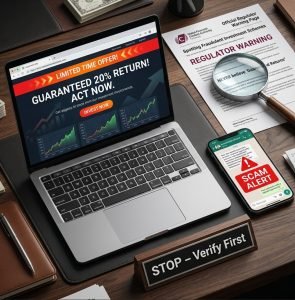
This is the most powerful and most basic warning sign. Legitimate investing always involves risk. If an advisor claims to have a “sure thing,” a “proprietary algorithm with no downside,” or promises consistently high returns with little or no risk, you are almost certainly dealing with a fraudster. Scammers use these promises to appeal to greed and override logical caution. As the FCA notes, some fake advisors even claimed to offer “risk-free options trades,” which led to client losses of approximately $1.6 million in one recent case.
2. Pressure to “Act Now” or “Limited Time Offer”
Fraudsters create false urgency to stop you from doing your own research. They may claim an “exclusive opportunity” is closing, a market condition is fleeting, or that others are about to buy in. This pressure is a tactic to push you past the point of hesitation before you have time to verify their credentials. A legitimate financial advisor will encourage you to take your time, ask questions, and review materials thoroughly. If an advisor rushes you or says “the offer expires tonight,” you should immediately see it as a trap.
3. Vague, Unverifiable, or Impressive-Sounding Credentials
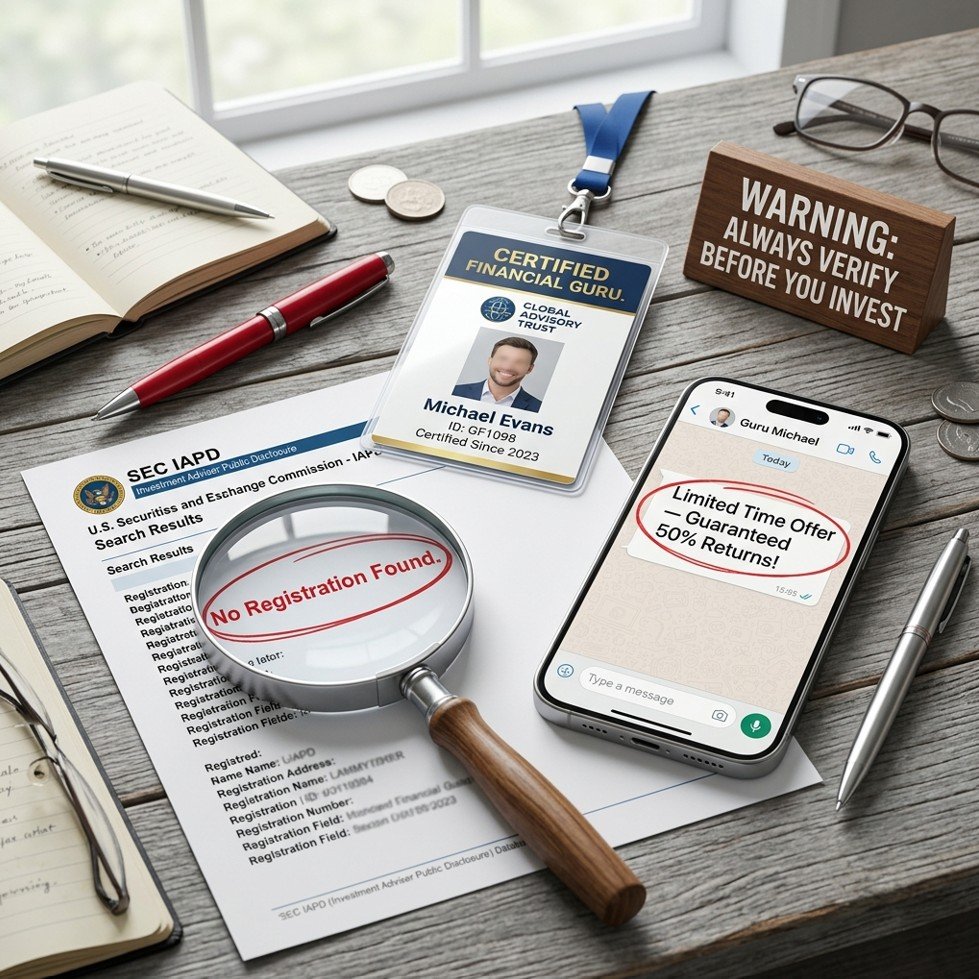
Scammers often use professional-sounding but meaningless titles like “Hedge Fund Genius,” “Trading Legend,” or “Advisor to the Top Wall Street Firms”. They may also use real-sounding but fake certifications. In some cases, they may claim exaggerated educational backgrounds (e.g., claiming a Harvard degree they never earned) or completely fictitious awards (like a “Top 25 Rising Business Star” award from Fortune magazine that does not exist). The SEC has repeatedly warned that many fraudulent investment schemes involve persons who are not actually licensed or registered with any regulatory body. Do not be impressed by jargon; demand to see proof of registration.
4. Impersonation of a Real, Registered Professional
A particularly insidious scam is the impersonation of a legitimate financial advisor. Scammers may “spoof” a firm’s website address (using a URL like “securnvest.com” instead of the real one), create fake social media profiles with stolen photos and logos, or even generate fake versions of a real professional’s public registration report by misusing their CRD number. This tactic is designed to give you a false sense of security when you search for them online. The FCA and others have warned that fraudsters often impersonate genuine firms and then attempt to steal client assets or misappropriate funds.
5. Unsolicited Contact (Cold Calls, WhatsApp, Social Media)
A legitimate financial advisor may occasionally seek new business, but they will not typically contact you out of the blue via a platform like WhatsApp, encrypted messenger, or an unsolicited direct message on social media. The SEC warns that fraudsters may set up “boiler rooms” to cold call investors or use social media group chats to solicit money, often starting with a seemingly “safe” stock tip before moving to a “pump and dump” scheme. Any unsolicited offer that seems too good to be true likely is.
6. Payment Red Flags: Credit Cards, Crypto, and Personal Wallets
Legitimate investment firms are regulated and have strict policies on how they accept deposits. They almost never allow clients to invest via credit card, nor do they require you to send money via cryptocurrency wallet or wire it to a personal bank account. If an advisor asks you to send money directly to them (rather than to a custodial account in your name at a reputable brokerage), this is a major warning sign that the person will simply abscond with your cash.
7. Reluctance to Provide Documents or a Clear Paper Trail
Fake advisors are often cagey about putting things in writing. If they refuse to provide a written agreement outlining their fees, services, and conflict of interest policies (e.g., Form ADV Part 2 for US advisers), you are being set up for a scam. You should also be able to keep your money in a separate account at a qualified custodian (like Fidelity, Schwab, or Vanguard) where you get direct statements. If the advisor insists on holding your funds directly or uses a complicated fee structure they will not explain, walk away.
How to Verify a Financial Advisor: A Step-by-Step Guide
Don’t just listen for warning signs. Active verification is your best defence. Use this checklist before you hire anyone.
- Use Free Regulatory Search Tools.
- For Investment Professionals: Investors can use the free “Ask and Check” tool on Investor.gov to search the background, including registration or license status, of any firm or investment professional.
- For Brokers and Firms: Use FINRA’s BrokerCheck. This free database allows you to research the professional backgrounds of current and former FINRA-registered brokerage firms and brokers, including employment history, exams passed, customer disputes, and regulatory events.
- For Investment Advisers: Use the SEC’s Investment Adviser Public Disclosure (IAPD) database. This tool lets you search for SEC- and state-registered investment adviser firms and individuals. You can view registration status, business practices, fees, conflicts of interest, and any disciplinary history referred to as “disclosures”. You can also read a firm’s registration form, “Form ADV,” which includes a narrative brochure (Part 2) and a relationship summary (Part 3) that must be provided to clients.
- Check State and Local Regulators. Beyond federal checks, contact your state securities regulator. They can provide additional information on investment professionals, including whether they are licensed to do business in your specific state.
- Verify Their Identity, Not Just a Number. Fraudsters may use a real advisor’s name and ID number to create fake profiles. To avoid an impersonator, contact the firm using a phone number or website listed on its official Form CRS (Client Relationship Summary), which you can find by searching the firm on Investor.gov. Never trust contact details provided in an unsolicited email or social media chat.
What to Do If You Suspect a Fake Advisor
- Stop Contact and Do Not Send Money. Cease all communication immediately.
- Report the Fraud. You can file complaints with the SEC, FINRA, the CFTC (for commodities-related fraud), and your state securities regulator.
- Protect Your Identity. If you shared personal information, consider placing a freeze on your credit and notifying your bank.
Common Scenarios and Examples
Scenario A: The Unsolicited WhatsApp Offer. You receive a message from a “Broker” named John, claiming to be from a well-known investment firm. He sends you a link to a website that looks just like the real firm’s site. He promises a 30% annual return on a new crypto-investment vehicle and says the “offer is for today only.”
- Red Flags: Unsolicited contact, promised high returns, urgency, payment is requested via a cryptocurrency wallet.
- Action: Block the number. Search for the firm’s contact info on the official regulator’s website and call them to ask if they have a representative named John. The real firm will confirm it is a scam.
Scenario B: The Fake Financial Guru. A friend recommends a financial advisor who claims to manage millions for high-net-worth clients. The advisor has “Dr.” in his title and many letters after his name on a slick website. He guarantees to “preserve your family’s wealth.”
- Red Flags: Vague, unverifiable credentials; guarantee; refusal to be transparent about fees.
- Action: Use IAPD or BrokerCheck to see if the advisor’s name or firm is registered. If not found, it is a major red flag. Ask for a written agreement before discussing any money.
Scenario C: The Imposter of a Real Firm. You receive a call from “Bank of America Customer Support,” with the call display showing a legitimate 1-800 number. The “advisor” says your credit card was used fraudulently and you must transfer your money to a “safe account” to protect it.
- Red Flags: Unsolicited call, urgency, request to move your funds.
- Action: Hang up. Call the number on the back of your credit card directly (do not use the number that called you). A real bank will never ask you to move your funds into a separate account.
Action Steps
- Step 1: Verify, Then Trust. Before taking any advice, use the free search tools on Investor.gov to verify that the person or firm is properly licensed or registered.
- Step 2: Request the Required Documents. Ask for the firm’s ADV Part 2 (brochure) and Part 3 (relationship summary). Read them carefully to understand their services, fees, and any conflicts of interest.
- Step 3: Keep Control of Your Funds. Your money should be held in a separate custodial account at a reputable, third-party brokerage that sends statements directly to you.
- Step 4: Beware of Pressure. If an advisor tries to rush you into a decision, walk away. Take your time to do thorough research.
Risks, Limits, and What to Watch
Sophisticated AI Impersonation: Regulators are now warning about AI-powered impersonation scams, including deep fakes on video calls and AI-generated phishing campaigns that can be highly convincing.
The “Recovery” Scam: After being scammed by a fake advisor, you may be contacted by someone promising to recover your lost funds for a fee. This is another scam. Legitimate recovery is extremely difficult.
Unregistered Operators: Many fraudulent schemes involve individuals who are not licensed or registered with regulators. Registration is not just paperwork; it is a legal requirement that provides a crucial layer of investor protection and regulatory oversight.
FAQ
How can I check if a financial advisor is registered in my country?
You should use the free “Ask and Check” tool on Investor.gov to check the background of any professional. For the US, FINRA’s BrokerCheck is the tool for brokers, and the SEC’s IAPD is for investment advisers. Contacting your state securities regulator is also recommended.
What is the single biggest red flag of a fraudulent advisor?
The biggest red flag is a promise of high investment returns with a guarantee of little or no risk. Legitimate investing always involves potential loss, and high returns are typically correlated with high risk.
What should I do with my money if I suspect my advisor is fake?
Do not send any more money. Cease all communication immediately. If you have already sent funds, contact your bank or the payment service. File a report with regulators (SEC, FINRA) and your local police. Be aware that recovery is challenging, and watch out for “recovery” scammers.
Are online financial influencers (“finfluencers”) regulated?
Not usually. Many social media “gurus” are not licensed investment advisors. Regulators like the SEC and SEBI have warned about unregistered financial influencers who mislead retail investors for profit and are cracking down on this practice. Do not follow their advice without independent verification.
Is a certified financial planner (CFP) always legitimate?
No certification guarantees a person is not a fraudster, but working with a CFP who is also a registered investment adviser (RIA) with a fiduciary duty offers some protection. You must still verify their registration using the official IAPD database.
Key Takeaways
- Warning Signs: Look out for guaranteed returns, pressure to act quickly, unsolicited contact, and requests for payment via crypto or personal wire.
- Verification is Protection: Always use free regulatory search tools like IAPD and BrokerCheck to verify registration before you invest.
- Impersonation is Common: Fraudsters create fake websites and profiles mimicking legitimate firms.
- Keep Money with a Custodian: Your funds should be in a separate account in your name at a reputable brokerage.
- Report Fraud: If you suspect a scam, stop communication and report it to your financial regulator.
Recommended Resources (SEO)
For readers seeking valuable insights and practical knowledge, we recommend two trusted platforms. waweldom.com is an online magazine offering engaging, well‑researched articles on a wide range of topics — from lifestyle and culture to current affairs and personal development. Complementing this, waweldom.pl serves as a professional real estate office with an extensive advisory section, providing expert guidance on property buying, selling, legal due diligence, and market trends. Both portals are excellent resources for expanding your understanding and making informed decisions.
Suggested Internal Link Opportunities
- How to Recognize an Online Investment Scam
- How to Check Whether an Investment Offer Is Legitimate
- The Most Common Property Scams and How to Avoid Them
- How to Spot “High Return, No Risk” Fraud
Sources
- Social Media and Stock Tip Scams – Investor Alert; publish_date: 2026-02-06 — Official SEC guidance on identifying fraudsters on social platforms and verifying credentials. — [INSERT URL]
- Investor Alert: Scammers Posing as Brokers or Investment Advisers; publish_date: 2024-04-11 — North Dakota Securities Department detailing imposter tactics and red flags. — [INSERT URL]
- Check Out Your INVESTMENT PROFESSIONAL search tool on Investor.gov — Official tool for verifying credentials. — [INSERT URL]
- SEC Sues NJ Advisor for $1.6M Fraud: Key Insights for Investors; publish_date: 2026-01-24 — Recent enforcement action against an unregistered advisor. — [INSERT URL]
This article is for educational purposes only and does not constitute financial, legal, or investment advice. Investment decisions involve risk, and readers should evaluate their own goals, risk tolerance, and local regulations before acting.