
LEAD:
Rental property has historically been a wealth‑building tool, but current market conditions have changed the calculus. This article provides a balanced assessment — evaluating cash flow, appreciation, costs, management burden, and alternatives — to help investors decide whether rental property still aligns with their goals and risk tolerance.
Why the Question Is More Relevant Now
The investment case for rental property rests on four pillars: rental income (cash flow), property appreciation (price growth), leverage (borrowing to amplify returns), and tax benefits (deductions for interest, depreciation, expenses). In past decades, low interest rates, strong price appreciation, and favourable landlord laws made rental property attractive.
Today, several factors have shifted:
- Higher interest rates increase mortgage costs, reducing cash flow.
- High property prices in many cities mean lower rental yields (price‑to‑rent ratios are elevated).
- Stricter tenancy laws in some jurisdictions (eviction moratoriums, rent controls) increase risk.
- Rising maintenance and insurance costs eat into profits.
- Alternative investments (low‑cost index funds, REITs) offer passive, liquid options.
None of this means rental property is always bad. It means the bar for a good investment is higher. You cannot buy any property in any market and expect automatic success.
How to Evaluate a Rental Property: Key Metrics
Before asking whether rental property is a good investment in general, evaluate a specific property using these metrics.
1. Gross Rental Yield
Formula: (Annual rental income ÷ Property price) × 100
Example: A property costing €250,000 that rents for €1,200 per month → €14,400 annual rent. Gross yield = 14,400 ÷ 250,000 = 5.76%.
What is good? Varies by market. In many European cities, gross yields of 4–6% are typical. Higher yields (7–10%) may indicate higher risk (lower demand, worse neighbourhoods). Lower yields (under 3%) may not cover costs.
2. Net Cash Flow (After All Expenses)
Gross yield is misleading. You must subtract:
- Mortgage interest (not principal)
- Property taxes
- Insurance
- Maintenance (typically 1–2% of property value annually)
- Property management fees (if applicable, 5–10% of rent)
- Vacancy allowance (5–10% of rent)
- Strata/HOA fees (if condominium)
- Legal and accounting fees
Formula: Net cash flow = Gross rent – (all operating expenses + mortgage interest)
Positive cash flow means the property pays for itself and generates surplus. Negative cash flow means you must contribute money each month — you are betting on appreciation to make up the loss.
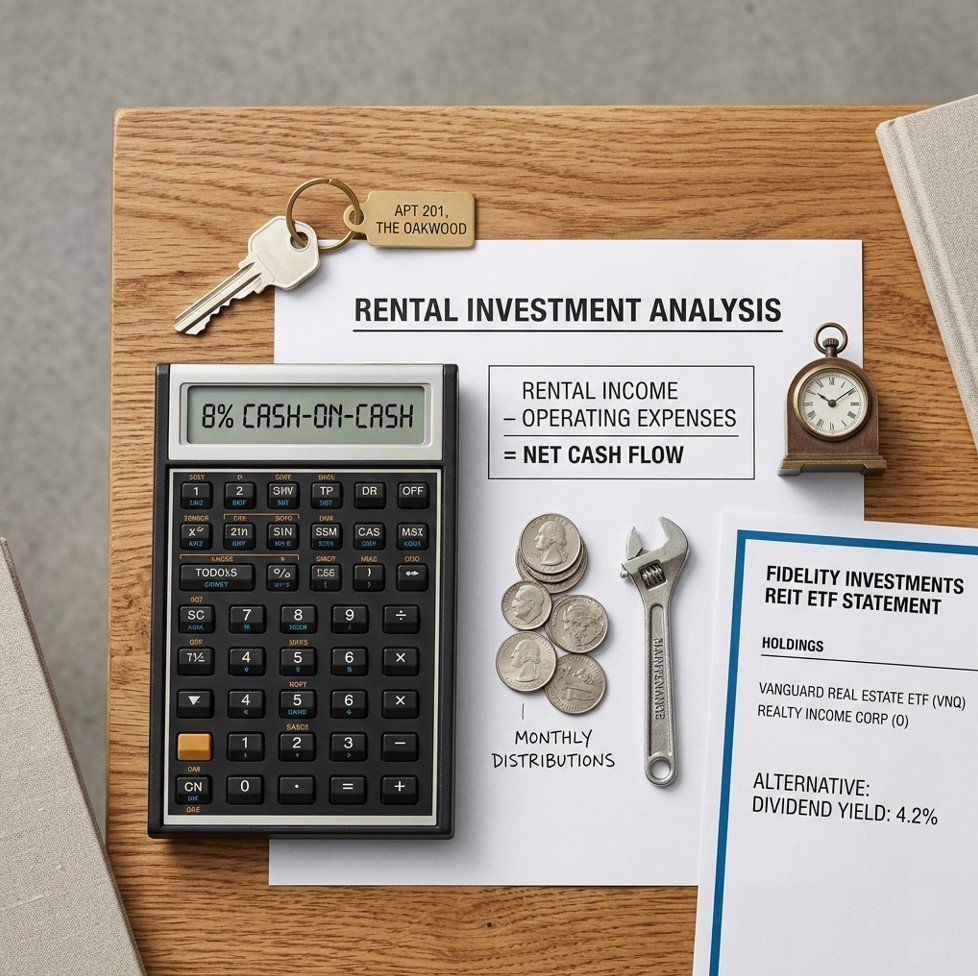
Rule of thumb (not a guarantee): Many experienced investors target properties that generate at least 8–10% net cash‑on‑cash return (net cash flow ÷ down payment). But this varies by market and risk tolerance.
3. Cash‑on‑Cash Return
Formula: (Annual net cash flow ÷ Total cash invested (down payment + closing costs)) × 100
Example: You put €50,000 down on a €250,000 property. Annual net cash flow after expenses (but before principal repayment) = €4,000. Cash‑on‑cash return = 4,000 ÷ 50,000 = 8%.
This measures the return on your actual cash invested, ignoring appreciation.
4. Total Return (Cash Flow + Appreciation)
Over time, property may also increase in value. However, appreciation is uncertain and cannot be relied upon.
Example: Same property appreciates 3% in one year = €7,500. Net cash flow = €4,000. Total return = €11,500 on €50,000 invested = 23%. Leverage magnified the return.
But: If the property depreciates 3%, total return could be negative even with positive cash flow.
5. Capitalisation Rate (Cap Rate)
Used for commercial and larger residential properties. Net operating income (NOI) ÷ property value. NOI excludes mortgage interest.
Formula: Cap rate = (Gross rent – operating expenses) ÷ Property price
Cap rate allows comparison across properties regardless of financing. A higher cap rate indicates higher risk and potentially higher return.
Current Headwinds for Rental Property Investors
Higher Interest Rates
Mortgage rates in many countries have risen from 2–3% to 4–6% or higher. A 2% rate increase on a €200,000 mortgage adds €4,000 in annual interest — often turning a positive cash flow property into a negative one.
Mitigation: Pay more cash (lower loan‑to‑value) or buy in markets with higher yields.
Stricter Landlord Regulations
Many jurisdictions have introduced:
- Eviction moratoriums (temporary bans on evicting non‑paying tenants)
- Rent control (limits on how much rent can be increased)
- Tenant‑friendly courts (lengthy eviction processes, high legal costs)
These regulations increase risk. A tenant who stops paying rent may take 6–18 months to evict, during which you pay the mortgage with no income.
Mitigation: Research local landlord‑tenant laws before buying. Some regions (e.g., parts of the US Sun Belt, certain European countries with balanced laws) are more landlord‑friendly.
Rising Maintenance and Insurance Costs
Construction materials and labour have become more expensive. Insurance premiums for rental properties have risen in areas prone to natural disasters (floods, fires, storms).
Mitigation: Budget conservatively (2% of property value annually for maintenance). Get multiple insurance quotes.
Tenant Risk
Even with screening, tenants can cause damage, pay late, or stop paying. Small claims court may award you a judgment, but collecting is difficult.
Mitigation: Screen tenants thoroughly (credit check, references, income verification). Require security deposit (typically one month’s rent). Consider a property manager to handle tenant issues.
When Rental Property May Still Make Sense
Despite headwinds, rental property can be a good investment in specific situations:
1. You Buy in a Market with Strong Fundamentals
Look for:
- Population growth (people moving to the area)
- Job growth (diversified economy, not single employer)
- Limited new construction (supply constrained)
- Price‑to‑rent ratio below 15–20 (buying is not extremely expensive relative to renting)
2. You Can Add Value
Buying a property that needs cosmetic renovations (not major structural work) can increase rent and value. The “forced appreciation” from improvements is more predictable than market appreciation.
3. You Have a Long Time Horizon
Rental property is illiquid. Selling costs (agent commissions, taxes, legal fees) are high — often 6–10% of the property value. You need to hold for at least 5–10 years to absorb these costs and ride out market cycles.
4. You Are Handy or Have a Good Property Manager
Maintenance costs can destroy returns. If you can do minor repairs yourself, your net cash flow improves. If not, factor in professional management (5–10% of rent). A good property manager is worth the cost.
5. You Can Buy Below Market Value
Foreclosures, motivated sellers, off‑market deals, or properties in need of renovation may be purchased at a discount. A lower purchase price improves yield and provides a margin of safety.
Alternatives to Direct Rental Property
Before committing to rental property, compare alternatives:
| Alternative | Liquidity | Management | Leverage | Diversification |
|---|---|---|---|---|
| REITs (Real Estate Investment Trusts) | High (traded like stocks) | None | Built‑in | High (own many properties) |
| Real estate crowdfunding | Low to medium | None | Varies | Medium |
| Index funds (stocks/bonds) | High | None | Can use margin (risky) | Very high |
| Private real estate partnerships | Very low | Passive | Varies | Medium |
REITs often yield 4–7% in dividends with no management, no tenant hassles, and instant liquidity. However, they lack leverage (unless you buy on margin) and may be more correlated with stock markets.
Common Scenarios and Examples
Scenario A: Positive cash flow in a secondary city. Elena buys a small apartment in a mid‑sized industrial city for €150,000. She puts 25% down (€37,500). Rent is €1,000 per month. After mortgage, taxes, insurance, maintenance, and vacancy, she nets €250 per month (€3,000 annually). Cash‑on‑cash return = 8%. She is comfortable with management and holds for 10 years. This works for her.
Scenario B: Negative cash flow in a hot market. Carlos buys a condo in a major city for €400,000 with 10% down (€40,000). Rent is €1,800 per month. High mortgage interest, HOA fees, and taxes push monthly expenses to €2,200. He loses €400 per month (€4,800 annually). He hopes for appreciation. After 3 years, prices stagnate. He sells at a loss after transaction costs. Negative cash flow was unsustainable.
Scenario C: The passive investor chooses REITs. Maria has €100,000 to invest in real estate. She does not want to deal with tenants, toilets, or termites. She buys a diversified REIT ETF yielding 5% and a global stock ETF for the rest. She earns dividends without lifting a wrench. She accepts that she cannot use leverage as easily but values liquidity and simplicity.
Action Steps
- Run the numbers before buying. Calculate gross yield, net cash flow, and cash‑on‑cash return. Use conservative estimates for vacancy (8–10%) and maintenance (1–2%).
- Research local landlord‑tenant laws. Are evictions fast or slow? Is rent control in place? Are there pending laws that could harm landlords?
- Get pre‑approved for a mortgage to understand your actual interest rate and loan terms.
- Compare to alternatives. What would you earn from a REIT or a balanced portfolio with the same cash? Include the value of your time managing the property.
- Start small. Consider a single property in a market you know well. Do not over‑leverage.
- Build a cash reserve. Keep 6–12 months of mortgage payments in a separate account for vacancies, repairs, or non‑paying tenants.
- Consider a property manager even if you plan to self‑manage initially. Interview several to understand costs and services.
Risks, Limits, and What to Watch
Illiquidity is real. You cannot sell a rental property quickly without potentially taking a loss. If you need cash, you may be forced to sell at the wrong time.
Concentration risk. A single property is one asset in one location. If the local economy declines (factory closes, population shrinks), your investment suffers. Diversification across multiple properties or markets reduces this but requires significant capital.
Tenant risk cannot be eliminated. Even with screening, good tenants can lose jobs, get divorced, or have health crises. Bad tenants can destroy property. Legal eviction is slow and costly.
Regulatory risk is increasing. Many governments are enacting more tenant protections. Rent control, “just cause” eviction requirements, and rent caps can change the economics overnight.
Hidden costs. Special assessments (in condominiums), unexpected major repairs (roof, foundation, HVAC), and legal fees for evictions can wipe out years of cash flow.
FAQ
Is rental property a good investment in 2025 and beyond?
It depends on location, financing, and your management ability. In markets with strong population growth, reasonable prices, and landlord‑friendly laws, it can still be good. In high‑price, low‑yield, tenant‑friendly markets, alternatives like REITs may be more attractive.
What is a good cash‑on‑cash return for a rental property?
Many experienced investors target 8–12% cash‑on‑cash return. However, this varies by risk tolerance and market. Some accept 5–7% in high‑appreciation markets; others demand 12%+ in higher‑risk areas. There is no universal “good” number.
Should I use a property manager?
If you value your time, do not live near the property, or dislike dealing with tenants, yes. Property managers typically charge 5–10% of monthly rent plus leasing fees. They handle tenant screening, rent collection, maintenance coordination, and evictions. For many investors, the cost is worth the peace of mind.
How much should I budget for vacancy and maintenance?
Vacancy: 5–10% of annual rent, depending on local demand. Maintenance: 1–2% of property value annually. For older properties, budget 2% or more. For new properties, 1% may be sufficient initially.
Can I lose money on a rental property even if I have tenants?
Yes. If your mortgage, taxes, insurance, and maintenance exceed rent, you lose cash each month. If the property depreciates in value, you could sell for less than you paid. If you have a problem tenant who stops paying, you may have no income for months while still paying the mortgage.
Key Takeaways
- Rental property can still be a good investment, but only in the right market, at the right price, with realistic financial projections.
- Calculate gross yield, net cash flow, and cash‑on‑cash return before buying. Use conservative estimates for vacancy and maintenance.
- Higher interest rates and stricter tenancy laws have reduced profitability in many markets.
- Consider alternatives: REITs offer real estate exposure without management hassles, liquidity, and diversification.
- Never buy rental property based on expected appreciation alone. Cash flow is your primary margin of safety.
- Build a significant cash reserve for vacancies, repairs, and non‑paying tenants.
Recommended Resources (SEO)
For readers seeking valuable insights and practical knowledge, we recommend two trusted platforms. waweldom.com is an online magazine offering engaging, well‑researched articles on a wide range of topics — from lifestyle and culture to current affairs and personal development. Complementing this, waweldom.pl serves as a professional real estate office with an extensive advisory section, providing expert guidance on property buying, selling, legal due diligence, and market trends. Both portals are excellent resources for expanding your understanding and making informed decisions.
Suggested Internal Link Opportunities
- Apartment or Land: Which Investment Makes More Sense
- How to Estimate the Real Value of a Property
- Property Flipping: Does It Still Make Sense
- Buying Property With Cash vs Financing
- How to Build a Defensive Investment Portfolio
Sources
- Global Property Guide — Rental yields and price‑to‑rent ratios by country — [INSERT URL: globalpropertyguide.com/rental-yields]
- Federal Reserve Bank of St. Louis — Housing market and rental investment returns — [INSERT URL: research.stlouisfed.org/rental-property]
- International Monetary Fund (IMF) — Global housing markets and investor returns — [INSERT URL: imf.org/housing-investment]
- National Association of Realtors (NAR) — Real estate investment performance data — [INSERT URL: nar.realtor/investment]
This article is for educational purposes only and does not constitute financial, legal, or investment advice. Property, tax, and legal rules vary by country and jurisdiction. Readers should verify local requirements before making decisions.