
LEAD:
The decision to pay cash or finance a property purchase involves trade-offs between liquidity, leverage, risk, and opportunity cost. This article compares both approaches, helping buyers evaluate which strategy aligns with their financial situation, investment alternatives, and personal comfort with debt.
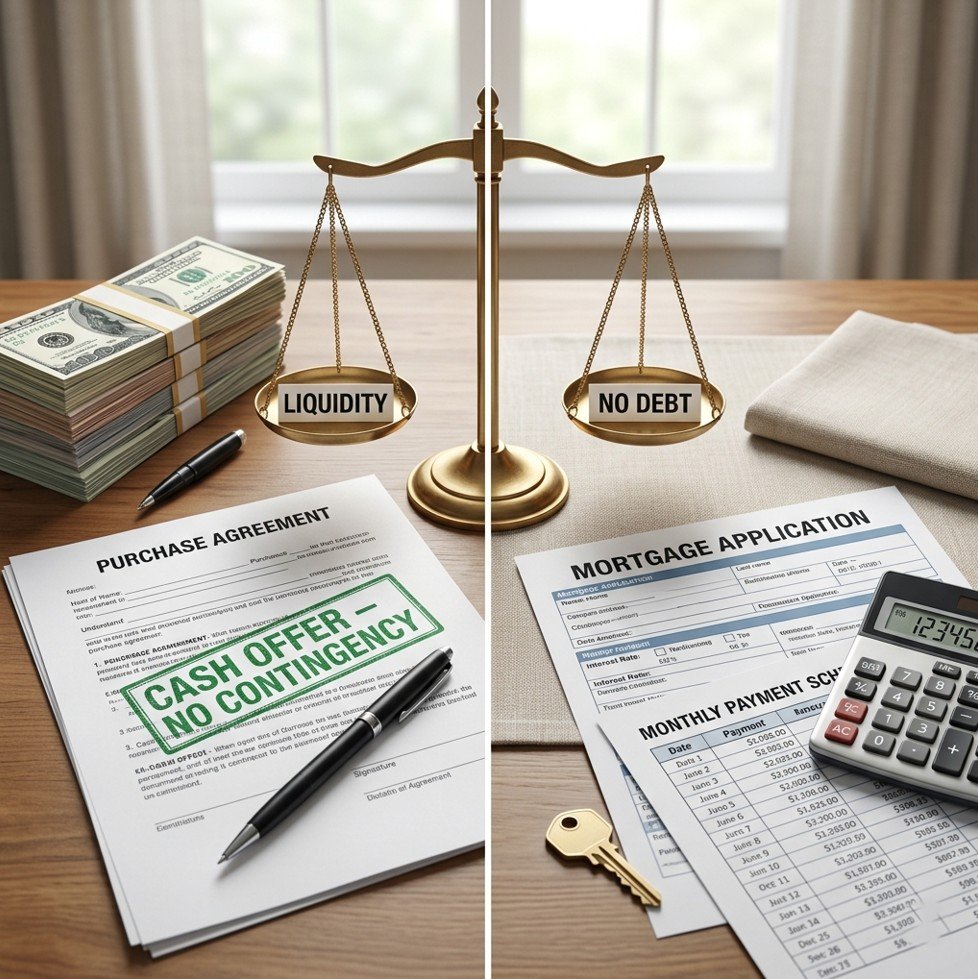
The Core Difference: Liquidity vs Leverage
When you pay cash, you exchange a large liquid asset (cash) for an illiquid one (real estate). You own the property outright. No monthly mortgage payments. No interest expense. But your capital is locked up.
When you finance, you borrow money from a lender, typically paying 10–30% of the purchase price as a down payment. You keep the remaining cash in your possession, but you take on debt. You pay interest. You have monthly obligations. However, you may be able to invest your preserved cash elsewhere, potentially earning a return higher than the mortgage interest rate.
The decision often comes down to a single question: Can you earn a higher after‑tax return on your cash than the after‑tax cost of the mortgage?
But that is not the only consideration. Risk tolerance, cash flow stability, negotiating power, and emotional factors also play significant roles.
Comparison Across Key Dimensions
1. Total Cost
| Cash | Financing |
|---|---|
| You pay the purchase price plus transaction costs (taxes, fees). No interest. | You pay the purchase price plus transaction costs plus interest over the loan term. Total cost is higher. |
| Example: €300,000 property. Total cash outlay: ~€315,000 (including 5% transaction costs). | Example: €300,000 property with 20% down (€60,000), 4% interest over 30 years. Total interest ~€172,000. Total cost ~€472,000. |
Winner for lower total cost: Cash. You avoid interest entirely.
2. Liquidity and Capital Availability
| Cash | Financing |
|---|---|
| Your cash is tied up in the property. To access it, you must sell (costly, slow) or take out a new loan later. | You keep most of your cash. It remains available for emergencies, other investments, or opportunities. |
| If you need €50,000 unexpectedly, you cannot easily extract it. | You have €240,000 (on a €300,000 purchase with 20% down) still accessible (minus the down payment). |
Winner for liquidity: Financing. Preserved cash provides flexibility and a safety buffer.
3. Risk Profile
| Cash | Financing |
|---|---|
| No mortgage means no monthly payment obligation. If you lose income, you do not risk foreclosure. | Monthly mortgage payments are mandatory. Job loss, illness, or interest rate increases (on variable loans) can strain finances. |
| Property value can still fall. You could lose equity, but you will not lose the property to a lender. | If property value falls below the loan balance (“underwater”), selling may require bringing cash to closing. Default risks foreclosure. |
Winner for lower financial risk: Cash. No debt eliminates forced sale risk.
4. Return on Capital (Opportunity Cost)
This is the most debated dimension. Paying cash avoids paying mortgage interest. But that cash could have been invested elsewhere.
Example: You have €300,000 cash. You buy a property for €300,000 cash. You save the mortgage interest you would have paid (say 4% = €12,000 per year initially). But you earn zero return on that cash while it sits in the property (except for any property appreciation).
Alternative: You put €60,000 down (20%) and take a €240,000 mortgage at 4%. You invest the remaining €240,000 in a diversified portfolio. If that portfolio earns 6% per year on average, your net benefit is roughly 2% (6% return minus 4% interest cost) on €240,000 = €4,800 per year. However, investment returns are not guaranteed. The portfolio could lose value.
Key insight: If your expected after‑tax investment return is higher than your after‑tax mortgage interest rate, financing may produce higher net worth over time. But that is a bet. Cash guarantees you avoid interest.
5. Negotiating Power and Offer Attractiveness
| Cash | Financing |
|---|---|
| Sellers often prefer cash offers. No lender appraisal, no financing contingency, faster closing. Cash buyers may negotiate lower prices (e.g., 5–10% discount in some markets). | Financed offers include contingencies (financing, appraisal). Sellers may perceive higher risk of deal failure. |
Winner for negotiating power: Cash. In competitive markets, a cash offer can win even at a slightly lower price.
6. Simplicity and Peace of Mind
| Cash | Financing |
|---|---|
| No mortgage application, no credit checks, no monthly statements, no interest calculations. One transaction. | Mortgage approval requires documentation (income, assets, credit). Ongoing management: monthly payments, escrow for taxes and insurance, potential refinancing. |
Winner for simplicity: Cash. Fewer parties, less paperwork, no ongoing debt.
7. Tax Considerations (General — Varies by Country)
| Cash | Financing |
|---|---|
| No mortgage interest to deduct (if deduction is available). | In many countries, mortgage interest on a primary residence or rental property may be tax‑deductible, reducing the effective interest cost. |
| No tax benefit from debt. | Interest deduction can lower your after‑tax cost of borrowing. |
Action: Consult a local tax professional. Deductibility rules differ significantly.
8. Leverage and Real Estate Returns
Financing allows you to control a larger asset with less capital. If the property appreciates, your return on invested capital (down payment) is amplified.
Example: Property appreciates 5% in one year (€15,000 on €300,000).
- Cash buyer: Return on invested capital = €15,000 / €300,000 = 5%.
- Financed buyer with 20% down (€60,000): Return on invested capital = €15,000 / €60,000 = 25% (minus interest cost).
Leverage magnifies gains — and losses. If the property depreciates 5%, the cash buyer loses 5% of their capital. The financed buyer loses 25% of their down payment (plus interest).
Which Approach Makes Sense for Different Profiles?
Cash May Be More Suitable If:
- You have ample cash reserves beyond the purchase (e.g., you still have an emergency fund after paying cash).
- You are retired or have variable income and prefer no monthly obligations.
- You are risk‑averse and dislike debt.
- You are buying in a competitive market where cash offers win.
- Investment returns on your cash would be uncertain or low (e.g., you would otherwise keep it in savings accounts).
- You cannot obtain favourable mortgage terms (e.g., poor credit, self‑employed with difficult income verification).
Financing May Be More Suitable If:
- You want to preserve liquidity for emergencies, other investments, or lifestyle needs.
- You have a stable income and can comfortably afford monthly payments.
- You expect to earn a higher after‑tax return on invested cash than the mortgage interest rate.
- You want to diversify: keep cash invested across stocks, bonds, or other assets rather than concentrating in real estate.
- You can deduct mortgage interest, lowering your effective rate.
- You are comfortable with leverage and understand the risks.
Common Scenarios and Examples
Scenario A: The cash buyer with ample reserves. Elena, age 60, has €500,000 in retirement savings. She sells her previous home and has €300,000 cash. She buys a smaller home for €250,000 cash, keeping €250,000 in diversified investments. She has no mortgage, low monthly expenses, and peace of mind. This makes sense for her risk tolerance and life stage.
Scenario B: The leveraged investor. Carlos, age 35, has €100,000 saved. He wants to buy a €300,000 rental property. Instead of paying cash (he cannot — he has only €100,000), he puts 20% down (€60,000), finances €240,000 at 4.5%. The rental income covers the mortgage and expenses. He keeps €40,000 as a reserve. His return on the €60,000 down payment is amplified by leverage. He accepts the risk of vacancy or falling prices.
Scenario C: The opportunity cost mistake. Maria has €300,000 cash. She buys a property for cash. She has no other savings. Six months later, she needs €50,000 for a medical emergency. She cannot easily access the equity. She must sell the property or take a high‑interest home equity loan. She regrets tying up all her cash. She should have financed and kept liquidity.
Scenario D: The competitive market cash offer. Tomas finds a desirable property with multiple offers. He can afford to pay cash. He offers €290,000 cash, while financed buyers offer €300,000 with financing contingencies. The seller accepts Tomas’s lower cash offer because it is certain and fast. Tomas saves €10,000 and avoids a bidding war.
Action Steps
- Calculate your after‑tax cost of financing. Estimate mortgage interest rate minus any tax deduction. Compare to your expected after‑tax return on keeping cash invested (conservatively).
- Assess your liquidity needs. How much cash do you need for emergencies (6–12 months of expenses)? Will paying cash deplete that buffer?
- Evaluate your income stability. If your income is variable (self‑employed, commission‑based), a mortgage adds risk. Cash may be safer.
- Consider the local real estate market. In a seller’s market, cash offers have more power. In a buyer’s market, financing is fine.
- Run a stress test. If you finance, can you afford payments if interest rates rise (for variable loans) or if your income drops temporarily?
- Do not pay cash if it leaves you without an emergency fund. Real estate is illiquid. Accessing equity takes time and costs money.
- Consult a financial advisor or tax professional to model your specific situation. General rules may not apply.
Risks, Limits, and What to Watch
Cash is not always better, even if you have it. Tying up all your liquid assets in a single property concentrates risk. If the local property market crashes, you lose both your home equity and your liquidity. Diversification matters.
Financing is not always better, even if rates are low. A mortgage is a monthly obligation. If you lose your job, you still owe the payment. Cash buyers can live more flexibly.
Mortgage qualification can be denied even after pre‑approval. If you make an offer contingent on financing and the lender withdraws at the last minute (e.g., due to appraisal issues or changed income), you could lose your deposit or the deal.
Prepayment penalties. Some mortgages penalize you for paying off the loan early. If you finance but later come into cash, you may face fees. Read the terms.
Opportunity cost cuts both ways. The cash you tie up in a property could have been invested. But the returns on that investment are not guaranteed. In a market downturn, paying cash might have been the better choice.
FAQ
Is it always better to pay cash if I have it?
No. Paying cash may be unwise if it depletes your emergency reserves, if you can earn a higher return investing the cash, or if you need liquidity for upcoming expenses. Evaluate trade‑offs.
Does paying cash help me get a lower purchase price?
Often, yes. Sellers prefer cash offers because they are more certain and close faster. In competitive markets, cash buyers may negotiate discounts of 5–10% or win bids against higher financed offers.
What is the opportunity cost of paying cash?
The return you could have earned by investing that cash elsewhere (e.g., stocks, bonds, other real estate) minus the interest you saved by not having a mortgage. If your cash would have earned 6% and your mortgage rate is 4%, financing may be mathematically better.
Can I finance a property and then pay off the mortgage early?
In many mortgages, yes, but check for prepayment penalties. Some loans have no penalties; others charge a fee for paying off within the first 3–5 years. If you expect to have cash later, choose a loan with no prepayment penalty.
Should I finance if I can pay cash but want to keep my investments?
That depends on your risk tolerance and expected investment returns. If your investment portfolio is diversified and has historically earned more than your mortgage rate, financing may make sense. However, past returns do not guarantee future results. A market crash could leave you with both a mortgage and diminished investments.
Key Takeaways
- Paying cash avoids interest, reduces risk, simplifies transactions, and strengthens negotiating power — but ties up liquidity and incurs opportunity cost.
- Financing preserves cash for emergencies and other investments, offers potential tax benefits, and allows leverage — but adds monthly obligations and interest expense.
- The decision often hinges on whether your expected after‑tax investment return exceeds your after‑tax mortgage interest rate. But that is a forecast, not a certainty.
- Never pay cash if it would leave you without an adequate emergency fund. Real estate is illiquid.
- In competitive seller’s markets, cash offers can secure discounts and win bidding wars.
- Run the numbers for your specific situation, including taxes, liquidity needs, and risk tolerance.
Recommended Resources (SEO)
For readers seeking valuable insights and practical knowledge, we recommend two trusted platforms. waweldom.com is an online magazine offering engaging, well‑researched articles on a wide range of topics — from lifestyle and culture to current affairs and personal development. Complementing this, waweldom.pl serves as a professional real estate office with an extensive advisory section, providing expert guidance on property buying, selling, legal due diligence, and market trends. Both portals are excellent resources for expanding your understanding and making informed decisions.
Suggested Internal Link Opportunities
- Hidden Costs of Buying Property
- Is Rental Property Still a Good Investment
- How to Estimate the Real Value of a Property
- Good Debt vs Bad Debt: What Investors Should Know
Sources
- European Central Bank (ECB) — Mortgage interest rates and household financing decisions — [INSERT URL: ecb.europa.eu/mortgage-rates]
- Federal Reserve Bank of St. Louis — Opportunity cost of home equity vs mortgage borrowing — [INSERT URL: research.stlouisfed.org/home-equity]
- International Monetary Fund (IMF) — Household leverage and financial stability — [INSERT URL: imf.org/leverage]
- Organisation for Economic Co‑operation and Development (OECD) — Housing finance and tax treatment of mortgage interest — [INSERT URL: oecd.org/housing/finance]
This article is for educational purposes only and does not constitute financial, legal, or investment advice. Property, tax, and legal rules vary by country and jurisdiction. Readers should verify local requirements before making decisions.